
(Chapter 1)
I could smell the fear before I saw the flames. It’s a scent unique to the California hills when the wind changes—an acidic mixture of burning sage and ancient oak, cooked by an unnatural heat.
We were supposed to have evacuated an hour ago. Mark was throwing suitcases into the trunk; I was frantically gathering photo albums. We thought we had time. We were wrong. The fire didn’t crawl; it ran, consuming the ridge behind our house in a terrifying, hungry rush.
“”Sarah! Leo! We need to go now!”” Mark yelled from the driveway, his face pale beneath the falling ash.
I grabbed Leo’s hand. He was seven, small for his age, clutching his favorite toy truck. And then I looked around. “”Where’s Buster?””
Buster, our three-year-old rescue mix—half Lab, half loyalty—had been right behind us a minute ago. But in the panic, he’d vanished.
“”He’s outside! Come on!”” I urged Leo toward the door.
But Leo pulled back. His small face crumpled. “”No! Buster’s scared! He’s hiding in his spot under the porch!”” Before I could stop him, Leo ripped his hand free and bolted not toward the front door, but the back—straight toward the part of the house already wreathed in orange smoke.
“”LEO!”” I screamed, chasing him, but the smoke choked me. It was a solid wall. I couldn’t see my own feet. The sound was deafening—a roaring beast that drowned out my cries. I collapsed, coughing, the heat scorching my lungs. Mark dragged me out, both of us sobbing as our house began to ignite.
“”Our boy is in there!”” I shrieked at the flames, at the uncaring sky.
And then, a flash of brown. Buster didn’t hesitate. He didn’t bark; he didn’t stop. While every instinct should have sent him fleeing for the hills, he took one look at the burning house, then at us, and launched himself into the inferno.
He ran into the fire to find his boy.
We could do nothing but watch our life burn, waiting for a miracle that felt impossible. The firefighters arrived, but the structure was fully involved. It was a recovery mission, not a rescue. I fell to my knees in the driveway, the gravel cutting my skin, praying to a God I hadn’t spoken to in years.
“”There! By the back porch!”” Mark’s voice cracked.
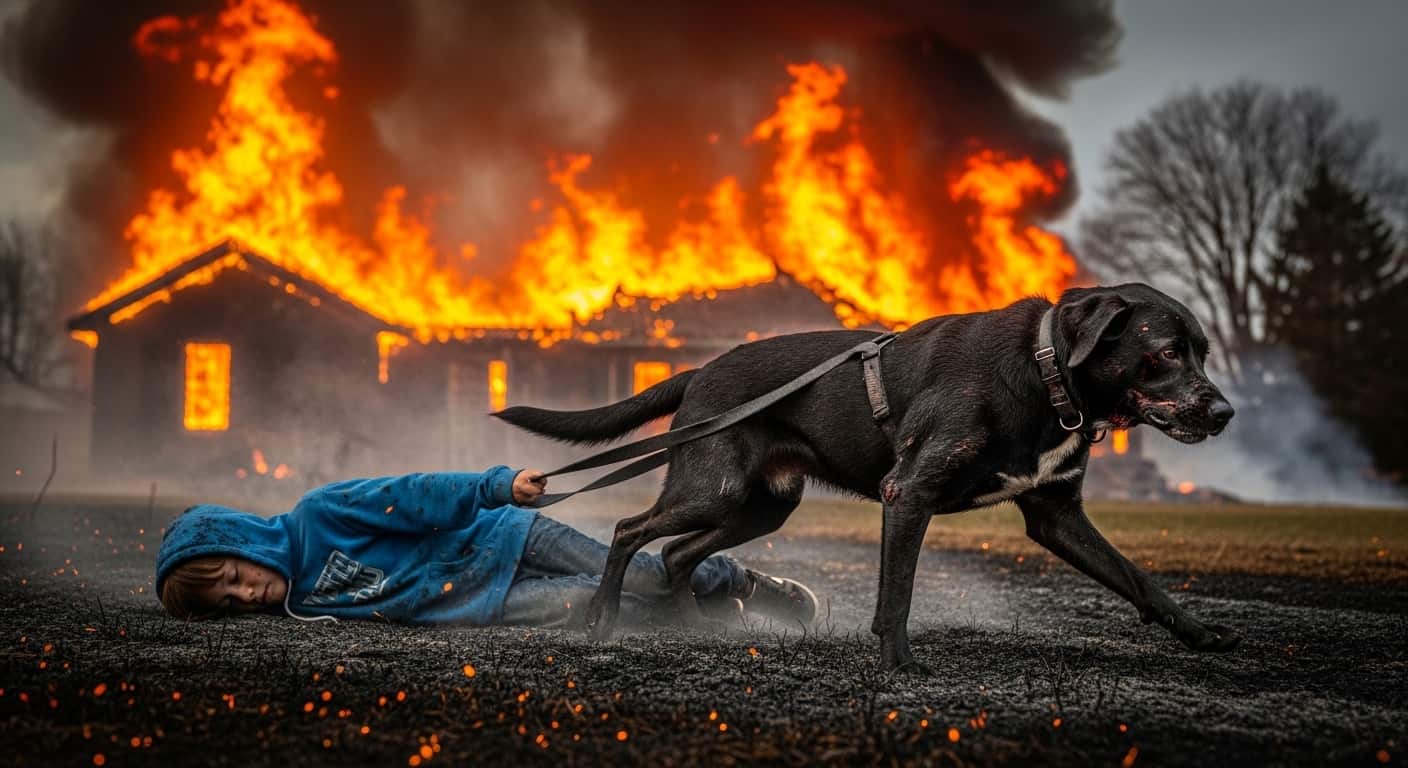
Through the shifting black curtains of smoke, a figure emerged. It was slow. It didn’t move like a dog. It was dragging something.
Buster was raw. He was blackened, unrecognizable. He had Leo by the hood of his favorite blue sweatshirt, pulling him inch by inch across the scorching grass. The dog’s own fur was still smoking. He was crying, a continuous, piteous sound, but his grip never loosened. He pulled his boy twenty feet, thirty feet, finally collapsing only when he was clear of the heat, his body a charred shield.
I ran to them, screaming, “”Leo! Leo!””
He was unconscious but breathing, covered in soot but otherwise whole. Mark scooped him up, sobbing, running toward the waiting ambulance. I turned to Buster.
He was a shadow of the dog he’d been. His beautiful coat was gone, replaced by raw, blistered skin. His face… oh, his beautiful face was melted. Yet, when I approached, he made a small, weak thud with his tail against the ash-covered earth. His eyes, miraculously untouched, looked up at me with a love that felt stronger than the fire that had just failed to break him.
“FULL STORY
(Chapter 2)
The ambulance ride was a blur of flashing lights and oxygen masks. We were lucky. Leo was suffering from smoke inhalation, but the doctors at the triage center assured us he would make a full recovery. He was young, resilient. He was found.
But in the chaos of saving the boy, the hero was sidelined. Buster was taken by a kind volunteer neighbor, Sheila, to a temporary animal rescue shelter.
“”We’ll take care of him, Sarah,”” Sheila had said, her own face streaked with tears and soot. But when she had first seen Buster—the raw flesh, the smell of burnt skin, the missing fur—I saw her recoil. It wasn’t malice; it was visceral, primal shock. And I felt a cold dread in my stomach. What had my loyalty cost my friend?
The next forty-eight hours were a testament to the fragile resilience of life. Leo was in a medically induced coma to allow his lungs to heal. Mark and I took turns staying by his bedside, the fear and the gratitude fighting a war within us. When the doctors finally said they were going to wake him, we prepared ourselves. We expected confusion. We expected tears. We expected a traumatized seven-year-old.
What we weren’t prepared for was what happened next.
Buster had been fighting his own war. The burn specialist veterinarian, a compassionate man named Dr. Aris Thorne, had worked tirelessly. “”He’s a fighter,”” Aris told me when I visited the shelter, my heart breaking at the sight of my dog covered in bandages, his eyes dull with pain. “”His burns are extensive, Sarah. The face is the worst. We had to graft what we could, but he’s going to be… different. Scarred. He’ll need a lot of love.””
“”We love him more than anything,”” I promised.
Buster sense my voice. He lifted his head with agonizing slowness. I approached, ignoring the smell of antiseptic and burnt flesh, and sat beside him. I stroked his bandages, the only place I could touch him. His eyes met mine, and that same spark of pure, uncomplicated devotion was there. He was still Buster. My Buster.
When Leo woke up, the first word he said was a rasp: “”Buster.””
“”He’s okay, baby. He’s safe,”” I said, my tears flowing freely. I showed him a picture I’d taken of Buster’s eyes, carefully framing the shot to hide the severity of the burns. “”He’s a hero, Leo. He saved you.””
Leo wanted to see him. I didn’t know if it was too soon. I didn’t know how to prepare a seven-year-old for the physical manifestation of trauma. But Sheila, the neighbor, was at the shelter and volunteered to bring him by.
“”Maybe it’ll help them both,”” she suggested. “”Buster needs to see his boy.””
I looked at Mark, and we agreed. It had to be done. We were a family.
(Chapter 3)
When Sheila arrived with Buster, the shift in the room was palpable.
She didn’t lead him in on a leash; he walked stiffly beside her, a phantom made of gauze and determination. The shelter had cleaned him up, but the visual was overwhelming. His elegant nose was warped. One ear was half-gone. His entire face was a landscape of raw, red tissue and surgical grafts. Only his eyes remained—bright, amber pools of consciousness.
When Buster saw Leo lying in the bed, he let out a sound. It wasn’t a bark; it was a soft, urgent whine of recognition and relief. His tail, a bandaged stump, began a pathetic, rhythmic thud-thud-thud against his own sore side. Despite the pain, he pulled Sheila toward the bed.
“”Look, Leo! It’s Buster! The hero came to see you!”” Sheila said, her voice overly bright, tight with anxiety.
Mark and I stood back, holding our breath, watching.
Buster managed to jump, stiffly, onto the foot of the bed. He was careful, so careful. He was raw, but he wanted to get close to his boy. He began to crawl, an inch at a time, toward Leo’s face.
He just wanted to lie down next to him, to smell his familiar scent, to feel the warmth of the life he’d nearly died to protect.
Leo, groggy from the medication, turned his head. He looked directly at Buster.
He looked directly at the face that had run into a furnace for him.
At first, there was confusion. He blinked. And then, the recognition hit. Not recognition of the dog he loved, but recognition of a monster.
Leo didn’t see Buster. He saw the physical embodiment of the fire that had almost consumed him.
His eyes widened until they looked ready to pop from their sockets. A look of pure, primal, uncontrolled terror—the kind you hope to never see in a child’s eyes—washed over him. He recoiled violently, kicking his legs, pushing the blanket between himself and the disfigured creature.
“”NO! Get it away! GET IT AWAY!””
Leo didn’t just scream; he shrieked, a piercing, soul-shredding sound that seemed to shatter the sterile peace of the room. He scrambled back against the headboard, pointing a trembling hand.
“”It’s a monster! It’s going to eat me! HELP! MOMMY, HELP! MAKE IT GO AWAY!””
The rejection was so complete, so instant, it felt like another explosion.
(Chapter 4)
The silence that followed Leo’s shriek was heavier than any roar of a fire.
Mark rushed to Leo, pulling him into his arms, trying to calm his hysterical thrashes. Sheila stood frozen, her hand over her mouth. I looked at Buster.
My dog had been mid-crawl. He stopped. His tail stopped.
He didn’t whine. He didn’t protest. He just froze, his disfigured face inches from the boy he’d nearly died for.
I have never, in all my life, seen such profound, complete heartbreak as I saw in my dog’s eyes at that moment.
Buster looked at Leo, the child whose toy truck he used to gently fetch, the child whose face he’d licked clean of ice cream, the child who had run back into a burning house for him. And he saw that his presence was now causing that child terror.
He didn’t understand the concepts of disfigurement or trauma. He only understood Leo’s fear. And he understood that he was the source of it.
For perhaps ten seconds, he just looked at his boy. The silence in the room was deafening. Leo was sob-choking in Mark’s arms, his face buried, refusing to look.
Buster’s eyes, those beautiful, unchanged eyes, took a final, long look at Leo. And then, the spark of joy I had seen just moments before went out, replaced by a deep, heartbreaking clarity.
With slow, mechanical movements, Buster turned his disfigured body around. He slipped off the bed. His burned paws hit the floor with a soft, painful pat. He didn’t look back at us. He didn’t look at me or Mark or Sheila.
He walked past Sheila, past the nurse who was rushing in, and walked toward the door to the outside. He had been let out earlier to go to the bathroom and knew the layout of this temporary hospital.
I was paralyzed by the sheer tragedy of it. I wanted to run to him, to tell him it was a mistake, that Leo didn’t mean it. But I also saw my son, shaking and hysterical. I was a mother, and I was a pet-owner, and I was being torn in half.
“”Sarah…”” Sheila whispered, but I couldn’t move.
Buster pushed open the screen door with his burned nose and walked outside. He didn’t pause. He walked right past the triage center, toward the black, skeletal edge of the still-smoldering forest.
He was a warrior who had fought his war, saved his prince, and now, he was accepting his banishment because his presence caused pain.
(Chapter 5)
The search for Buster began thirty minutes later.
Once Leo had been calmed down by the doctors, the reality of what had happened hit me like a physical blow. Buster hadn’t just walked out; he had made a conscious decision. My dog had sacrificed his body to save my son, and now, he had sacrificed his last bit of happiness to save him from fear.
We drove around the edges of the perimeter, Mark, Sheila, and I, calling his name. We knew where he’d gone. He’d gone toward the burn zone.
“”He won’t make it,”” Sheila sobbed. “”His paws were so raw… he’s in so much pain.””
“”He’s smart,”” Mark argued, though his voice lacked conviction. “”He knows the territory. He’s Buster.””
I sat in the back, silent, a photo of Buster from before the fire cradled in my lap. I was recalling the moments I’d seen him lying on his side, Leo lying perpendicular to him, using the dog’s soft belly as a pillow. I recalled the patience in his soul. And I realized I had underestimated it. I had loved him as a pet, but he was a better being than any human I knew.
We found him just as the sun was dipping below the scorched horizon.
He was a mile into the burn zone. We found him not because he responded to our calls—he hadn’t—but because we followed the trail of his silent agony. His scent, the scent of medicine and raw flesh, was distinct.
Buster was lying in the deep, powdery gray ash beneath a lone, surviving oak tree, the place where he and Leo had often napped on hot summer days. The area around him was clear, as if he’d cleaned it one last time. He lay on his side, his raw body resting in the warm earth he’d known his whole life.
His breathing was shallow. His eyes were open, looking up at the ash-dusted leaves.
When I ran to him, I fell in the gray powder, covering my own face in it. I scooped his bandaged head into my lap. “”Oh, Buster. My boy. My sweet, beautiful boy.””
I sobbed into the bandages. Mark stood behind me, his hand on my shoulder, tears tracking down his face. Dr. Thorne, the vet, who had joined us, knelt beside the dog.
He checked for a pulse and then looked up at me, his face grim. He shook his head.
Buster lifted his head with a last, monumental effort. He was dying, but his will was still there. He didn’t look at Dr. Thorne, or Mark, or me.
He looked back over his shoulder, toward the hospital, toward the world he’d left behind, toward the boy he loved. And then, he turned his gaze back to me. His amber eyes, unchanged by the fire, filled with a final, deep, and perfect sadness, but beneath it all, a powerful, absolute peace.
He didn’t need me to fix his body. He only needed me to see him.
He rested his scarred head back in my lap. The tail stump made one last, soft thud in the gray powder. And then, he was gone.
(Chapter 6)
We buried Buster beneath that old oak tree, in the ash that he chose as his final resting place. We placed his favorite toy truck, the one Leo had dropped in the fire, in the grave with him.
The physical recovery from the fire was a long road. Our house had to be rebuilt. Leo had night terrors for months. He didn’t speak of the monster; he spoke only of “”The Fire Dog.””
It was a year before we dared to get another pet. A golden retriever mix. When we brought the new puppy home, Leo was cautious, but the puppy’s exuberant, wagging tail eventually won him over. Leo named him Buster.
But he never forgot the first Buster.
When Leo was ten, three years after the fire, we were driving past the old ridge. The new growth was already hiding the black scars on the land. We stopped by the oak tree to leave a flower.
Leo walked to the grave. He looked at the simple marker Mark had made, a piece of wood from our old house: BUSTER: OUR HERO.
“”He was the best dog, wasn’t he, Mom?”” Leo asked, his voice mature beyond his years.
“”He was the best friend, Leo.””
Leo traced the letters on the wood. “”Do you think he knew… that I was just scared? Not that I hated him?””
The question hung in the air, a final, unanswered echo of that terrible hospital room.
“”I think he knew you were scared,”” I said, putting my arm around him. “”And I think that’s why he left. He didn’t want you to be scared anymore. He loved you that much.””
Leo looked at me, and his eyes, for just a fleeting second, held a depth of understanding and a profound sorrow that reminded me of those amber eyes in the triage center. A single tear tracked down his cheek, cutting through the light dust.
“”I wish I’d said thank you,”” he whispered.
“”You can say it now,”” I said. “”He’s still listening.””
Leo knelt and closed his eyes. “”Thank you, Buster. I love you.””
And in that quiet moment, with the new-growth grass moving in the breeze, I understood the final lesson. Life is fragile, and appearance is a fleeting construct of smoke and mirrors. But kindness, loyalty, and the ability to make the ultimate sacrifice for another… those are the things that are eternal. They are the eyes that love us anyway, no matter how disfigured the world makes us.
We are all broken. We are all scarred. We are all monsters to someone. But to someone who truly sees us, we are always heroes.
And if we are lucky, we will find that one soul who looks past our raw edges to see the kindness that truly matters.”


