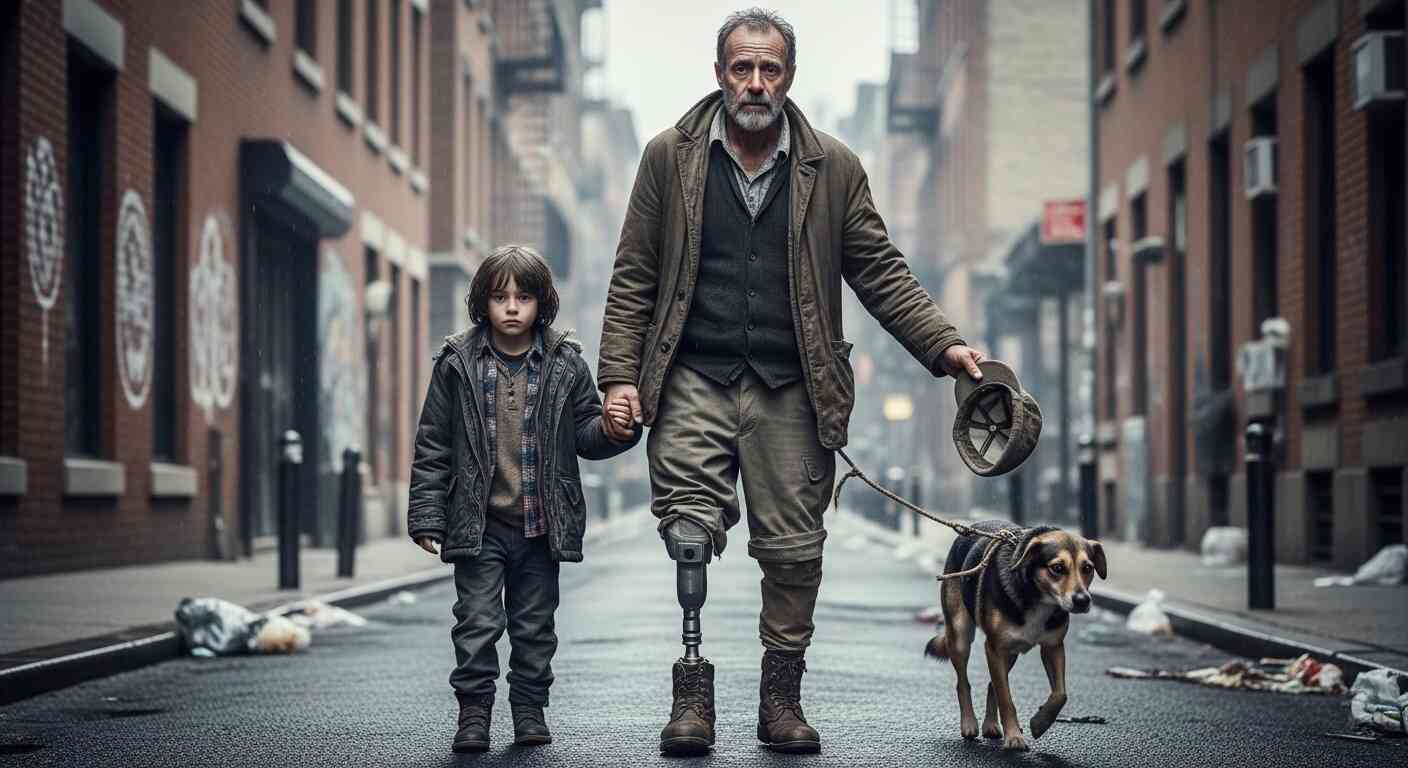
The humidity in Savannah was thick enough to choke a man, but for Silas Thorne, it was just another Tuesday at Forsyth Park.
He sat on the edge of a weathered stone bench, his fingers buried deep in the matted fur of Bucky, his twelve-year-old Golden Retriever. Bucky’s ribs were prominent, a roadmap of the hunger they both shared.
Silas wore his old field jacket. The patches were frayed, the “U.S. ARMY” strip barely hanging on by a few threads of stubborn polyester. He didn’t ask for much. He just wanted a bit of shade.
But the tourists didn’t see a hero. They didn’t see the man who had crawled through the mud of the Ia Drang Valley. They saw an eyesore.
“Look at them,” a teenager sneered, holding a half-eaten basket of chili cheese fries. “Is it a man or a pile of laundry?”
The group of kids, dressed in brand-name clothes that cost more than Silas had seen in a decade, began to laugh. It started with a grape. Then a fry.
Then, a crumpled-up greasy wrapper hit Bucky right in the eye. The dog whimpered, tucking his tail.
“Leave him be, please,” Silas rasped, his voice sounding like dry leaves skittering across pavement. “He’s old. He’s tired.”
“Oh, he talks!” the teenager mocked. He stepped closer, emboldened by the cameras his friends were holding up. He reached into his pocket, pulled out a handful of loose change, and pelted it at Silas’s chest.
“Dance for it, old man. Go on.”
The crowd around them didn’t stop it. Some looked away, uncomfortable. Others whispered about how the park was “going downhill.”
The teenager, a boy named Hunter whose father owned half the real estate in the county, felt the rush of power. He raised his hand, high and wide, ready to deliver a humiliating slap to the veteran’s face.
Silas flinched, closing his eyes. He had faced mortars and bayonets, but this—this public shaming—hurt worse than any shrapnel.
He waited for the blow.
It never came.
Instead, there was a sound like a dry branch snapping. A sharp intake of breath.
“I wouldn’t do that if I were you, son.”
The voice was like rolling thunder. Silas opened his eyes.
A man stood there, towering over the teenager. He was dressed in the Army Service Uniform, the four stars on his shoulders catching the dappled sunlight. General Marcus Sterling.
His grip on the boy’s wrist looked like it could crush granite.
“Let go of me! Do you know who my dad is?” Hunter squealed, his face turning a sickly shade of purple.
“I don’t care if your father is the King of England,” Sterling growled, his voice vibrating in the chest of every person standing in that park. “You are standing in the presence of a man who gave his youth so you could be this stupid in public.”
The General shoved the boy’s hand back toward his own chest. The force sent Hunter stumbling into his friends, who scrambled to catch him.
Then, the General did something that silenced the entire park.
He turned toward Silas. He didn’t look at the dirt. He didn’t look at the smell. He looked into Silas’s eyes.
General Marcus Sterling, the man who commanded tens of thousands, slowly brought his hand to his brow in a perfect, rigid salute.
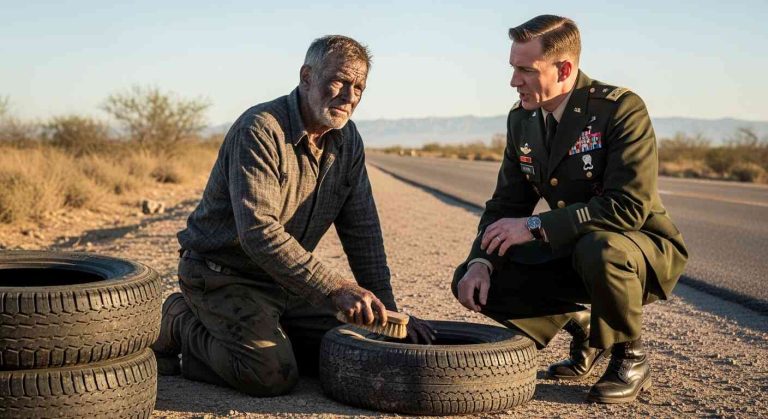
“Sergeant Thorne,” the General said, his voice cracking with an emotion he couldn’t hide. “I’ve been looking for you for thirty years.”
“FULL STORY
Chapter 1: The Weight of Gold and Grime
The air in Savannah during the height of July doesn’t just sit; it weighs. It presses against your lungs like a damp wool blanket, smelling of salt air, old stone, and the sickly-sweet rot of overripe peaches. For Silas Thorne, that weight was a constant companion, nearly as familiar as the ache in his lower back and the rhythmic, labored breathing of Bucky, the dog who had become his entire world.
Silas was seventy-two, though his reflection in the shop windows of Broughton Street suggested a man a century old. His skin was the color of cured leather, mapped with the scars of a life lived in the margins. He was a ghost in a city that prided itself on its history, yet chose to ignore the living relics sitting on its park benches.
He sat on his usual bench in Forsyth Park, right near the edge where the shadows of the great oaks stretched long and spindly. Beside him, Bucky lay with his chin on Silas’s boot. The dog was a Golden Retriever mix, or at least he had been once. Now, he was a silver-muzzled creature of pure devotion, his coat dusty and thin.
They were hungry. They were always hungry.
Across the paved walkway, a group of tourists had stopped. They were a vivid splash of color against the green backdrop—neon t-shirts, expensive cameras dangling from necks, and the unmistakable aura of people who had never known the cold bite of a winter without a roof.
In the center of the group was Hunter Vance. Hunter was seventeen, the kind of boy who had been told “”yes”” since the moment he could crawl. His father, Arthur Vance, was a titan of local industry, a man whose name was etched into the cornerstones of the very buildings Silas used for shelter during rainstorms. Hunter was bored, and boredom in a boy with too much privilege is a dangerous thing.
“”Look at this,”” Hunter said, his voice carrying with the easy arrogance of the protected. He pointed a manicured finger at Silas. “”Dad says the city is wasting tax dollars on ‘beautification’ when they let this sit in the middle of the park.””
His friends, a girl named Chloe and a boy named Tyler, giggled. Chloe was busy framing a photo on her phone, looking for the right filter to capture the “”grit”” of the scene without having to actually touch it.
“”He looks like he’s part of the bench,”” Tyler joked. “”Hey, Grandpa! You still alive over there?””
Silas didn’t look up. He had learned long ago that eye contact was an invitation for escalation. He stared at the brass button on his jacket—the last one remaining. It featured the eagle of the United States, worn smooth by decades of his thumb rubbing it for luck.
“”I bet he’d move if we gave him a reason,”” Hunter mused. He reached into a white paper bag from a local upscale deli. He pulled out a handful of crusts from a sourdough panini—scraps he hadn’t wanted.
With a flick of his wrist, he tossed a piece of bread. It bounced off Silas’s tattered cap.
“”Fetch!”” Hunter laughed.
Bucky’s ears twitched. The dog, driven by a primal need he couldn’t suppress, tried to lurch forward toward the bread. But he was weak. He stumbled, his front legs sliding on the pavement, and he let out a sharp, pained yelp.
“”Don’t,”” Silas whispered, his voice a dry rasp. He placed a hand on Bucky’s head. “”Stay, boy. It’s okay.””
“”Oh, it’s not okay!”” Hunter shouted, stepping closer. “”He’s hungry, isn’t he? Here, boy! Have some more!””
He began to throw the scraps faster. They hit Silas’s shoulders, his lap, and Bucky’s face. It was a rain of mockery. A few onlookers paused. A woman in a sundress frowned, her hand fluttering to her throat, but she didn’t speak. A tour guide leading a group of retirees looked the other way, continuing his monologue about the Civil War.
Lydia, a barista from the coffee shop across the street who was on her smoke break, watched from twenty yards away. She felt a knot of cold fire in her stomach. She knew Silas. He came in once a week for a cup of hot water, always offering a penny he’d found on the street as payment. She always gave him a full coffee and a muffin, pretending the penny covered it. She wanted to move, to scream at the kids, but her feet felt like lead. She saw Hunter’s face—the sheer, unadulterated cruelty of a child who had never been taught that a person’s worth isn’t measured in their bank account.
Hunter reached into his pocket and pulled out a handful of nickels and dimes.
“”Since you’re such a good dog, maybe your owner can use some change for a bath,”” Hunter sneered. He flung the coins.
One of them, a nickel, caught Silas right on the cheekbone, drawing a thin line of bright red blood.
Silas didn’t flinch. He just reached out and picked up the nickel. He looked at it, then looked at Hunter.
“”Son,”” Silas said, his voice surprisingly steady. “”I walked through fire for the right for you to stand there. You don’t have to like me. But please, don’t hurt my dog.””
The sincerity in Silas’s voice seemed to enrage Hunter. It wasn’t the reaction he wanted. He wanted a fight, or he wanted Silas to beg. He didn’t want a lesson in dignity.
“”You didn’t do anything but fail at life,”” Hunter spat. He stepped into Silas’s personal space, the smell of his expensive cologne clashing with the scent of damp earth and age. “”My dad says people like you are just drains on the system. Parasites.””
Hunter raised his hand. It wasn’t a toss this time. He pulled his arm back, his palm open, his face twisted in a sneer. He was going to strike an old man in broad daylight, in the heart of a city that called itself “”The Hostess of the South.””
Silas braced himself. He felt Bucky tremble against his leg. He closed his eyes, waiting for the impact, waiting for the familiar sting of being reminded that to some, he wasn’t a man at all.
But the slap never landed.
There was a sudden, violent movement. A blur of olive green and polished brass.
A hand, thick-fingered and powerful, intercepted Hunter’s wrist in mid-air. The sound of the impact was like a gunshot.
“”AAGH!”” Hunter screamed, his knees buckling.
Silas opened his eyes.
Standing over him was a giant. That was the only word for it. The man was in his late sixties, but he stood with a spine made of iron. He was dressed in the full formal uniform of a General in the United States Army. His chest was a kaleidoscope of ribbons—the Silver Star, the Bronze Star with Valor, the Purple Heart.
His face was a landscape of fury.
“”Do you have any idea,”” the General said, his voice a low, vibrating growl that seemed to rattle the very atoms of the air, “”whose blood is on that nickel you just threw?””
Hunter was gasping, his face white. “”Let… let go! You’re hurting me!””
“”Hurting you?”” The General leaned in, his nose inches from the boy’s. “”I have seen men die in the mud holding their own intestines just so a brat like you could grow up and think he’s a king. You aren’t a king, son. You’re a coward.””
The General flung the boy’s arm away. Hunter fell back into the dirt, the very dirt he had looked down upon. His friends stood frozen, their phones still recording, though Chloe’s hand was shaking so hard the image must have been a blur.
The General didn’t look at them again. He turned to Silas.
The fury vanished. It was replaced by a look of such profound, agonizing recognition that Lydia, watching from the distance, felt tears prick her eyes.
The General slowly reached up. His movements were deliberate, steeped in centuries of tradition. He snapped his hand to his forehead in a salute so sharp it looked like it could cut glass.
“”Sergeant Silas Thorne,”” the General said, his voice thick. “”First Battalion, Seventh Cavalry. Ia Drang. 1965.””
Silas stood up. His legs were shaky, and he had to lean on the bench for support. He looked at the General—really looked at him. He saw the scar running through the man’s left eyebrow. He saw the way the man held his left shoulder slightly lower than the right.
“”Marcus?”” Silas whispered. “”Little Marky?””
The General let out a choked sound, half-laugh and half-sob. He stepped forward and pulled the grimy, smelling veteran into a crushing embrace.
“”I’ve been looking for you for thirty-two years, Silas,”” the General whispered into his ear. “”Thirty-two years.””
The park went silent. The tourists, the teenagers, the joggers—everyone stopped. They were witnessing a collision of two worlds: the high-ranking power of the present and the forgotten sacrifice of the past.
And in that moment, the “”parasite”” on the bench was the most important man in Georgia.
FULL STORY
Chapter 2: The Ghost of the Ia Drang
The General didn’t care about the cameras. He didn’t care about the whispers or the fact that his $2,000 dress uniform was being stained by the grease and sweat of Silas’s tattered field jacket. He held on to the older man as if letting go would cause Silas to vanish back into the shadows of the city.
“”You’re shaking,”” Marcus Sterling said, pulling back to look at Silas. He noticed the thin trail of blood on Silas’s cheek. His eyes flickered back to Hunter Vance, who was currently being helped up by Tyler.
“”I’m fine, Marcus,”” Silas said, though his voice was barely a thread. “”Just… it’s been a long day. Bucky’s tired.””
Marcus looked down at the dog. Bucky looked up, his tail giving a single, hopeful wag. The General knelt—actually knelt in the dirt—and placed a hand on the dog’s head.
“”I remember the stories you told me about the dogs back home, Silas. You said they were the only things worth coming back for.”” Marcus looked up at the teenagers. “”Go. Now. Before I decide to call the Provost Marshal and have you charged with assaulting a decorated war hero.””
“”A hero?”” Hunter scoffed, trying to regain some of his bravado now that he was at a safe distance. “”He’s a bum! He’s been living in this park for months!””
Marcus stood up slowly. The air around him seemed to chill. “”This ‘bum,’ as you call him, carried me two miles through a jungle while he had a bullet in his lung and a piece of a mortar shell in his hip. He didn’t stop because he was ‘tired.’ He didn’t stop because he was ‘hungry.’ He stopped because the medic told him if he took another step, his heart would burst. And even then, he wouldn’t let go of my collar until he knew I was on the chopper.””
The General stepped toward Hunter. “”What have you ever carried, son? Besides your father’s ego?””
Hunter turned and ran. His friends followed, their laughter replaced by the frantic patter of expensive sneakers on pavement.
Marcus turned back to Silas. “”We’re leaving. Now.””
“”I can’t just leave, Marcus,”” Silas said, looking at the bench. “”This is my spot. If I leave, someone else takes it. And my things…”” He pointed to a plastic bag tucked under the bench, containing a spare pair of socks and a battered Bible.
“”Silas, look at me,”” Marcus said, taking the man by the shoulders. “”You are never sleeping on a bench again. Not as long as I have breath in my body. Do you understand me?””
Silas looked down at Bucky. “”What about him? They don’t let dogs in most places.””
“”Bucky comes with us. My driver is waiting at the North gate. He likes dogs.””
As they walked through the park, the atmosphere had shifted. The people who had been ignoring Silas just ten minutes ago were now staring in awe. Some even started to clap. Silas kept his head down, his hand resting on Marcus’s arm for balance. He felt like a man walking through a dream, terrified that any second he would wake up to the sound of rain hitting a cardboard box.
They reached a black SUV parked illegally on the curb. A young corporal stood by the door, snapping to attention as the General approached.
“”Corporal, help the Sergeant into the back. And the dog,”” Marcus commanded.
“”Sir, yes sir!”” The corporal didn’t hesitate. He helped Silas into the plush leather interior. Bucky hopped in, sniffing the air-conditioned air with wide-eyed wonder.
As the SUV pulled away from the curb, Silas looked out the window at the park. He saw Lydia, the barista, standing on the sidewalk. She raised a hand in a small, hesitant wave. Silas gave a tiny nod back.
“”Where are we going, Marcus?”” Silas asked.
“”To my quarters at Fort Stewart. We’re going to get you cleaned up. We’re going to get Bucky to a vet. And then,”” Marcus’s jaw tightened, “”we’re going to talk about why the hell the United States Army let its finest Sergeant fall through the cracks of the world.””
The drive was quiet. Silas stared at the passing city. He saw the high-rise apartments, the boutique shops, and the vibrant life of a city that had outgrown him. He felt like a relic, a piece of old machinery that had been tossed onto a scrap heap, only to be picked up by someone who knew its value.
At Fort Stewart, the transition was jarring. Silas was used to the chaotic noise of the streets; here, everything was orderly, quiet, and precise. Marcus led him into a large, comfortable house on the base.
“”Maidie!”” Marcus called out.
A woman in her sixties, with kind eyes and silver hair, came into the hallway. “”Marcus? I thought you were at the ceremony—”” She stopped, her eyes landing on Silas and the scruffy dog.
“”This is Silas Thorne,”” Marcus said. “”The man I told you about. The man who saved my life at LZ X-Ray.””
Maidie’s hand went to her mouth. She didn’t look at the dirt. She didn’t look at the smell. She walked straight to Silas and took his weathered hands in hers. “”Welcome home, Silas. We’ve been waiting for you.””
Silas felt something break inside him. The wall he had built—the one that kept the cold out and the pain in—crumbled. He let out a sob, a ragged, ugly sound that had been buried for thirty years. Marcus put an arm around him, and for the first time since 1965, Silas Thorne felt safe.
But the peace was short-lived.
Marcus’s phone rang. It was the post commander.
“”General, we have a problem,”” the voice on the other end said. “”A man named Arthur Vance is down here at the gate. He’s claiming you assaulted his son in Forsyth Park. He’s bringing the police and a news crew. He wants blood, Marcus.””
Marcus looked at Silas, who was sitting on the edge of a velvet chair, Bucky asleep at his feet. The General’s eyes turned to cold flint.
“”Let him come,”” Marcus said. “”I’ve been waiting for a reason to have this conversation with the city of Savannah.””
FULL STORY
Chapter 3: The Lion and the Jackal
Arthur Vance was a man who believed that the world was a series of transactions. Everything had a price: silence, loyalty, and justice. He stood at the gates of Fort Stewart, his tailored suit shimmering under the harsh fluorescent lights of the guard shack. Beside him, his son Hunter sat in the back of a luxury sedan, nursing a bruised wrist and an even more bruised ego.
A local news van sat idling nearby, its satellite dish pointed toward the sky like a hungry bird.
“”I want to see the General!”” Arthur shouted at the young MP behind the glass. “”I don’t care about ‘protocol.’ That man put his hands on a minor. He used military force against a civilian. This is a scandal!””
The MP, a nineteen-year-old from Ohio, remained impassive. “”The General is expecting you, Mr. Vance. But only you. The press stays outside.””
Arthur gritted his teeth. “”Fine. But this will be on the six o’clock news regardless.””
He was escorted to the General’s quarters. When he entered the living room, he expected to see a cowering homeless man and an apologetic officer. Instead, he found Marcus Sterling sitting behind a heavy oak desk, looking as though he were presiding over a court-martial. Silas was nowhere to be seen, though the faint smell of wet dog lingered in the air.
“”Sit down, Arthur,”” Marcus said. He didn’t stand. He didn’t offer a hand.
“”I’m not here for social calls, Marcus,”” Arthur snapped, sitting in the chair opposite the desk. “”My son is traumatized. You assaulted him. You took a vagrant from a public park and used a government vehicle to transport him. I could have your stars for this.””
“”You could try,”” Marcus said calmly. He picked up a thick folder from the desk. “”But before you do, let’s talk about your son. And let’s talk about your company, Vance Development.””
Arthur’s eyes narrowed. “”What does my company have to do with this?””
“”Everything,”” Marcus said. “”I did some reading on the way over. It turns out, Vance Development was the primary contractor for the new veteran’s transition center that was supposed to open in Savannah three years ago. The one that was ‘delayed’ due to budget overruns. The one that eventually became a luxury condo complex.””
Arthur’s face paled, just for a fraction of a second. “”That was a legal zoning change. The city council approved it.””
“”The city council you happen to fund,”” Marcus countered. “”While you were turning a profit on those condos, men like Silas Thorne—men who were promised a place to stay, medical care, and a chance at a life—were being pushed further into the dirt. Your son didn’t just stumble upon Silas today. He stumbled upon a victim of his father’s greed.””
“”That’s a reach, even for you,”” Arthur sneered. “”My son is a kid. He was playing around.””
“”He was throwing trash at a human being,”” Marcus’s voice dropped an octave, becoming dangerously quiet. “”He was striking a man who can barely stand. If that’s how you raise your children, Arthur, then you’ve failed more than Silas ever did.””
In the other room, Silas sat on a bed with sheets so white they looked like clouds. He had showered, the hot water scrubbing away layers of Savannah grime, but the feeling of being “”dirty”” went deeper than skin. He wore a set of clean sweats Marcus had given him. Bucky lay on a rug by the bed, his stomach full of high-quality dog food.
Through the door, Silas could hear the muffled voices. He heard his name. He heard the word “”vagrant.””
A shadow fell across the doorway. It was Sarah.
Silas froze. Sarah was thirty-four now. He hadn’t seen her in twelve years. She was standing there in a nurse’s uniform, her eyes red-rimmed, her hands trembling.
Marcus had called her. He had tracked her down at the local hospital.
“”Dad?”” she whispered.
Silas couldn’t speak. He looked at his hands—clean now, but still scarred. He felt the old shame rise up. The reason he had stayed away. The reason he had chosen the park over her. He didn’t want her to see the shell of the man he had become. He didn’t want to be a burden.
“”I’m sorry, Sarah,”” he choked out. “”I’m so sorry.””
She didn’t wait. She ran across the room and threw her arms around him, her tears soaking into his clean shirt. “”I looked for you, Dad. I went to the shelters. I went to the police. Why didn’t you come home?””
“”I didn’t have a home to give you, honey,”” he whispered. “”I was… I was lost.””
Back in the living room, the confrontation was reaching its peak.
“”I’m going to the press, Marcus,”” Arthur Vance said, standing up. “”By tomorrow morning, the whole country will know that General Marcus Sterling is a vigilante who protects bums and assaults children.””
“”Go ahead,”” Marcus said, leaning back. “”But before you do, you should know that the young lady who works at the coffee shop—Lydia—she was recording the whole thing. From the first piece of trash your son threw to the moment he tried to hit Silas. And she’s already uploaded it to the internet.””
Marcus turned a laptop around. On the screen, a video was playing. It already had 500,000 views. The comments were a torrent of outrage. #JusticeForSilas was trending.
Arthur watched as his son’s face, twisted in a cruel sneer, became the face of a national villain. He watched as the General saluted the old man.
“”You’re ruined,”” Marcus said simply. “”Not because of me. But because you forgot that in this country, we still value honor. Even if it’s covered in dirt.””
Arthur Vance didn’t say another word. He turned and walked out, his shoulders slumped, the weight of his own greed finally pulling him down.
But for Silas, the battle wasn’t over. He had a daughter to answer to, and a past that was finally catching up to him.
FULL STORY
Chapter 4: The Secret of the Valley
The night at Fort Stewart was quiet, but for Silas, it was louder than the streets. The silence of a real room allowed the memories to crawl out of the corners. With Sarah sitting at the foot of his bed and Marcus in a chair by the window, the truth finally had a place to land.
“”You always told me you were a cook, Dad,”” Sarah said, her voice soft in the dim light. “”You said you just made sure the boys stayed fed.””
Silas looked at Marcus. The General had a grim smile on his face.
“”He was the best damn cook in the Army,”” Marcus said. “”But he didn’t spend much time in the kitchen.””
Silas sighed, his hand finding Bucky’s head for comfort. “”I didn’t want you to know the rest, Sarah. I didn’t want you to see the dark parts of me. I wanted to be the dad who played catch and worked at the post office. Not the man who… who did what we did.””
“”Tell her, Silas,”” Marcus urged. “”She deserves to know why her father is a legend in the Seventh Cavalry.””
Silas closed his eyes, and suddenly, he wasn’t in a comfortable room in Georgia. He was back in the Ia Drang Valley. November, 1965. The air was thick with the smell of cordite and copper. The sun was blocked out by smoke, and the sound of the world ending was constant.
“”We were at Landing Zone X-Ray,”” Silas began, his voice dropping into a rhythmic, haunting cadence. “”Marcus was a young Second Lieutenant then. He was green, full of fire, and way too brave for his own good. Our platoon got cut off. We were surrounded by three hundred NVA regulars. We were in a dry creek bed, pinned down by a machine gun nest that was chewing us to pieces.””
Marcus nodded, his gaze fixed on the floor. “”I’d been hit in the leg. I couldn’t move. My radio was dead, and my sergeant was gone. I was twenty-two years old, and I was waiting to die.””
“”I saw him,”” Silas whispered. “”I saw him lying there, trying to return fire with a jammed 1911. I wasn’t supposed to be out there. I was a supply sergeant. But everyone else was down. I picked up an M60 and just… I stopped thinking.””
Silas described the next hour in terrifying detail. How he had charged the machine gun nest alone, using the weight of his own body to shield Marcus from the incoming rounds. How he had taken a bullet in the lung—the very injury that would plague him for the rest of his life—and kept walking.
“”He didn’t just save me,”” Marcus told Sarah. “”He dragged four other men into that creek bed. He stayed awake for twenty hours, holding a dressing on my femoral artery with one hand and firing his rifle with the other. When the choppers finally came, he refused to get on until every one of his ‘boys’ was loaded. By the time they got him to the hospital in Saigon, he’d lost half his blood. They gave him the Distinguished Service Cross. But he never told a soul.””
“”Why, Dad?”” Sarah asked, tears streaming down her face. “”Why didn’t you tell us?””
“”Because when I came back,”” Silas said, his voice trembling, “”nobody wanted to hear about it. People spat on me at the airport. They called me a baby killer. Your mother… she tried to understand, but I couldn’t sleep. I’d wake up screaming, smelling the jungle. I started drinking to quiet the noise. And then the drinking became the noise.””
Silas looked at his daughter, his heart bared. “”I left because I didn’t want my ‘noise’ to drown out your life. I thought you were better off with a memory of a father than the reality of a drunk.””
“”You were wrong,”” Sarah said, moving up to hug him. “”I didn’t need a hero, Dad. I just needed you.””
Marcus stood up and walked to the window. “”Silas, after the war, your records were… ‘misplaced’ during the 1973 fire at the National Personnel Records Center. That’s why your benefits stopped. That’s why you couldn’t get into the VA. It wasn’t because you were forgotten. It was because the system broke.””
Marcus turned around, his eyes shining. “”But I’m the Deputy Chief of Staff now. And I’ve spent the last six hours on the phone. Your records have been reconstructed. Your back pay, your disability, and your pension have all been reinstated, effective immediately. You’re not a ‘vagrant’ anymore, Silas. You’re a retired Sergeant First Class with a healthy bank account and a grateful nation.””
Silas sat in stunned silence. For years, he had lived on the charity of strangers and the scraps of the wealthy. He had accepted his fate as a discarded man. To have his life returned to him in a single evening was more than he could process.
“”It’s not just the money, Silas,”” Marcus said. “”Tomorrow, there’s going to be a press conference. Arthur Vance thinks he can control the narrative. We’re going to show him what a real narrative looks like.””
“”I don’t want a circus, Marcus,”” Silas said.
“”It’s not a circus,”” Marcus replied. “”It’s an accounting. And it’s time Savannah paid what it owes.””
As Silas fell into a deep, dreamless sleep that night—the first one in decades—Bucky curled up at his feet, sensing that the long winter was finally over. But in the city, the storm was just beginning.
FULL STORY
Chapter 5: The Court of Public Opinion
The following morning, Savannah was a city on edge. The video of the incident in Forsyth Park had gone supernova. It was no longer just a local story; it was a national flashpoint for how America treats its veterans and the widening gap between the elite and the vulnerable.
Arthur Vance had tried to get ahead of it. He sat in a news studio, wearing a pained expression. “”My son is a good boy,”” he told the interviewer. “”He was startled by a vagrant and reacted defensively. General Sterling’s intervention was an abuse of power.””
But the General wasn’t watching. He was standing in front of the City Hall fountain, flanked by Silas, Sarah, and a line of veterans from every conflict since Korea.
A sea of microphones was thrust toward them. The crowd was massive—thousands of people who had seen the video and felt a pang of shame for every time they had walked past a man like Silas without looking.
General Sterling stepped to the podium. He didn’t use notes.
“”Twenty-four hours ago,”” Marcus began, his voice echoing off the historic buildings, “”a young man in this park thought he could strike an elderly veteran because that veteran had no money, no home, and no voice. He thought Silas Thorne was trash. Today, I am here to tell you who Silas Thorne really is.””
Marcus spent ten minutes recounting the battle of LZ X-Ray. He described the bravery that most people only see in movies. He spoke about the “”lost”” records and the systemic failure that leads to 40,000 veterans sleeping on the streets every night.
“”The man you saw on that bench isn’t a failure,”” Marcus roared. “”The failure is us. The failure is a city that allows developers to turn veteran housing into luxury condos while the men those houses were built for are treated like zoo animals in our parks!””
The crowd erupted in cheers.
Then, Marcus stepped aside. “”I want you to hear from the man himself.””
Silas stepped forward. He was wearing a new suit, but he still had his old Army cap on. He looked at the cameras, and for a moment, he felt the urge to run. But he felt Sarah’s hand on his back. He felt Bucky leaning against his leg.
“”I don’t have much to say,”” Silas started, his voice hushed. The crowd went silent, leaning in to hear him. “”I spent a long time being invisible. When you’re invisible, you start to believe you aren’t there anymore. You start to think the world is right to forget you.””
He looked toward the back of the crowd, where he could see the silhouette of the Vance Development building.
“”To the young man who threw the trash… I forgive you. You didn’t know. You weren’t taught better. But to the rest of you… don’t wait for a General to tell you someone is worth your respect. Look at the person, not the clothes. Everyone has a story. Most of us are just looking for a way to get home.””
The response was deafening. The “”Savannah Hero,”” as the news dubbed him, had spoken not with anger, but with a grace that made the Vance family’s pettiness look pathetic.
By noon, the fallout was catastrophic for Arthur Vance. Several major investors pulled out of his projects. The city council, sensing the shift in the wind, announced an emergency investigation into the condo development. Within a week, the “”luxury”” project was halted, and a new plan was put in place to convert half of the units into permanent supportive housing for veterans.
Lydia, the barista, was there in the crowd. She fought her way to the front afterward, tears in her eyes. “”Silas! Sergeant Thorne!””
Silas turned and smiled. “”Hello, Lydia. I think I might need a real coffee today. No hot water required.””
She laughed and hugged him. “”It’s on the house. Forever.””
But as the cameras faded and the crowds dispersed, the real work began. Silas had to figure out how to be a father again. He had to learn how to live in a house with walls that didn’t move. He had to face the quiet.
Sarah took him to her small home on the outskirts of the city. It had a porch and a big oak tree in the yard.
“”This is your room, Dad,”” she said, opening a door to a sunlit space. “”And Bucky has the whole yard.””
Silas sat on the bed. He looked at his hands. They were still shaking slightly, a remnant of the war and the years of struggle. But for the first time, they weren’t shaking from cold.
“”I don’t know if I can do this, Sarah,”” he whispered. “”I’ve been a ghost for so long.””
“”You’re not a ghost anymore, Dad,”” she said, sitting beside him. “”You’re home. And ghosts don’t have daughters who love them this much.””
FULL STORY
Chapter 6: The Long Way Home
Six months later, Savannah was still the same humid, beautiful, complicated city. But some things had changed.
In Forsyth Park, on the bench where Silas used to sit, there was now a small brass plaque. It didn’t have Silas’s name on it. It simply said: “For those we chose not to see. May we never look away again.”
Silas Thorne didn’t visit the plaque often. He was too busy.
He had become a regular fixture at the new “”Sterling-Thorne Veteran Center””—the building that had once been Arthur Vance’s pride and joy. Silas didn’t run the place; he was the greeter. He sat at the front desk with Bucky at his feet, and every time a man or woman walked through those doors with that specific, hollow look in their eyes, Silas would stand up.
He would give them a cup of coffee. He would look them in the eye. And he would say the three words he had waited thirty years to hear: “”Welcome home, soldier.””
His relationship with Sarah was a work in progress, like a garden after a long drought. There were moments of awkwardness, flashes of the old PTSD that made him retreat into silence. But they had Sunday dinners. They talked about the mother Silas had lost and the childhood Sarah had missed. They were rebuilding, brick by brick.
Marcus Sterling visited often. The two old soldiers would sit on Sarah’s porch, drinking iced tea and watching Bucky chase squirrels. They didn’t talk much about the war anymore. They talked about the future.
“”Arthur Vance filed for bankruptcy last week,”” Marcus said during one of his visits. “”The kid, Hunter… he’s doing community service at the VA. I hear he’s learning how to scrub floors.””
Silas chuckled. “”Maybe it’ll do him some good. Hard work has a way of clearing the mind.””
“”You saved me twice, Silas,”” Marcus said, his voice turning serious. “”Once in the valley. And once in that park. You reminded me why I put this uniform on in the first place.””
Silas looked out at the street. He saw a young man in a worn-out camo jacket walking down the sidewalk. The man looked tired. He looked invisible.
Silas stood up, his joints popping, but his spirit light.
“”I’ll be right back, Marcus,”” Silas said.
He walked down the steps, across the lawn, and out to the sidewalk. He caught up to the young man.
“”Excuse me, son,”” Silas said.
The young man stopped, his shoulders tensed, ready for a lecture or a dismissal. “”Yeah?””
Silas reached into his pocket and pulled out a small, laminated card with the address of the center on it. He also pulled out a five-dollar bill.
“”The coffee is better at the center,”” Silas said with a wink. “”But this is for the bus ride there. My name’s Silas. I was a Sergeant. And I’d like to hear your story.””
The young man looked at the card, then at Silas. He saw the kindness in the old man’s eyes, a reflection of a dignity that hadn’t been crushed by the weight of the world. He saw a man who knew exactly what it felt like to be trash, and how it felt to be a treasure.
The young man’s shoulders dropped. He let out a long, shaky breath. “”I’m Mike. I… I was in the Sandbox. 10th Mountain.””
“”I know the 10th,”” Silas smiled, putting a hand on Mike’s shoulder. “”Good people. Come on, Mike. Let’s walk.””
As they walked down the moss-draped street of Savannah, the sun began to set, casting long, golden shadows. The city continued its frantic pace, but for these two men, the world had slowed down.
Silas Thorne was no longer a ghost. He was a bridge. He was a hero who had found his way back from the darkness, proving that no matter how much trash the world throws at you, the gold underneath never truly loses its shine.
The final sentence of his memoir, which Sarah helped him write a year later, became the most shared quote in the state:
“”A country is not judged by how it treats its generals, but by how it honors the soldiers it no longer needs.”””