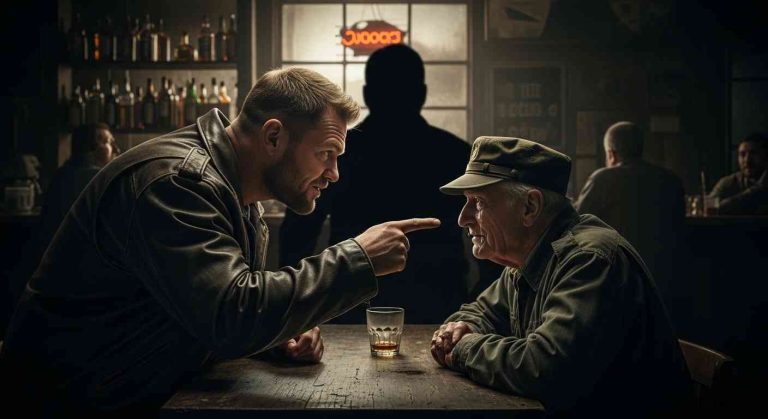
The L train was a pressure cooker that Tuesday. It was 5:30 PM, the air was thick with the scent of damp wool and exhausted ambition, and we were all just trying to get home.
He didn’t look like much—just an older man in a faded M65 field jacket, tucked into the corner seat with a scruffy dog curled at his feet. He was invisible, the way we make people invisible when they remind us of things we’d rather forget.
Until the man in the $3,000 suit decided he’d had enough.
“You’re a walking biohazard,” the suit spat, his voice cutting through the screech of the tracks. “Some of us actually contribute to society. Some of us don’t want to smell your ‘service’ mutt for twenty blocks.”
The veteran didn’t even look up. He just tightened his grip on the dog’s leash, his knuckles white. He whispered something—a plea, maybe—but the suit wasn’t listening.
Then came the shove. A hard, two-handed thrust that sent the old man sprawling onto the grease-stained floor of the car.
For three seconds, the train went deathly silent. You could hear the hum of the electric motors and the heavy breathing of a bully who thought he’d won. He had no idea that in New York, silence isn’t weakness. It’s the sound of a fuse burning down.
“FULL STORY
Chapter 1: The Invisible Man
The NYC subway has a specific rhythm, a violent, metallic lullaby that forces you to retreat into yourself. On the Canarsie-bound L train, Elias Thorne was a master of being nobody. He sat with his back pressed against the plexiglass divider, his hands buried deep in the pockets of a jacket that had seen the mountains of Korengal and the rainy streets of Seattle. At his feet sat Barnaby, a golden retriever mix whose vest was patched and frayed but clean.
Elias was fifty-two, but in subway years—and combat years—he looked seventy. His eyes were the color of a winter Atlantic, haunted by memories of things that didn’t exist in Manhattan. He smelled of the cheap black coffee from the shelter and the faint, metallic tang of the city. To the commuters around him, he was just part of the infrastructure—like a chipped tile or a flickering light.
Sitting across from him was Marcus Vance. Marcus was the kind of man who viewed the world as a series of obstacles to be optimized. His hair was perfectly coiffed, his shoes were polished to a mirror shine, and his patience was non-existent. He had just lost a mid-day trade, and the humidity of the crowded car was making his expensive shirt stick to his back.
Marcus looked at Elias. Then he looked at Barnaby. Then he wrinkled his nose.
“”Are you kidding me with this?”” Marcus snapped. The sound was like a whip cracking.
Elias didn’t move. He was used to it. He’d learned long ago that if you don’t provide a target, the arrows eventually stop flying. But Marcus wasn’t done.
“”I’m talking to you, Chief,”” Marcus said, leaning in. “”This is a public conveyance, not a kennel. That animal reeks. You reek. Why is it that people like you think the rest of us should have to suffer through your choices?””
A young woman sitting next to Marcus, Chloe, shifted uncomfortably, pulling her headphones tighter. She looked at her phone, desperate to be anywhere else. Across the aisle, Jackson, a man with hands calloused by forty years of masonry, looked up from his newspaper. His eyes narrowed.
“”He’s not bothering anyone, man,”” Jackson said quietly.
Marcus whirled on him. “”He’s taking up space. He’s a health hazard. I pay more in taxes in a month than this guy has seen in a decade. I shouldn’t have to breathe the same air.””
Elias finally looked up. His voice was a low, gravelly rasp. “”He’s a service dog, sir. He’s working.””
“”Working?”” Marcus laughed, a jagged, ugly sound. “”Doing what? Helping you find the nearest soup kitchen? Get up. Move to the next car. Now.””
Elias shook his head slowly. “”I’m just trying to get to the VA, sir. Please.””
Marcus’s face turned a deep, bruised purple. The frustration of his failing trades, his failing marriage, and his own hollow life boiled over. He reached out and grabbed the lapel of Elias’s jacket.
“”I said. Get. Up.””
With a violent jerk, Marcus shoved. Elias, caught off guard and weakened by years of chronic pain, flew backward. He hit the floor hard. His head made a sickening thwack against the metal pole, and Barnaby let out a sharp, pained yelp as he was dragged down by the leash.
The car went still. The only sound was the rhythmic clack-clack of the wheels. Elias lay on the floor, dazed, his hand instinctively reaching out to pull Barnaby close to his chest. He looked small. He looked broken.
Marcus stood over him, straightening his silk tie. “”There,”” he said, looking around for validation. “”Now the seat is open for someone who actually matters.””
But no one moved to take the seat. Instead, the atmosphere in the car changed. The air grew heavy, thick with a collective, simmering rage.
Chapter 2: The Weight of Silence
For Elias, the floor of the subway car disappeared. For a terrifying second, the screech of the brakes became the scream of a downed bird in a valley far away. The smell of the floor wax became the scent of scorched earth. He clutched Barnaby, his fingers digging into the dog’s fur.
“”Easy, boy,”” he whispered, though his own voice was trembling. “”Easy.””
He waited for the next blow. That was the rule of the world he lived in: once you were down, people usually kept kicking. He closed his eyes, bracing for the impact of a polished Italian leather shoe.
But it didn’t come.
Instead, he heard a sound he hadn’t expected. It was the sound of rustling fabric. The sound of heavy boots hitting the floor. The sound of a dozen people moving at once.
Sarah, the social worker who had been watching from the end of the car, felt the paralysis of the bystander effect shatter. She had spent her career fighting for people who had been discarded, and seeing Elias on the floor—a man who had clearly given everything to a country that gave him nothing back—was the breaking point.
She stood up. Her heart was hammering against her ribs like a trapped bird.
“”That was an assault,”” she said. Her voice was thin at first, but it gained strength. “”You just assaulted a veteran.””
Marcus turned to her, a smirk playing on his lips. “”Oh, please. I gave him a nudge. And how do you know he’s a veteran? He’s probably wearing that jacket to get free hand-outs. It’s a costume.””
Jackson, the mason, stood up next. He was six-foot-four and built like a brick wall. He stepped into the aisle, his presence suddenly making the subway car feel very, very small.
“”I know that jacket,”” Jackson said, his voice a low rumble that vibrated in the floorboards. “”My son wore one just like it. He didn’t come home from Kandahar so people like you could treat a man like trash on the 4:15 to Brooklyn.””
Marcus’s smirk wavered. He looked around, looking for an ally. He turned to a businessman in a gray suit next to him. “”Tell them. This guy is a nuisance, right?””
The businessman didn’t say a word. He simply stood up, folded his Wall Street Journal, and stepped toward Marcus.
One by one, they stood. Chloe took off her headphones and stood. An elderly woman clutching a grocery bag stood. A teenager with a skateboard stood. They didn’t yell. They didn’t scream. They just stood up and began to walk toward the center of the car, forming a living wall around Elias and a closing circle around Marcus.
The silence was louder than any shout. It was the sound of a city that had seen too much cruelty, finally saying no.
Marcus backed up, his hand hitting the cool glass of the subway door. “”What is this? Some kind of mob? I’ll call the police! I have rights!””
“”You have the right to get off at the next stop,”” Sarah said, her eyes locked on his. “”And you’re going to do it quietly.””
Chapter 3: The Ghost of the Regiment
Elias looked up from the floor, his vision clearing. He saw the legs—dozens of them. Work boots, sneakers, high heels, and loafers. They weren’t stepping over him. They were standing in front of him.
For the first time in fifteen years, Elias Thorne didn’t feel invisible. He felt guarded.
Barnaby licked his face, sensing the shift in energy. The dog’s tail gave a tentative thump against the metal floor.
Marcus was sweating now. The “”finance bro”” bravado was melting away, revealing a hollow, frightened man underneath. He looked at the circle of faces. They weren’t just angry; they were disgusted. It’s one thing to be hated; it’s another to be looked at like you are something small and insignificant.
“”You don’t understand,”” Marcus stammered, his voice climbing an octave. “”I’ve had a terrible day. My firm… I’m under a lot of pressure. I just wanted to sit down.””
“”We’re all under pressure, son,”” Mrs. Gable, the elderly woman, said. She stepped forward, her floral handbag swinging. “”But we don’t take it out on the people who kept us safe while we were sleeping in our warm beds. You should be ashamed of yourself.””
Marcus looked at her, then back at Jackson. He tried to push his way through the circle to get to the other end of the car. “”Get out of my way.””
Jackson didn’t move an inch. He was an oak tree in a storm. “”The man is still on the floor. You haven’t apologized.””
“”I’m not apologizing to a vagrant!”” Marcus yelled.
The word ‘vagrant’ seemed to ripple through the car like a physical shock. Sarah knelt down next to Elias, ignoring Marcus entirely.
“”Sir? Can you hear me?”” she asked softly. “”My name is Sarah. I’m going to help you up. Are you hurt?””
Elias looked at her. He saw the genuine concern in her eyes, the kind of look he usually only got from Barnaby. “”I… I think I’m okay. Just my head.””
“”Take your time,”” she said, placing a steadying hand on his shoulder.
As she helped Elias to a sitting position, she noticed the small, tarnished pin on his collar. A Silver Star. Her breath hitched. This wasn’t just a veteran. This was a man who had walked through hell.
She looked up at Marcus, her voice cold and sharp. “”You called him a vagrant. This man has a Silver Star. He’s done more for this world by breakfast than you’ll do in your entire life. Now, you have exactly ten seconds to decide how this ends.””
Chapter 4: The Breaking Point
The train began to slow as it approached the Bedford Avenue station. The screech of the wheels felt like a countdown.
Marcus was panting now. He looked trapped. He reached into his pocket, pulling out a wad of cash—hundreds. “”Look, here. Take it. Give it to him. Buy him a new dog, I don’t care. Just let me through.””
He held the money out toward Jackson. Jackson didn’t even look at the bills. He just stared into Marcus’s eyes with a look of profound pity.
“”You think everything has a price tag,”” Jackson said. “”That’s your problem. You think dignity can be bought. It can’t. It can only be earned. And you just lost yours.””
Jackson reached out and gently took the money from Marcus’s hand. Marcus looked relieved for a split second, thinking he’d bribed his way out. But then Jackson turned and handed the cash to Elias.
“”For the dog’s vet bills, brother,”” Jackson said. “”And for a decent meal.””
“”Hey! That’s mine!”” Marcus lunged forward, but the circle tightened instantly.
The teenager with the skateboard, a kid named Leo who had spent most of his life being ignored by men like Marcus, stepped up. “”You gave it to him. We all saw it. It was a ‘donation,’ right?””
The train jolted as the brakes fully engaged. The lights in the car flickered—on, off, on. In the darkness, Marcus felt the sheer weight of the crowd’s disapproval. He felt small. For the first time in his life, his money, his suit, and his status meant absolutely nothing. He was just a man who had been caught being cruel.
The doors hissed open.
The platform at Bedford Avenue was crowded with people waiting to board, but they stopped when they saw the scene inside. A circle of people, a man on the floor, and a shivering bully pressed against the glass.
“”This is your stop,”” Sarah said.
Marcus looked at the platform, then back at the silent wall of New Yorkers. “”I’m not getting off here. My stop is two more blocks.””
“”No,”” Jackson said, his voice like iron. “”This is your stop. Forever.””
Jackson didn’t have to touch him. He just leaned forward slightly. Marcus crumbled. He scrambled through the gap in the crowd, nearly tripping over his own feet as he burst onto the platform.
He didn’t look back. He ran toward the stairs, the sound of his expensive shoes echoing through the station.
Chapter 5: The Resurrection
As the doors stayed open for a few extra seconds, the silence in the car changed. It wasn’t heavy anymore; it was light. It was the sound of a shared breath.
Jackson reached down and offered a hand to Elias. “”Let’s get you up, soldier.””
Elias took the hand. Jackson’s grip was steady, warm, and real. He pulled Elias to his feet. Sarah helped steady him from the other side.
Elias stood tall, brushing the dust from his jacket. He looked at the people around him. Chloe was picking up his dropped cap. Leo was checking on Barnaby, who was wagging his tail and licking the kid’s hand. Mrs. Gable was handing him a tissue for the small cut on his forehead.
“”Thank you,”” Elias whispered. His voice broke. “”I… I thought I was alone.””
“”Not today,”” Mrs. Gable said, patting his arm. “”Not in this city.””
The people who had stood up didn’t immediately sit back down. They hovered, making sure Elias was truly okay. Someone offered him a bottle of water. Someone else gave him a granola bar. It was a communion of strangers, a sudden, beautiful village built in the middle of a subway car.
Elias sat back down in the seat—the same seat Marcus had tried to take. But he didn’t feel like a victim anymore. He felt like a guest of honor.
As the train began to move again, Chloe sat down next to him. She didn’t put her headphones back on.
“”What’s his name?”” she asked, gesturing to Barnaby.
“”Barnaby,”” Elias said, a small smile finally reaching his eyes. “”He was my sergeant’s dog. When my sergeant didn’t make it back, I… I took him in. He’s the only one who knows what it was like over there.””
The car grew quiet again, but this time it was a respectful silence. Everyone was listening.
“”He’s a good dog,”” Leo said, leaning against the pole. “”He looks like a hero.””
“”He is,”” Elias said. “”He saved my life more than once. Not from bullets… but from the quiet. The quiet is worse.””
Sarah sat across from him, her eyes misty. “”We won’t let it stay quiet anymore, Elias. We see you.””
Chapter 6: The Final Stop
When the train reached Elias’s stop, he stood up. His legs were a little shaky, but his heart felt heavier—not with sadness, but with the weight of unexpected kindness.
Jackson walked him to the doors. “”You take care of yourself, Elias. And thank you for your service. I mean it.””
Elias nodded, unable to find the words. He stepped onto the platform, Barnaby trotting faithfully by his side.
As the train doors began to close, Elias turned back. He saw them—the mason, the social worker, the student, the grandmother. They were all watching him. As the train pulled away, Chloe raised a hand in a small wave. Leo gave a thumbs up.
Elias stood on the platform for a long time, watching the tail lights of the L train disappear into the dark tunnel. The station was loud, dirty, and chaotic, but to Elias, it felt like a cathedral.
He looked down at Barnaby. The dog looked up at him, his golden eyes bright.
“”They saw us, Barnaby,”” Elias whispered. “”They actually saw us.””
Elias walked toward the exit. He felt the cash in his pocket—the “”donation”” from a man who had tried to break him. He knew exactly what he was going to do with it. He’d keep enough for a bag of the good dog food for Barnaby, and the rest he’d give to the shelter. Kindness shouldn’t stop with one person; it should be a relay race.
As he reached the street level, the crisp evening air hit him. The city was glowing, a million lights reflecting off the glass towers. For the first time in years, Elias didn’t look at the ground. He looked up at the sky.
He realized then that the man in the suit hadn’t been his enemy. He had been a catalyst. He had been the darkness that allowed the light of a dozen strangers to finally shine through.
Elias Thorne adjusted his cap, straightened his Silver Star, and walked home through the city he had fought for, knowing that he wasn’t a ghost anymore.
He was home.
The world may try to push you down, but remember: you never know who is standing up just to catch you.”