The salt air usually felt like freedom, but today, it tasted like humiliation. I sat on the sun-bleached wood of the Atlantic City pier, my “iron leg”—the heavy, outdated prosthetic I’d been stuck with since the accident—stretched out in front of me.
Beside me, Leo, just eight years old and already knowing too much about hunger, clutched a small paper bag. It held two stale rolls and a half-eaten sandwich we’d managed to scavenge. It was everything we had for the day.
Then came the “Pier Pack.” That’s what the locals called them. Julian Sterling and his flock of golden-born vultures. They smelled of expensive cologne and entitlement.
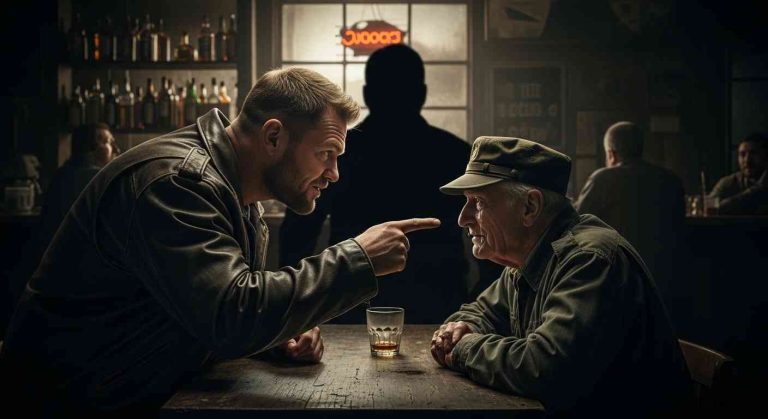
“Look at this,” Julian sneered, his designer sneakers stopping inches from my prosthetic. “The city’s really letting the trash pile up on the boardwalk these days.”
Before I could pull Leo away, Julian’s foot moved like a snake. He kicked the bag right out of Leo’s small, trembling hands. The boy let out a choked sob as the bag sailed over the railing and vanished into the churning grey water of the Atlantic.
“Barnaby!” Leo cried, grabbing his mangy dog as the pup growled.
I tried to stand, my metal joint groaning, but Julian stepped closer. He looked at my iron leg—the limb I’d lost saving a coworker in a collapsing trench—and he did the unthinkable. He leaned over and spat on it.
The white foam slid down the dull metal. The tourists nearby gasped, some turning their heads, others pulling their children away. No one stepped in. Why would they? We were the invisible ones.
Julian laughed, a sharp, ugly sound. “Keep the change, hero.”
I looked up at him, my heart breaking for the boy crying at my side. I felt small. I felt broken. But as Julian turned to walk away, I saw something he didn’t.
In the shadow of the bait shop, a man in a charcoal suit was leaning against a pillar. He wasn’t looking away. He wasn’t scared. He was holding a phone, his thumb pressing ‘stop’ on a recording. It was Marcus Thorne—the man they called the “City’s Executioner.” The toughest prosecutor in the state.
Julian’s world was about to end, and he was still laughing.
“
Chapter 1: The Weight of Metal and Salt
The Atlantic City pier was a place of ghosts for Elias Vance. Ten years ago, he’d walked these boards on two legs of flesh and bone, a cold beer in one hand and a steady paycheck in his pocket. Now, he was a collection of scars and rusted dreams, anchored by a prosthetic leg that felt more like a shackle than a tool.
“”Elias? Are we going to get more?”” Leo’s voice was small, barely audible over the crashing waves.
Elias looked down at the boy. Leo wasn’t his by blood, but in the two years since the boy’s parents had died in a fire that took their apartment complex, they had become an inseparable pair. They were the discarded pieces of a city that moved too fast to care about the fallen.
“”We’ll find something, Leo. I promise,”” Elias said, though his stomach twisted with the lie.
Then came the shadows. Julian Sterling was the kind of boy who had never known a “”no”” that couldn’t be bought off. At eighteen, he drove a car that cost more than the house Elias had lost. He and his friends moved through the crowd like they owned the air everyone else breathed.
The incident happened in a flash of cruelty. The kick. The bag of food hitting the water. The mocking laughter that felt like glass shards in Elias’s ears.
When Julian spat on the prosthetic, it wasn’t just an insult to Elias’s poverty; it was a desecration of the sacrifice that had cost him his livelihood. Elias had lost that leg pulling a father of three out of a trench. To Julian, it was just a target for his contempt.
“”You think you’re better than us?”” Julian hissed, leaning down so Elias could smell the expensive mint on his breath. “”You’re a drain on this city. A metal-legged leach.””
Elias gripped the bench, his knuckles white. He wanted to swing. He wanted to show this boy what a man’s hands felt like. But he looked at Leo—terrified, shaking Leo—and he forced his heart to slow down. If he went to jail, who would protect the boy?
As the teenagers strutted away, a man stepped out from the shadows of a nearby souvenir stand. He was tall, wearing a suit that cost five figures, with eyes that looked like they were made of flint.
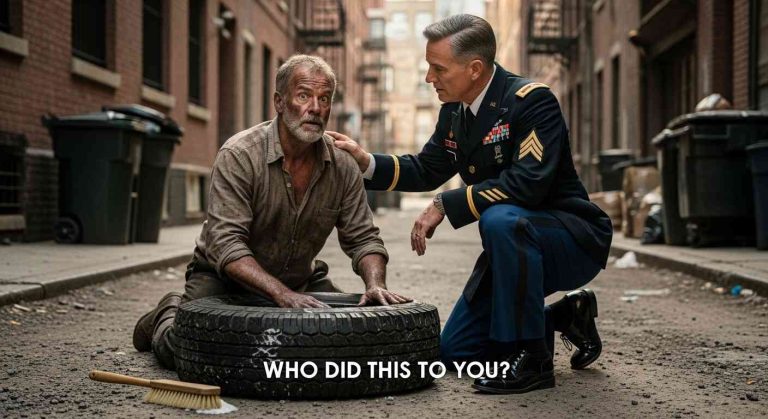
Marcus Thorne didn’t say a word to the teenagers. He walked straight to Elias. He pulled a silk handkerchief from his pocket and, to the shock of the remaining onlookers, knelt down.
Without a word, the most feared prosecutor in the city wiped the spit from Elias’s iron leg.
“”I saw everything,”” Thorne said, his voice a low, vibrating hum of controlled rage. “”And I think it’s time Mr. Sterling learned that some things in this world can’t be bought.””
Chapter 2: The Cold Reality of Justice
The night following the incident was the longest of Elias’s life. They huddled under the crawlspace of an old boardwalk arcade, the smell of grease and salt thick in the air. Leo was silent, his stomach growling a rhythmic, painful sound. Barnaby, the dog, curled around the boy’s feet, offering what little warmth his thin frame could provide.
“”Elias?”” Leo whispered. “”Why do they hate us?””
Elias stared out at the dark ocean. “”They don’t hate us, Leo. To hate us, they’d have to see us. To them, we’re just… background noise.””
He thought about Marcus Thorne. The man’s intervention felt like a fever dream. Why would a man who spent his days putting criminals behind bars care about a homeless man and a bag of scraps?
The answer came the next morning.
A black sedan, polished to a mirror finish, pulled up to the curb near the arcade. A woman stepped out. She was in her late thirties, wearing a simple waitress uniform but carrying herself with a weary grace. This was Sarah, a woman Elias had known from the “”before”” times, when he still had a home.
“”Elias? Marcus Thorne sent me,”” she said, holding out a heavy bag of warm food. “”He said you’d be here. He also said he’s started the paperwork.””
“”What paperwork?”” Elias asked, his voice gravelly from sleep and salt.
“”Assault. Harassment. And a few other things Julian Sterling has been doing to people on that pier for months,”” Sarah said, her eyes flashing with a hidden pain. Elias remembered then—Sarah had a son who had been bullied out of the local high school by Julian’s “”Pack.”” She had a stake in this, too.
But Julian Sterling wasn’t just a kid. He was the son of Richard Sterling, the real estate mogul who practically owned the city council.
“”Thorne is dreaming,”” Elias sighed, taking a bite of a warm biscuit. “”Sterling will bury him.””
“”You don’t know Marcus,”” Sarah replied softly. “”He doesn’t fight to win. He fights to destroy. And he’s got the video.””
By noon, the video had hit the local news. It wasn’t just the spit; it was the look on Leo’s face as his food hit the water. It was the raw, unvarnished cruelty of the wealthy against the defenseless. The city, usually indifferent, began to simmer.
Chapter 3: The Lion’s Den
Marcus Thorne sat in his office on the 22nd floor, watching the view count on the video climb into the millions. His phone was vibrating off the desk—calls from the Mayor, the Police Chief, and, most frequently, Richard Sterling’s lawyers.
He ignored them all.
Thorne had a secret. Twenty years ago, he’d had a younger brother—a boy with a limp and a heart of gold. His brother had been bullied by boys like Julian until one day, he didn’t come home. The “”accident”” at the quarry had been ruled a tragedy, but Marcus knew better. He’d spent his entire career becoming the monster that other monsters feared so he could finally strike back.
A knock at the door interrupted his thoughts. It was Officer Miller, a veteran cop with a guilty conscience.
“”Thorne, Richard Sterling is downstairs. He’s losing his mind. He’s offering a ‘donation’ to the victim’s fund if you drop the criminal lead.””
“”A donation?”” Thorne smiled, but there was no warmth in it. “”Tell him to double it. And then tell him the answer is still no.””
Thorne knew the system was rigged. He knew that Julian would likely get a slap on the wrist. But he wasn’t playing the legal game—he was playing the psychological one. He needed Elias Vance to stand up. He needed the victim to find his voice.
He drove down to the pier that evening, finding Elias sitting on the same bench.
“”They’re going to offer you money, Elias,”” Thorne said, sitting beside him. “”More money than you’ve seen in a decade. Enough to get a real leg. Enough to get Leo an apartment.””
Elias looked at him, his eyes weary. “”And what’s the catch?””
“”You have to sign a non-disclosure agreement. You have to say the video was a ‘misunderstanding.’ You have to let Julian walk away.””
Elias looked at Leo, who was playing with Barnaby a few feet away. The boy’s shoes were falling apart. His ribs were starting to show.
“”What would you do?”” Elias asked.
Thorne looked at the iron leg. “”I’d remember the spit. I’d remember the hunger. And I’d realize that if you let him buy your silence, he didn’t just spit on your leg—he bought your soul.””
Chapter 4: The Price of a Man
The next day, the “”Golden Boy”” himself, Richard Sterling, showed up at the pier. He didn’t come in a sedan; he came on foot, trying to look “”relatable”” in a polo shirt and khakis. He found Elias near the docks.
“”Mr. Vance,”” Richard said, his voice smooth as silk. “”I’m Julian’s father. I want to apologize for my son’s… exuberance. He’s a high-spirited boy, and he didn’t realize your situation.””
“”Exuberance?”” Elias barked a laugh. “”Is that what you call spitting on a veteran?””
Richard didn’t flinch. He pulled a checkbook from his pocket. “”Let’s be practical. My son has a scholarship to Yale. A criminal record would ruin his life. You, on the other hand, have a life that needs a fresh start. Fifty thousand dollars. Right now. All you have to do is tell the press it was a prank that went too far.””
Elias looked at the checkbook. Fifty thousand dollars. It was a fortune. He could get Leo into a good school. He could get the surgery he needed for his stump.
Just then, Mrs. Gable, an elderly woman who lived in the apartments overlooking the pier, walked by. She stopped and spat on the ground near Richard’s feet.
“”Shame on you, Dicky Sterling,”” she hissed. “”We all saw that video. You’re trying to buy the boy’s dignity like you bought the north side of the tracks.””
The interaction was caught by a group of teenagers nearby—not Julian’s friends, but local kids who worked the fry stands. They started filming.
“”Is that the bribe, Mr. Sterling?”” one of them yelled.
Richard’s face turned a deep, angry purple. He realized he was losing the narrative. “”You’re making a mistake, Vance. Take the money, or you’ll end up with nothing. I’ll make sure no shelter in this city takes you in.””
The threat hung in the air, cold and sharp. Elias felt the old fear—the fear of a man with nothing to lose being told he could lose even more. But then he felt Leo’s hand slip into his.
“”Elias,”” the boy whispered. “”I don’t want his money. It smells like the ocean.””
Elias looked at Richard Sterling. He reached out, took the check, and slowly, deliberately, tore it into four pieces. He let the wind carry the scraps into the water, right where Leo’s food had gone the day before.
“”Get off my pier,”” Elias said.
Chapter 5: The Truth Revealed
The trial—if you could call the preliminary hearing that—was a media circus. Marcus Thorne had bypassed the usual channels, using a rarely invoked “”Victim’s Rights”” clause to fast-track the hearing.
The courtroom was packed. Julian Sterling sat at the defense table, looking bored, his expensive lawyer whispering in his ear. Richard Sterling sat in the front row, glaring at Elias.
But Thorne had an ace up his sleeve.
“”Your Honor,”” Thorne said, his voice echoing through the chamber. “”The defense claims this was an isolated incident. A ‘prank.’ But we have found a witness who says otherwise.””
A woman walked into the courtroom. She was pale, her hands shaking. It was Sarah, the waitress from the diner. But she wasn’t alone. She was holding the hand of a young man in a wheelchair.
“”This is my son, Toby,”” Sarah said, her voice cracking. “”Two years ago, Julian Sterling and his friends did the same thing to Toby on that pier. Only they didn’t just spit. They pushed him. They pushed him off the ledge into the shallow water.””
The courtroom went silent. Julian’s lawyer jumped up, screaming about relevance, but the judge—a woman who had worked her way up from the public defender’s office—silenced him with a look.
“”Julian’s father paid for Toby’s medical bills,”” Sarah continued, her eyes locked on Richard Sterling. “”He paid for our silence. He told us if we spoke, he’d have us evicted. I’ve lived in fear for two years. But when I saw Elias Vance stand up… when I saw him tear up that check… I knew I couldn’t be a coward anymore.””
The “”isolated incident”” defense crumbled. The video of Elias wasn’t just a recording of a crime; it was the key that unlocked a decade of Sterling family cover-ups.
Julian’s face finally changed. The arrogance vanished, replaced by a raw, naked terror. He looked at his father, but Richard was looking at the floor. The Sterling empire was built on a foundation of silence, and Elias Vance had just started a landslide.
Chapter 6: A New Horizon
The aftermath was a whirlwind. Julian Sterling was sentenced to community service—two thousand hours of it, specifically cleaning the very pier where he had bullied Elias. But the real victory was the civil suit. Marcus Thorne didn’t take a dime, but he ensured that the settlement from the Sterlings was enough to establish the “”Vance-Leo Foundation,”” a shelter and resource center for the city’s “”invisible”” population.
A month later, Elias stood on the pier. He had a new leg—not a heavy iron one, but a high-tech carbon fiber prosthetic that allowed him to walk without a limp.
He wasn’t wearing rags. He was wearing a clean button-down shirt. Beside him, Leo was holding a brand-new fishing pole, his face bright and healthy. Barnaby had a new collar and a coat that shone in the sun.
Marcus Thorne walked up to them, his hands in his pockets.
“”How does it feel?”” Thorne asked.
Elias looked at his leg, then at the bustling pier. People weren’t looking away anymore. Some nodded. Some smiled. A group of tourists even stopped to ask Elias for directions, treating him like a human being.
“”It feels like I’m finally standing on my own two feet,”” Elias said. “”Both of them.””
Thorne nodded. “”The Sterlings are moving out of the state. The house is on the market. The city feels a little lighter, don’t you think?””
“”It does,”” Elias agreed. He looked down at Leo, who had just hooked a small fish. The boy’s laughter was the loudest thing on the pier, a sound of pure, unadulterated joy.
Elias realized then that justice wasn’t about the jail time or the money. It was about the moment the world stopped being a place where you had to hide.
He took a deep breath of the salt air. It didn’t taste like humiliation anymore. It tasted like home.
He looked at Leo and squeezed his shoulder. “”Come on, kid. Let’s go get some lunch. The good kind.””
The final sentence of the story was etched into the plaque of the new shelter they opened that winter, a reminder for everyone who felt invisible:
“”Your dignity is the only thing the world can’t take from you unless you agree to give it away.”””