The suburban quiet of Oak Ridge didn’t break with a scream; it broke with a realization.
I watched from the edge of the driveway as Rick Miller—the man whose family practically owned this zip code—pointed a finger at my sister, Maya. He was laughing. It was that high, whinnying sound of a man who had never been told “”no”” in his entire life.
Maya sat in her chair, her hands trembling in her lap, her eyes fixed on the ground. She couldn’t find the words to defend herself. She never could. But I had enough words for both of us.
“”You’re going to apologize,”” I said. My voice didn’t sound like mine. It sounded like the desert wind back in Kandahar—dry, sharp, and carrying the scent of a storm.
Rick didn’t even look at me. He just kept snickering to his friends about how Maya “”didn’t belong”” at the neighborhood gala. “”What are you gonna do, Caleb? Call the homeowner’s association?””
I didn’t answer. Instead, I whistled. A short, sharp burst that cut through the humid afternoon air.
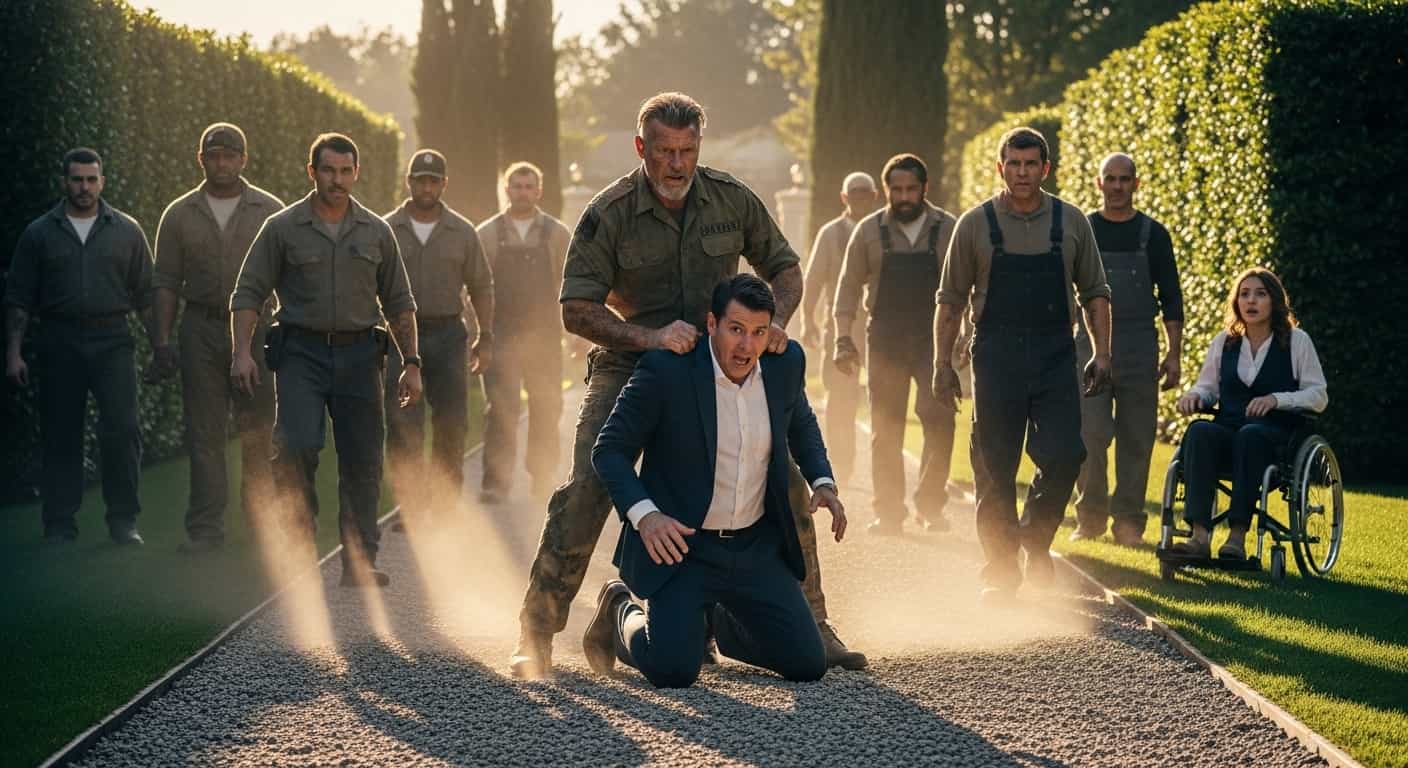
From behind the parked SUVs and the manicured hedges, they stepped out. Men Rick had ignored for years. The guys who mowed his lawn, the veterans he skipped over for jobs, the mechanic he’d cheated last month. My brothers. My army.
The laughter stopped. The color drained from Rick’s face as I stepped forward and wrapped my hand into his expensive, gelled hair.
“”You’re going to apologize,”” I commanded, forcing him down until his knees hit the gravel. “”And you’re going to do it on your knees.””
“FULL STORY
Chapter 1: The Sound of Breaking Glass
The humidity in Oak Ridge, Virginia, always felt like a wet wool blanket. It was the kind of heat that made tempers short and the air taste like gasoline and mown grass. Today was the Annual Founders’ Day Block Party, an event designed to showcase the “”perfection”” of our gated community.
I stood by the cooler, a bead of sweat tracing a path down my spine, watching Maya. She was twenty-two, with eyes like autumn leaves and a spirit that had been tested more than any human being’s should be. She sat in her motorized chair under the shade of a massive oak tree, sketching in her notebook. She was happy. Or she was, until Rick Miller decided he needed an audience.
Rick was the crown prince of Oak Ridge. His father was the developer; Rick was the “”VP of Acquisitions,”” which mostly meant he spent his days at the country club and his nights making everyone else feel small.
“”Hey, Maya!”” Rick shouted, his voice carrying over the soft jazz playing from the speakers. He was holding a beer, leaning against his $90,000 Raptor. “”You drawing a map to the exit? Because you’re kind of blocking the flow of traffic here, sweetheart.””
His friends, a group of guys in matching pastel shorts, chuckled.
Maya flinched. She didn’t look up, but her pencil stopped moving. She began to pick at the skin around her cuticles—a nervous habit she’d had since the accident ten years ago.
“”I said, are you lost?”” Rick stepped closer, his shadow falling over her sketchbook. “”Maybe this isn’t the right ‘vibe’ for someone like you. Isn’t there a… specialized park somewhere else?””
I felt it then. That familiar, cold click in the back of my brain. It was the same feeling I got before an IED went off in the Helmand Province. It was the sound of safety being switched off.
I started walking. Every step felt heavy, deliberate. I wasn’t Caleb, the quiet neighbor who worked at the local gym anymore. I was Sergeant Miller.
“”Rick,”” I said, my voice barely a whisper.
He turned, a smirk plastered on his face. “”Oh, hey, Cal. Tell your sister to move her rig, alright? People are trying to walk here.””
I didn’t stop until I was inches from his face. I could smell the expensive craft ale on his breath. I could see the tiny veins in his eyes.
“”She isn’t moving,”” I said. “”But you are.””
“”Excuse me?”” Rick laughed, looking around at his friends for backup. “”You forget whose street this is?””
“”I don’t care about the street, Rick. I care about the girl you just insulted.””
He rolled his eyes. “”God, you’re so dramatic. It was a joke. She probably didn’t even understand it, right? I mean, look at her.””
He made a vague, mocking gesture toward Maya’s legs.
The world went quiet. The music seemed to fade into a dull hum. I reached out—not fast, but with a terrifying precision—and grabbed a handful of his hair. With my other hand, I gripped his collar, twisting the fabric until he gasped.
“”Hey! What the hell—””
I yanked him forward, forcing him to lean over until his face was level with Maya’s.
“”You’re going to apologize,”” I commanded, my voice low and dangerous.
“”Let go of me! I’ll have you arrested! I’ll sue your—””
I leaned into his ear. “”I brought an army, Rick. Look around.””
He looked. And for the first time in his life, Rick Miller was afraid.
Chapter 2: The Unseen Guard
Rick’s eyes scanned the perimeter of the cul-de-sac. He expected to see the neighbors rushing to his aid. He expected Officer Miller (no relation, just a local cop who played golf with Rick’s dad) to come running.
Instead, he saw a wall.
Emerging from the shadows of the garages and the sides of the catering vans were men and women he had looked past for a decade. There was Elias, the landscaper who had been underpaid for three years. There was Sarah, the waitress from the diner Rick always stiffed on tips. And then there were the others—men I’d served with, guys like Coop and Benji, who lived in the trailer park three miles down the road but came when I called.
They didn’t say a word. They just stood there, arms crossed, a silent phalanx of the “”unimportant.””
“”What is this?”” Rick hissed, his voice cracking. “”A protest? Get these losers off my property.””
“”It’s not your property yet, Rick,”” I said, my grip tightening. “”And these ‘losers’ are the only reason your world keeps spinning. Now, look at my sister.””
Maya was looking up now. Her eyes were wide, filled with a mixture of terror and a strange, budding hope. She had spent a decade being the “”tragedy”” of the neighborhood. She was the girl people spoke about in hushed tones, the one they offered “”thoughts and prayers”” to while never actually inviting her to dinner.
“”I… I’m sorry,”” Rick stammered, his eyes darting toward the silent crowd.
“”Not good enough,”” I said. “”You didn’t just ‘misspeak.’ You tried to make her feel like she wasn’t human. You tried to take the one thing she has left—her dignity.””
I felt the crowd move closer. A collective step forward. The sound of twenty pairs of boots hitting the pavement in unison.
“”I’ll give you a choice,”” I whispered. “”You can apologize to her, properly, on your knees, in front of everyone you’ve ever tried to impress. Or, I can let my friends here explain to you exactly how they feel about your ‘jokes’.””
Rick looked at Coop—a 250-pound former Ranger with a scar running from his ear to his chin. Coop didn’t smile. He just cracked his knuckles.
“”Caleb, stop,”” a voice called out.
I looked up. It was Sarah, my wife. She was standing on our porch, her face pale. She knew what happened when I got like this. She knew that the “”army”” wasn’t just a metaphor—it was a manifestation of the rage I’d been burying since I came home to find our sister’s life shattered by a hit-and-run the police “”couldn’t solve.””
A hit-and-run that happened on this very street. Ten years ago.
“”Don’t do this here,”” Sarah said, her voice trembling.
“”He needs to know, Sarah,”” I said. “”He needs to know that the silence is over.””
Chapter 3: The Ghost of Oak Ridge
The “”accident.”” That’s what everyone called it.
Ten years ago, Maya was a track star. She was fourteen, all legs and sunshine, running down the shoulder of Oak Ridge Drive. A silver SUV had rounded the corner too fast, clipped her, and sent her flying into a stone mailbox.
The driver never stopped. The police found paint chips, but the investigation stalled. Funny how things stall when the only silver SUV in the neighborhood belongs to the man who signs the mayor’s campaign checks.
I was in a hospital in Landstuhl, Germany, recovering from shrapnel wounds, when I got the call. I spent the next decade watching my sister learn to live in a body that wouldn’t obey her anymore. I watched her give up her dreams of college, of dancing, of just walking.
And I watched the Millers.
I watched Rick get a new car every two years. I watched him bully the “”help.”” I watched him thrive while my sister withered in the shadows of our small house.
Standing there now, holding him by his expensive hair, the past ten years boiled down into a single, sharp point of fury.
“”Why do you hate her so much, Rick?”” I asked, my voice terrifyingly calm. “”Is it because she’s a reminder? Is it because every time you see those wheels, you remember the night you came home with a dent in your fender?””
The crowd went deathly still. Even the wind seemed to stop.
Rick’s face went from pale to ghostly white. “”I… I don’t know what you’re talking about. That was… that was an accident. I wasn’t even—””
He stopped, his eyes widening as he realized what he’d just admitted.
“”You weren’t even what, Rick?”” I asked. “”You weren’t even drunk? You weren’t even looking? Or you weren’t even going to tell anyone?””
The “”army”” moved again. This time, they didn’t just stand there. They began to circle. Elias, the landscaper, stepped forward, his eyes wet with tears. “”My daughter was on that track team, Rick. She cried for a year because of what happened to Maya.””
“”You’re all crazy!”” Rick screamed. “”This is kidnapping! This is assault!””
“”No,”” I said, shoving him toward the center of the circle. “”This is a deposition.””
Chapter 4: The Gathering of the Broken
By now, the entire neighborhood was out. People were filming on their phones, their expressions a mix of horror and morbid curiosity. This wasn’t how Founders’ Day was supposed to go. There were supposed to be sliders and craft sodas, not a public execution of a social reputation.
But the “”army”” didn’t care about the phones.
“”My name is Thomas,”” an older man stepped forward. He was a veteran of the Gulf War, a man who usually sat on his porch in silence. “”I worked for your father for twenty years, Rick. When I got sick, he fired me two days before my pension kicked in. He said I was ‘no longer a viable asset’.””
“”My name is Maria,”” a woman said, her voice shaking. “”I cleaned your house. You accused me of stealing a watch you’d actually left at a hotel. You made sure I couldn’t get work anywhere else in this county.””
One by one, they spoke. It was a litany of small cruelties, of the ways the powerful had ground down the weak in this “”perfect”” suburb.
Rick was shaking now, truly shaking. The bravado was gone. He looked like a small, trapped animal. He looked toward his friends—the guys in the pastel shorts. They were already backing away, tucking their phones into their pockets, looking for the quickest way to disappear.
“”No one is coming, Rick,”” I said. “”Not your dad. Not the cops. Not your friends. It’s just you, and the people you’ve spent your life hurting.””
I looked at Maya. She was watching me, her hands gripped tightly to the armrests of her chair.
“”Maya,”” I called out. “”What do you want?””
The crowd parted to let her through. The electric hum of her chair was the only sound in the street. She rolled into the center of the circle, stopping three feet from the man who had ruined her life and then mocked the ruin.
She looked at him for a long time. She didn’t look angry. She looked tired.
“”I just want to know why,”” she whispered. Her voice was thin, but in the silence of the cul-de-sac, it sounded like thunder. “”Why did you keep driving, Rick? I saw your face. We made eye contact in the rearview mirror.””
The gasp that went through the crowd was visceral. It wasn’t just a rumor anymore. It was a confession.
Chapter 5: The Kneeling
Rick broke. He collapsed, his legs giving out before I even had to force him. He hit the asphalt hard, his hands scraping against the stones.
“”I was scared!”” he sobbed, the sound pathetic and ugly. “”I was nineteen! My dad said he’d fix it! He said it would go away if we just kept quiet! I didn’t mean to hit you, Maya! I swear!””
“”But you meant to mock her today,”” I said, stepping behind him. I placed a heavy hand on his shoulder, keeping him down. “”You meant to make her feel small because you couldn’t stand the sight of what you’d done.””
“”I’m sorry!”” Rick wailed, his forehead touching the ground. “”I’m so sorry!””
“”Say it to her,”” I commanded. “”And say it like you mean it. Get on your knees, Rick. All the way.””
He shifted, his knees grinding into the gravel. He looked up at Maya, his face a mask of snot and tears. The “”army”” stood behind him, a wall of judgment that wouldn’t let him turn away.
“”Maya… I’m sorry,”” he choked out. “”I took everything from you. I’m a coward. Please… please don’t let them hurt me.””
Maya looked at him—this broken, powerful man who was now smaller than she had ever been. She looked at me, then at the “”army”” I had assembled. She saw the rage in our eyes, the desire for a type of justice that usually ended in blood.
She reached out her hand. For a second, I thought she was going to strike him. I almost wanted her to.
Instead, she touched the top of his head. A light, fleeting touch.
“”The accident made me lose my legs, Rick,”” she said softly. “”But hiding it made you lose your soul. I don’t want your apology because you’re scared. I want you to go to the station. I want you to tell the truth. Not for me… but so you can finally stop running.””
I felt the fire in my chest flicker. It didn’t go out, but the pressure changed. I looked at my sister—the strongest person I had ever known—and I realized that while I was a leader of men, she was a leader of spirits.
“”You heard her,”” I said, my voice cold. “”Coop, Benji. Escort Mr. Miller to the precinct. Make sure he doesn’t get ‘lost’ on the way.””
Chapter 6: The Weight of Peace
The sun was beginning to set over Oak Ridge, casting long, golden shadows across the lawns. The “”army”” had begun to disperse, melting back into the roles they played—the gardeners, the mechanics, the forgotten. But they walked differently now. They walked with their heads up.
Rick was gone, driven to the police station in the back of Coop’s beat-up truck, followed by a procession of cars that ensured he wouldn’t turn back.
The neighborhood was strangely quiet. The gala was over. The “”perfect”” facade of the community had been stripped away, revealing the messy, painful truth underneath.
I sat on the porch steps next to Maya’s chair. My hands were still shaking, the adrenaline finally leaving my system.
“”You didn’t have to do that, Caleb,”” she said, looking out at the street.
“”Yes, I did,”” I replied. “”I should have done it years ago. I spent so much time being a soldier, I forgot how to be a brother.””
“”You never forgot,”” she said, reaching over to take my hand. Her grip was surprisingly strong. “”You just thought you had to fight the whole world to keep me safe. You didn’t realize that the world was waiting for someone to lead them.””
We sat there as the streetlights hummed to life. For the first time in ten years, the air didn’t feel heavy. The humidity hadn’t broken, but the tension had.
Sarah came out and sat on my other side, leaning her head on my shoulder. We looked like any other suburban family, but we knew better. We were survivors.
The story of what happened that day went viral before the sun was even fully down. The “”Army of Oak Ridge,”” they called it. But it wasn’t about the confrontation or the kneeling. It was about the moment the invisible became visible.
As I watched Maya pick up her sketchbook and begin to draw again, her hand steady and her face calm, I realized that true power isn’t in the ability to force someone to their knees.
It’s in the strength it takes to help them find the courage to stand up and face the truth.
I looked at the silver locket around my neck, the one with her picture inside. I didn’t need it anymore to remember why I fought. I just needed to look at her.
The silence was finally gone, and in its place, we found our voice.”