
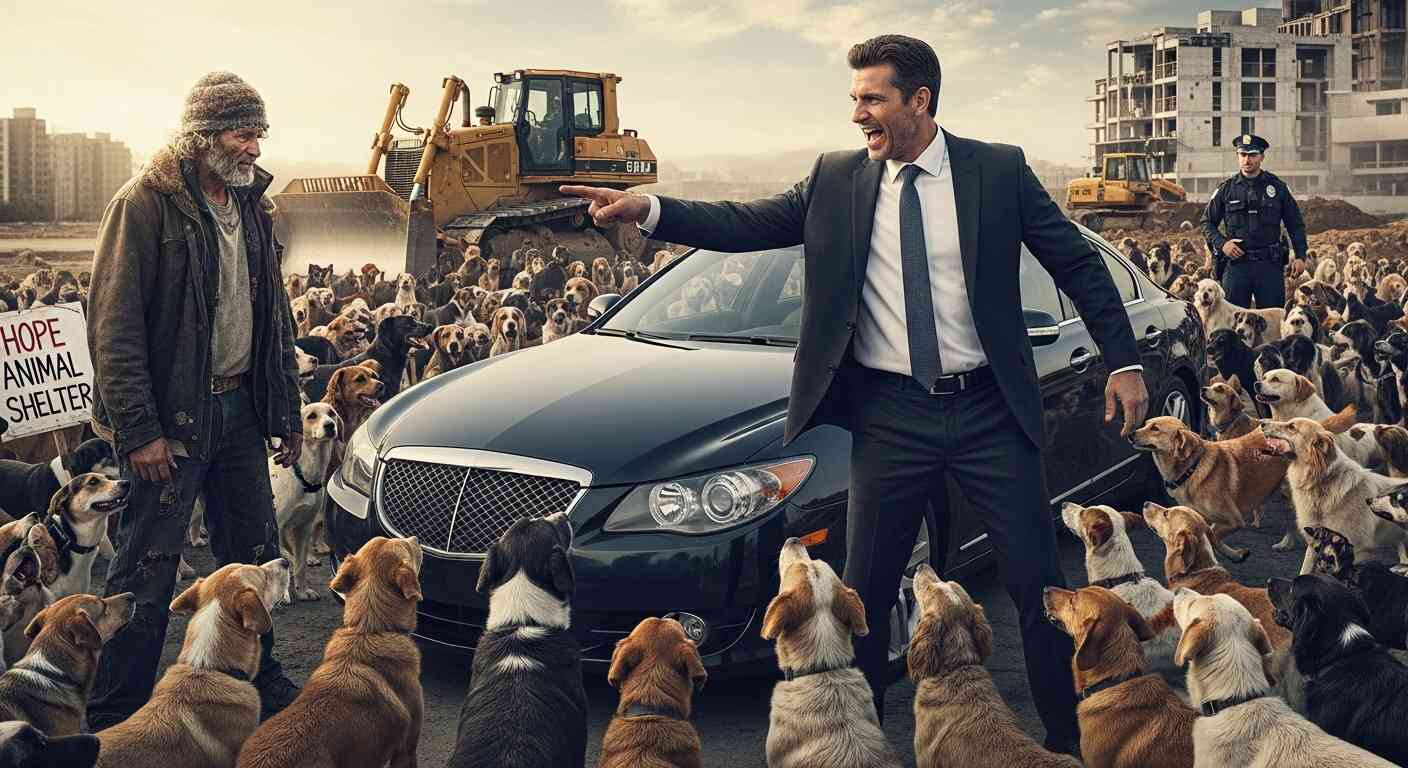
He Ripped My Father’s Only Memento And Called My 500 Dogs “Useless Eaters,” Not Realizing They Were The Only Ones Who Could Smell The Fire In His Soul—Now The Whole State Is Watching Him Fall.
The humidity in Oakhaven, Georgia, always felt like a wet wool blanket, but tonight, the air carried the rancid sting of smoke and cold-blooded greed. I stood on the edge of the gravel path at “The Haven,” my boots caked in the mud of a long day’s work. Beside me stood Silas Vane. He was a man made of expensive silk and cheap morals, the kind of developer who saw a sunset and wondered how much he could charge for the view.
He looked at my tattered M65 field jacket—the one my father wore in the 101st Airborne—and the grime under my fingernails with a disgust so thick you could taste it.
“Look at this place, Elias,” Silas growled, his voice a low, vibrating snarl of contempt. “Five hundred mouths to feed. Five hundred piles of filth. And you, the King of the Trash Heap. You’re a pathetic loser, holding onto a graveyard when you could be sitting on a million-dollar buyout.”
I didn’t answer. I couldn’t. My throat was tight with the weight of five hundred lives. I looked at the communal water trough—the one I had scrubbed by hand that morning.
Silas didn’t like the silence. He didn’t like that I wouldn’t look him in the eye and beg. With a sudden, violent lunge, he grabbed the front of my father’s jacket. The sound of the vintage canvas ripping echoed through the yard like a gunshot.
“I’m done talking,” Silas sneered, leaning over me, his shadow swallowing me whole. “By tomorrow morning, the bulldozers arrive. Your ‘useless eaters’ are going to be gone. It’s a public service, really. Cleaning the street of rats.”
He laughed, a sharp, jagged sound that made the hair on my neck stand up. He thought he was looking at a broken veteran. He thought he was looking at a man who had nothing left but the loyalty of 500 strays.
He didn’t notice the 500 pairs of eyes watching him from the shadows of the kennels. He didn’t notice that the dogs weren’t barking. They were waiting for a command he didn’t even know existed.
Chapter 1: The Ripped Legacy
The gravel bit into my palms as I pushed myself up from the dirt, a familiar pain that grounded me. I watched Silas Vane walk toward his silver Porsche, his gait full of the unearned confidence of a man who had never been told “no.” He was the “Prince of Oakhaven,” the man who was turning our blue-collar town into a playground for the elite. To him, my sanctuary—and the lives inside it—was just a line item on a balance sheet that needed to be erased.
I looked down at the jagged tear in my jacket. It wasn’t just fabric; it was a connection to a man who had taught me that a life was measured by what you protected, not what you owned. My father had survived the jungles of Vietnam and the deserts of the Gulf, only to lose his life to a heart that grew too big for his chest. He had left me this land and a mission: “Look after the ones the world discards, Elias. They have more truth in them than any man in a suit.”
“Elias? You okay?”
The voice was small, hesitant. It was Tommy, a nineteen-year-old runaway I’d found sleeping in a shipping container six months ago. He had a black eye from a father he’d cuối cùng cũng bỏ rơi (finally left behind) and a heart that only felt safe when he was brushing the fur of a dog.
“I’m fine, Tommy,” I said, pushing myself up. My shoulder screamed in protest—an old souvenir from a roadside IED. “Get the dogs ready. The transport is five minutes out.”
Tommy’s eyes widened. “Already? But Vane… he said the bulldozers…”
“Vane is about to learn that some things can’t be bought, and some people can’t be pushed,” I said, looking toward the heavy steel doors of the main kennel.
Inside that building weren’t “useless eaters.” They were the results of three years of grueling, silent work. After I was discharged, I’d started training rescues. But these weren’t just “sit and stay” dogs. I’d used the old Special Forces protocols my father had taught me.
For the last year, a string of arsons had plagued the state. Historical landmarks, affordable housing units, and small businesses were going up in flames. The investigators were baffled. There were no traces of gasoline, no kerosene, no traditional accelerants. The fires were “untraceable.”
But I had a friend in the State Fire Marshal’s office. He’d brought me a sample of charred debris from the third fire. My dogs—every single one of them—had spent months learning the scent of a specific, rare chemical compound: Tributyl Phosphate mixed with a stabilized nitrate. It was an industrial-grade accelerant used in specialized manufacturing, almost impossible to detect unless you knew exactly what you were looking for.
And Silas Vane’s construction firm was one of the few with a license to buy it.
“Elias, look,” Tommy whispered, pointing toward the gate.
Vane had stopped at his car. He was looking at his phone, his face turning a shade of purple that matched his expensive tie. He looked back at me, then at the road. The low hum of heavy engines began to vibrate the ground. It wasn’t the sound of bulldozers.
It was the sound of justice.
Chapter 2: The Backstory of 500 Souls
To understand the 500, you have to understand the man who gathered them. When I came back from my third tour, the world felt too loud. Every car backfire was a mortar; every crowded street was an ambush. The only time the noise stopped was when I was in the woods with my father’s old hunting dog, Moose.
When Moose passed, the silence became deafening. I started volunteering at the local kill-shelter. I saw the “unadoptables”—the ones with the scars, the ones that growled out of fear, the ones that had been used for fighting or abandoned by owners who moved to luxury condos.
I started bringing them home. One, then ten, then fifty.
The community called me crazy. My ex-wife left when she realized I’d rather buy a bag of high-protein kibble than a new dining room set. But I didn’t care. I saw the intelligence in their eyes. I saw that they were waiting for a purpose.
I began to train them. I used my GI Bill money to study scent theory and behavioral psychology. I realized that 500 dogs working as a network were more powerful than any high-tech sensor. We called them the “Haven Network.”
Silas Vane had been trying to buy my land for two years. “It’s prime real estate, Elias. You’re sitting on a gold mine of dirt and dog hair.”
He didn’t realize the “dog hair” was actually the world’s most sophisticated bio-detection unit. Silas had been burning out his competition, clearing “eyesores” to make room for his luxury developments. He thought he was a genius because he used a chemical that evaporated at high temperatures, leaving no residue for the labs to find.
He didn’t account for the fact that a dog’s nose can detect one part per trillion.
I’d spent the last six months working under the table with Detective Sarah Miller. She was the only one who didn’t think I was a “pathetic loser.” She saw the data. She saw the way my dogs would alert on a piece of charred wood from across a football field.
“He’s going to hit the old theater tonight, Elias,” Sarah had whispered to me yesterday. “We need the dogs on site. We need the proof that he’s carrying the chemical in his own vehicle.”
I had prepared. The 500 were ready. When Silas ripped my coat tonight, he didn’t just insult me; he walked into a forensic trap that had been three years in the making.
Chapter 3: The Scent of a Predator
The black tactical vans pulled into the sanctuary with military precision. Silas Vane, who had been about to get into his Porsche, frozen like a deer in the headlights. He tried to hide his phone in his pocket, his hand shaking.
“Silas Vane! State Police! Do not move!”
The voice came from a megaphone, but the real power was in the 500 dogs that had suddenly emerged from their kennels. They formed a silent, disciplined semi-circle around Silas and his car. They didn’t bark. They just sat, their eyes fixed on him, a sea of fur and focus.
Detective Sarah Miller stepped out of the lead vehicle. She was wearing her tactical vest, her hair pulled back into a tight knot. She didn’t look at the dogs; she looked at the man in the silver suit.
“Elias,” she said, nodding to me. “You okay?”
“He ripped my coat, Sarah,” I said, holding up the jagged sleeve. “But he didn’t realize he was just giving me a better reason to finish this.”
“Officer,” Silas stammered, his “Prince of Oakhaven” mask crumbling. “This is a misunderstanding. I’m a taxpayer! This man is a trespasser on his own land! I have the eviction papers!”
“The eviction papers are the least of your worries, Silas,” Sarah said. She signaled to a K9 handler who stepped forward with a large, grey-muzzled Labrador named Barnaby.
Barnaby was the senior member of my network. He had “retired” from the force after a bomb blast, but his nose was still a legend. He walked toward Silas’s Porsche. He didn’t jump. He didn’t growl. He simply walked to the rear bumper and sat down.
Then, he barked—a sharp, authoritative sound that echoed through the valley.
“He’s alerting, Silas,” Sarah said. “Do you want to tell us why my dog thinks there’s a highly volatile, illegal chemical accelerant in your trunk?”
“That’s… that’s impossible!” Silas shrieked. “That dog is a mutt! He doesn’t know what he’s smelling!”
“He’s not a mutt, Silas,” I said, walking toward him. “He’s a specialist. And he’s not the only one.”
I let out a sharp, low-frequency whistle. Across the yard, 500 dogs stood up in unison. The sound of 2,000 paws hitting the gravel was like a low-frequency rumble of thunder.
Chapter 4: The Night of the Revelation
Silas was trembling now. He looked at the sea of dogs, then at the tactical team that was already prying open his trunk. They didn’t need a warrant; the K9 alert gave them probable cause.
Inside the hidden compartment of the luxury SUV, they found it: a pressurized canister of TPN accelerant. It was the same chemical found at twelve different arson sites across the state.
“The labs couldn’t find it because it disappears in the heat of the fire,” Sarah explained to the forensic team. “But Elias’s dogs were trained on the raw, unburned chemical. They can smell it even through a steel tank.”
As the handcuffs clicked shut on Silas’s wrists, the neighborhood began to wake up. Neighbors who had looked down on me for years—the ones who had complained about the “noise” and the “beggar” with too many dogs—were standing at the edge of the property, their faces filled with a mixture of shock and shame.
“He was the one?” Mrs. Gable, an elderly neighbor who had lost her family’s florist shop to a “mysterious” fire last year, whispered. “Silas Vane burned my shop?”
“He wanted your corner lot for a parking garage, Mrs. Gable,” I said, walking to the fence. “He thought he could burn his way to a fortune.”
Silas was being led toward the van. He caught my eye one last time. There was no more arrogance, only a hollow, pathetic fear. He realized that the “useless eaters” he had mocked were the ones who had finally devoured his reputation.
“You’re still a loser, Elias!” he screamed as they shoved him into the van. “You’re still going to be poor! You’re still going to be alone with your dogs!”
“I might be poor, Silas,” I said quietly. “But I’m the only one here who can look his father in the eye when he gets to the other side.”
I watched the blue and red lights fade into the night. The “Haven” was silent again, but it was a different kind of silence. It was a silence of peace.
Chapter 5: The Cooling Down
The following week was a whirlwind of legal filings, depositions, and a strange, overwhelming influx of support. The State Fire Marshal’s office issued a formal apology to me. The city of Oakhaven, desperate to save face, offered to buy the sanctuary and turn it into an official K9 training facility for the state.
“I’m not selling, Sarah,” I said, sitting on the porch of the main cabin.
“I know,” she said, sitting next to me. She was holding a new jacket—a heavy, dark green canvas coat with a warm wool lining. “But you can at least take the contract as a consultant. They want you to lead the new Bio-Detection Task Force.”
“And the dogs?”
“They stay with you. The state pays for their food, their vet bills, and a full-time staff. Tommy can be your lead assistant. He’s already got the touch.”
I looked out at the fields. Tommy was out there now, running with a group of younger dogs. He looked happy. He looked like he had found a home.
“What about Silas?” I asked.
“He’s talking,” Sarah said, her voice turning cold. “He’s trying to cut a deal by giving up the other developers who were in on the scheme. It’s a house of cards, Elias. And you were the one who blew it over.”
I looked at Moose, a massive Shepherd mix who had been one of the first dogs I’d rescued. He rested his head on my knee, his eyes full of a quiet, soulful intelligence.
“I didn’t do it, Sarah,” I said. “They did. I just gave them the chance to show what they were worth.”
The “useless eaters” were now the heroes of the state. The “beggar” was now the Director of the Haven Project. But as I sat there in the quiet of the Georgia evening, I realized that the titles didn’t matter.
What mattered was the feeling of a cold nose against my hand and the knowledge that the fires were finally out.
Chapter 6: The Final Sentence
A year later, the Haven looked like a different place. The rusted fences were gone, replaced by high-tech enclosures and a beautiful, modern training center. We weren’t just a “shelter” anymore; we were a school of justice.
I stood on the porch, wearing the jacket Sarah had given me. It had a small patch on the shoulder: Haven K9 – Unit 1. I looked at the spot where Silas had ripped my father’s coat. I’d kept that old jacket. I’d had it framed and hung it in the main lobby of the training center. I wanted every handler who came through these doors to remember that a man’s worth isn’t found in his bank account, but in what he’s willing to sacrifice to protect the vulnerable.
Arthur Sterling, a wealthy developer from the neighboring county, pulled up in a luxury sedan. He was here to “donate” a large sum of money to the project—mostly to keep his own name clean in the wake of the Vane scandal.
“Mr. Thorne,” he said, extending a hand. “What a remarkable achievement. Five hundred dogs… it must have been a burden to carry them for so long.”
I didn’t take his hand. I looked at the 500 dogs sitting in perfect formation on the lawn behind me.
“They were never a burden, Mr. Sterling,” I said. “They were the weight that kept me from drifting away.”
Sterling looked at the dogs, and for a second, I saw a flicker of that old Silas Vane fear in his eyes. He realized that he was being judged by more than just a man. He was being judged by a pack that could smell a lie from a mile away.
As he drove away, I turned back to my family. The sun was setting, casting long, golden shadows over the hills. I reached into my pocket and pulled out a small, silver whistle.
I blew a long, low note.
In perfect unison, 500 heads tilted. 2,000 paws hit the ground. And a chorus of howls rose into the air—a sound of triumph, of loyalty, and of a fire that could never be put out.


