Chapter 1
The grease under my fingernails was the only thing that felt real anymore. It was a deep, stubborn black that didn’t come off with Dawn or a pumice stone, and frankly, I didn’t want it to. That grease was the only thing connecting me to 1944.
I was hunched over the carburetor of my 1942 Harley-Davidson WLA. Most people in Oakwood Creek saw it as a hunk of rusted iron taking up space in a driveway that should have been occupied by a Tesla. To me, it was the last heartbeat of the men I’d left behind in the mud of the Ardennes.
“Hey, Pops! I thought I told you this eyesore had to be gone by noon.”
I didn’t look up. I knew the voice. Jax Miller. He was twenty-five, owned a customized Dodge Charger with an exhaust that sounded like a lawnmower in a trash can, and thought he owned the three blocks surrounding our cul-de-sac because his uncle was on the city council.
“It’s a work in progress, Jax,” I said, my voice like gravel. “And it’s on my property.”
“Your property looks like a junkyard,” Jax spat. I could hear his boots clicking on the pavement, getting closer. Behind him, three of his buddies—kids who had never worked a day in their lives—chucked rocks at my mailbox. “The HOA is complaining. I’m complaining. This ‘trash’ is lowering my property value.”
I finally stood up, my knees popping like small-caliber rounds. I wiped my hands on a rag and looked him in the eye. I’d stared down Tiger tanks and men with bayonets; a kid in a designer hoodie didn’t move the needle for me. “This ‘trash’ carried a radio that saved an entire company of paratroopers. Show some respect.”
Jax laughed, a high, mocking sound that made my skin crawl. “Respect? For a bike that doesn’t even run? You’re living in the past, Elias. You’re a relic, just like this junk.”
Before I could respond, Jax did something he would live to regret. He reached out and grabbed the collar of my worn-out flight jacket. The fabric groaned. He pulled me toward him until I could smell the cheap energy drink on his breath.
“I’m gonna give you one hour,” Jax hissed, his eyes darting to his friends to make sure they were watching his ‘tough guy’ act. “If this bike isn’t in a trailer and headed for the scrap heap by then, I’m coming back with a can of gasoline. I’ll burn the bike, and I’ll burn that little shed you call a garage. You hear me, old man?”
I didn’t flinch. I just looked at his hand on my collar. “You might want to let go, son.”
“Or what?” Jax sneered, tightening his grip. “Who’s gonna stop me? You? You can barely walk.”
In that moment, the air in the suburb changed. It wasn’t a sound at first; it was a vibration in the soles of my feet. The neighbors—Mrs. Gable across the street, the young couple three doors down—all stopped what they were doing. They weren’t looking at us anymore. They were looking past Jax, toward the entrance of the neighborhood.
A low, guttural roar began to fill the valley. It wasn’t the sound of one engine. It was hundreds.
Jax frowned, his bravado wavering for a split second. He turned his head just enough to see the horizon. The sun was dipping low, casting long shadows, but the street was suddenly being filled by a wall of black.
Luxury SUVs, sleek black sedans, and high-end motorcycles were turning onto our street. They weren’t speeding; they were moving with a slow, predatory precision. One, ten, fifty… the line didn’t stop. It looked like a funeral procession for a king, except there was nothing mournful about the way those engines growled.
“What the hell is this?” Jax muttered, his hand finally slipping from my collar.
I felt a ghost of a smile touch my lips. “That,” I said quietly, “is the ‘trash’ coming to pick itself up.”
“FULL STORY
Chapter 2
The arrival of the convoy wasn’t just a spectacle; it was a physical weight that settled over Oakwood Creek. The pristine, manicured lawns and the white picket fences suddenly seemed flimsy, like stage props in the face of the armored reality rolling down the asphalt.
Jax backed away from me, his eyes wide. He looked like a cornered animal trying to decide which way to bolt. His friends had already retreated to the sidewalk, their hands shoved deep into their pockets, trying to look invisible.
The lead vehicle, a matte-black Cadillac Escalade that looked like it could withstand a landmine, pulled up directly in front of my driveway. It didn’t park; it commanded the space. Behind it, the street was a sea of black metal and tinted glass. The 500 engines cut out at the exact same moment. The silence that followed was louder than the roar.
The driver’s side door of the Escalade opened. A man stepped out who looked like he’d been carved from a mountain. Marcus Thorne—no relation, though I loved him like a son—was fifty-five, dressed in a charcoal suit that probably cost more than Jax’s Charger. He was the CEO of Thorne Global Security, one of the most elite private firms in the country. But to me, he was the kid who had been my Sergeant Major twenty years ago in a desert halfway across the world.
Marcus didn’t look at Jax. He didn’t look at the neighbors. He walked straight to me, snapped his heels together, and gave me a salute that could have cut glass.
“”Colonel,”” Marcus said, his voice booming in the quiet street. “”We heard there was a localized disturbance regarding the regiment’s history.””
“”At ease, Marcus,”” I said, though my chest tightened. “”Just a misunderstanding about what constitutes ‘trash’.””
Marcus finally turned his gaze toward Jax. It wasn’t a look of anger. It was the look a gardener gives a weed before pulling it out. Jax tried to find his voice. “”Look, man, I don’t know who you are, but this is a private neighborhood. You can’t just block the street—””
Marcus took one step toward him. He didn’t raise a hand. He didn’t have to. Jax actually tripped over his own feet, falling back against the hood of his Charger.
“”I am the man who ensures that people like you sleep safely in their beds without ever having to know what real fear feels like,”” Marcus said softly. “”And the man you just laid hands on is the reason I’m still breathing. He’s the reason this country has a history worth protecting.””
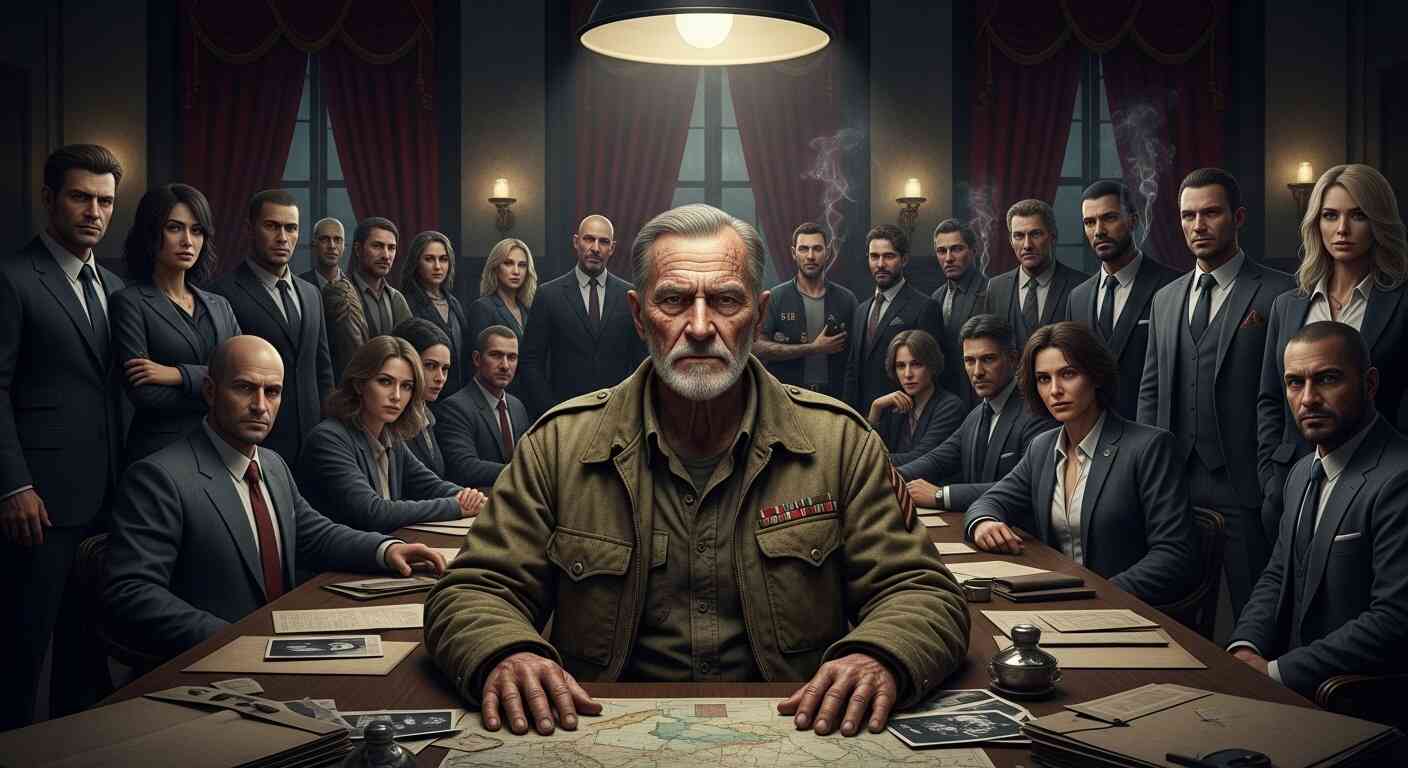
By now, the doors of the other vehicles were opening. Men and women—some in suits, some in veteran caps, some in tactical gear—stepped out into the street. They weren’t a mob. They were a phalanx. They stood in the street, 500 strong, their eyes fixed on my driveway.
Sarah, my granddaughter, came running out of the house. She had her sketchbook in one hand, her face pale. She stopped when she saw the sea of black-clad men. She looked at me, then at Marcus, and finally at the Harley.
“”Grandpa?”” she whispered. “”What’s happening?””
“”History is catching up with the present, honey,”” I said, reaching out to pat her hand.
I looked back at Jax. He was trembling now. The “”Viper”” of Oakwood Creek looked like a garden worm. But this wasn’t just about scaring a bully. It was about the fact that for years, I’d been the “”crazy old veteran”” on the corner. I’d been the man people ignored at the grocery store. I’d been the man whose stories were treated like fairy tales.
“”Marcus,”” I said, my voice steady. “”Mr. Miller here was just telling me that this bike needs to be moved. He was even planning on helping me with some gasoline.””
The 500 men didn’t move, but a low murmur went through them—a sound like the sea before a storm. Marcus smiled, but there was no warmth in it.
“”Is that right?”” Marcus asked Jax. “”You want to see this bike move?””
Jax couldn’t even nod. He just stared.
“”Fine,”” Marcus said. “”Let’s move it. But not to the scrap heap. We’re taking it to the museum. And you, Mr. Miller, are going to help us load it. Very, very carefully.””
FULL STORY
Chapter 3
The process of moving the 1942 Harley was handled with more reverence than a royal coronation. Marcus’s men brought out a specialized hydraulic lift, but before they touched it, Marcus pointed at Jax.
“”You,”” Marcus barked. “”Pick up that wrench.””
Jax looked at the heavy adjustable wrench lying in the oil-stained driveway. His hands were shaking so hard he almost dropped it twice. “”I—I don’t know anything about bikes.””
“”You knew enough to call it trash,”” Marcus said, looming over him. “”Now you’re going to learn about the metal that built this world. Start by cleaning the grime off the rear fender. With your own shirt if you have to.””
The neighbors were all out now, lining the sidewalks. They weren’t whispering anymore; they were watching in a stunned, reverent silence. Mrs. Gable, who had complained about my “”noisy”” engine for three years, looked like she wanted to apologize but didn’t know how.
Sarah stood next to me, her eyes darting between the 500 men and the bike. “”Who are they really, Grandpa? I know Marcus, but… all of them?””
“”They’re the ‘Ghosts of the 101st,’ Sarah,”” I told her. “”Some served with me. Some served under the men I trained. It’s a brotherhood that doesn’t have an expiration date. When Marcus put out the call on the encrypted boards that someone was threatening the Colonel and the ‘Wartime Bride’—that’s what we call the bike—they didn’t ask questions. They just started driving.””
As Jax scrubbed at the fender, his face red with humiliation, a police cruiser pulled into the neighborhood, its lights flashing. It was Officer Miller, Jax’s cousin. He stepped out of the car, his hand hovering near his holster, looking ready to shut down the “”illegal gathering.””
He stopped dead when he saw the 500 men. He saw the badges on some of their belts—federal agents, state troopers, high-level private security. He saw the medals pinned to the jackets of the older men.
Officer Miller slowly took his hand away from his belt. He looked at Jax, who was currently on his knees scrubbing a motorcycle wheel while 500 elite operators watched him.
“”Problem here, Officer?”” Marcus asked, his tone deceptively polite.
Miller looked at his cousin, then at the sea of black SUVs. He was a small-town cop who liked to bully teenagers; he knew a losing battle when he saw one.
“”No,”” Miller stammered. “”No problem. Just… checking on a noise complaint. Seems like everything is under control.””
“”It is,”” Marcus said. “”We’re just helping a hero move his property. Maybe you should stay and watch. You might learn something about service.””
Officer Miller didn’t stay. He got back in his car and backed out of the street so fast he nearly hit a mailbox. Jax looked up, his last hope for an out disappearing with the flash of the blue and red lights.
“”Grandpa,”” Sarah said softly, “”look at the bike.””
In the setting sun, the Harley seemed to glow. The dirt and grime were being wiped away by the very man who had insulted it. Underneath the dust of decades, the olive-drab paint was still there. The white star on the tank was faded but visible.
It wasn’t just a machine. It was a witness. It had seen the liberation of villages; it had carried wounded men to safety; it had survived the harshest winter in European history.
“”Elias,”” Marcus said, stepping beside me. “”We’re not just taking the bike. We’re taking you, too. There’s a gala tonight at the Veterans’ Memorial. The Governor is there. The Joint Chiefs are there. They’ve been looking for the man who held the bridge at Bastogne for a long time.””
I looked down at my grease-stained hands. “”I’m just a mechanic, Marcus. I don’t belong at a gala.””
“”You’re the guest of honor,”” Marcus insisted. “”And Sarah is coming too. It’s time this town—and this country—sees what a real legend looks like.””
FULL STORY
Chapter 4
The transformation was jarring. Two hours later, I wasn’t the “”old man in the driveway.”” Marcus’s team had whisked me into the house, and Sarah had helped me find my old dress blues. They were tight in the waist and smelled of mothballs, but the medals… the medals still shone. The Purple Heart, the Silver Star, the Distinguished Service Cross.
When I stepped out onto the porch, the 500 men stood at attention. A collective “”Ooh-rah”” and “”Hooah”” rippled through the air, shaking the windows of the suburban homes.
Jax was still there. Marcus had made him stay, sitting on the curb, watching the man he’d called “”trash”” be treated like a deity. I walked down the steps, Sarah on my arm. She looked beautiful in a simple black dress, her eyes shining with a pride I hadn’t seen in years.
I stopped in front of Jax. He wouldn’t look up.
“”Son,”” I said. He flinched. “”You looked at me and saw a weakness. You looked at that bike and saw junk. That’s because you only see the surface of things. You think power is the volume of your exhaust or the money in your uncle’s pocket.””
I leaned down, my medals clinking. “”Power is the man standing next to you when everything goes to hell. Power is the history you carry in your bones. I don’t want your apology. I want you to remember this feeling. The feeling of being small. Because that’s how the rest of the world feels when people like you think they’re big.””
Jax nodded, a single tear tracking through the grease on his cheek. He was finally quiet.
We climbed into the lead Escalade. The 500-car convoy began to move. It was a slow, majestic exit. As we passed the neighbors, I saw Mrs. Gable standing on her porch, saluting. She didn’t know how to do it right—her palm was facing out—but the gesture was there. The young couple was filming, their faces full of awe.
The drive to the city was surreal. Traffic cleared as if by magic. State troopers escorted us, their sirens silent out of respect. We reached the Memorial Plaza, where thousands of people had gathered.
The 1942 Harley was already there, mounted on a velvet-covered dais under the spotlights. It looked like a piece of fine art.
As I stepped out of the car, the flashbulbs were blinding. I felt a moment of panic—the old “”combat rattle”” as we used to call it. But then I felt Marcus on my left and Sarah on my right.
“”Just like the parade in ’45, Colonel,”” Marcus whispered. “”Only this time, we’re making sure they don’t forget.””
I walked up to the podium. The crowd went silent. I looked out at the faces—young, old, civilian, military. I looked at the Harley, the white star gleaming under the lights.
“”I was told today that this bike was trash,”” I began, my voice amplified across the plaza. “”And in a way, the man was right. It’s a piece of metal. It’s rusted. It’s outdated.””
I paused, letting the words sink in.
“”But this metal has soul. It carries the echoes of men who gave everything so a kid could stand in a driveway in the suburbs and feel safe enough to be a bully. We don’t preserve these things because they’re pretty. We preserve them because they are the anchors of our identity.””
The applause started low and built into a roar that rivaled the 500 engines. But as I looked out into the crowd, I saw something that moved me more than the cheers. I saw a group of young men, about Jax’s age, standing at the back. They weren’t cheering. They were standing perfectly still, looking at the bike with a newfound sense of gravity. They were finally seeing the weight of the world they lived in.
FULL STORY
Chapter 5
The gala was a whirlwind of handshakes and hollow praise from politicians, but the real heart of the night happened in the shadows. After the speeches, I found myself sitting on a bench near the Harley, just me and the bike.
Marcus approached, two glasses of expensive scotch in his hands. He handed me one and sat down, his heavy frame making the bench groan.
“”We did it, Elias,”” he said, nodding toward the bike. “”She’s going into the permanent collection. Climate-controlled, 24-hour security. No one will ever threaten her again.””
I took a sip of the scotch. It burned in a way that reminded me I was still alive. “”It’s not just about the bike, Marcus. You know that.””
“”I know,”” he said softly. “”It’s about the fact that guys like Jax think they can erase the past by screaming loud enough. They think if they don’t see the scars, the wounds never existed.””
We sat in silence for a while, watching the elite of the city mingle. Sarah was across the room, talking to a curator from the Smithsonian. She looked happy. She looked like she finally understood why her father—my son—had chosen the life he did. He hadn’t died for a flag; he’d died for the man standing next to him.
“”Colonel,”” Marcus said, his voice turning serious. “”The firm… we’ve been talking. We want to start a foundation in your name. ‘The Thorne Initiative.’ We’re going to find veterans like you—men and women who have been pushed to the margins of their own neighborhoods—and we’re going to give them the support they need. Legal, financial, emotional. No more being bullied out of their homes. No more being told their memories are trash.””
I looked at him, stunned. “”Marcus, that’s… that’s a lot of work.””
“”We have 500 men who are looking for a mission, Elias. Today was just the muster. The real work starts tomorrow.””
The night ended late, but as we drove back to Oakwood Creek, the atmosphere was different. The convoy was smaller now—just Marcus and a few of the core team—but as we turned onto my street, I noticed something.
Every house on the block had their porch light on.
In front of my house, the driveway had been power-washed. The oil stains were gone. And sitting on my porch was a small, hand-written note weighted down by a brand-new, high-quality wrench.
I picked it up. I’m sorry. I didn’t know. I want to learn. — J.
I looked over at Jax’s house. His Charger was in the driveway, but the lights were off. For the first time, the neighborhood felt like a community instead of just a collection of houses.
“”He’s got a long way to go,”” I muttered, pocketing the note.
“”We all do, Colonel,”” Marcus said, leaning against the SUV. “”But at least now, the road is clear.””
FULL STORY
Chapter 6
The following weeks were quiet, but it was a new kind of quiet. It wasn’t the silence of being forgotten; it was the peace of being respected.
People stopped by my house now. Not to complain, but to talk. Mrs. Gable brought over a peach cobbler and spent an hour asking me about what it was like to see Paris for the first time. The young couple from down the street asked if I could help them fix an old lawnmower. I became the unofficial mechanic of Oakwood Creek, the man who could make anything run if you gave him enough time and a bit of grease.
The Harley was gone, moved to its place of honor in the museum, but in its place in the garage stood a new project. Jax started coming over every Saturday morning. At first, it was awkward. He didn’t know how to hold a hammer, let alone a torque wrench. But he listened. He worked until his hands were as black as mine.
One Saturday, as we were working on an old Indian Scout I’d picked up, Jax looked at me.
“”Why didn’t you let them crush me, Mr. Thorne? Marcus… he could have ruined my life that day.””
I tightened a bolt and looked at him. “”Because, Jax, a leader knows when to use a hammer and when to use a level. You didn’t need to be crushed. You needed to be built back up on a better foundation.””
He nodded, looking down at his grease-stained fingernails with a strange kind of pride.
That evening, Sarah came over for dinner. She brought a painting she’d been working on. It was a portrait of me and the 1942 Harley, but the background wasn’t the suburb. It was a ghostly image of the 500 men, their faces blurred but their presence overwhelming.
“”I’m calling it ‘The Unseen Guard,'”” she said, kissing my cheek.
We sat on the porch as the sun went down, the same spot where Jax had grabbed my collar only a month before. The air was cool, smelling of cut grass and woodsmoke.
I realized then that my war hadn’t ended in 1945. It had continued in every small act of standing up for what’s right, in every moment of teaching the next generation that honor isn’t something you buy, it’s something you earn through sweat and silence.
I looked at my hands—old, scarred, and perpetually stained with the black grease of a life well-lived. I wasn’t a relic. I wasn’t a ghost. I was a man who had found his unit again, and this time, we weren’t fighting for a bridge in a far-off land. We were fighting for the soul of the place we called home.
I leaned back in my chair, watching the stars come out over the quiet American suburb, knowing that if I ever needed them, 500 engines were only a phone call away.
True strength doesn’t roar to prove it’s there; it waits in the silence for the moment it’s needed most.”