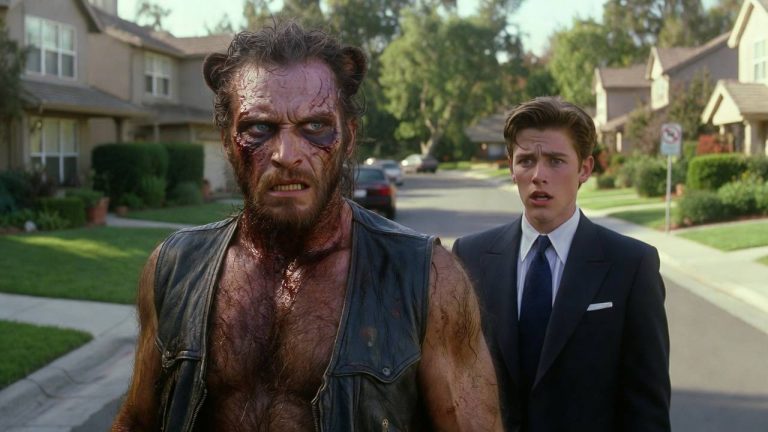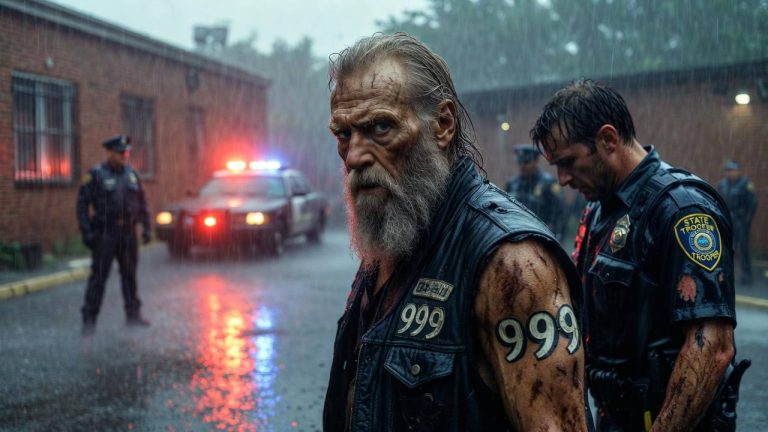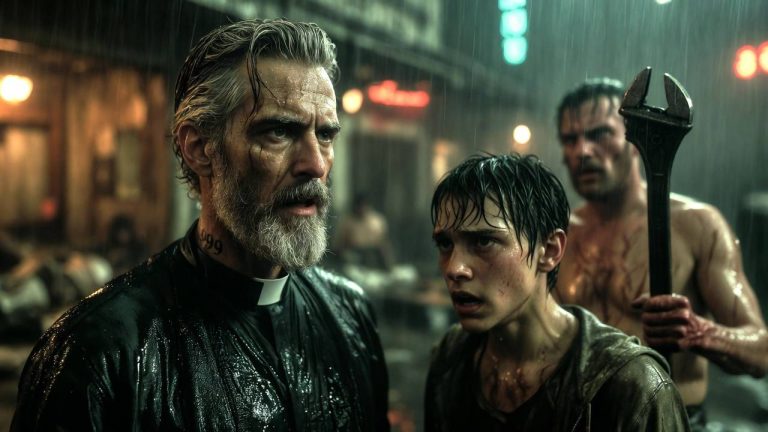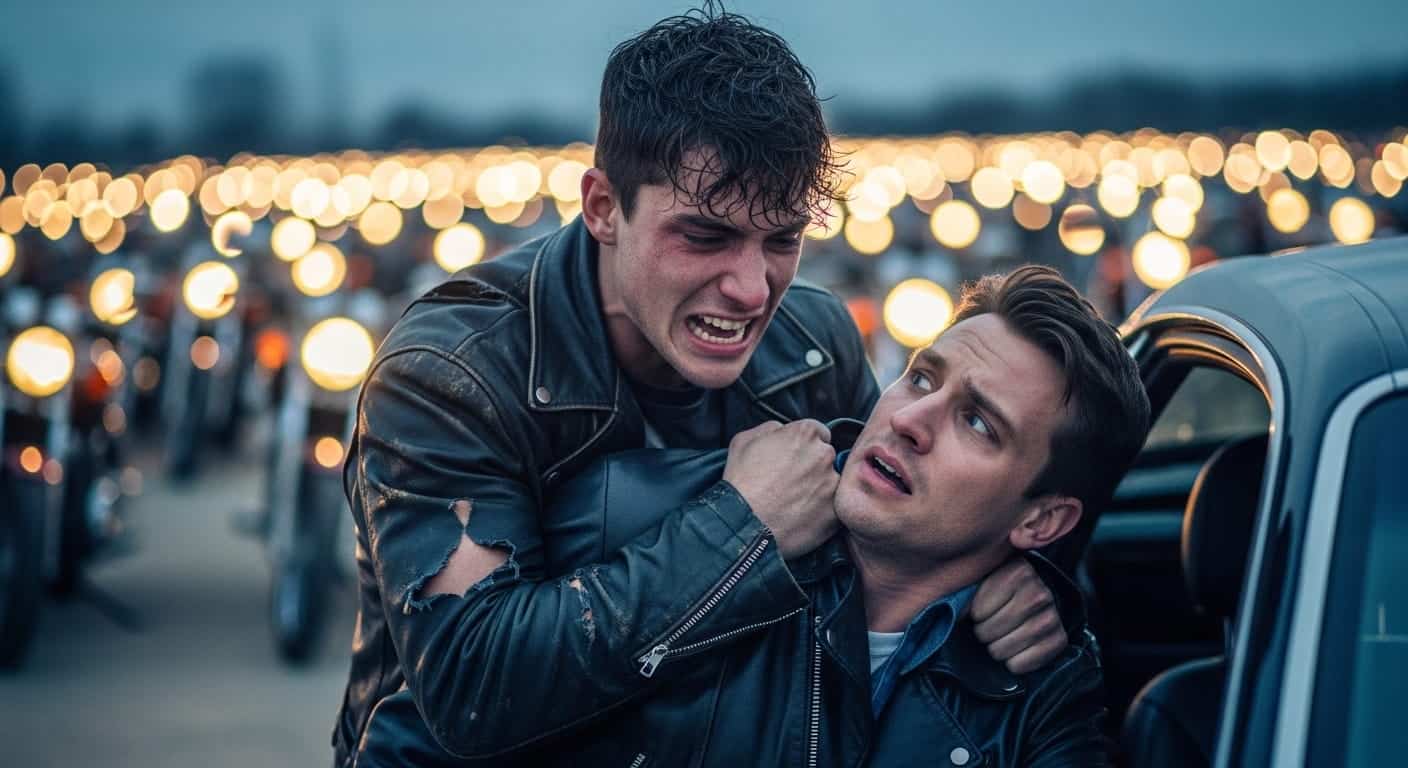
“”I’m going to give you ten seconds to run, but you won’t get far,”” I whispered. My hand was a vice on his throat, pinning him against the cold metal of his own overpriced car.
My other hand held what was left of it. The vintage Schott Perfecto. The leather was soft, broken in by years of my brother Leo wearing it until it became a second skin. Now, there was a jagged, intentional tear straight down the back.
Bryce looked at the shredded leather and actually smirked. “”It’s a rag, Jax. My dad can buy you ten more. Hell, I’ll buy you a whole shop of them if you’ll just stop acting like a psycho.””
He didn’t get it. He couldn’t.
Leo died six months ago on Route 9. This jacket was the only thing that still smelled like him—like peppermint gum and old gasoline. It was the only thing I had left to hold onto when the silence in our house got too loud.
“”Ten,”” I started counting. My voice was a low growl, vibrating in my chest.
“”Oh, come on—”” Bryce started to sneer, but the sound was cut short.
From three blocks away, a low hum started. It sounded like a storm rolling in from the valley, but there wasn’t a cloud in the sky. It was a mechanical growl, deep and primal.
“”Nine.””
The hum turned into a roar. The ground beneath our boots began to tremble. Bryce’s eyes darted toward the entrance of the parking lot.
“”Eight.””
One headlight appeared. Then two. Then twenty. Then a sea of them, cutting through the dusk like a vengeful army. My family wasn’t just blood. My family was the Brotherhood of the Iron Road—the men Leo had ridden with, the men who had carried his casket when I was too weak to stand.
And they were all answering the call.
“FULL STORY
Chapter 1: The Weight of Leather
The neon sign of “”Miller’s Diner”” flickered, casting a sickly blue light over the gravel parking lot. I was tired. My hands were stained with the kind of engine grease that requires a week of scrubbing to disappear, and my back ached from ten hours under a rusted Chevy. But I didn’t care about the fatigue. I only cared about the weight on my shoulders.
I was wearing Leo’s jacket. I wore it every night after work. It was too big for me—Leo had been the athlete, the golden boy with the broad shoulders and the easy laugh. I was just the quiet younger brother who knew how to make machines scream.
“”Nice rags, Jax. Did you find that in a dumpster or did your brother leave it to you in his will?””
I froze. Bryce Thorne was leaning against his brand-new Mustang, surrounded by a group of his usual hangers-on. He was the son of the town’s biggest developer, a kid who had never known the feeling of dirt under his fingernails.
I tried to walk past. I really did. I could hear Sarah’s voice in my head—my girlfriend, the only person who could talk me down from a ledge. Ignore him, Jax. He’s not worth the trouble.
But Bryce wasn’t finished. He reached out as I passed, his fingers catching the collar of the jacket.
“”I asked you a question, grease monkey.””
“”Let go, Bryce,”” I said, my voice dangerously calm. “”I’m not in the mood.””
“”Or what? You’ll cry? Just like you did at the funeral?”” He yanked the collar, trying to turn me around. I heard it then. The sound of high-quality leather surrendering. Rrip.
The world went silent. The sound of the wind, the distant traffic, the chatter of the teenagers—it all vanished. All I could feel was the tear. The physical manifestation of my brother’s memory being desecrated.
I didn’t think. I reacted. In one motion, I had Bryce by the throat, slamming him back against the Mustang. The thud of his spine hitting the window was the most satisfying thing I’d felt in months.
“”Do you have any idea what you just did?”” I whispered. My face was inches from his. I could see the tiny broken capillaries in his eyes, the way his pupils dilated in sudden, sharp terror.
“”It’s… it’s just a jacket, man! Let go!””
I looked down at the tear. It was jagged. Ruined. “”This was his,”” I said, my voice cracking. “”This was all I had left.””
I felt the rage bubbling up, not as a heat, but as a cold, suffocating tide. I reached into my pocket and hit the SOS button on my phone—a specific signal tied to a group chat that hadn’t been active since Leo’s funeral.
“”I’m going to give you ten seconds to run,”” I told him, my grip tightening. “”But you won’t get far.””
“”You’re crazy!”” Bryce choked out.
“”Ten,”” I said.
And then, the horizon began to scream.
Chapter 2: The Ghost in the Garage
To understand why a piece of leather could drive a man to the edge of sanity, you have to understand Leo.
Leo was the sun. I was just a moon reflecting his light. Growing up in Oakhaven, a town that the rest of the world forgot in the seventies, there weren’t many ways out. You either played ball, joined the army, or worked at the mill until your lungs gave out. Leo was the one who was supposed to play ball.
Then came the accident. Not the one that killed him—the one that ended his dreams. A blown knee in senior year. He didn’t get bitter; he just bought a bike. An old, beat-up Harley Sportster that he rebuilt in our dad’s garage. That’s where he found the Brotherhood.
I remembered the day he bought the jacket. He’d saved up for six months, working double shifts at the mill. When he put it on, he looked invincible. “”It’s armor, Jax,”” he’d told me, punching my shoulder lightly. “”As long as I’m wearing this, nothing can touch me.””
He was wrong, of course. Armor doesn’t protect you from a drunk driver crossing the center line on a rainy Tuesday night.
After the funeral, my mother wanted to give his clothes to the church. I fought her for the jacket. It was the only thing that didn’t feel like a grave. It felt like him. I’d sit in the garage, the smell of oil and old leather surrounding me, and for a few minutes, I could pretend he was just in the kitchen getting a beer.
“”Jax? You in there?””
It was Sarah. She stepped into the garage, her eyes soft with that look of pity I had come to hate. She was the supporting pillar I didn’t deserve. She’d stayed through the nights I spent screaming in my sleep and the days I didn’t say a word.
“”I’m here,”” I muttered, rubbing a cloth over a wrench.
“”The Millers are worried about you. You’re working too many hours. And you’re wearing that jacket again. It’s eighty degrees out, honey.””
“”I like the weight of it,”” I said, not looking up.
“”It’s not armor, Jax. It’s a shroud. You’re burying yourself alive in it.””
She didn’t understand. Nobody did. They saw a grieving brother. I saw a debt I couldn’t pay. I was the one who was supposed to be out that night. Leo had gone to the store to pick up a part for my bike.
I looked at the jacket hanging on the hook. It looked lonely.
Back in the parking lot, as I counted down for Bryce, the weight of those memories pressed against my chest. Bryce wasn’t just tearing leather; he was tearing the only thing keeping me from drowning.
“”Seven,”” I counted.
The roar of the engines was closer now. I could hear the distinct rhythm of the big V-twin engines—the heartbeat of the Iron Road.
“”Please, Jax, I’ll pay for it! Name a price!”” Bryce was sobbing now.
“”You can’t afford the price, Bryce. Because the man who owned this jacket… he would have given you the shirt off his back. And you killed him all over again for a laugh.””
Chapter 3: The Scars of Oakhaven
The thing about towns like Oakhaven is that everyone has a wound. Old Man Miller, who ran the diner, had lost his son to the same mill that paid his mortgage. Cole, my best friend, had a back held together by pins and a heart hardened by a father who used his fists more than his words.
We were a community of the broken, held together by the thin thread of the Iron Road.
When Leo died, the town didn’t just send flowers. The bikers—men like Big Sal and Preacher—they stood guard at our house for a week. They knew what it was like to lose a piece of your soul on the asphalt.
Bryce Thorne represented everything we hated. His father had bought up the land where the old park used to be to build condos that sat empty. They were the “”New Oakhaven,”” clean and sterile and heartless.
“”Five,”” I said, my voice barely audible over the approaching thunder.
A black SUV pulled into the lot, screeching to a halt next to us. The door flew open and a woman stepped out. Mrs. Thorne. She was dressed in a silk suit that probably cost more than my bike, her face tight with a mix of fury and fear.
“”Release my son this instant!”” she screamed. “”I’ve already called the police!””
I didn’t let go. If anything, my grip tightened. “”He destroyed something that can’t be replaced, Mrs. Thorne. Does your money cover the cost of a dead man’s memory?””
“”It’s a piece of clothing! You’re assaulting him over a jacket!””
“”It was Leo’s,”” a voice said from the shadows.
Cole stepped into the light of the diner. He looked like a nightmare—six-foot-four, covered in tattoos, with eyes that had seen too much war. He was holding a heavy chain in one hand, not swinging it, just letting the weight of it be known.
“”Cole, stay out of this,”” I said.
“”The call went out, Jax,”” Cole said, his voice like grinding stones. “”The brothers don’t stay out of it when one of our own is being bled by a Thorne.””
The first line of bikes crested the hill. It was a sight out of a fever dream. Fifty, sixty, a hundred bikes, their chrome gleaming under the streetlights, moving in a tight, disciplined formation. They didn’t look like a gang; they looked like a funeral procession that had run out of patience.
“”Four,”” I whispered to Bryce.
He looked at the wall of iron approaching and finally, truly, understood. His mother’s SUV was blocked in. The “”police”” she called were miles away, probably stuck behind the very wall of bikes she was looking at in horror.
Chapter 4: The Truth in the Shreds
The bikes didn’t stop. They swirled around the Mustang in a perfect, terrifying circle, the riders keeping their engines at a low, menacing thrum. They were a ring of fire and steel.
In the center of the circle, it was just me, Bryce, his mother, and the ghost of my brother.
Big Sal, the president of the local chapter, kicked his stand down and hopped off his massive Road Glide. He walked toward us, his heavy boots crunching on the gravel. He didn’t look at Bryce. He looked at me, then at the shredded jacket in my hand.
He reached out, his massive, calloused hand touching the torn leather with a gentleness that didn’t fit his frame.
“”He did this?”” Sal asked.
“”He laughed while he did it,”” I said.
Sal turned his gaze to Bryce. It was like a predator looking at a wounded rabbit. “”You think because your name is on the buildings in this town, you own the people inside them?””
“”I… I didn’t know!”” Bryce blurted out. “”It was just a joke!””
“”A joke,”” Sal repeated. He looked at the circle of men. “”He thinks Leo’s life was a joke.””
The roar that went up from the bikes wasn’t a mechanical one. It was a collective shout of fury.
But then, a secret slipped out. One I didn’t even know I was holding until that moment.
“”Why were you even near me, Bryce?”” I asked, my mind suddenly connecting dots I’d ignored for months. “”You’ve been following me. You’ve been at the diner every night I work. Why?””
Bryce’s face went from pale to ghostly white. He looked at his mother. She looked away.
“”Tell him, Bryce,”” I said, a new kind of dread settling in my stomach. “”Or I let the countdown reach zero.””
“”It was the car!”” Bryce screamed, the words tumbling out. “”The night of the accident! I was in the other car! Not the one that hit him—the one racing it! We didn’t see him until it was too late… my dad paid to keep my name out of the report! I just… I wanted to see if you knew! I wanted to see if you were as pathetic as everyone said!””
The silence that followed was heavier than the engines.
My brother didn’t die because of one drunk driver. He died because a rich kid wanted to feel a rush on a Tuesday night. And his father had bought his way out of the guilt, leaving us to rot in the aftermath.
Chapter 5: The Reckoning
The countdown was gone. There were no numbers left. There was only the truth, raw and bleeding in the gravel of a cheap diner.
I let go of Bryce’s collar. He slumped to the ground, sobbing, his expensive clothes covered in dust. His mother tried to reach for him, but Cole stepped in her way, a silent, immovable wall.
“”You knew,”” I said, looking at Mrs. Thorne. “”You watched my mother bury her oldest son, knowing your boy was the reason the road was a graveyard that night.””
“”We did what any parent would do!”” she hissed, though her voice lacked conviction. “”We protected our future!””
“”By destroying mine?”” I asked. I looked at the jacket. The tear seemed even deeper now. “”Leo was our future. He was the best of us.””
Big Sal stepped forward, his hand on the hilt of a knife at his belt. The circle of bikers tightened. The air was thick with the scent of ozone and unspent violence. It would have been so easy. One nod from me, and the Thorne family legacy would have ended right there in the dirt.
Bryce looked up at me, his face twisted with a pathetic, desperate plea for mercy. He expected me to be like him. He expected me to use power to crush the weak.
I looked at the men around me. Hard men. Men who had been dealt bad hands by life but stayed together because they had a code. A code Leo lived by.
Armor, Jax. As long as I’m wearing this, nothing can touch me.
I realized then that the jacket wasn’t the legacy. The people standing around me were. The way they showed up when the signal went out. The way they carried the weight when I couldn’t.
I looked at Sal. “”He’s not worth the ink on your vests, Sal.””
Sal looked disappointed for a second, then he nodded slowly. “”Your call, Jax. He’s your blood’s debt.””
I knelt down in front of Bryce. I didn’t hit him. I just held up the shredded jacket.
“”You’re going to go to the police station,”” I said, my voice cold and clear. “”You’re going to tell them exactly what happened that night. You’re going to tell them who was driving, who was racing, and who paid to cover it up.””
“”And if I don’t?”” Bryce whined.
I looked around at the hundred engines, their chrome reflecting the moonlight. “”Then every time you hear a bike, every time you see a headlight in your rearview mirror, you’ll know. We’re not going away. We are the ghosts of this town, Bryce. And we have a very long memory.””
Chapter 6: The Brotherhood of Peace
The police arrived eventually, but by then, the “”thousand engines”” were gone. They had melted back into the night as quickly as they had appeared, leaving only the smell of burnt rubber and the echoes of their roar.
Bryce confessed. He was a coward at heart, and the fear of the Brotherhood was stronger than his father’s influence. The investigation was reopened, and within a month, the “”New Oakhaven”” was rocked by scandals that saw the Thorne family lose almost everything.
I sat in the garage one last time.
The jacket was on the table in front of me. I had taken it to an old tailor in the city, a man who specialized in vintage leather. He’d done his best, but the scar was still there—a thick, visible seam running down the back.
Sarah walked in, carrying two cups of coffee. She didn’t say anything about the jacket. She just sat next to me.
“”It looks different,”” she said softly.
“”It’s better,”” I replied. I ran my fingers over the new stitching. “”The tear is still there, but it’s held together by something stronger now.””
I realized I didn’t need to wear it every night anymore. The coldness that had settled in my bones after the funeral had finally started to thaw. Leo wasn’t in the leather. He was in the way Cole checked in on me every morning. He was in the way Sal had looked at me when I chose mercy over vengeance.
I stood up and walked over to a glass display case I’d built into the wall of the garage. I placed the jacket inside, smoothing out the sleeves.
“”You’re retiring it?”” Sarah asked, surprised.
“”I’m letting him rest,”” I said. “”He kept me safe while I needed it. But I think I can walk on my own now.””
I turned off the lights in the garage, but before I closed the door, I looked back one last time. The scar on the jacket caught a stray beam of moonlight. It wasn’t a mark of shame; it was a mark of survival.
We are all torn eventually. By grief, by anger, by the world’s indifference. But if you’re lucky, you have a family that answers when you call, and a brotherhood that helps you sew the pieces back together.
I walked out to the porch, took a deep breath of the cool night air, and for the first time in six months, I didn’t feel like I was waiting for an accident to happen.
I was finally home.”