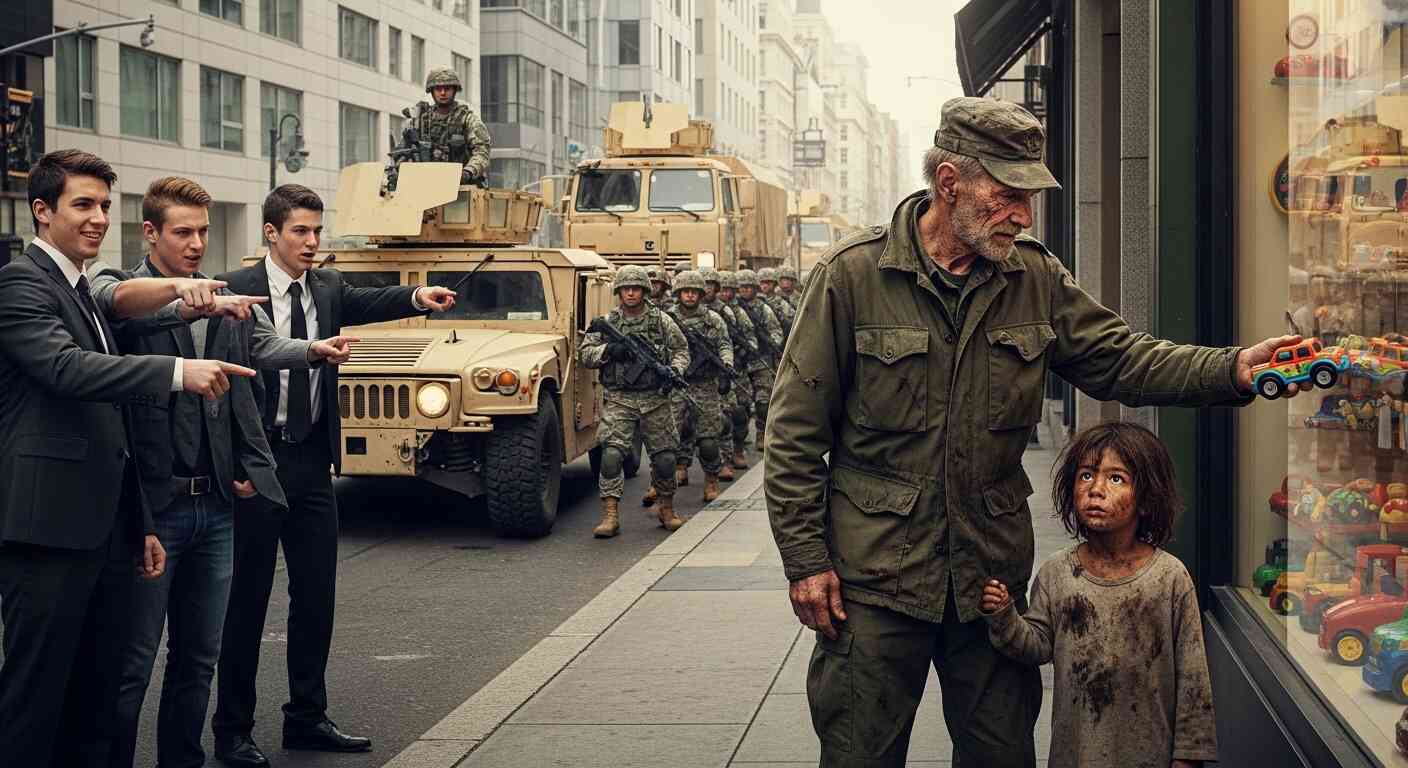
The sun was too bright for a day this dark.
I felt the fabric give way—the old, sweat-stained cotton of my 2003 deployment shirt. To Chad Harrington, it was a rag. To me, it was the only thing I had left of the men who didn’t come home.
“Look at this garbage,” Chad sneered, his fingers twisting the collar. He smelled like expensive bourbon and unearned confidence. “This is a Five-Star plaza, old man. Take your brat and your stench back to the gutter.”
I didn’t move. I couldn’t. Not because I was afraid of a bully in a Ralph Lauren shirt, but because if I moved, I might kill him. And I had promised Sarah I’d leave the war behind.
Little Leo whimpered, his small, dirty hands clutching my cargo pants. He was shaking. That was the mistake. You can touch me. You can tear my clothes. You can spit on my medals.
But you never, ever make the boy shake.
“Please,” I said, my voice sounding like gravel under a tank tread. “Just let us go.”
The crowd gathered. People I’d seen every day for months while I sat on this bench. People who thought they knew me. The “homeless vet.” The “quiet drifter.” They watched as Chad gave one final, violent tug.
Rrip.
The shirt hung in tatters. My scars—the ones from Fallujah, the ones from the mountains of Kabul—were laid bare for the whole suburban world to see.
Chad laughed. It was a high, mocking sound that cut through the afternoon air.
He didn’t notice the black SUV idling at the curb. He didn’t see the silent drones hovering above the trees. He didn’t know that the “bum” he was bullying was currently the primary advisor to the Joint Chiefs of Staff, out on a “sanity walk” that had just turned into a tactical nightmare.
“What are you gonna do, hero?” Chad mocked, stepping into my personal space. “Cry?”
I looked him dead in the eye. For the first time in years, I let the “Advisor” out. I let the “Ghost of the Pentagon” speak.
“No,” I whispered. “I’m going to watch you lose everything.”
“FULL STORY
Chapter 1: The Ripped Veil
The Oak Ridge Plaza was a monument to American excess. It was all manicured lawns, fountains that danced to synchronized jazz, and air that smelled faintly of expensive vanilla and espresso. It was the kind of place where people wore white linen without fear of stains.
And then there was Elias Thorne.
Elias sat on the edge of a concrete planter, his back straight despite the ache in his lumbar spine. He wore a faded Army fatigue shirt, the sleeves rolled up to reveal forearms mapped with silver scar tissue. Next to him, Leo, an eight-year-old with eyes far too old for his face, was meticulously trying to glue the wing back onto a plastic airplane.
“”Steady hands, Leo,”” Elias murmured. “”Precision is everything.””
“”Like in the stories, Elias?”” Leo asked, his tongue poking out in concentration.
“”Exactly like the stories.””
The peace didn’t last. It never did in Oak Ridge when Chad Harrington was around. Chad was the son of the town’s biggest real estate mogul, a man who viewed the world as a series of obstacles to be demolished. He was followed by a retinue of three other men—clones of privilege in fitted polos and boat shoes.
“”I thought I told the city council to clear the trash out of here,”” Chad said, his voice carrying across the plaza. He stopped in front of Elias, blocking the sun.
Elias didn’t look up. “”It’s a public park, Mr. Harrington. We’re just enjoying the breeze.””
“”You’re an eyesore,”” Chad snapped. He kicked Leo’s plastic airplane, sending it skittering across the pavement. The wing snapped off again.
Leo let out a small, choked gasp. He scrambled to retrieve it, but Chad stepped on the toy, crushing it under his leather loafer.
“”Oops,”” Chad grinned.
Elias stood up. He wasn’t a tall man, but when he stood, the space around him seemed to contract. There was a gravity to him that made the air feel heavy. “”Apologize to the boy.””
Chad’s grin widened. “”Or what? You’ll huff and puff? You’re a bum, Elias. You’ve been haunting this bench for six months. You probably don’t even have a discharge paper to your name. Just another fake hero looking for a handout.””
Chad reached out, his hand fast and aggressive. He grabbed the front of Elias’s shirt—the one with the faded ‘THORNE’ name tape.
“”Let go,”” Elias said. The tone wasn’t a plea. It was a final warning.
“”Make me.”” Chad yanked. He didn’t just pull; he twisted and ripped.
The sound of the fabric tearing was like a gunshot in the quiet plaza. The shirt, weakened by years of wear and the harsh sun of three different continents, gave way. It split down the center, falling away from Elias’s chest.
The crowd that had gathered went silent.
Elias wasn’t just scarred. His torso was a mosaic of survival. There were the jagged lines of shrapnel, the circular puckers of entry wounds, and most notably, a deep, blackened indentation right over his heart where a sniper’s round had nearly ended the legend of the “”Pentagon’s Ghost.””
But it wasn’t the scars that stopped the breath of the onlookers. It was the tattoo on his left shoulder—a crest so classified that most active-duty officers wouldn’t recognize it, but those who did would immediately drop to their knees.
Chad didn’t know that. He just saw a man he’d successfully humiliated.
“”Look at you,”” Chad laughed, though his voice wavered slightly at the sight of the carnage on Elias’s skin. “”A broken man in a broken shirt.””
Elias looked down at the tattered fabric. He felt the cold air on his skin, but inside, a furnace was roaring to life. He looked at Leo, who was crying silently, clutching the remains of his toy.
“”Leo,”” Elias said, his voice eerily calm. “”Cover your ears.””
Elias reached into his pocket and pulled out a small, unremarkable black device no larger than a key fob. He pressed a sequence of buttons.
“”This is Advisor One,”” Elias said into the air. “”I have a Level Alpha breach in Sector Four. The package is compromised. Initiate ‘The Welcoming Committee.'””
Chad barked a laugh. “”Who are you talking to, the mothman? You’re delusional.””
“”Thirty seconds,”” Elias said, looking at his watch. “”I’d suggest you use them to say goodbye to your reputation, Chad. It’s the only thing you actually own.””
Chapter 2: The Ghost and the Orphan
The silence that followed was heavy. The shoppers in Oak Ridge didn’t know whether to laugh or run. They stayed, frozen in that strange American voyeurism that precedes a disaster.
Elias sat back down on the planter, ignoring his exposed chest. He pulled Leo close, shielding the boy’s eyes.
“”Why do they hate us, Elias?”” Leo whispered into his side.
“”They don’t hate us, Leo,”” Elias said softly. “”They’re just afraid. People like Chad… they build walls out of money because they know that without it, they’re hollow. They see us, and they see the truth they’re trying to hide.””
Elias’s mind drifted back, as it often did when the adrenaline spiked. He wasn’t supposed to be here. He was supposed to be in a climate-controlled room in Arlington, moving the pieces of the world’s most powerful military across a digital map.
But three years ago, Leo’s mother—Captain Sarah Miller—had died in an extraction mission Elias had planned. It was a “”success”” by every military metric. The target was neutralized. The data was recovered. But Sarah was gone.
Elias had resigned the next day. He couldn’t sit in the ivory tower anymore. He had tracked down Sarah’s only living relative—a sister who had no interest in a traumatized orphan—and eventually found Leo in a state-run facility.
He had taken the boy and disappeared. He wanted Leo to grow up seeing the world, not the inside of a government agency. He chose Oak Ridge because it was “”safe.”” He chose to live simply, staying in a small apartment, spending his days in the park, trying to teach Leo how to be a man in a world that often forgot how to be human.
He had kept his identity a secret, even from the local police. To them, he was just “”the veteran on the bench.”” A man who received a modest pension and never caused trouble.
But the world has a way of finding you.
“”Ten seconds,”” Elias said.
Chad stepped back, looking around nervously. “”You’re crazy. You’re literally a crazy person.””
Then, the sound started.
It wasn’t a siren. It was a thrumming—a deep, rhythmic vibration that shook the windows of the nearby Tiffany’s and Starbucks. It was the sound of synchronized machinery.
From the north end of the plaza, a fleet of black Suburbans screeched to a halt, blocking the exits. From the south, two massive transport trucks roared over the sidewalk, their tires crushing the decorative hedges.
And from above, the sky went dark. Two MH-60M Black Hawk helicopters descended, their rotors kicking up a hurricane of dust and discarded shopping bags.
The people of Oak Ridge screamed, scattering like leaves. Chad’s friends turned to run, but they found their paths blocked by men in charcoal-grey tactical gear, appearing from the shadows of the alleyways like ghosts.
These weren’t police. They didn’t have “”POLICE”” written on their backs. They had no insignias at all, save for a small, silver pin on their collars—a raven clutching a sword.
“”Secure the perimeter!”” a voice boomed over a megaphone.
Five hundred soldiers, moving with a lethal, terrifying grace, flooded the plaza. They didn’t point their weapons at the civilians. They pointed them at a single point in the center of the square.
They pointed them at Chad Harrington.
Chapter 3: The Weight of the Crown
Chad was on the ground before he realized he’d fallen. He was surrounded by a wall of Kevlar and steel. The bayonets on the ends of the soldiers’ rifles were fixed, glinting under the midday sun.
A tall man with a chest full of medals and a face carved from granite stepped out of the lead Suburban. This was General Marcus Vance, a man who answered only to the President and the man currently sitting shirtless on a concrete planter.
Vance marched through the line of soldiers. He didn’t look at Chad. He didn’t look at the screaming civilians. He walked straight to Elias.
The General stopped three paces away. He snapped to the crispest salute the town of Oak Ridge had ever seen.
“”Advisor Thorne,”” Vance said, his voice like iron. “”We received your signal. We were beginning to think you’d forgotten our number.””
Elias stood up slowly. He looked at the General, then at the 500 soldiers standing in perfect formation. He felt the old weight returning—the burden of command, the cold logic of war.
“”I didn’t forget, Marcus,”” Elias said. “”I just hoped I wouldn’t need you.””
He gestured to the tattered shirt on the ground. “”He ripped the uniform, Marcus. He humiliated a child of the Regiment.””
General Vance turned his gaze toward Chad. It was the look a predator gives a particularly annoying insect.
“”Is that right?”” Vance asked.
Chad was hyperventilating. “”I… I didn’t know! He looked like a nobody! He’s just a guy on a bench! I’m Chad Harrington! My father owns half this town!””
Vance stepped closer to Chad, his shadow swallowing the younger man. “”Your father owns dirt and debt, son. This man? This man owns the strategies that keep the sky from falling on your entitled head. He is the principal architect of the Global Defense Initiative. He has more security clearances than the Cabinet.””
Vance leaned in, his voice dropping to a terrifying whisper. “”And you tore his shirt.””
A female officer stepped forward, carrying a briefcase. She opened it to reveal a crisp, new dress uniform—the four stars on the shoulders gleaming.
“”Sir,”” she said, her eyes fixed forward. “”Your presence is required at the Pentagon. The situation in the South China Sea has escalated. We need the Ghost.””
Elias looked at Leo. The boy was no longer crying. He was looking at Elias with a mixture of awe and confusion.
“”I can’t leave him,”” Elias said.
“”The boy comes with us,”” Vance said. “”He’ll be a ward of the State, under your direct supervision. He’ll have the best education, the best security. He’ll be what his mother wanted him to be.””
Elias nodded. He took the uniform.
Chapter 4: The Moral Choice
As Elias began to dress in the middle of the plaza, a local police officer, Miller, pushed through the crowd. He was a good man, one of the few who had ever bought Elias a coffee during those long months on the bench.
“”Elias?”” Miller asked, his eyes wide. “”What… what is this?””
“”This is the world as it really is, Miller,”” Elias said, buttoning the stiff, blue jacket. “”I tried to live in yours. I really did.””
“”What about Chad?”” Miller asked, looking at the terrified man being zip-tied by the tactical team. “”He’s a jerk, but… five hundred soldiers?””
Elias paused, his hand on the final button of his uniform. This was the moment. He could have Chad erased. He could have him sent to a black site for “”interrogation”” regarding the assault on a high-level official. He could ruin the Harrington family with a single phone call to the IRS and the SEC.
The “”Old Elias””—the one who had spent twenty years in the dark corners of the world—wanted to crush them.
But then he felt Leo’s hand slip into his.
“”Elias,”” Leo whispered. “”Don’t be like him.””
The words hit harder than any bullet. Elias looked at Chad. The man was weeping now, begging for his father. He looked pathetic. He looked small.
Elias turned to General Vance. “”General, Mr. Harrington has committed an assault on a federal officer and the destruction of government property. Turn him over to Officer Miller here. Ensure the local DA handles it with… extreme transparency. I want every business deal the Harringtons have ever made audited. If they’re as clean as they claim, they have nothing to fear.””
Elias knew they weren’t clean. No one like Chad was.
“”And the plaza?”” Vance asked.
“”Buy it,”” Elias said. “”Turn the Harrington Real Estate office into a community center for displaced veterans. Name it after Captain Sarah Miller.””
Elias looked at Officer Miller. “”Thank you for the coffee, Officer. Watch over this town. It needs more people who see the man, not the shirt.””
Chapter 5: The Climax of Truth
The roar of the Black Hawks intensified. The soldiers began to move back toward their transports in a synchronized dance of power.
But Chad wasn’t done. In a final, desperate burst of ego, he screamed out, “”You think you’re better than us? You’re just a killer in a fancy suit! You left that boy’s mother to die! I know who she was! I looked it up when you first showed up! You’re a failure!””
The soldiers froze. General Vance’s hand went to his sidearm.
Elias stopped at the door of the Suburban. He turned around slowly. The air in the plaza seemed to drop twenty degrees.
He walked back to Chad. The soldiers parted for him like the Red Sea.
Elias stood over Chad. He didn’t yell. He didn’t strike him. He simply reached into his pocket and pulled out a small, jagged piece of metal—a fragment of the shrapnel that had been pulled from his own chest.
“”You’re right, Chad,”” Elias said, his voice vibrating with a terrifying sincerity. “”I am a killer. I have spent my life making choices that haunt my dreams. I have lost the people I love because I was busy saving people like you.””
Elias dropped the shrapnel into Chad’s hand. It was still sharp.
“”That came out of my lungs,”” Elias said. “”I earned the right to sit on that bench. I earned the right to wear that torn shirt. You? You haven’t earned the air you’re breathing right now. You’re not a villain, Chad. You’re just a footnote.””
Elias leaned in closer, his eyes boring into Chad’s soul. “”When they take you to jail tonight, remember this: the only reason you’re alive to go there is because the man you mocked decided you weren’t worth the paperwork.””
Elias turned his back. He didn’t look back again.