Chapter 1
The mud was cold, but the laughter was colder.
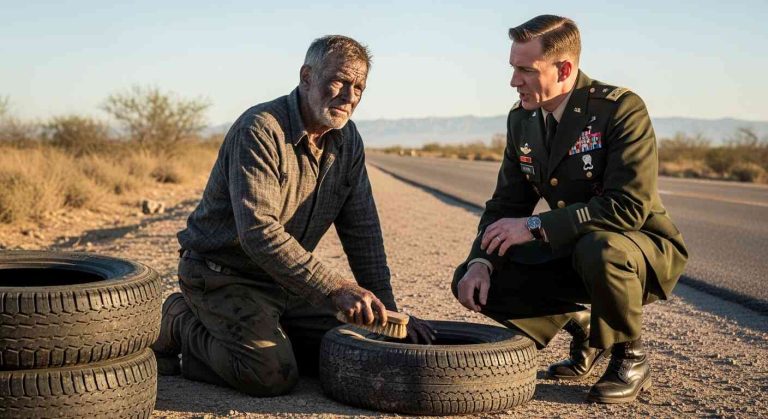
Arthur Vance felt the slick, grey grit of the Ohio street seep through his threadbare trousers. At seventy-five, the ground felt a lot further away than it used to. His hip screamed in protest, a sharp, white-hot reminder of a piece of shrapnel he’d picked up in a valley near the 38th parallel—a lifetime ago.
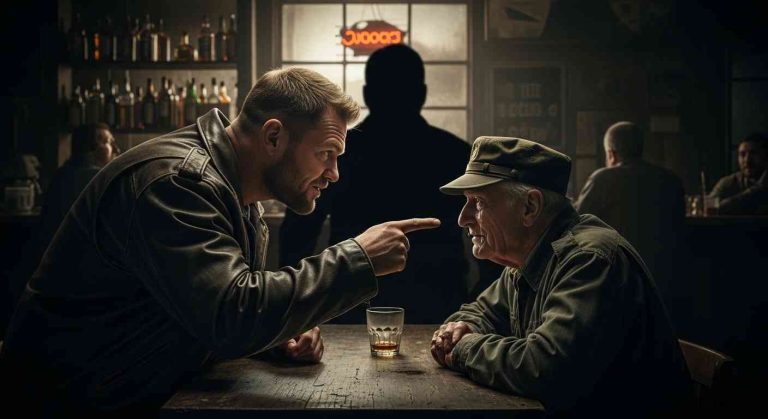
“Look at him,” a voice sneered from above. “He’s ruining the aesthetic of the whole block. Hey, Grandpa! The soup kitchen is three miles that way. Try not to track your filth onto the sidewalk on your way out.”
Arthur looked up. The man speaking couldn’t have been older than twenty-five. He wore a tuxedo that cost more than Arthur’s first house, and he held a glass of champagne like it was a scepter. Beside him, two other young men—clones of the first, with perfectly styled hair and expensive watches—grinned like hyenas.
This was Oak Ridge, one of the wealthiest suburbs in America. A place of manicured lawns and silent secrets. Arthur had lived here for forty years, tucked away in a small, weathered cottage that the new money developers had been trying to buy and bulldoze for a decade.
“I was just walking to the pharmacy, son,” Arthur said, his voice raspy but steady. He tried to push himself up, but his hand slipped in the grime.
“Don’t call me ‘son,'” the young man, Bryce Sterling, snapped. He was the son of the town’s biggest real estate mogul, a boy who had never known a day of hunger or a moment of true fear. He stepped forward, his polished Italian leather shoe landing inches from Arthur’s face. “You’re an eyesore. You’re a reminder of a world we’ve outgrown. People pay millions to live here so they don’t have to look at… this.”
Bryce flicked the rest of his champagne onto Arthur’s shoulder. The crowd of gala-goers, gathered for the “Heritage Foundation Ball,” didn’t intervene. They watched with a detached curiosity, as if witnessing a minor car wreck. Some whispered behind manicured hands. Others checked their watches.
Among them was Sarah Miller, a local waitress who had just finished her shift. She felt a knot of pure ice form in her stomach. She knew Arthur. He came into the diner every Tuesday, ordered black coffee, and tipped two dollars on a four-dollar tab, always asking about her daughter’s grades.
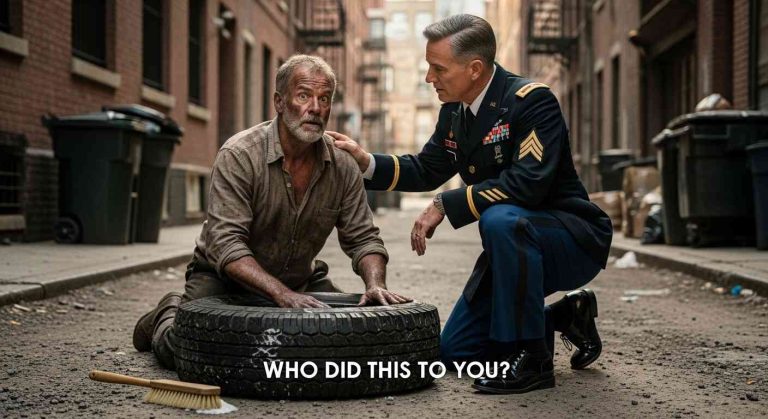
“Stop it!” Sarah cried out, pushing through the crowd of silk and sequins. She knelt in the mud beside Arthur, her uniform staining instantly. “He’s a human being, Bryce! Have you lost your mind?”
Bryce rolled his eyes. “He’s a vagrant, Sarah. And you’re late for your shift at the dive bar. Why don’t you both crawl back to the gutter together?”
Arthur caught Sarah’s eye. He gave a tiny, almost imperceptible shake of his head. He didn’t want her to get in trouble. He knew how this world worked now. In Oak Ridge, the thickness of your wallet determined the weight of your soul.
But Bryce wasn’t finished. He wanted a show. He reached down, grabbing the collar of Arthur’s old, faded olive-drab field jacket—the one with the missing patches and the frayed cuffs.
“This rag stinks,” Bryce hissed. He jerked Arthur upward, then shoved him back down. This time, Arthur’s head clipped the curb.
A collective gasp went up from the crowd, but no one moved.
Arthur lay there, the world spinning. He tasted copper in his mouth. He looked at the stars beginning to peek through the suburban smog and thought of a ridge in Korea. He thought of a jungle in Vietnam. He thought of the war rooms in the Pentagon where he had sat in the dark, moving pieces on a map that sent thousands of men to their deaths so that boys like Bryce could drink champagne in the sun.
He had spent fifty years being the “Architect.” The man who designed the strategies that won the wars the history books forgot. He had chosen anonymity. He had chosen peace.
But as Bryce Sterling raised a foot to “nudge” the old man out of the way of his car, a low, rhythmic thrumming began to vibrate the very ground they stood on. It wasn’t thunder. It was the sound of heavy engines—dozens of them.
And from the end of the block, a line of headlights appeared, cutting through the twilight like the eyes of a vengeful god.
“Chapter 2: The Weight of Silence
The vibrations grew until the champagne in Bryce’s glass began to ripple. He lowered his foot, frowning as he looked toward the entrance of the cul-de-sac. The gala-goers turned their heads, their annoyed murmurs silenced by the sheer mechanical roar approaching them.
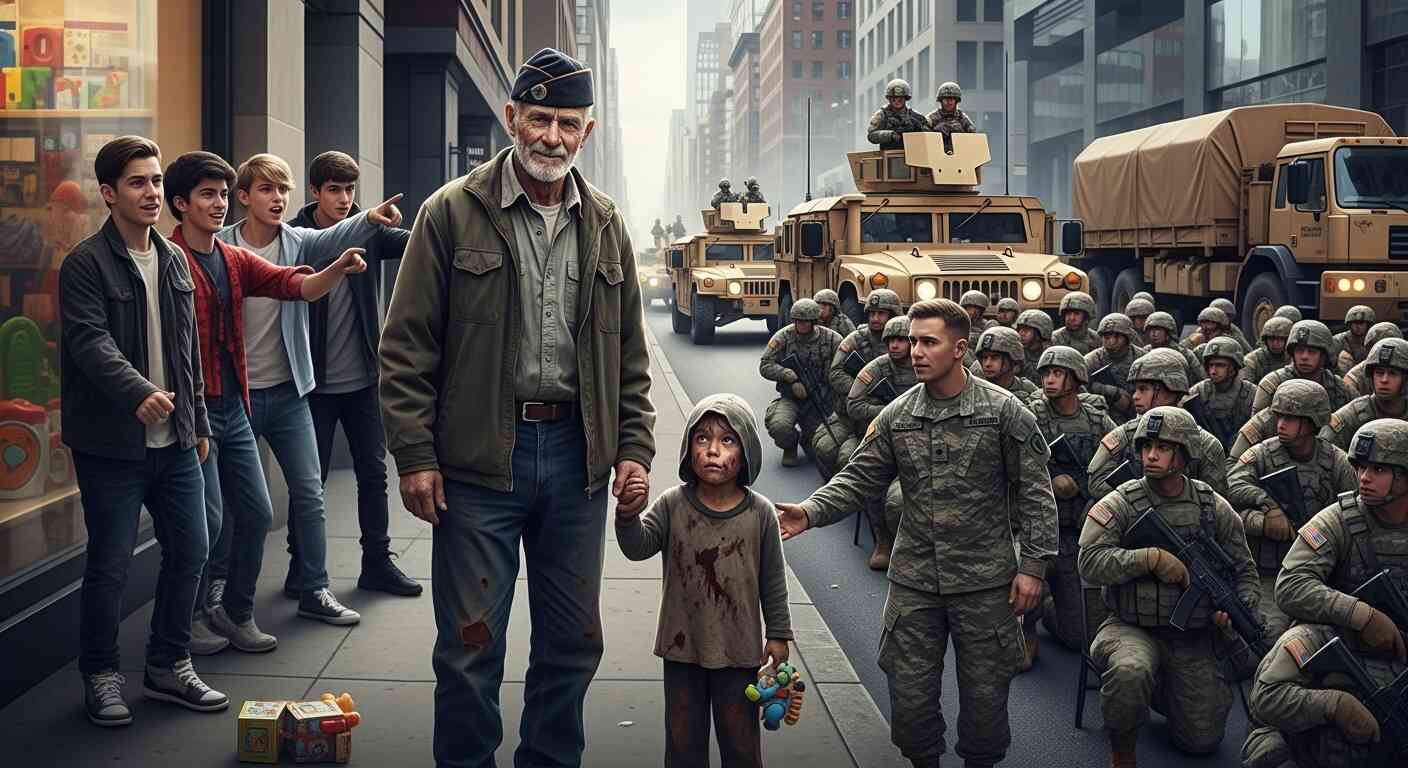
Six black Chevy Suburbans, armored and ominous, screeched around the corner in a perfect V-formation. They didn’t slow down for the velvet ropes or the “”Private Event”” signs. They flattened them. Behind them came two massive LMTV trucks, their olive-drab paint a stark, violent contrast to the pastel-colored mansions of Oak Ridge.
“”What the hell is this?”” Bryce shouted, his voice cracking. “”This is private property! Someone call the police!””
Officer Danny O’Malley, the local cop who had been standing by to ensure the gala wasn’t disturbed by “”riff-raff,”” stepped forward, his hand on his holster. He was a good man, but he was intimidated by the Sterling family’s influence. He started to wave his arms at the lead SUV.
The lead vehicle didn’t stop. It braked centimeters from O’Malley’s knees, the tires smoking. Before the officer could utter a word, the doors of all six SUVs flew open.
Men in tactical gear, carrying suppressed rifles and wearing headsets, blurred into the street. They didn’t look like mall security. They moved with the terrifying, synchronized precision of Tier One operators.
“”Secure the perimeter!”” a voice barked.
Within seconds, every exit to the square was blocked. The soldiers formed a tight circle around the mud puddle where Arthur still lay, and where Bryce stood frozen, his face drained of color.
Sarah Miller stayed on her knees, her arms wrapped protectively around Arthur. She looked up at the soldiers, her heart hammering against her ribs. “”Please,”” she whispered. “”He’s hurt. He needs a doctor.””
One of the soldiers, a man whose face looked like it was carved from granite, looked down at her. His eyes softened for a fraction of a second, then went back to the crowd. “”Stand fast, ma’am. Help is here.””
From the second LMTV, the back flap was thrown open. A dozen soldiers in full Dress Blues jumped out, their medals clinking in the sudden, eerie silence of the suburb. They didn’t look at the mansions. They didn’t look at the terrified socialites. They looked only at the man in the mud.
A tall, broad-shouldered man stepped out of the lead SUV. He wasn’t in tactical gear. He was wearing the Army Service Uniform, his chest a literal wall of multicolored ribbons. On his shoulders sat four silver stars.
General Marcus Reed, the current Chief of Staff of the Army, walked toward the center of the square. Every soldier he passed snapped to a crisp, rigid salute.
Bryce Sterling, regaining some of his misplaced bravado, stepped forward. “”General! Thank God. I don’t know what kind of drill this is, but this vagrant was harassing our guests. I was just trying to move him—””
General Reed didn’t even look at him. He didn’t even acknowledge Bryce existed.
Reed reached the edge of the puddle. He didn’t hesitate. He stepped into the mud, the muck ruining his spit-shined low-quarters and staining the hem of his trousers. He sank to his knees in front of Arthur Vance.
The silence that followed was so heavy it felt like it might crush the houses surrounding them.
“”Sir,”” Reed said, his voice thick with an emotion that shocked everyone who heard it. “”We’ve been looking for you for three days. Why didn’t you answer the secure line?””
Arthur wiped a smear of blood from his lip and smiled weakly. “”The battery died, Marcus. And I… I just wanted to go for a walk. I wanted to see if the world I built was still worth living in.””
Reed’s jaw tightened. He reached out, his hands trembling slightly, and grasped Arthur’s forearms. “”It’s not, sir. Not if this is how it treats you.””
Reed looked up at the soldiers. “”Corpsman! Front and center!””
A combat medic rushed forward, but before he could reach them, Reed turned his head toward Bryce Sterling. The look in the General’s eyes was enough to make the younger man stumble back and fall over his own feet.
“”You,”” Reed whispered. The word carried the weight of a death sentence. “”Do you have any idea whose blood you just drew?””
Chapter 3: The Architect’s Shadow
The crowd was now a sea of pale faces. The “”Heritage Foundation Ball”” had become a crime scene, though the crime wasn’t what anyone expected.
Bryce’s father, Richard Sterling, pushed his way to the front, his face a mask of practiced corporate concern. “”General, I’m Richard Sterling. I’m sure there’s been a misunderstanding. My son is a bit high-spirited, but we are the primary donors to—””
“”I don’t care if you’re the President of the United States,”” Reed snapped, standing up but keeping a hand on Arthur’s shoulder. “”Your son just assaulted a recipient of the Congressional Medal of Honor. He just laid hands on the man who authored the ‘Vance Doctrine.’ Every tactical success this country has had in the last forty years started in the mind of this man.””
A murmur of disbelief rippled through the onlookers. Arthur Vance? The “”Crazy Artie”” who lived in the shack on the hill?
Arthur sighed, leaning on the medic as he was helped to a sitting position on a folding chair brought from an SUV. “”Marcus, don’t make a scene. It’s a quiet town. I liked it that way.””
“”It’s not a quiet town, sir,”” Reed said, his voice rising so everyone could hear. “”It’s a blind one. They saw a man in an old jacket and decided he had no value. They saw a veteran who gave his youth and his mind to their safety, and they treated him like trash.””
Reed turned to Bryce, who was trembling so hard his champagne glass finally shattered on the pavement. “”You called him an eyesore. You said he was a reminder of a world you outgrown.””
Reed stepped closer, his four stars gleaming under the streetlights. “”This man was the youngest General in the history of the Republic. He spent twenty years in a windowless room in the basement of the Pentagon, sacrificing his family, his health, and his sanity to make sure you could grow up in a world where your biggest problem is the ‘aesthetic’ of your street.””
Sarah Miller, still standing nearby, felt tears prick her eyes. She looked at Arthur—the man she’d seen as just a lonely, kind old soul. She saw the way the soldiers looked at him. It wasn’t just respect. It was awe. It was the way a monk looks at a saint.
“”Officer O’Malley,”” Reed barked.
The local cop snapped to attention. “”Yes, sir?””
“”Arrest that man,”” Reed pointed at Bryce. “”Assault, battery, and whatever federal charges I can dream up for interfering with a high-priority military asset. If you don’t cuff him in the next five seconds, I’ll have my MPs do it, and they won’t be as gentle.””
O’Malley didn’t hesitate. He knew the wind had shifted. He grabbed Bryce’s arm and spun him around, the zip of the handcuffs echoing in the silence.
“”Dad! Do something!”” Bryce wailed.
Richard Sterling started to speak, but a captain in tactical gear stepped into his path, his hand resting on the grip of his sidearm. “”Stay back, sir.””
Arthur watched it all with a profound sadness. He looked at the mansions, the expensive cars, and the people who were now terrified not of him, but of the power he represented.
“”Marcus,”” Arthur said softly. “”Enough. Help me up.””
Reed immediately moved to his side. “”Sir, you need a hospital. That hit to the head—””
“”I’ve had worse from people who actually knew how to fight,”” Arthur joked, though his voice was thin. He stood, his legs shaky. He looked at Sarah. “”Thank you, Sarah. You were the only one who saw a man instead of a ghost.””
He reached into the pocket of his tattered jacket and pulled out a small, heavy object wrapped in a silk handkerchief. He handed it to her.
“”What is this?”” she asked, her voice trembling.
“”A reminder,”” Arthur said. “”That kindness is the only thing that doesn’t age.””
As Sarah unwrapped the silk, the crowd gasped. Inside was a heavy gold coin—a “”Challenge Coin”” with the seal of the Joint Chiefs of Staff, encrusted with small, brilliant diamonds. On the back, it was engraved: To the Architect. For the victories we can never tell.
Chapter 4: The Fortress Walls
The “”Heritage Ball”” was effectively over. The guests were being herded back into the hotel, not for the party, but for questioning. The military had declared the three-block radius a “”Sensitive Site.””
In the back of a luxury ambulance—part of the General’s convoy—Arthur sat as the medic cleaned the cut on his temple. General Reed sat across from him, his cap on his knee.
“”Why, sir?”” Reed asked. “”You could have lived in the Distinguished Quarters at West Point. You could have had a mansion in D.C. with a full security detail. Why this? Why Oak Ridge?””
Arthur looked out the window at his little cottage on the hill, now surrounded by Humvees. “”Because I wanted to see what I was protecting, Marcus. When you spend your life looking at maps and casualty projections, you lose the sense of the individual. I wanted to live among the people. I wanted to be a neighbor.””
He laughed, a dry, hacking sound. “”I suppose I found out that when you become a neighbor, people eventually start looking for reasons to hate you. If you aren’t rising, you’re sinking in their eyes.””
A knock came on the ambulance door. It was the Captain from earlier. “”General, we’ve finished the preliminary background checks on the civilians involved. The Sterling family has a history of… let’s call it ‘aggressive’ land acquisition. They’ve been trying to force Mr. Vance out of his home for years through local ordinance harassment.””
Reed’s eyes turned to ice. “”They were trying to take his home?””
“”Apparently, they wanted to build a clubhouse for the Heritage Foundation on that specific ridge,”” the Captain reported.
Arthur shook his head. “”It’s the highest point in the county. Good lines of sight. I chose it for the tactical advantage, forty years ago. They just liked the view.””
Reed stood up, his height filling the ambulance. “”Sir, I’m taking you back to D.C. Your ‘retirement’ in the field is over. The President wants a briefing on the Pacific theater anyway, and I’m not leaving you here to be bullied by real estate developers.””
“”I’m not leaving, Marcus,”” Arthur said firmly.
Reed blinked. “”Sir?””
“”If I leave now, they win. Bryce Sterling goes to jail for a few months, his father pays a fine, and they wait until I’m dead to pave over my garden. No. I’m staying. But I think it’s time I stopped being a ghost.””
Arthur looked at the General. “”Do you still have that uniform we prepared for the 50th-anniversary gala? The one I refused to wear?””
Reed’s face broke into a slow, predatory grin. “”It’s in the trunk of my car, sir. I never go anywhere without it, just in case I could convince you.””
“”Get it,”” Arthur said, his eyes sharpening. The “”Architect”” was back. “”And Marcus? Tell the local news. Tell the national news. I think Oak Ridge needs a lesson in history.””
Chapter 5: The Uniform
An hour later, the square was flooded with light—not from the streetlamps, but from the high-intensity floodlights of the military vehicles and the flashing strobes of news vans that had bypassed the police cordons.
The wealthy residents of Oak Ridge stood behind the yellow tape, huddled in their furs and tuxedos, watching as the LMTV trucks formed a corridor leading from the ambulance to the front steps of the Oak Ridge Town Hall.
A hush fell over the crowd as the back of the ambulance opened.
First, General Reed stepped out, standing at the base of the ramp. Then, two Colonels. Then, four Sergeants Major, their faces masks of pure discipline.
Then came Arthur.
The “”tramp”” was gone. In his place stood a man who looked like he had stepped off a monument. He wore the Army Service Uniform, the dark blue wool pressed to a razor edge. The gold braids on his sleeves shimmered. But it was his chest that stopped everyone’s breath.
Rows upon rows of ribbons—the Silver Star with three oak leaf clusters, the Distinguished Service Cross, the Purple Heart with multiple stars. And hanging from his neck, on a simple blue ribbon, was the Medal of Honor.
He walked with a cane, but his back was straight. The limp that had looked like a “”drunkard’s stumble”” an hour ago now looked like the gait of a wounded lion.
As he reached the bottom of the ramp, General Reed barked a command: “”Present… ARMS!””
Five hundred soldiers, lining the streets and the rooftops, snapped their hands to their brows in a single, thunderous motion. The sound echoed off the million-dollar mansions like a physical blow.
Arthur Vance walked past the crowd. He stopped in front of Richard Sterling, who was being detained by two MPs.
The older Sterling looked at Arthur, his mouth working but no sound coming out. He looked at the medals. He looked at the man he had called a “”nuisance”” in a dozen legal filings.
Arthur leaned in close. He didn’t yell. He didn’t have to.
“”You wanted my land because of the view, Richard,”” Arthur said softly. “”But you never learned how to look at what was right in front of you. You taught your son that power is something you buy. I spent my life learning that power is something you earn through sacrifice.””
Arthur looked at the crowd, his voice carrying through the microphones of the gathered press.
“”I came here to be a citizen. I came here to find the peace I spent fifty years securing for you. But I see now that peace has made you soft. It has made you cruel. You look at a man in a dirty jacket and you see a shadow. You forget that the only reason you are allowed to stand in the light is because men like me were willing to live in the dark.””
He turned to Officer O’Malley. “”Officer, I won’t be pressing charges against the boy.””
The crowd gasped. Bryce, sitting in the back of the squad car, looked up with a glimmer of hope.
“”However,”” Arthur continued, “”I have just signed a deed of gift. My property—the ridge overlooking this town—is now federal land. It will be the site of a new National Cemetery and a Veteran’s Outreach Center. Construction begins tomorrow at 0600. The heavy machinery will be coming through this street. Daily.””
Richard Sterling turned grey. The property values of his “”exclusive”” neighborhood would plummet. The “”aesthetic”” he prized so much was about to be replaced by the one thing he feared most: reality.