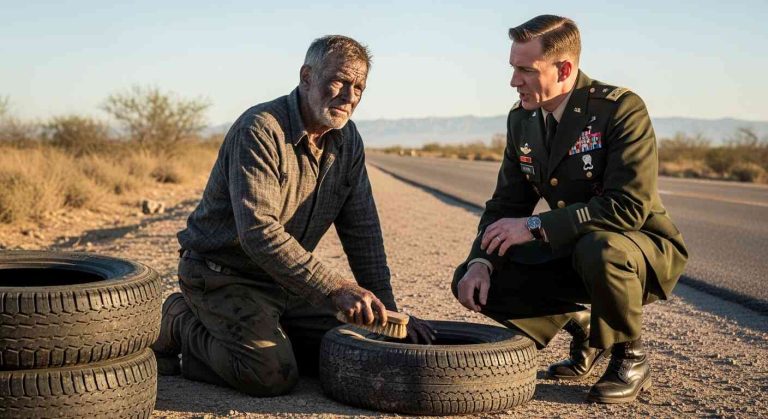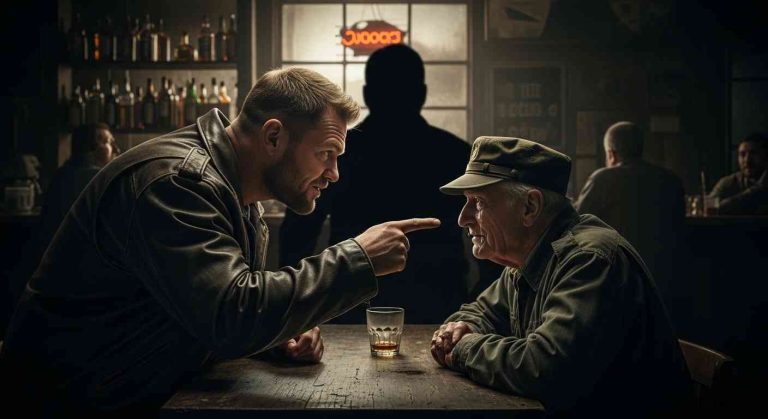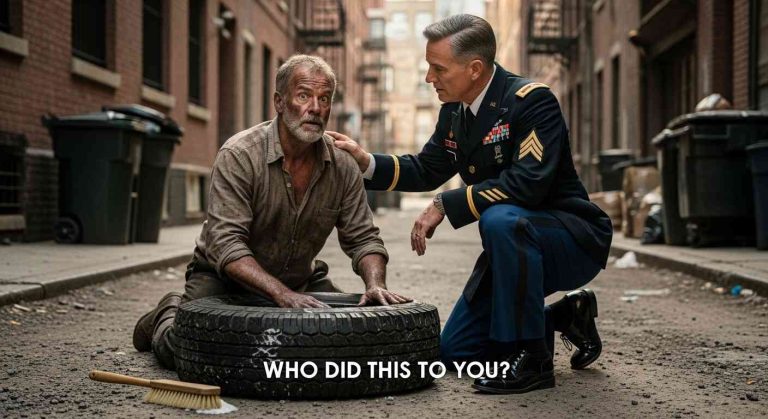
The gravel dug into my palms, sharp and unforgiving, as I hit the ground. I could taste the copper of blood in my mouth and the grit of Pennsylvania coal dust. Above me, Miller was laughing—a wet, arrogant sound that echoed off the half-finished skeletons of the luxury condos we were building.
“Look at you, Elias,” Miller spat, his boot hovering inches from my face. He had just ripped my safety vest down the middle, the neon fabric fluttering in the wind like a white flag. “You’re sixty years of dead weight. A liability. This is a man’s job, not a retirement home for washed-up losers who can’t keep a pace.”
I didn’t answer. I couldn’t. Not because I was hurt—though my ribs burned—but because I was calculating. It was an old habit, a ghost of a life I’d spent twenty years trying to bury. I was calculating the wind speed, the distance to the nearest exit, and the three different ways I could have snapped Miller’s femur before his foot even touched the ground.
But I stayed down. I had promised Sarah I would be a “normal” man. No more shadows. No more “tactical solutions.” Just a father. A grandfather. A guy who worked for an hourly wage and came home with sore muscles.
“Get your gear and get out,” Miller sneered, tossing the shredded vest onto my head. “Don’t bother coming for your final check. Consider it a fine for wasting my time.”
The other guys on the crew, men I’d shared coffee with for three years, looked away. Some looked sorry, but most just looked relieved it wasn’t them. That’s the thing about a pack; once the alpha marks a target, the rest fall in line.
I stood up slowly, my joints popping. I didn’t look at Miller. I looked at the horizon. I felt a strange vibration in the soles of my boots—a rhythmic thrumming that didn’t belong to the heavy machinery on site. It was deeper. More surgical.
“Did you hear me, old man?” Miller stepped closer, his chest puffed out.
“I heard you, Miller,” I said, my voice sounding like dry leaves on pavement. “But I think you should look up.”
The sky didn’t just turn dark; it turned metal. Within seconds, the screaming whine of Black Hawks drowned out Miller’s insults. Dust kicked up into a blinding cyclon, and before the foreman could even scream, the perimeter was breached by black SUVs moving in a flawless diamond formation.
Miller stumbled back, tripping over a pile of rebar. He watched, trembling, as five hundred elite operators—the kind of men who don’t exist on paper—poured out of the vehicles and the hovering birds. They didn’t look at the site. They didn’t look at the foreman.
They looked at me.
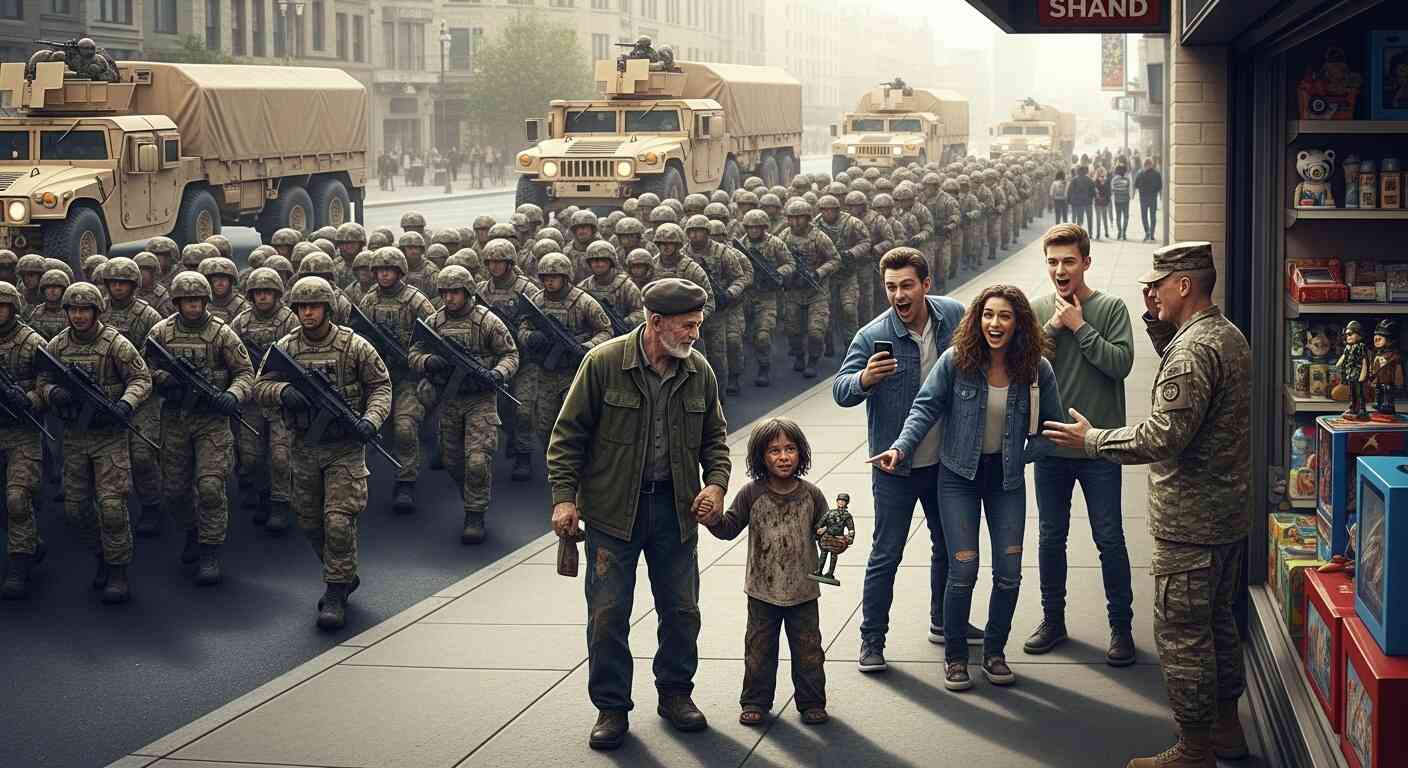
And then, the sound of five hundred boots clicking together in a simultaneous salute shattered the silence of the suburb.
“FULL STORY
Chapter 1: The Weight of the Dust
The humidity in Scranton was a physical weight, the kind that settled into your marrow and reminded you of every injury you’d ever sustained. For Elias Thorne, that was a lot of reminders. He worked the rebar at the “”Hilltop Vista”” project, a job that required the kind of mindless, repetitive labor that kept the voices of the past at bay.
He was known as ‘Old Eli’ to the crew. He was the guy who never complained, never shared a beer after the shift, and never missed a day. He was invisible, and that was exactly how he wanted it.
Miller, the site foreman, was twenty years younger and fifty pounds heavier, most of it in a beer belly that strained against his designer work shirts. Miller hated Elias because Elias was everything Miller wasn’t: disciplined, quiet, and possessed of a strange, unsettling stillness that Miller mistook for weakness.
“”Thorne! Move that pallet!”” Miller shouted, his face flushed red.
Elias hoisted the wood, his muscles screaming. He was fifty-eight, but his body was a map of scar tissue—shrapnel from Kabul, a knife wound from a dark alley in Prague, a bullet graze from a mission that officially never happened.
“”I said move it, not massage it!”” Miller stepped into Elias’s personal space.
Elias stopped. He looked at Miller. It was a look that had made warlords hesitate, a cold, predatory focus. But then Elias remembered Sarah’s face. He remembered the promise. “Just be a dad, Dad. No more monsters.”
He lowered his gaze. “”Moving it now, sir.””
Miller’s ego, fed by the silence, grew. He reached out and grabbed the front of Elias’s safety vest. “”You know what I think? I think you’re a mole. A spy for the insurance companies. Or maybe just a pathetic old man who can’t cut it.””
With a violent jerk, Miller ripped the vest. The cheap plastic snaps gave way, and the fabric tore. He shoved Elias backward. Elias, caught off balance by the weight of the pallet, hit the dirt hard.
The site went silent. The hum of the generators seemed to fade as the crew watched the humiliation. Miller stood over him, spitting on the ground near Elias’s hand.
“”You’re done. Get your pathetic life out of my sight before I have the boys throw you into the foundation.””
Elias sat in the dust. He felt the familiar surge of adrenaline—the “”cold fire.”” It told him to sweep Miller’s leg, drive a thumb into his carotid, and end the threat. His hand flicked toward a discarded piece of jagged rebar.
Then, the air changed.
It started as a low-frequency hum, the kind you feel in your teeth. Then came the birds. Three MH-60M Black Hawks, flying low and fast, crested the nearby ridge. They weren’t Coast Guard. They weren’t National Guard. They were Ghost-grey, unmarked, and bristling with sensors.
“”What the hell is that?”” Miller gasped, shielding his eyes from the sudden gale of the rotor wash.
The construction site became a tactical LZ in forty-five seconds. Black SUVs tore through the chain-link fence as if it were tissue paper. Men in Tier-1 gear—multicam black, suppressed rifles, facial shrouds—deployed in a perfect perimeter.
A tall man in a crisp Army dress uniform stepped out of the lead vehicle. General Marcus Vance. The man Elias had once saved from a burning embassy in Benghazi.
Vance walked through the dust, his eyes locked on the man sitting in the dirt. He ignored Miller, who was now trembling so hard his hardhat fell off.
The General stopped three feet from Elias. He didn’t offer a hand to help him up; he knew Elias wouldn’t want it. Instead, he snapped a salute so sharp it could have cut glass. Behind him, five hundred of the country’s finest soldiers followed suit.
“”Architect,”” Vance’s voice boomed over the fading roar of the helicopters. “”The failsafe has been triggered. The Kremlin is dark, and the silos in the Midwest are showing a heartbeat. You’re the only one who knows the back door.””
Elias stood up. He didn’t look like a construction worker anymore. He looked like a wolf who had been wearing a sheep’s skin for too long. He looked at the shredded vest on the ground, then at Miller.
“”I’m retired, Marcus,”” Elias said.
“”The world isn’t,”” Vance replied. “”Please. For the girls.””
Elias sighed, a sound of profound weariness. He looked at Miller, who looked like he was about to faint.
“”Miller,”” Elias said quietly.
“”Y-yes, sir?”” Miller stammered.
“”You’re right about one thing. This isn’t a job for an old man.”” Elias turned toward the Black Hawk. “”It’s a job for a ghost.””
Chapter 2: The Ghosts of the Architect
The interior of the Black Hawk was a sharp contrast to the grit of the construction site. It smelled of hydraulic fluid, ozone, and filtered air. As the helicopter banked sharply over the Pennsylvania forests, General Vance handed Elias a ruggedized tablet.
“”We don’t have time for the ‘I told you so’ speech, Elias,”” Vance said, his face etched with lines of exhaustion.
Elias ignored the tablet for a moment, staring at his hands. His fingernails were still stained with the grease of the job site. He felt a sudden, sharp pang of guilt. “”I have a dinner date with my granddaughter at six. She’s turning five.””
“”The world might not make it to six o’clock, Thorne,”” Vance snapped. “”Four hours ago, a ‘logic bomb’ was detected in the CORE system. It’s a dormant code, something buried in the foundation of the national defense grid twenty-five years ago. It’s waking up, and it’s eating every firewall we have.””
Elias finally looked at the tablet. His eyes scanned the cascading lines of red code. A cold chill that had nothing to do with the cabin’s AC ran down his spine. “”This isn’t just a bomb. This is my handwriting.””
“”Precisely,”” Vance said. “”You designed the ‘Black Cell’ protocols back in ’99. You said they were unbreakable. You were wrong. Someone is breaking them from the inside.””
The “”Architect”” wasn’t just a call sign. Elias had been the primary designer of the digital and physical architecture of the United States’ most clandestine assets. When he left the service, he’d tried to delete himself. He’d moved six times, changed his name twice, and eventually settled into the life of a laborer, hoping the world would forget him.
But men like Elias Thorne are never forgotten; they are merely stored until the crisis matches their specific brand of genius.
“”Who’s the team?”” Elias asked, his voice shifting into a clipped, professional tone.
“”Kade is leading the ground support. You remember her?””
Elias nodded. Sergeant Major Kade was a woman who could dismantle a bomb or a man with equal efficiency. She was standing in the back of the hold, her eyes fixed on Elias with a mixture of awe and resentment. To her, he was a legend who had abandoned his post.
“”Where are we going?””
“”The Hive,”” Vance replied. “”The deep-site facility in the Blue Ridge Mountains. That’s where the primary server is located. The code is radiating from there.””
Elias leaned back, closing his eyes. He thought of Sarah. He’d spent the last three years trying to convince her he was just a normal guy. He’d helped her move into her new apartment, he’d fixed her leaky faucet, he’d played tea party with little Maya.
Now, he was heading back into the dark.
“”I need a suit,”” Elias said. “”And my kit. Is it still in the vault?””
“”We never move your gear, Elias. We were just waiting for you to come home.””
The helicopter descended toward a hidden pad nestled in a mountain crevice. As they landed, Elias saw the scale of the mobilization. Thousands of troops, armored columns, and mobile command centers. It was a war footing.
As Elias stepped off the bird, Kade walked up to him. She didn’t salute. She just handed him a heavy, locked Pelican case.
“”Welcome back, sir,”” she said, her voice tight. “”Try not to break the world this time.””
Elias opened the case. Inside lay his old gear: the custom-weighted sidearm, the encrypted deck, and a worn photograph of Sarah as a baby. He touched the photo, then tucked it into his tactical vest.
He wasn’t Old Eli anymore. The construction site was a lifetime ago. He was the Architect, and he had exactly three hours to stop his own masterpiece from destroying everything he loved.
Chapter 3: The Breach at the Hive
The Hive was a cathedral of technology buried under six hundred feet of solid granite. As Elias moved through the corridors, the younger technicians stared. They’d heard the stories of the man who had mapped the vulnerabilities of the modern world, but seeing him—dusty, wearing a torn construction shirt under a tactical vest—was something else entirely.
“”The logic bomb is at 60% saturation,”” a young captain reported, sweating over a console. “”It’s bypassing the hardware locks. We’ve tried a hard-kill on the servers, but the code has moved into the backup power grid. It’s literally everywhere.””
Elias stood behind the captain, his eyes moving across the monitors. He wasn’t seeing code; he was seeing a pattern. A flow.
“”It’s not trying to shut us down,”” Elias said quietly.
Vance frowned. “”Then what is it doing?””
“”It’s opening a door,”” Elias replied. “”The Black Cell protocols weren’t just for defense. They were a trapdoor. If someone had the right key, they could gain total administrative control over every automated system in the country. Power, water, communication… and the silos.””
“”Who has the key?”” Kade asked, her hand tightening on her rifle.
“”Only two people,”” Elias said. “”Me. And the man I killed in 2004. Silas Vane.””
Vance’s face went pale. “”Vane is dead, Elias. You confirmed the kill yourself in the wreckage of that bunker in Grozny.””
“”I saw a body,”” Elias corrected. “”I didn’t see a soul.””
Suddenly, the lights in the command center flickered and turned a deep, pulsating red. A message appeared on every screen in the room. A single sentence in a font Elias hadn’t seen in two decades.
HELLO, OLD FRIEND. DID THE DUST TASTE GOOD?
Elias felt a cold sweat prickle his neck. Vane had been watching him. The construction site, Miller, the humiliation—it hadn’t been a coincidence. Vane had been waiting for Elias to be at his lowest, his most vulnerable, before striking.
“”He’s in the building,”” Elias said, his voice a low growl.
“”Impossible,”” Kade said. “”This facility is sealed. No one enters without a biometric scan and a DNA swab.””
“”He doesn’t need to enter,”” Elias said, grabbing his tactical deck. “”He’s been here for years. He’s in the walls. He’s the one who’s been ‘maintaining’ the system.””
A loud metallic thud echoed through the facility. The blast doors to the server core began to slide shut, locking the command team out and trapping someone inside.
“”Thermal signature!”” the captain yelled. “”We have a heat source in the core! Someone is physically accessing the master terminal!””
“”Kade, with me!”” Elias shouted. He didn’t wait for orders. He was moving with a fluid, terrifying speed that defied his age.
They ran through the maze of white corridors, the alarm klaxons screaming. Elias pulled his sidearm, checking the chamber.
“”If Vane is alive,”” Kade panted as they reached the primary elevator shaft, “”how did he stay hidden for twenty years?””
“”He didn’t stay hidden,”” Elias said, his jaw set. “”He became the system. He’s not a man anymore. He’s a virus.””
They reached the core’s observation deck. Below them, in a forest of glowing server towers, stood a figure in a simple lab coat. He was old, his hair white and thin, but his eyes glowed with a manic, digital fever.
He looked up and smiled. He held a small, glowing device—the physical key to the Architect’s trapdoor.
“”Elias,”” Silas Vane’s voice came through the intercom, distorted and echoing. “”You look tired. You should have stayed in the dirt. It was a more honest life for a man like you.””
“”Drop the key, Silas,”” Elias said, his voice amplified by the room’s speakers.
“”I can’t do that. I’ve spent twenty years rewriting your mistakes. You built a world of glass, Elias. I’m just the one who brought the hammer.””
Vane pressed a button on the device. Above them, the overhead monitors showed a map of the United States. One by one, major cities began to blink out. New York. D.C. Chicago.
The darkness was spreading.
Chapter 4: The Architect’s Choice
“”He’s cutting the grid,”” Kade whispered, her face illuminated by the dying glow of the screens. “”In ten minutes, the entire Eastern Seaboard will be in a total blackout. The hospitals, the airports… the casualties will be in the thousands.””
Elias looked at the map, then at Silas Vane. He felt a familiar pressure in his chest. It was the weight of the moral choice. He could try to shoot Vane, but the glass was reinforced and the servers were rigged to explode if the biometric link was severed.
“”Silas!”” Elias yelled. “”You want me? Fine. Let’s talk about 2004. Let’s talk about why I left you in that bunker.””
Vane’s smile faltered. “”You left me because you were afraid of what we were becoming. You wanted to be a hero. You wanted a family. You wanted to be human.””
“”I left you because you were a monster,”” Elias said. “”And I’m not a hero. I’m the man who knows how to destroy everything you’ve built.””
Elias plugged his tactical deck into the terminal on the observation deck. His fingers flew across the keys, a blur of motion.
“”What are you doing?”” Vance’s voice crackled over the comms. “”Elias, if you upload a counter-virus, you might fry the entire national infrastructure!””
“”I’m not uploading a virus,”” Elias said, his eyes fixed on the code. “”I’m uploading a mirror.””
Down in the core, Vane’s expression shifted from triumph to confusion. The device in his hand began to hum a high-pitched, discordant note.
“”What is this?”” Vane screamed. “”My code… it’s turning back!””
“”You forgot the first rule of the Black Cell, Silas,”” Elias said. “”The Architect always builds a back way out. I didn’t just build a trapdoor for the government. I built a trapdoor for you.””
The “”mirror”” was a piece of code Elias had written in the dead of night, years ago, as a fail-safe against himself. It was a parasitic program that looked for a specific digital signature—Vane’s signature—and reflected its destructive power back onto the source.
“”Elias, stop!”” Vane shrieked. “”You’ll kill us both! The feedback loop will overload the core!””
“”Then we go together,”” Elias said.
He looked at Kade. “”Get the General out of here. Now.””
“”Sir—””
“”That’s an order, Sergeant Major! Go!””
Kade hesitated, then grabbed Elias’s shoulder for a brief second before sprinting toward the emergency exits.
Elias stood alone on the deck, watching the man who had been his brother-in-arms. He thought of Sarah. He thought of little Maya. He realized he was never going to make that six o’clock dinner.
“”You always were too sentimental, Elias,”” Vane sneered, his body shaking as the servers around him began to spark and smoke.
“”And you always were too arrogant,”” Elias replied.
He hit the final key.
The explosion wasn’t loud. It was a muffled whump of discharging electricity and melting silicon. The lights in the Hive went out completely. For a long, terrifying minute, there was only the sound of cooling metal and the heavy breathing of a man who had finally finished his job.
Elias slumped against the terminal, his vision swimming. The darkness was absolute. He felt the cold floor against his face, a sensation not unlike the dust of the construction site.
“”Is it over?”” he whispered to the silence.
A small green light flickered on his deck. A single line of text appeared:
SYSTEM RESTORED. BLACKOUT PREVENTED.
And then, a second line:
VOICEMAIL RECEIVED: 5:45 PM.
Elias pressed play with a trembling finger.
“”Hey, Dad! It’s Sarah. Just wanted to make sure you’re still coming. Maya is wearing her princess dress and she won’t sit down because she doesn’t want to wrinkle it. We love you. See you soon.””
Elias let out a choked laugh that turned into a sob. He was a tactical genius. He was the Architect. He was a ghost.
But he was also a man who was very, very late for dinner.
Chapter 5: The Aftermath
The extraction from the Hive was a blur of medical checkups, debriefings, and frantic activity. The world outside didn’t know how close it had come to a total collapse. They only knew that for a few minutes, the internet had flickered and the lights had dimmed.
General Vance found Elias in a quiet corner of the facility’s infirmary. Elias was sitting on the edge of the bed, wearing a fresh set of clothes, staring at a cup of lukewarm coffee.
“”Vane’s body was recovered,”” Vance said quietly. “”He didn’t survive the feedback loop.””
Elias nodded. “”He died twenty years ago, Marcus. Today was just the paperwork catching up.””
“”The President wants to see you,”” Vance continued. “”A Medal of Valor. A full reinstatement. You can have any post you want. You could run this entire agency.””
Elias looked up. His eyes were clear, but the weariness remained. “”I have a better idea.””
“”What’s that?””
“”I want you to tell the world I’m dead. Officially. For good this time.””
Vance sighed. “”You know I can’t do that. You’re too valuable, Elias. You’re the only one who can navigate the mess we’re in.””
“”Then you haven’t been paying attention,”” Elias said. “”I didn’t just stop Vane. I deleted the Black Cell protocols. All of them. There are no more trapdoors. No more back ways. You’re going to have to build a world that doesn’t rely on ghosts to keep it safe.””
Vance was silent for a long time. He looked at the man who had given everything to a country that didn’t even know his name. “”And where will you go?””
“”I have a granddaughter who’s very upset with me,”” Elias said, standing up. “”And I have a boss I need to visit.””
Twenty-four hours later, a convoy of black SUVs pulled up to the construction site in Scranton. The work had resumed, the sounds of hammers and saws filling the air.
Miller was standing near the trailer, looking nervous every time a car drove by. When he saw the SUVs, he almost dropped his coffee.
Elias stepped out of the lead vehicle. He wasn’t wearing a tactical vest. He was wearing his old, stained work clothes.
He walked up to Miller, who was trembling so hard he couldn’t speak.
“”Thorne… Elias… I didn’t know… I swear to God, I didn’t know who you were,”” Miller stammered, his face white.
Elias looked at the man. He saw the fear, the pathetic desperation of a bully who had finally met a predator.
“”You were right about one thing, Miller,”” Elias said, his voice calm. “”I was a liability.””
He reached into his pocket and pulled out a small, shredded piece of neon yellow fabric—the remains of his safety vest. He handed it to Miller.
“”But not because I was old,”” Elias said. “”But because I was the only thing standing between you and the rest of the world. And you made the mistake of trying to push me away.””
“”I’m sorry,”” Miller whispered. “”Please… don’t kill me.””
Elias smiled, a small, sad expression. “”I’m not going to kill you, Miller. I’m going to do something much worse. I’m going to let you keep your job. And every day, when you walk onto this site, you’re going to wonder if the guy carrying the rebar is just an old man, or if he’s someone who can end your world with a phone call.””
Elias turned and walked back to the SUV.
“”Wait!”” Miller called out. “”Who are you? Really?””
Elias paused, his hand on the door. He thought of the servers, the shadows, and the weight of the code. Then he thought of a five-year-old in a princess dress.
“”I’m a grandfather,”” Elias said. “”And I’m late for a very important tea party.””