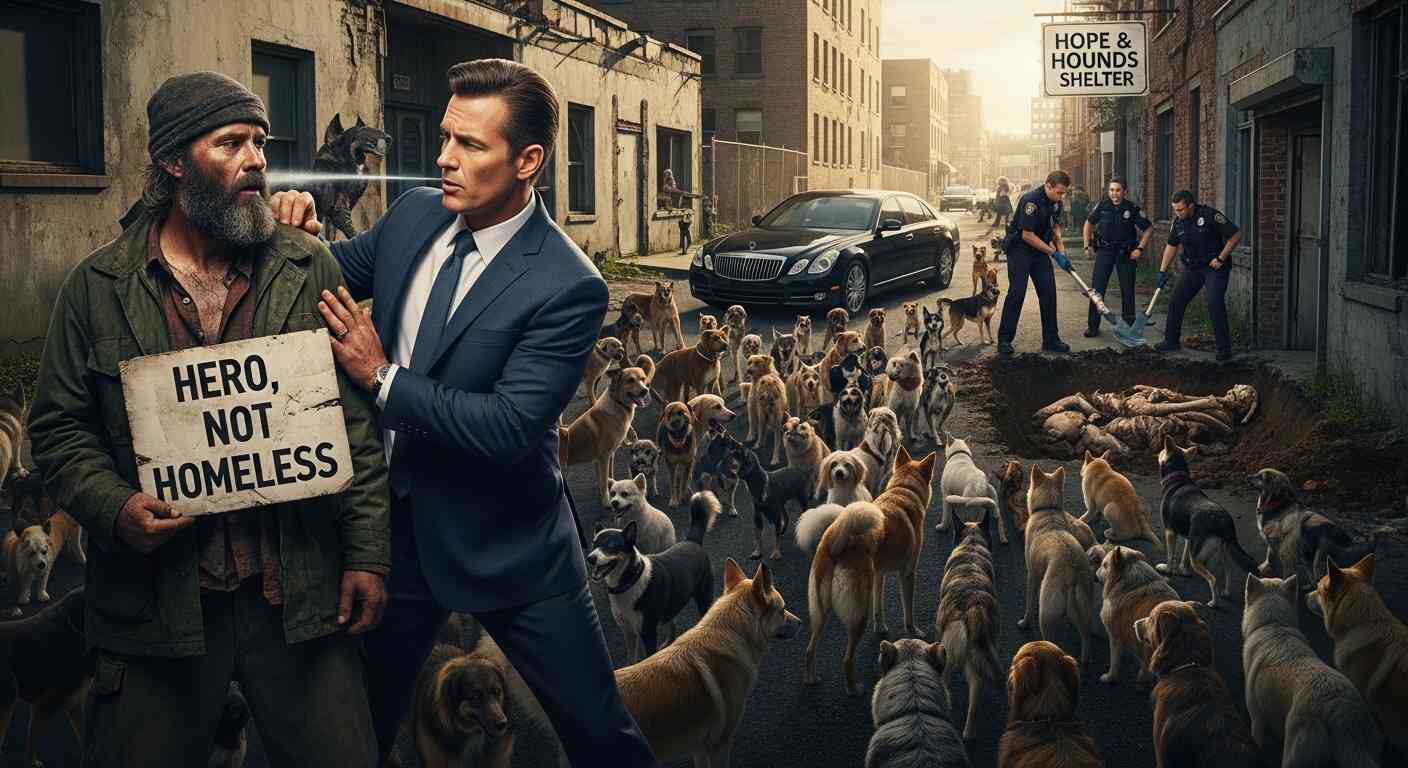
THEY CIRCLED HIM LIKE VULTURES, POKING HIM WITH STICKS AND LAUGHING AT HIS RAGGED CLOTHES WHILE HE SAT HUDDLED ON A PARK BENCH. THEY THOUGHT HE WAS ALONE. THEY WERE DEAD WRONG. 🐕🔥💔
The wood of the stick was jagged, and every time Chad jabbed it into Silas’s ribs, it felt like a reminder that the world had no more use for an old man who once made its gardens bloom.
Silas Thorne sat on the rusted remains of Bench 42 in Miller’s Park, the same park he had hand-planted thirty years ago. Back then, he was the City Head Gardener. Now, he was just “The Eyesore.”
“Hey, look at this! It’s a literal human turtle!” Chad laughed, his designer varsity jacket gleaming in the afternoon sun. He jabbed the stick again, catching the skin of Silas’s neck. “Come on, Grandpa. Give us a show! Do you even have a voice?”
Chad’s friends huddled around, their iPhones held high like digital torches, recording the “content” for their followers. They didn’t see a man who had served his country or a man who had lost his wife to a cancer that ate their savings. They saw a prop for a viral video.
“Please,” Silas whispered, his voice a dry rasp. “I’m just… I’m just trying to stay in the sun.”
“The sun is for people who pay taxes, Silas!” Chad sneered, leaning in to poke at the old man’s tattered shoes. “Why don’t you go find a hole to crawl into?”
But the laughter died in an instant.
A sound emerged from the edges of the park—a low, rhythmic thrumming of paws on the pavement. Hundreds of them.
Suddenly, a hundred dogs leapt over the fences, surrounding the bench and snarling at the bullies until they begged for mercy from the man they just insulted.
Chapter 1: The Circle of Sticks
The air in Miller’s Park usually smelled of freshly cut grass and the faint, sweet scent of the rose garden Silas had designed back in the nineties. But today, the air was thick with the copper scent of fear and the acrid smell of expensive cologne.
Silas Thorne was seventy-four years old, but his body felt like a house that had survived too many storms. He sat on Bench 42, his back curved like a question mark. He was wearing three layers of clothes despite the heat—a survival tactic for a man who never knew where his next blanket was coming from.
“Look at the layers, guys! He’s like an onion of failure!” Chad Sterling stood in front of him, a three-foot-long maple branch in his hand. Chad was the son of Mayor Sterling, a man who currently had a “Park Sanitization” bill sitting on his desk.
Chad poked the stick into Silas’s chest, pushing him back against the iron slats of the bench. “I heard the city is putting a new fountain here, Silas. That means the trash has to be cleared out. That’s you, buddy. You’re the trash.”
Silas didn’t fight back. He’d learned long ago that for boys like Chad, a fight was just an invitation to hit harder. He just looked down at his hands—hands that were stained with thirty years of earth and soil.
“Stop it, Chad,” a voice called out.
Sarah, a young mother pushing a stroller, had stopped ten feet away. Her face was pale, her knuckles white on the handle of the carriage. She’d seen Silas in this park every day for a year. He’d once picked a dandelion and given it to her crying toddler, making the child laugh when nothing else would.
“Stay out of this, Sarah,” Chad snapped without looking back. “We’re just having some fun with the local wildlife.”
Chad poked the stick again, this time catching Silas’s cheek. A thin line of blood began to bloom against the grey stubble. Silas didn’t flinch. He just closed his eyes.
“You should leave,” Silas whispered.
“Oh, now he talks!” Chad laughed, turning to the camera. “Did you hear that, fans? The turtle has a voice!”
But the wind suddenly shifted. The constant hum of the city—the cars, the sirens—seemed to fade into a heavy, suffocating silence.
Then came the growl.
It wasn’t one dog. It wasn’t even ten. It was a low, guttural vibration that seemed to come from the ground itself. Chad froze, the stick still hovering inches from Silas’s face.
From the north fence, a massive, scarred German Shepherd leapt over the iron bars with the grace of a predator. Then came a Pitbull. A Greyhound. A Doberman. They flowed over the fences like a rising tide of fur and teeth. A hundred paws hit the grass in a rhythmic, terrifying cadence.
They didn’t bark. They simply moved into a tight, military-style formation, encircling the bench and the boys.
The lead Shepherd, whom Silas called “The General,” stepped into the center of the circle. He didn’t look at Silas. He looked at Chad. He let out a growl that wasn’t a warning—it was a sentence.
Chad’s stick clattered to the ground. His phone slipped from his hand, the screen cracking on the pavement. He was no longer the Mayor’s son. He was just a boy realized he had just poked a sleeping giant.
Chapter 2: The Silent Breadcrusts
To understand the army of Miller’s Park, one had to understand the “Silent Breadcrusts.”
For three years, Silas Thorne had lived in the shadows of the city. He didn’t beg for coins at the intersections; he spent his days collecting the discarded. He’d walk to the back of the local bakeries at 5:00 AM, where the owners—men who remembered when Silas kept the city’s parks beautiful—would leave out bags of “seconds.”
Silas didn’t eat most of it.
He’d spend his afternoons walking the “blind spots” of the city—the abandoned railyards, the industrial alleys, the overgrown lots behind the strip malls. He’d whistle, a low, melodic three-note call.
Out of the darkness would come the broken. The dogs with the notched ears. The ones who had been “discarded” because they grew too big or weren’t mean enough. Silas was the man who never raised a hand, who always had a piece of ham or a crust of rye, and who treated them with the dignity the world denied them.
“You’re not strays,” he’d whisper to The General, whose neck still bore the scars of a heavy chain. “You’re just in between homes. Like me.”
He had built a secret kingdom of the unwanted. And today, the kingdom had come to claim its own.
In the park, Officer Miller (no relation to the park name) pulled his cruiser onto the curb. He’d seen Chad’s group heading toward the bench and had a bad feeling. He’d known Silas for years—he’d even brought the old man a hot coffee on the coldest nights.
But as Miller stepped out of his car, his hand instinctively moved to his holster. He’d never seen anything like it. A hundred dogs, standing in perfect, silent unison.
“Silas?” Miller called out, his voice shaking.
“It’s alright, Mark,” Silas said, standing up slowly. The dogs didn’t move for the officer, but they didn’t snarl either. Their focus remained entirely on Chad and his friends.
Chad was shaking so hard his knees were knocking together. “Officer! Help! They’re gonna kill us! Shoot them! Shoot the big one!”
Miller looked at the “big one”—The General. The dog wasn’t lunging. He was standing his ground. He looked at Silas, who was bleeding from the cheek. He looked at the maple stick lying in the dirt.
“Looks like they’re just following the park rules, Chad,” Miller said, his voice hard. “No bullying allowed. Maybe you should apologize to Mr. Thorne.”
Chapter 3: The Mayor’s Mandate
The incident at Bench 42 was the lead story on the evening news. But the narrative wasn’t what Silas expected.
Mayor Sterling, Chad’s father, stood at a mahogany podium in City Hall. He didn’t mention the stick. He didn’t mention the blood on Silas’s face. He showed a grainy photo of the dogs.
“This is an invasion!” the Mayor thundered. “A pack of a hundred aggressive, diseased animals is roaming our parks, led by a delusional vagrant. This is exactly why we need the ‘Public Safety and Sanitization Act.’ Tomorrow at dawn, Animal Control will be clearing Miller’s Park. Permanently.”
The city was terrified. People who had once smiled at Silas now locked their car doors when they drove past. Fear is a weed that grows faster than any rose, and the Mayor was a master at watering it.
That night, Silas sat in the dark under the gazebo, The General’s heavy head resting on his lap. He could feel the tension in the dog’s muscles.
“They’re coming for us, boy,” Silas whispered.
He looked at his hands. He realized he couldn’t just sit and wait for the “sanitization.” He had to protect the only things that loved him.
He stood up and walked to the edge of the park, where Sarah—the young mother—was waiting. She had come alone, carrying a heavy bag of dog food and a stack of clean blankets.
“Silas, you have to leave,” Sarah said, her eyes red. “They’re bringing the high-voltage nets. They’re not going to take them to a shelter. They’re calling them ‘unrehabilitatable.'”
“I know,” Silas said. “But where do we go, Sarah? The city is made of fences.”
“The old nursery,” Sarah said, reaching into her pocket and pulling out a set of rusty keys. “My grandfather used to own the wholesale nursery on the edge of the county. It’s been abandoned for ten years. It’s sixty acres of forest and greenhouses. It’s still in my name, and the city can’t touch it.”
Silas looked at the keys. He looked at the hundred pairs of glowing eyes in the darkness of the park.
“Why are you doing this, Sarah?”
“Because you gave my son a flower when I was too tired to even give him a smile,” she said. “And because the world needs more gardeners, Silas. Not more mayors.”