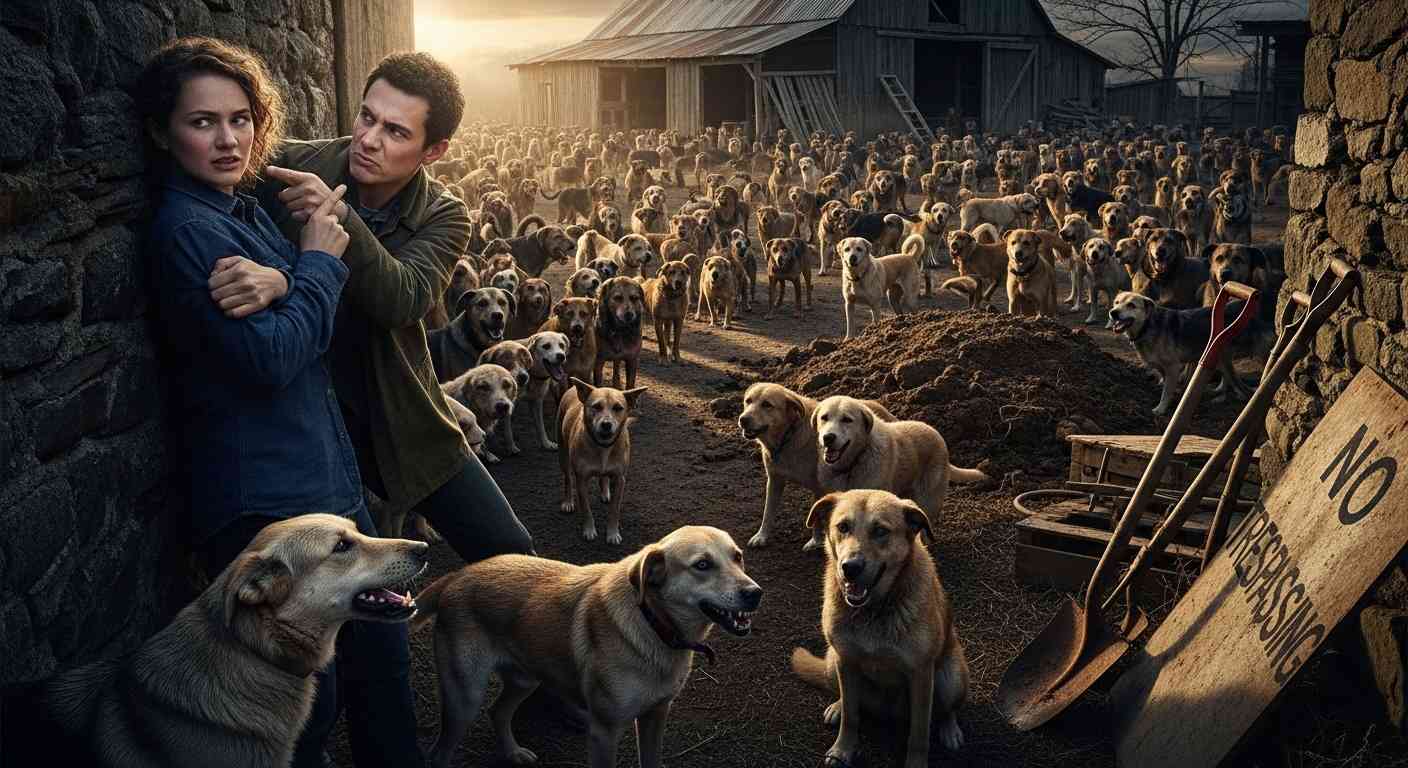
HE DRAGGED THE OLD MAN OUT BY HIS COLLAR, THROWING HIM ONTO THE HARD CONCRETE AND SCREAMING AT HIM TO NEVER COME BACK. BUT THE STORE OWNER DIDN’T REALIZE THAT THE “GHOST” OF THE TOWN HAD AN ARMY IN THE SHADOWS. 🐕🏙️💔
The sound of Silas hitting the pavement was a hollow, wet thud that made the neighbors turn their heads.
Arthur stood in the doorway of “Miller’s Tools,” his chest heaving under a grease-stained apron. He’d lived in Oakhaven his whole life, and he’d grown tired of seeing the “stain” of poverty sitting on his stoop.
“I told you! No loitering! Get your trash and get out before I call the cops!” Arthur’s voice was a jagged blade, cutting through the quiet evening air.
Silas didn’t fight back. He never did. At sixty-four, his body was a map of hard years and harder luck. He just stayed there on his knees, his hands trembling as he reached for a single, dented tin of dog food that had rolled into the gutter.
“You like animals more than people, Silas? Then go sleep with the mutts in the railyard!” Arthur spat on the concrete, mocking the old man’s tears.
But the laughter died in an instant.
A sound emerged from the morning fog—a low, rhythmic thrumming of paws on pavement. Hundreds of them.
Suddenly, a hundred dogs appeared from nowhere, their low growls shaking the ground as they stood between the trembling man and his cruel tormentor. They didn’t bark. They didn’t bite. They just… judged.
Chapter 1: The Weight of the Collar
The town of Oakhaven was a place where the American Dream had gone to sleep and forgotten to wake up. The Main Street was a row of boarded-up windows and fading memories, held together by a few stubborn businesses that refused to die. Arthur Miller’s hardware store was one of them.
Arthur was a man made of sharp angles and short patience. To him, the world was divided into those who worked and those who were a burden. And Silas Thorne was, in Arthur’s eyes, the heaviest burden of all.
Silas had been a ghost in Oakhaven for three years. He lived in the “blind spots”—the spaces between the buildings, the underside of the bypass, and the heart of the woods behind the old textile mill. He carried his life in a tattered rucksack and his dignity in a quiet, unblinking gaze.
“I’m not asking you again, Silas!” Arthur’s voice boomed, echoing off the brick walls.
Arthur reached down and grabbed Silas by the collar of his faded denim jacket. With a strength fueled by years of bitterness, he yanked the old man off the stoop. Silas stumbled, his boots catching on the uneven sidewalk, and then he was airborne.
The impact was brutal. Silas’s shoulder hit the concrete first, followed by his hip. He let out a sharp, ragged gasp as the air was punched from his lungs. His bag spilled open, revealing a few mismatched socks, a dog-eared copy of East of Eden, and four cans of “Value-Brand” dog food.
“Look at this,” Arthur mocked, kicking one of the cans into the street. “You’re begging for change at the intersection, and you’re spending it on this junk? You’re a joke, Silas. A pathetic, homeless joke.”
Silas stayed on the ground, his face pressed against the cold concrete. He could smell the dust and the old rain. He felt a single, hot tear track through the grime on his cheek.
“Please, Arthur,” Silas whispered. “It was… it was for the hungry ones.”
“The hungry ones? You can’t even feed yourself!” Arthur roared. “Stay out of my sight. If I see you on this block again, I’m not calling the cops—I’m taking a belt to you.”
Arthur turned to head back into his store, feeling a twisted sense of triumph. But he didn’t make it to the door.
The air in Oakhaven seemed to thicken. A low-frequency hum began to vibrate through the soles of Arthur’s boots. It was the sound of a hundred hearts beating in unison.
From the alley across the street, a massive, scarred Pitbull-mix stepped into the light. Behind him came a German Shepherd. Then a lean Greyhound. Then dozens more. They flowed out of the shadows like a rising tide of fur and muscle.
They didn’t bark. They didn’t growl. They simply marched.
Within sixty seconds, the street in front of Miller’s Tools was filled with dogs. A hundred pairs of eyes, ranging from amber to deep brown, were fixed solely on Arthur. They formed a tight, impenetrable semi-circle around Silas, shielding him.
The lead dog—the Pitbull Silas called “General”—stepped forward and placed its head on Silas’s shoulder. It let out a sound that wasn’t a growl, but a deep, vibrating hum of loyalty.
Arthur took a step back, his hand fumbling for the door handle. His face, which had been red with rage, was now a sickly, ghostly pale. “What… what is this? Get them away! Silas, call them off!”
Silas slowly pushed himself up, supported by the weight of the General. He looked at Arthur, and for the first time in three years, the ghost of Oakhaven spoke with the voice of a man.
“They aren’t mine to call off, Arthur,” Silas said. “They’re just making sure I get home. And they’re wondering why you’re so angry at a man who has nothing left but his heart.”
Chapter 2: The Viral Heart of Oakhaven
The incident at Miller’s Tools didn’t stay on the concrete of Main Street. Jackson, a seventeen-year-old kid with a skateboard and a phone that was always recording, had caught the whole thing from across the street. By 8:00 PM, the video was on every social media platform in the county.
The title Jackson gave it was simple: “THE DOG KING OF OAKHAVEN.”
The video showed the violence—the way Arthur’s knuckles turned white as he grabbed Silas. It showed the mockery. But it also showed the moment the world shifted. The sight of a hundred dogs emerging from the fog to defend a man who hadn’t even raised a hand.
“Look at the way they look at him,” Jackson’s voice narrated in the background of the video. “They’re not attacking. They’re… they’re saluting.”
By the next morning, Arthur Miller was the most hated man in three counties. He arrived at his store to find the windows covered in flyers and the sidewalk blocked by protesters. But it wasn’t just people.
A dozen dogs were sitting on his stoop. They weren’t barking. They were just… there. Waiting.
“Move! Get out of here!” Arthur screamed, waving a broom at a scruffy terrier.
The dog didn’t budge. It just stared at him with eyes that seemed to see right through his apron and into the hollow space where his empathy used to be.
Officer Miller (no relation to Arthur), a man who had walked the Oakhaven beat for twenty years, pulled his cruiser onto the curb. He’d seen the video. He’d also known Silas back when Silas was a foreman at the mill, before the mill closed and Silas’s wife got sick, and before the bank took the house.
“Arthur,” the officer said, stepping out of the car. “I think you should close up for the day.”
“Close up? These animals are trespassing! Arrest them! Arrest the old man for inciting a riot!”
“The dogs aren’t doing anything illegal, Arthur,” the officer said, his voice hard. “And as for Silas… well, I’ve got fifty witnesses who say you assaulted him. He isn’t pressing charges yet, but I’d suggest you stay inside.”
The officer walked over to the stoop. He reached into his pocket and pulled out a small piece of jerky. He offered it to the terrier. The dog sniffed it, took it gently, and then went back to its silent vigil.
“How does he do it, Mark?” Arthur whispered from behind the glass of his door. “How does a man with nothing get a hundred dogs to die for him?”
“He didn’t get them to do anything, Arthur,” the officer said, looking at the grey morning sky. “He just shared his crusts of bread when he was starving. Dogs don’t care about your credit score. They care about your soul. And right now, Silas Thorne is the richest man in this town.”
Meanwhile, Silas was at the “Sanctuary”—an abandoned greenhouse on the edge of the woods. He was surrounded by his pack. He was feeding them the cans of food he’d salvaged, breaking the meat into small pieces so the older ones could eat.
He looked at his bruised shoulder, then at the General. “It’s okay,” he whispered. “The world is just a little loud sometimes. We just have to keep walking.”
Chapter 3: The Secret in the Shadows
The town of Oakhaven was divided. Half the people were calling for Silas to be given a home, a job, a life; the other half were terrified of the “Wild Pack” roaming their streets. But the truth of Silas and the dogs went deeper than anyone knew.
It wasn’t just about bread. It was about the “Discarded.”
Silas had started his “Army” two years ago when he found a Pitbull tied to a tree in the woods, starving and left for dead. The dog had been used as bait in a local fighting ring. Silas had spent three nights in the rain, whispering to the dog, feeding it water from his own mouth, and telling it stories of the gardens he used to plant.
“You’re not a fighter,” Silas had told the dog. “You’re a sentinel. You’re the General.”
Word travels fast in the animal kingdom.
Slowly, the broken ones found him. The Greyhound that was too slow for the track. The Lab that had grown too old for its family. The mutts that were kicked and shouted at. Silas was the man who never raised a voice, who always had a bit of ham or a scratch behind the ears, and who treated them like the heroes they were.
Back in the village, Arthur Miller was losing his mind.
His business was failing. No one wanted to buy a hammer from a man who attacked a homeless grandfather. He sat in his darkened store, a bottle of cheap bourbon on the counter, watching the news.
“The Oakhaven Mystery,” the reporter said. “Experts are calling it a ‘Pack Bond’ that defies modern science. But the locals are calling it justice.”
Arthur looked at a photo of Silas on the screen. He remembered Silas from twenty years ago. They’d been on the same bowling team. They’d shared beers at the VFW. But when the town died, Arthur had turned his pain into anger, and Silas had turned his into kindness.
“It should have been me,” Arthur muttered, his voice thick with drink. “I’m the one with the store. I’m the one with the house. Why don’t they look at me?”
Suddenly, the bell above the door chimed.
Arthur looked up, expecting a protester or a cop. But it was Clara, a thirty-year-old waitress from the diner next door. She was holding a phone.
“Arthur,” she said, her voice trembling. “You need to see this.”
She showed him a live-stream. It was from the woods behind the mill. A group of teenagers, inspired by Arthur’s violence, had gone into the woods with high-voltage prods. They were trying to “clear out the pests.”
The video was chaotic. There was shouting, the spark of electricity, and then, a roar that didn’t sound like one dog—it sounded like a storm.
“They’re going to kill them, Arthur,” Clara said. “Or the dogs are going to kill the kids. Silas is trying to stop it, but he’s hurt from when you threw him down.”
Arthur looked at his hands. He looked at the row of heavy-duty flashlights and the bear spray on his shelves. For the first time in ten years, he didn’t see a burden. He saw a man.
“Get the truck,” Arthur said.