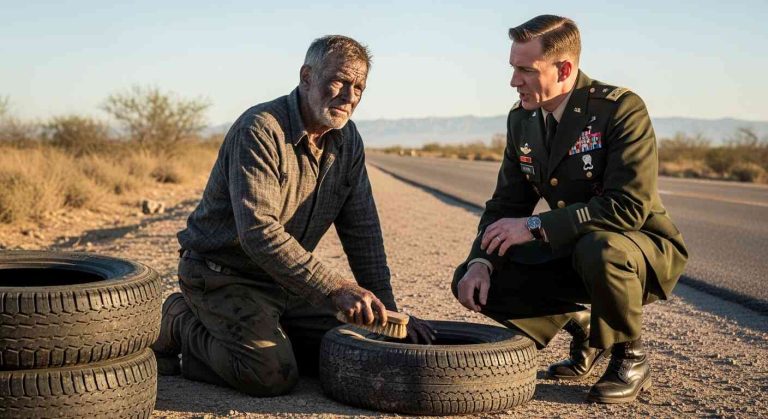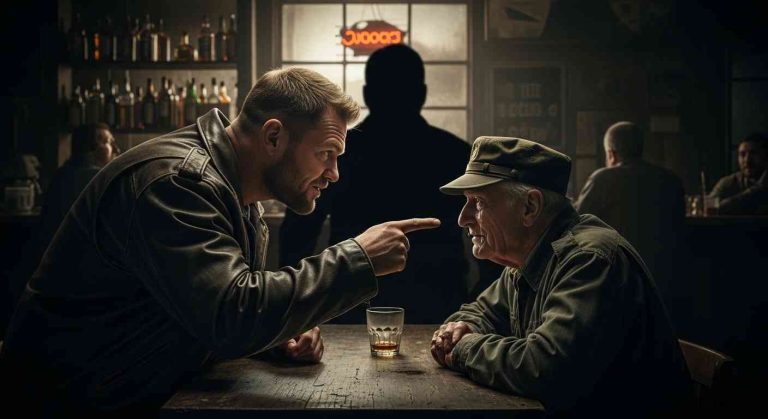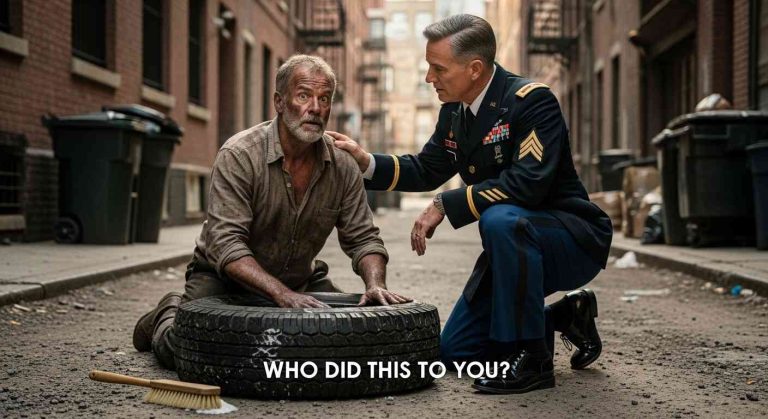
The sun over the Heights project was a brutal, unforgiving hammer. At sixty-five, the heat didn’t just make me sweat; it seeped into my marrow, making my old injuries thrum with a dull, rhythmic ache. I was holding a single industrial cinder block, my fingers cracked and stained with the gray dust of a life I had chosen to live in the shadows. My breath came in ragged hitches. To anyone passing by, I was just Elias, the “slow guy” on the crew, the one they gave the tasks that didn’t require speed, only endurance.
Then came the smell of expensive cologne and the sound of Italian leather soles crunching on gravel.
“Look at this, boys,” a voice drawled, sharp and poisonous. It was Julian Vane, the lead developer’s son. He was thirty-five, wore a suit that cost more than my annual salary, and had never had a callus on his hand in his life. He was followed by four other “suits”—junior VPs who fed off his arrogance like scavengers. “The Great American Work Ethic. Or what’s left of it. Hey, Pops, you need a nap? Or maybe a casket? You’re holding up the workflow.”
I didn’t look up. I just focused on the weight of the brick. “Just doing my job, Mr. Vane,” I muttered, my voice raspy from years of shouting over jet engines and artillery fire.
“Your job is to be efficient,” Julian snapped, stepping into my personal space. The other four chuckled, a synchronized sound of corporate cruelty. “Instead, you’re a liability. You’re slow, you’re ugly, and you’re making my site look like a retirement home.” He reached out, his hand flashing a gold watch, and gave the brick a sharp shove.
My grip was weak. The brick tumbled, shattering against my steel-toed boots. Dust billowed up, coating my worn jeans.
“Oops,” Julian mocked, leaning down so his face was inches from mine. “Maybe you should go home and wait for the end. You’re useless here.”
I looked him in the eye then. I didn’t see a threat. I saw a boy playing with matches in a room full of gasoline. I had spent forty years as the Supreme Strategic Advisor for the Joint Chiefs. I had ended wars with a signature and saved nations with a whisper. I was here because the silence of a construction site was the only thing that drowned out the ghosts of the men I couldn’t save.
“You should move your car, Julian,” I said softly.
“What did you say to me?” he hissed, his face reddening.
“Your car,” I repeated, pointing toward the gate. “It’s blocking the entrance. And you really don’t want to be in the way of what’s coming.”
He started to laugh, a high-pitched, mocking sound. But the laugh died in his throat as a low, rhythmic thrum began to vibrate through the soles of our boots. It wasn’t the sound of machinery. It was the sound of a storm.
“FULL STORY
Chapter 1: The Weight of the Dust
The construction site at the edge of the Arlington suburbs was a chaotic symphony of grinding metal and shouting men. To the world, I was Elias Thorne, a man who had appeared out of nowhere six months ago, looking for “”anything that required a heavy lift and a quiet tongue.”” I lived in a studio apartment that smelled of Pine-Sol and old memories, and I spent my days moving materials that younger men complained about.
I enjoyed the anonymity. After decades of being “”The Ghost””—the man who moved the pieces on the global chessboard—the simplicity of a physical burden was a relief. A brick has no hidden agenda. Gravity is the only law it follows.
But Julian Vane didn’t understand silence. To him, silence was a vacuum that needed to be filled with his own ego. He was the son of Silas Vane, a man I had once known in a very different capacity, though Julian didn’t know that. Julian was the kind of man who viewed people as assets or obstacles. To him, I was an obstacle—an eyesore on his father’s shiny new legacy project.
“”I’m talking to you, old man!”” Julian shouted, his voice cracking the humid air. His four cronies—men in their late twenties who thought a gym membership made them tough—moved in closer. “”You’re deaf as well as slow? I told you to pack your rags and get out. You’re fired. Effective five minutes ago.””
I looked at the shattered brick at my feet. “”I work for Miller,”” I said, referring to the site foreman. “”He’s the only one who gives me orders.””
“”Miller works for my father,”” Julian sneered. “”And my father is currently on a yacht in the Mediterranean, which means I am the law here. You’re done. And frankly, you’re lucky I don’t sue you for the time you’ve wasted.””
One of the suits, a tall guy with a bleached smile named Carter, stepped forward. “”Maybe he needs a little help finding the exit, Julian. He looks a bit confused.””
Carter put a hand on my shoulder, intending to shove me. It was a mistake. My body reacted before my mind could intervene. It was muscle memory, forged in the black sites of Eastern Europe and the jungles of South America. I didn’t flip him. I didn’t strike. I simply shifted my weight and caught his wrist in a grip that found the nerve endings with surgical precision.
Carter let out a sharp yelp, his knees buckling.
“”Don’t,”” I said, my voice dropping to a register that usually made generals sweat. “”I’m having a bad day, son. Don’t make it your last one.””
Julian recoiled, shocked by the sudden flash of steel in my eyes. “”You… you’re assaulting my staff! That’s it! Call the police! No, call security!””
“”You won’t need the police,”” I said, releasing Carter, who scrambled back, nursing his arm.
I checked my watch. 11:42 AM. They were early.
From the distance, a sound began to rise. It wasn’t the erratic noise of city traffic. It was the synchronized, heavy drone of high-output diesel engines. Then came the sirens—not the wailing of a police cruiser, but the deep, authoritative “”whoop-whoop”” of military escorts.
A fleet of black SUVs, flanked by armored troop carriers, rounded the corner of the suburban street. They didn’t slow down for the gates. They didn’t honk. The lead vehicle, a massive BearCat, simply drove through the chain-link fence as if it were made of spiderwebs.
Julian’s jaw dropped. “”What the hell is this? This is private property! Who do they think they are?””
The vehicles swirled into the center of the site, kicking up a massive wall of red dust. They formed a perfect defensive perimeter around the spot where I stood. Before the dust had even settled, the doors of the troop carriers flew open.
Five hundred soldiers, in full combat gear, rifles slung but hands ready, poured out. They didn’t look at the construction workers. They didn’t look at the expensive suits. They moved with a terrifying, singular purpose.
In less than sixty seconds, the construction site had been transformed into a forward operating base.
Julian was trembling now, his bravado evaporating like mist. “”I… I’m calling my father. This is an illegal occupation! You can’t—””
The door of the lead SUV opened. A man stepped out. He was tall, his uniform crisp enough to cut glass, with the silver eagles of a Colonel on his shoulders. This was Jax—a man I had plucked from a burning wreckage in Mogadishu twenty years ago.
Jax didn’t look at Julian. He walked straight toward me, his boots clicking on the gravel. Ten paces away, he stopped. He snapped his heels together, his hand coming up in a salute so sharp it seemed to vibrate.
“”Sir!”” Jax bellowed, his voice echoing off the half-finished skyscrapers.
Behind him, five hundred soldiers followed suit. The sound of five hundred hands hitting five hundred brows was like a clap of thunder.
“”Supreme Strategic Advisor Thorne! The President requests your immediate presence at the Pentagon. The situation in the North has escalated. We need The Ghost.””
The silence that followed was absolute. Julian Vane looked like he was about to vomit. The “”old fossil”” he had just insulted was being saluted by an army. And the look I gave him as I took the clean towel Jax offered me wasn’t one of anger. It was one of pity.
Chapter 2: The Ghost in the Machine
The transition from the gritty, dust-choked air of the construction site to the sterile, leather-scented interior of the armored SUV was jarring. Jax sat across from me, his eyes searching my face for any sign of the man he used to know.
“”You look like hell, Elias,”” he said, his voice dropping the formal military tone.
“”I feel like the Earth,”” I replied, wiping the gray concrete dust from my forehead. “”Heavy and tired. You shouldn’t have come like this, Jax. I told the Secretary I was out. Permanently.””
“”The Secretary didn’t have a choice. Neither do I,”” Jax said, handing me a secure tablet. “”The Silverside Protocol has been breached. Someone leaked the deep-sea cable coordinates. We’re blind in the Pacific, and the Joint Chiefs are screaming for a solution that doesn’t involve nuclear winter. You’re the only one who can see the moves before they happen.””
I stared at the screen, the familiar rush of data and logistics beginning to wake up the parts of my brain I had tried so hard to put to sleep. But as the car pulled away, I saw a face in the window.
It was Sarah.
Sarah was the site office manager, a woman in her late twenties who had spent the last six months bringing me coffee and asking about my “”grandkids”” that I didn’t have. She was a single mother, working two jobs to keep her daughter, Maya, in a decent school. She was standing by the ruins of the gate, her hand over her mouth, watching the man she thought was a lonely laborer disappear into a military motorcade.
“”Stop the car,”” I said.
“”Sir, we’re on a clock,”” Jax protested.
“”Stop. The. Car.””
The motorcade screeched to a halt. I stepped out, ignoring the confused stares of the soldiers. I walked over to Sarah. Julian Vane was standing a few feet away, looking paralyzed, his four friends huddled behind him like frightened children.
“”Elias?”” Sarah whispered, her eyes wide. “”What… who are you?””
“”I’m still the guy who likes his coffee black, Sarah,”” I said gently. I reached into my pocket and pulled out a small, brass coin—a challenge coin I’d carried since the Gulf War. I pressed it into her hand. “”If anyone on this site gives you trouble—anyone at all—you call the number on the back of that coin. Do you understand?””
She nodded, dazed.
I turned my gaze to Julian. He flinched as if I’d struck him.
“”Mr. Vane,”” I said, my voice like dry leaves. “”I’m sure your father will be interested to know that you’ve been obstructing a federal asset during a time of national crisis. Using a construction site as a playground for your insecurities is one thing. Interfering with the Department of Defense is quite another.””
“”I… I didn’t know!”” Julian stammered, his expensive suit now looking like a cheap costume. “”Elias—Sir—I was just… it was a joke!””
“”The world is full of men like you, Julian. Men who think power is the ability to humiliate those they deem beneath them,”” I said. “”True power is the ability to destroy someone and choosing not to because it’s a waste of your time. Today, you are a waste of my time. But tomorrow? Tomorrow I might be bored.””
I turned my back on him and walked back to the SUV.
As we drove away, Jax looked at me. “”Who was she?””
“”Someone who actually works for a living,”” I said, leaning back into the seat. “”Now, tell me about the Silverside breach. And tell me which of my ‘old friends’ in the Senate sold us out.””
Jax grimaced. “”You always were a pessimist.””
“”No,”” I corrected. “”I’m a strategist. In our world, they’re the same thing.””
But as the suburban sprawl faded into the distance, my mind wasn’t on the Pacific. It was on the feeling of that brick in my hand. It was easier to carry than the weight of what I had to do next.
Chapter 3: The Cold Room
The Pentagon doesn’t have windows in the places that matter. We were in “”The Tank””—the ultra-secure briefing room where the air feels processed and the silence is heavy with the scent of ozone and high-stakes anxiety.
I stood at the head of the table, still wearing my work boots and dusty jeans. Around me sat the most powerful men and women in the American military. General Vance, a man with more medals than personality, stared at me with a mix of resentment and desperation.
“”You look like a vagrant, Thorne,”” Vance snapped.
“”And you look like a man who just lost three billion dollars’ worth of surveillance equipment,”” I countered. “”Shall we talk about your failures, or shall we talk about how I’m going to fix them?””
The room went cold. I spent the next four hours dissecting the enemy’s movements. I didn’t use a computer. I used a whiteboard and a marker, drawing lines that connected dots no one else had seen. I showed them how the breach wasn’t a hack, but a psychological play. They weren’t trying to steal data; they were trying to provoke a specific response.
“”They want us to move the Seventh Fleet to the Taiwan Strait,”” I explained, circling a point on the map. “”Because as soon as we do, they’ll trigger a financial collapse in the Baltic states. We’re being flanked, and you’re all staring at the shiny lure in the water.””
By the time I was done, the room was silent. I saw the realization sink in. They had been playing checkers. The “”slow laborer”” had just shown them they were in the middle of a grandmaster’s chess match.
But as I sat down, my phone—a burner I’d kept from the site—buzzed in my pocket.
It was a text from a number I didn’t recognize.
They’re hurting her, Elias. Julian came back. He’s crazy. He thinks you’re going to ruin him. He’s at Sarah’s house. Please.
My heart, which had remained steady at 60 beats per minute during a briefing on global war, suddenly spiked.
“”Thorne? Where are you going?”” Vance shouted as I stood up.
“”I’m taking a leave of absence,”” I said, already halfway to the door.
“”You can’t! We’re in the middle of a crisis!””
“”You have the map, General. Follow the lines,”” I growled over my shoulder. “”I have a different kind of fire to put out.””
I found Jax in the hallway. “”I need a bird,”” I said. “”And I need a team. Now.””
“”What’s wrong?””
“”A small man is trying to be big,”” I said, my voice trembling with a rage I hadn’t felt in years. “”And he’s about to find out why they call me The Ghost.””
Chapter 4: The Suburban Siege
The helicopter ride back to the suburbs was a blur of gray clouds and adrenaline. I sat in the back, checking the chamber of a sidearm I hadn’t touched in a decade.
Julian Vane wasn’t a mastermind. He was a coward who had been cornered. When people like Julian realize their status is a lie, they don’t reflect. They lash out. He knew I had the power to strip his family of everything. He thought that by silencing the witnesses—or using them as leverage—he could negotiate.
It was the logic of a child.
We landed in a park two blocks from Sarah’s modest ranch-style home. My team—six Delta operators who looked like they were carved from granite—moved out with me.
The street was eerily quiet. Julian’s silver Porsche was parked crookedly in Sarah’s driveway. The front door was slightly ajar.
I signaled for the team to hold. “”This one is mine,”” I whispered into the comms.
“”Sir, protocol dictates—””
“”I don’t care about protocol, Jax. He thinks I’m an old man. Let’s not disappoint him.””
I walked through the front door. The house smelled of lavender and fear. In the living room, Julian was pacing, holding a small, silver pistol that looked like a toy in his shaking hands. Sarah was huddled on the sofa, clutching her seven-year-old daughter, Maya. Julian’s four “”suits”” were there, too, but they didn’t look so confident anymore. They looked like they realized they were part of a kidnapping.
“”Julian,”” I said, my voice calm, almost conversational.
He spun around, nearly dropping the gun. “”Elias! Stay back! I mean it! I’ll… I’ll do it!””
“”Do what, Julian? Become a murderer on top of being a failure?”” I walked toward him, my hands open and visible. “”You’re not a killer. You’re a boy who’s upset because he found out he’s not the most important person in the room.””
“”You’re going to ruin me!”” he screamed, his voice cracking. “”You told those soldiers… you’re going to tell my father! He’ll cut me off! I’ll have nothing!””
“”You already have nothing,”” I said, stepping closer. “”You have no respect. No honor. No friends—only people you pay to agree with you. Look at them, Julian.”” I pointed to his four associates. “”They’re already calculating how to testify against you so they can stay out of prison.””
The men shifted uncomfortably, avoiding Julian’s eyes.
“”Shut up! Shut up!”” Julian raised the gun, pointing it at my chest. “”You think you’re so tough? You’re just a bricklayer! A slow, old man!””
“”Then pull the trigger,”” I said. I was five feet away now. I could see the sweat dripping off his chin. “”But know this: if you miss, or if you don’t kill me instantly, the men standing outside that door will make sure you never see the sun again. And they won’t use guns. They’ll use their hands.””
The terror in his eyes reached a breaking point. His finger tightened on the trigger.
Sarah screamed.
I didn’t wait. I closed the distance in a blur of movement. I didn’t go for the gun first. I went for his throat, my palm striking his Adam’s apple just hard enough to steal his breath. As he gasped, I twisted the gun from his hand, snapping his thumb in the process.
He fell to the floor, clutching his hand and wheezing.
I stood over him, the silver pistol looking ridiculous in my weathered, scarred hand. I didn’t look at him with anger. I looked at him with the same clinical detachment I used when analyzing a troop movement.
“”You’re done, Julian,”” I said.
I turned to Sarah. Maya was crying into her mother’s chest. I knelt down, making myself small.
“”I’m sorry, Sarah,”” I said, my voice cracking for the first time. “”I brought this to your door.””
She looked at me, her eyes searching the face of the “”laborer”” she thought she knew. “”You saved us,”” she whispered.
“”I just did my job,”” I said.
Chapter 5: The Reckoning
The aftermath was swift and surgical. Within an hour, the house was swarming with federal agents. Julian and his “”suits”” were led away in zip-ties. They wouldn’t be going to a local jail; they were being taken to a facility where “”national security threats”” were handled.
I sat on the bumper of an SUV, watching the sun begin to set over the suburb. Jax stood next to me, handing me a bottle of water.
“”Vane Senior is back from the Mediterranean,”” Jax said. “”He’s currently at the Pentagon, trying to beg for his son’s life. The Secretary told him to talk to you.””
“”I don’t want to talk to him,”” I said. “”Tell him to liquidate his holdings in the Heights project. Every cent of the profit goes into a trust for the families of the workers he’s been underpaying for years. And Sarah gets the deed to this house, clear and free.””
“”And if he refuses?””
“”He won’t,”” I said. “”He knows what I have in my ‘private collection’ of files.””
I stood up, my old bones protesting. The adrenaline was fading, leaving behind the familiar, crushing weight of reality.
“”The Pacific situation is stabilized,”” Jax said, his voice hesitant. “”The President wants to know when you’re coming back to D.C. for the formal reappointment.””
I looked at the house. Sarah was standing in the doorway, watching me. She didn’t look afraid anymore. She looked… grateful. But there was a distance there now. I wasn’t Elias the laborer anymore. I was a man who moved armies. And that man could never truly be part of her world.
“”I’m not coming back, Jax.””
“”Elias, you’re the best we have. The country needs—””
“”The country needs men who aren’t tired of the sound of their own name,”” I said. “”I’ve spent my life looking at the big picture. I think I’d like to focus on the small one for a while.””
“”You’re going back to the site?”” Jax asked, incredulous.
“”No,”” I said, looking at my hands. The calluses were thick, the skin stained with the earth. “”I think I’m going to go find a place where no one knows how to salute. A place where a brick is just a brick.””