The heat in Northern Virginia was a living thing that day. It crawled down your throat and sat in your lungs like hot lead.
Arthur Vance didn’t complain. He never did. At seventy years old, he just kept his head down, his weathered hands gripping the handle of a push-broom, sweeping the fine gray dust of the luxury condo site.
He was a ghost in dirty rags. To the men in the air-conditioned trailers, he was less than a ghost—he was an eyesore.
“Hey, Grandpa! You missed a spot!”
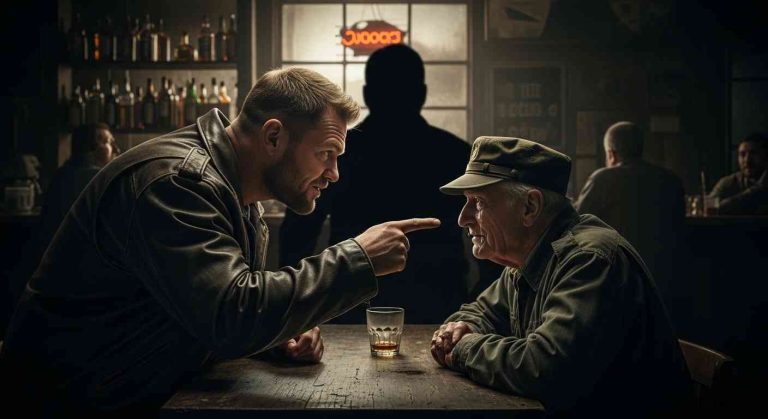
Marcus Thorne, the project lead, stepped out of the trailer. He looked like he’d been plucked from a GQ catalog for assholes: crisp white button-down, gold watch, and a smirk that suggested he’d never worked a day of real labor in his life.
Behind him trailed his four lieutenants, a pack of sycophants who lived for Marcus’s approval.
Arthur didn’t look up. He just kept sweeping. His back ached with a familiar, deep-seated pain—the kind earned from decades of carrying things heavier than a broom.
“I’m talking to you, old man,” Marcus snapped, his voice cutting through the roar of the nearby highway. He walked over to a five-gallon Gatorade cooler sitting on a sawhorse. It was filled to the brim with ice and water.
Arthur finally stopped. He wiped sweat from his brow with a hand that shook just a fraction. “The dust is heavy today, Mr. Thorne. I’ll get it cleared before the concrete trucks arrive.”
“You’re too slow,” Marcus sneered. “You look overheated. Let me help you out.”
Before Arthur could move, Marcus and another manager grabbed the handles of the heavy cooler. With a heave, they tipped it.
The impact was violent. Gallons of ice-cold water slammed into Arthur’s back and head. The shock sent the elderly man to his knees. The freezing water turned the dust on his skin into a gray, muddy slurry.
The managers erupted in laughter.
“Look at him!” one shouted, pointing at the shivering man. “He looks like a drowned rat!”
Arthur sat there in the mud, his breath coming in ragged hitches. He didn’t yell. He didn’t beg. He just stared at the ground, his eyes fixed on a small, silver ring hanging from a chain around his neck—a ring that had been tucked under his shirt until the weight of the water pulled it out.
He felt the cold deep in his marrow, but it wasn’t the water. It was the memory of a different kind of cold. A cold he had spent five years trying to forget.
“Get up and get back to work,” Marcus spat, kicking a spray of gravel toward Arthur. “Or you’re fired without pay.”
Arthur slowly looked up. The tired, defeated look in his eyes was gone. In its place was a terrifying, crystalline clarity.
“You shouldn’t have done that, Marcus,” Arthur said quietly.
“Oh yeah? And what are you gonna do, call AARP?”
Arthur didn’t answer. He reached into his pocket and pressed a small, waterproof button on a device no one even knew he carried.
“I didn’t call AARP,” Arthur whispered as a low rumble began to shake the ground. “I called the cavalry.”
“FULL STORY
Chapter 2: The Weight of Silence
The laughter of the five managers was the only sound for a few seconds, a sharp, ugly contrast to the rhythmic thrum of the city. Marcus Thorne felt like a god. To him, the world was divided into two categories: the predators and the prey. And Arthur Vance, with his tremors and his tattered work boots, was the ultimate prey.
“”Did you hear him?”” Jenner, the youngest of the managers, wheezed through his giggles. “”He said we ‘shouldn’t have done that.’ I’m shaking, Artie! I’m really shaking!””
Across the street, Sarah, a twenty-four-year-old waitress from ‘The Greasy Spoon’ diner, dropped her tray. The sound of shattering porcelain finally broke the spell of the bullying. She sprinted across the asphalt, her apron fluttering.
“”You monsters!”” she screamed, dropping to the mud beside Arthur. “”He’s seventy years old! What is wrong with you?””
Marcus rolled his eyes. “”Relax, sweetheart. It’s just water. It’s a hundred degrees out. We’re doing him a favor.””
“”He’s a veteran!”” Sarah yelled, her voice cracking. She had seen the way Arthur carried himself, the way he always folded his napkins with military precision, the way he looked at the American flag outside the diner with a mixture of reverence and deep, unspeakable sorrow. “”He has a Purple Heart tattooed on his forearm! Have you no shame?””
“”A tattoo doesn’t give you a pass to be a slow-motion statue on my job site,”” Marcus countered. He stepped closer, his expensive leather loafers sinking into the mud Marcus had just created. He looked down at Arthur. “”You want to play the hero, Sarah? You can take him home. He’s done here. Both of you, get off my property.””
Arthur felt Sarah’s small, warm hand on his shoulder. It was the first time someone had touched him with kindness in years. For five years, Arthur had lived in the shadows. He had been a “”Ghost””—the Pentagon’s premier strategic mind, the man who moved the pieces on the global chessboard. After a mission in the Hindu Kush went wrong—a mission he had planned—Arthur had vanished. The guilt of the lives lost had been a weight too heavy for even his broad shoulders. He had chosen this life. The dirt, the heat, the anonymity. It was his penance.
But the world was changing. He knew it. He’d seen the headlines in the discarded newspapers he swept up. A shadow was falling over Eastern Europe, a tactical knot that no one in D.C. knew how to untie. They had been looking for him. And today, when Marcus tipped that water, Arthur realized that his penance was a luxury the world could no longer afford.
“”Arthur, come on,”” Sarah whispered, trying to help him up. “”Let’s get you inside. I’ll make you some coffee.””
Arthur stood up. He didn’t use Sarah’s help. He rose with a fluid, terrifying grace that didn’t belong to a seventy-year-old laborer. He wiped the mud from his face, and for the first time, he looked Marcus Thorne directly in the eye.
Marcus flinched. There was something in Arthur’s gaze—a cold, calculating steel that made the manager’s stomach do a slow, sickening flip.
“”The coffee sounds nice, Sarah,”” Arthur said, his voice no longer raspy, but commanding. “”But I think we should stay right here. You’re going to want to see this.””
“”See what?”” Marcus sneered, trying to regain his bravado. “”What are you—””
He was cut off by a sound that started as a low hum and quickly escalated into a bone-rattling roar. From the north, two black specks appeared against the haze of the afternoon sun. They were moving fast, skimming the tops of the suburban office buildings.
“”Is that… helicopters?”” Jenner asked, shielding his eyes.
“”Not just helicopters,”” Arthur said, checking his watch. “”Sixty seconds. You’re right on time, Miller.””
Chapter 3: The Sky Falls
The construction site, usually a symphony of jackhammers and backup beepers, fell into a stunned silence. The two specks grew into the menacing silhouettes of MH-60M Black Hawks. They weren’t flying the standard routes. They were “”nap-of-the-earth,”” screaming in low and loud, the downwash from their rotors beginning to whip the construction dust into a blinding whirlwind.
“”What the hell is going on?”” Marcus shouted, clutching his hard hat as his white shirt billowed wildly. “”They can’t fly that low!””
But they did. The lead bird banked hard over the site, the door gunners visible, their weapons cold but their presence unmistakable.
And then came the ground.
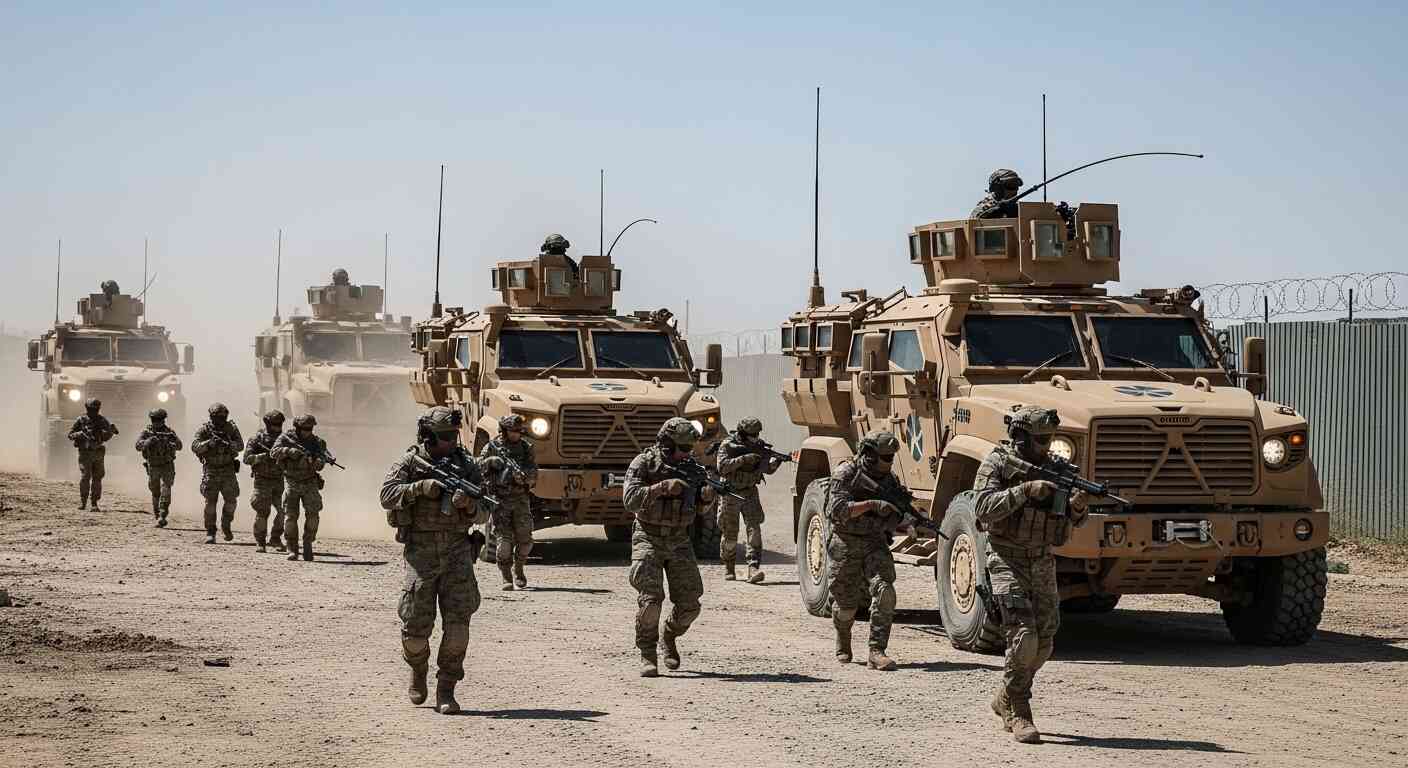
From both ends of the construction corridor, blacked-out Chevy Suburbans and armored Humvees shrieked around the corners, tires smoking as they performed synchronized J-turns, effectively sealing off the entire block.
Five hundred men. That was the count. Not local police. Not even FBI. These were men in MultiCam Black, carrying suppressed HK416s, their faces covered by ballistic masks. They moved with the terrifying, silent efficiency of a tidal wave.
“”Down! Everybody down!”” a voice boomed over a megaphone.
The laborers dropped. The pedestrians on the sidewalk hit the pavement.
Marcus and his four managers stood frozen. They were paralyzed by the sheer scale of the force descending on their mundane little world. Marcus felt a bead of sweat—real, panicked sweat—trickle down his spine.
One of the Suburbans slid to a halt just feet from the mud where Arthur stood. The door flew open before the vehicle had even fully stopped.
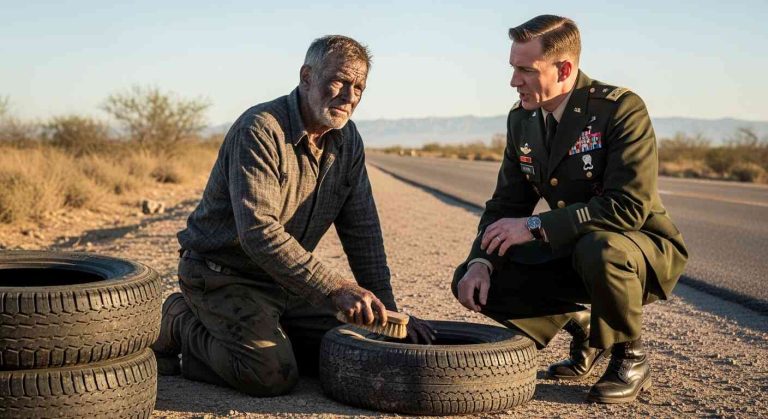
A man stepped out. He wore a crisp Army Combat Uniform with the silver eagles of a Colonel on his chest. He looked like he hadn’t slept in a week. Behind him, a tactical team formed a human shield, their eyes scanning the rooftops.
Colonel Miller didn’t look at the construction equipment. He didn’t look at the terrified managers. He ran straight toward the man covered in mud and ice water.
“”Sir!”” Miller shouted over the dying whine of the helicopter turbines.
He stopped three feet from Arthur and snapped the sharpest salute Sarah had ever seen. “”General Vance, sir! We’ve been searching for you for eighteen months. The situation in the Black Sea… it’s gone red. The Joint Chiefs are in the bunker. They’re waiting for ‘The Ghost.’ They won’t move without your sign-off.””
Sarah gasped, her hand flying to her mouth. General?
Arthur looked at the Colonel, then down at his muddy hands. “”I’m retired, Miller. I’m a janitor. I sweep dust.””
“”With all due respect, sir,”” Miller said, his voice cracking with emotion, “”the world is burning, and you’re the only one who knows where the extinguishers are hidden. Please. Get in the damn car.””
Arthur sighed. He looked at Sarah, who was staring at him as if he had just turned into a superhero. Then, he looked at Marcus Thorne.
Marcus was shaking. His knees actually hit the mud. “”General? I… I didn’t… We were just joking, sir. We didn’t know.””
Arthur walked over to Marcus. He didn’t look angry. He looked disappointed. “”That’s the problem, Marcus. You didn’t know who I was, so you thought it was okay to be a monster. But leadership isn’t about how you treat the Generals. It’s about how you treat the men with the brooms.””
Chapter 4: The Price of Arrogance
The five managers were now surrounded by six Special Forces operators, the muzzles of their rifles held at a “”low ready”” position. The air was thick with the smell of JP-8 fuel and the ozone of high-stakes tension.
“”Colonel,”” Arthur said, his voice cutting through the wind.
“”Yes, sir?”” Miller responded instantly.
“”This man,”” Arthur pointed at Marcus, “”seems to have a surplus of ice water and a lack of respect for the elderly. And these four…”” he gestured to the trembling sycophants, “”they seem to think bullying is a spectator sport.””
Miller’s eyes turned into flint as he looked at Marcus. “”Understood, sir. We’ll run a full background check. Every tax return, every permit, every safety violation this site has ever had. And Marcus? Assaulting a high-ranking military official during a time of national emergency is a federal offense. I suspect you’ll have a lot of time to ‘cool off’ in a cell while we figure out exactly how many laws you’ve broken.””
Marcus tried to speak, but only a pathetic, wet sob came out.
“”Wait,”” Arthur said.
He walked back to the orange cooler. It was lying on its side in the mud. He picked it up. It was still half-full of slushy ice. He walked over to Marcus, who was kneeling in the dirt, his expensive clothes ruined.
The site went silent. Everyone expected Arthur to pour it over him. To take his revenge.
Instead, Arthur set the cooler down in front of Marcus. He reached into his pocket, pulled out a five-dollar bill—the only money he had on him—and tucked it into Marcus’s shaking hand.
“”Buy some better shoes, Marcus,”” Arthur said quietly. “”You’re going to be doing a lot of walking where you’re going. And if I ever hear you’ve treated another human being like that, I won’t send the Army. I’ll come back myself.””
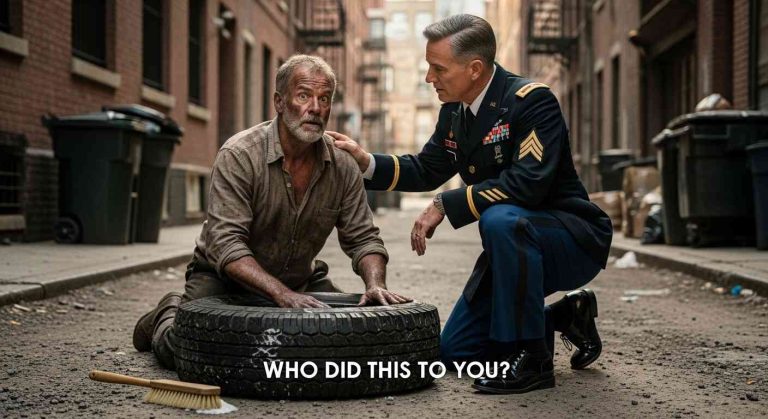
Arthur turned to Sarah. He reached out and took her hand. “”Thank you for the coffee offer, Sarah. And thank you for standing up. You were the only one who saw a human being today.””
He unclipped the silver ring from around his neck—his West Point class ring—and placed it in her palm. “”Keep this. If you ever need anything—medical bills, school, a new diner—you call the number engraved on the inside. Tell them Arthur sent you. They’ll take care of the rest.””
“”Arthur, I…”” Sarah started, tears blurring her vision.
“”Go inside, Sarah. It’s about to get very loud.””
Chapter 5: The Resurrection
Arthur Vance stepped into the back of the black Suburban. The moment the door closed, the “”Old Artie”” vanished. He took a tablet from Miller and began swiping through satellite imagery with a speed that made Miller’s head spin.
“”They moved the 4th Armored Division to the border?”” Arthur asked, his voice cold and analytical.
“”Two hours ago, sir,”” Miller replied.
“”Fools. It’s a feint. They’re going through the mountain pass in the north. Tell the Admiral to move the carrier strike group to the coordinates I’m sending now. We have twenty minutes to prevent a total blackout.””
Outside, the scene was chaotic. The Black Hawks began to lift off, the sheer force of their engines blowing over the temporary fences of the construction site. The managers were being loaded into a separate van, their faces pale and tear-streaked.
The laborers who had watched the humiliation now stood and cheered. They didn’t know the specifics of the global crisis, but they knew one thing: the man who had worked beside them in the trenches was a giant. And the bullies had finally met someone they couldn’t break.
As the convoy began to move, sirens wailing, the neighborhood watched in awe. This wasn’t just a military extraction; it was a resurrection. The “”Ghost”” was back, and he was bringing the lightning with him.
Inside the vehicle, Miller looked at Arthur. “”You lived in the mud for five years, sir. Why?””
Arthur looked out the darkened window at the construction site as it receded into the distance. “”I thought I needed to be punished for the men I lost, Miller. I thought if I felt the heat and the hunger, it would balance the scales.””
“”And did it?””
Arthur looked at the tablet, at the millions of lives hanging in the balance of the next hour’s decisions. “”No. I realized that the best way to honor the dead isn’t to suffer in a hole. It’s to make sure no one else has to die because the men in charge were too arrogant to listen.””