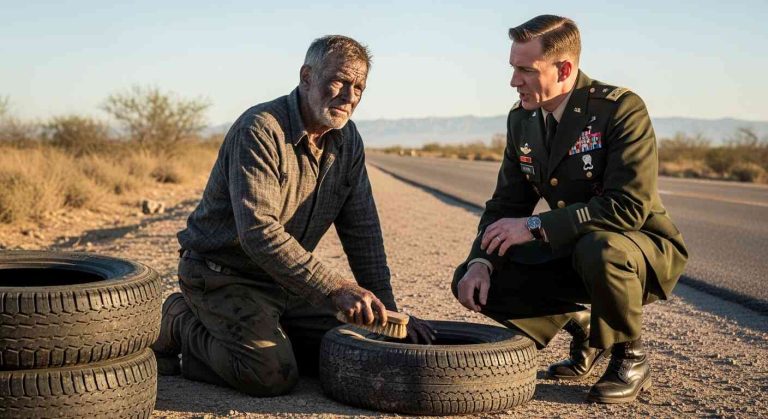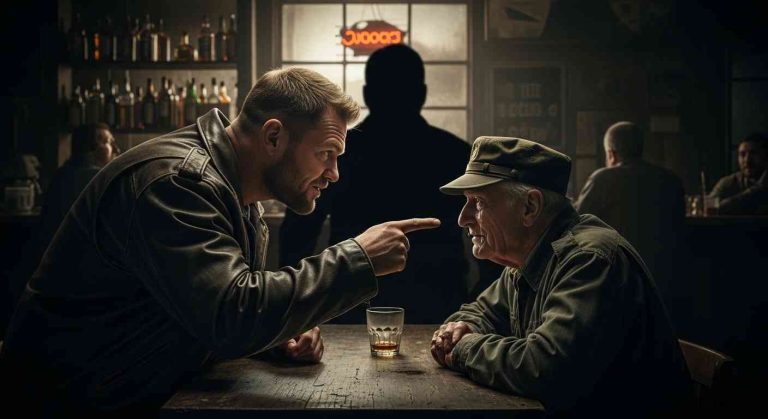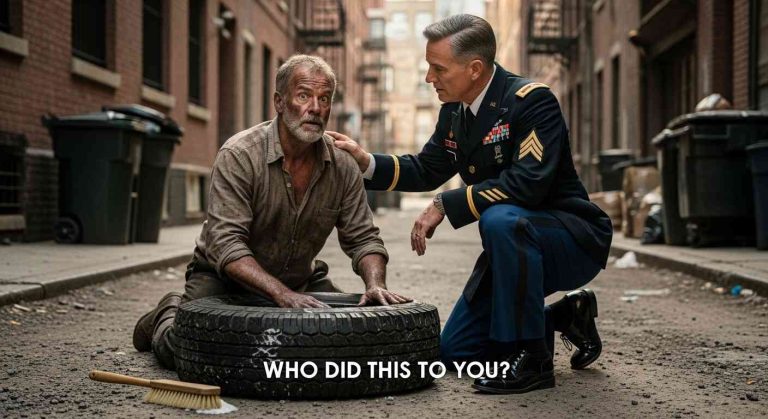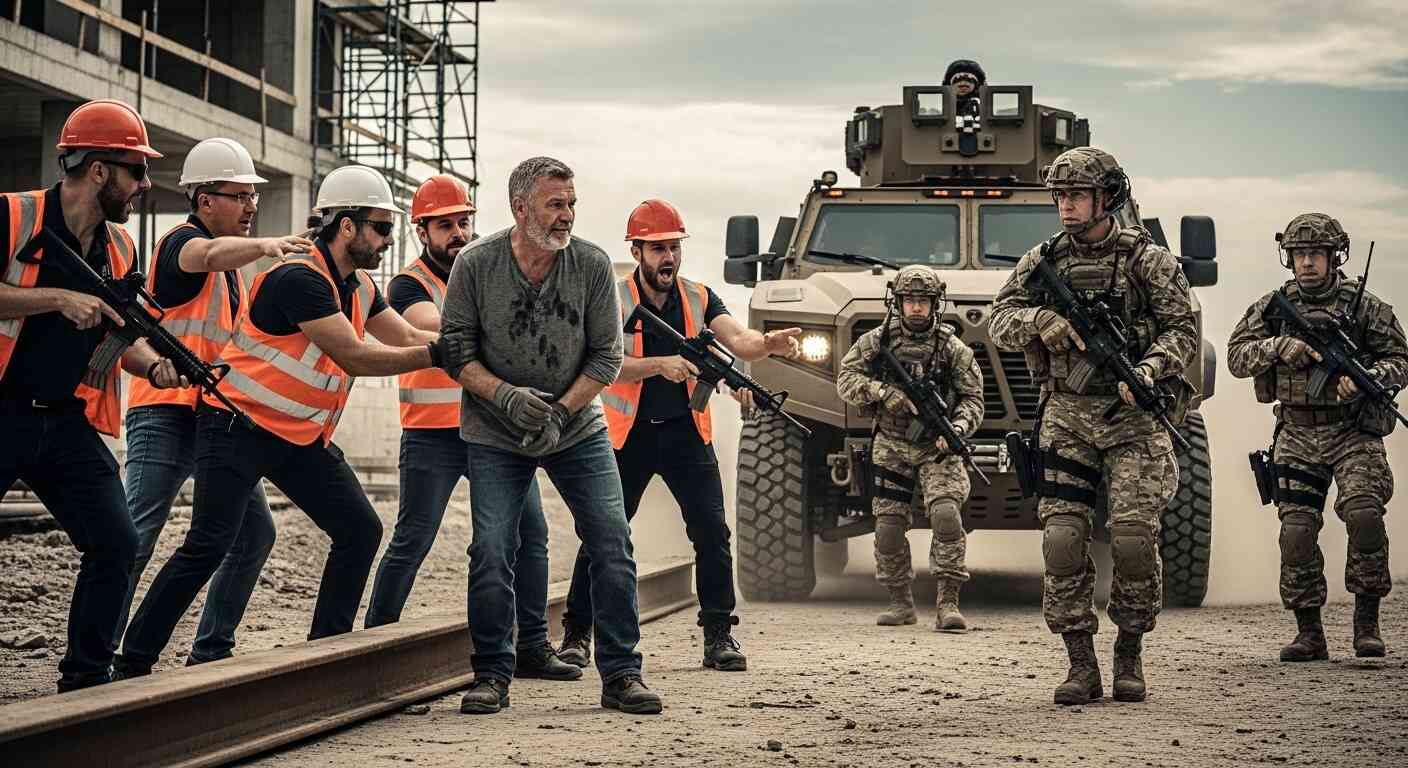
The punch didn’t hurt as much as the words did.
“Ancient history, Elias,” Jax sneered, his expensive silk tie fluttering in the drafty warehouse hallway. He shoved me again, his hand flat against my chest. “The world doesn’t need ‘strategists’ anymore. It needs results. You’re just a dinosaur in a work vest.”
I stood there, my boots planted firmly on the concrete I’d spent twelve hours a day sweeping. I could have broken his radius in three seconds. I could have collapsed his windpipe with a flick of my wrist. But I had promised Sarah—my daughter, my life—that those days were over.
“I’m just trying to do my job, Jax,” I said, my voice low.
The other four managers laughed. They were all under thirty, all wearing shoes that cost more than my monthly mortgage. They surrounded me, a wolf pack made of hair gel and entitlement.
“Your job is to stay out of the way,” another one, Miller, barked, stepping into my personal space. He reached out and flicked the small, faded Bronze Star pin I kept tucked under my collar. “This? This is garbage. You’re living in a fantasy, Thorne. You’re a nobody.”
Then, he did it. He shoved me hard enough that my back hit the industrial locker with a loud, metallic clang.
“What are you gonna do?” Jax taunted, leaning in close, his breath smelling of overpriced espresso. “Call for backup? The cavalry isn’t coming for a janitor.”
That was the moment the windows began to vibrate.
It started as a low hum, a frequency you feel in your teeth before you hear it in your ears. The managers looked around, confused. The mocking smiles began to fade as the coffee in Jax’s hand started to ripple.
Then came the roar.
Two MH-6 Little Birds hovered just outside the glass-walled lobby, their rotors kicking up a cyclonic storm of dust and debris. Black SUVs, the kind that don’t have license plates, screeched into the parking lot, blocking every single exit.
The managers scrambled back, their bravado evaporating instantly. “What the hell is this?” Jax stammered, his face turning the color of ash.
The heavy industrial doors didn’t just open—they were breached. A dozen men in full tactical gear, moving with the synchronized lethality of a precision machine, flooded the corridor.
They didn’t look at the managers. They didn’t look at the screaming staff. They looked at me.
A man in a charcoal suit, with a face carved from granite, stepped through the line of soldiers. It was Marcus. My best student. My brother-in-arms.
He walked straight up to Jax, who was trembling so hard he couldn’t stand straight. Marcus didn’t say a word. He just looked at Jax’s hand—the one that had shoved me—then looked at me.
“Colonel Thorne,” Marcus’s voice echoed through the silent hallway, vibrating with a terrifying, suppressed rage. “We’ve been looking for you for three days. The Pentagon is on a Level 5 lockdown. They need the man who wrote the book on the Black Sea maneuvers.”
He turned his gaze back to the five managers, who looked like they were about to faint.
“Now,” Marcus whispered, a sound colder than the Arctic, “who exactly decided it was a good idea to lay hands on a National Treasure?”
“FULL STORY
Chapter 1: The Weight of Silence
The fluorescent lights of the Sterling Logistics warehouse hummed with a persistent, nagging buzz that always seemed to sync up with the throb in Elias Thorne’s lower back. At fifty-two, Elias was a man built of scars and secrets, though to the world, he was simply “”Shift Lead 421.”” He wore a grey polyester vest, carried a clipboard like a shield, and kept his head down.
He had spent twenty-five years in the shadows of the world’s most dangerous corridors—Pentagon war rooms, humid jungles in Southeast Asia, and frost-bitten ridges in the Hindu Kush. He was the man who didn’t just fight wars; he visualized them three moves before they began. But that life had cost him everything. It had cost him his wife’s final years, his youth, and very nearly his soul.
Now, his only mission was Sarah. His daughter was twenty-one, a brilliant nursing student with her mother’s eyes and a heart that was currently failing. The bills for her specialized care were astronomical, which was why a man who could command an army was currently checking inventory on pallets of industrial solvent.
“”Thorne! My office. Now.””
The voice belonged to Jax Miller. Jax was twenty-six, the son of a regional VP, and possessed the specific kind of cruelty that only comes from never having been punched in the face.
Elias wiped his grease-stained hands on a rag and walked toward the glass-walled “”Command Center”” perched above the warehouse floor. Four other junior managers were already there, leaning against the desks, looking bored and predatory.
“”We’re missing a shipment of high-end electronics, Elias,”” Jax said, not looking up from his tablet. “”Funny how that happens on your shift.””
“”The shipment was diverted to the North dock by your father’s orders, Jax,”” Elias said calmly. “”I logged it at 0400. It’s in the system.””
Jax slammed the tablet down. “”Don’t you ‘Jax’ me. And don’t you dare bring my father into this to cover your incompetence. You’re a dinosaur, Thorne. You’re slow, you’re expensive, and you’ve got this arrogant ‘hero’ vibe that makes everyone sick.””
One of the other managers, a guy named Toby who lived for Jax’s approval, chimed in. “”He thinks because he spent some time playing soldier thirty years ago, he’s special. My grandfather was in the service, Thorne. He didn’t act like his presence was a gift to the world.””
“”I don’t act like anything,”” Elias said, his voice dropping an octave. “”I work. I do my job.””
“”You’re a relic,”” Jax sneered, stepping out from behind the desk. He walked up to Elias, invading his space. Elias didn’t flinch. He had stared down warlords who ate human hearts; a kid in a tailored suit was nothing.
Jax reached out and flicked the collar of Elias’s work shirt, revealing the tiny, faded ribbon Elias wore pinned to his undershirt—a habit he couldn’t break. “”Look at this. Ancient history. Does this make you feel brave? Does it make you feel like more than a glorified janitor?””
“”Leave it alone, Jax,”” Elias warned.
“”Or what?”” Jax laughed, looking at his friends. “”What are you going to do, ‘Colonel’? Call a strike? Look at you. You’re a broken-down old man who can’t even afford his kid’s medical bills without our charity.””
The mention of Sarah was the tripwire. Elias’s eyes darkened, a flash of the “”Ghost of Kabul”” flickering in his pupils. Jax saw it and, for a second, he hesitated. But his ego was too large to back down in front of his peers.
He shoved Elias. Hard.
Elias let it happen. He absorbed the blow, his back hitting the lockers with a dull roar. He knew the rules. If he fought back, he lost his insurance. If he lost his insurance, Sarah died.
“”See?”” Jax mocked, turning to the others. “”The ‘war hero’ is just a bag of wind. He’s nothing. He’s—””
The windows rattled.
The sound started as a low-frequency thrum, a vibration that made the pens on the desk dance. Then, the sky outside the warehouse turned black. Not from clouds, but from the massive, dual-rotor silhouettes of Chinook transport helicopters descending toward the parking lot.
Down in the warehouse, the workers stopped. The forklifts went silent.
Jax’s jaw dropped. “”What… what is that? Is that a drill?””
Elias didn’t answer. He knew that sound. It was the sound of a world he had tried to leave behind, finally catching up to him.
The warehouse doors were kicked off their hinges with a thunderous crack. Men in charcoal-grey tactical gear, devoid of any national insignia but carrying the most advanced weaponry on the planet, swarmed in. They moved with a terrifying, silent speed.
In the glass office, the five managers scrambled back, huddled against the far wall like cornered rats.
“”Elias, what did you do?”” Jax whimpered, his voice cracking.
The office door was kicked open. A man in a dark suit, his face a mask of controlled fury, stepped in. It was Marcus Vance, the Director of Special Operations.
He didn’t look at the chaos. He didn’t look at the trembling managers. He walked straight to Elias, who was still standing by the lockers, his work vest torn.
Marcus stopped six inches from Elias and snapped to the most perfect salute Elias had ever seen.
“”Colonel Thorne,”” Marcus said, his voice echoing like a gunshot. “”The President has authorized a Tier One retrieval. We have a crisis in the Mediterranean, and the Joint Chiefs won’t move a single asset until you’ve reviewed the board. They realize now… there is no ‘modern’ warfare without your brain.””
Marcus’s eyes then shifted to Jax, who was shaking so hard his knees were knocking. Marcus saw the coffee stain on Elias’s vest. He saw the bruise forming on Elias’s shoulder.
“”Sir,”” Marcus said, his voice dropping to a whisper that felt like a death sentence. “”Did this… civilian… just assault a Five-Star Emeritus of the United States Intelligence Command?””
The silence that followed was the loudest thing in the room.
Chapter 2: The Ghost and the Machine
The warehouse office, which had felt like a kingdom to Jax Miller only moments ago, now felt like a cage. The tactical team stood like statues, their suppressed rifles angled toward the floor, but their presence filled every cubic inch of the room.
Jax’s mouth opened and closed, but no sound came out. He looked at the man he had called a “”dinosaur””—the man he had shoved, mocked, and belittled. Elias Thorne hadn’t moved. He stood with his arms at his sides, his expression unreadable, a statue of weathered granite.
“”I asked you a question, son,”” Marcus Vance said, stepping toward Jax. The Director of Special Operations was a man of immense power, but standing next to Elias, he looked like an apprentice. “”Did you lay hands on this man?””
“”I… I didn’t know,”” Jax stammered, his eyes darting toward his friends, who had effectively vanished into the shadows of the corner. “”He’s just a shift lead. He… he was losing equipment. I was just… disciplined… I didn’t…””
“”Discipline?”” Marcus’s laugh was short and devoid of humor. “”You were ‘disciplining’ the man who designed the urban pacification protocols for three different continents? The man who was awarded the Medal of Honor in a ceremony so secret the public won’t hear about it for fifty years?””
Marcus turned back to Elias. “”Elias, say the word. I’ll have them in a black site by sundown. We can call it a matter of national security. Interfering with a high-value asset during a time of global crisis.””
Elias finally spoke. His voice was raspy, the sound of a man who didn’t use it often. “”Lower your weapon, Marcus. They’re just kids. They don’t know what a real threat looks like.””
“”That’s the problem, sir,”” Marcus countered. “”They think the world is a playground because men like you built the fences. They shouldn’t get to spit on the builder.””
Elias looked at Jax. The young man’s bravado had completely collapsed. He looked small. Pathetic. Elias felt no satisfaction in it—only a profound weariness.
“”I need to see my daughter,”” Elias said.
“”She’s already being moved, sir,”” Marcus said, his tone softening. “”The best cardiac team at Walter Reed is waiting for her. We’ve cleared her debt. We’ve cleared your mortgage. Consider it back pay for the last five years of ‘consulting’ you didn’t know you were doing.””
Elias felt a weight lift off his chest, one he hadn’t realized was crushing his ribs for years. Sarah was safe. That was the only victory that mattered.
“”And my job?”” Elias asked, glancing at the warehouse floor where hundreds of workers were watching in stunned silence.
“”Sir, with all due respect,”” Marcus said, gesturing toward the waiting helicopters, “”you’ve got a much bigger job to do. The world is burning, and you’re the only one who knows where the fire extinguishers are buried.””
Elias looked at his clipboard one last time. He set it down on Jax’s desk. “”The inventory is correct, Jax. Check the North dock. Maybe next time, try looking at the data before you start swinging.””
As Elias walked out of the office, flanked by the elite squad, the warehouse workers began to clap. It started with one, then ten, then the whole floor. They had all seen the way the managers treated the quiet man in the grey vest. They had all seen his dignity.
At the door, Elias paused and looked back at Marcus. “”The five of them. Don’t send them to a black site.””
Jax breathed a sigh of relief.
“”But,”” Elias added, “”make sure they never work in a position of authority again. They aren’t fit to lead a parade, let alone a company.””
Elias stepped out into the swirling dust of the parking lot. The sun was breaking through the clouds, catching the black metal of the helicopters. He climbed into the lead bird, the familiar scent of hydraulic fluid and ozone filling his lungs.
As the helicopter rose, Elias looked down at the shrinking warehouse. He saw Jax standing in the parking lot, looking up, a tiny, insignificant speck in a world that was far bigger and more dangerous than he could ever imagine.
Elias Thorne was a ghost no longer. The strategist had returned.
Chapter 3: The War Room’s Shadow
The transition from the grimy, oil-scented floor of Sterling Logistics to the sterile, high-tech hub of the Pentagon’s Sub-Level 4 was jarring. Within four hours, Elias had been scrubbed, suited in a sharp navy blazer, and briefed on three separate geopolitical flashpoints.
But his mind was three miles away, at Walter Reed National Military Medical Center.
“”She’s stable, Elias,”” Marcus said, walking beside him through the corridors where every person they passed stopped to snap a salute. “”The surgery is scheduled for 0600 tomorrow. The team is the best in the world. They know if they fail, they answer to me. And if they answer to me, they’re really answering to you.””
“”I don’t want them afraid, Marcus,”” Elias said, his eyes scanning the monitors lining the walls. “”I want them focused.””
They entered the Strategic Command Center—the “”Tank.”” Inside, the Joint Chiefs of Staff were gathered around a massive holographic map of the Mediterranean. The air was thick with tension and the smell of stale coffee.
“”He’s here,”” a four-star General whispered.
The room went silent. These were the men who moved fleets and decided the fate of nations, yet they looked at Elias Thorne like he was a prophet returned from the wilderness.
“”Colonel,”” the Chairman of the Joint Chiefs said, stepping forward. “”We have a carrier strike group boxed in. The adversary is using a localized jamming technique we’ve never seen. Our simulations give us a 40% loss rate if we try to break out. We’re told you predicted this scenario in a paper you wrote twelve years ago.””
Elias didn’t look at the General. He walked to the holographic map. He didn’t see lights and icons; he saw flow. He saw the way the water moved, the psychology of the opposing commander, the invisible threads of logistics.
“”You’re looking at the jamming as a wall,”” Elias said, his voice cutting through the room’s anxiety. “”It’s not a wall. It’s a funnel. They want you to move East. If you move East, you’re dead.””
He reached out, his fingers dancing across the interface. He began to rearrange the fleet’s trajectory, moving them into a formation that looked suicidal to the untrained eye.
“”That leaves the flank exposed!”” an Admiral protested.
“”No,”” Elias said, not looking up. “”It leaves the bait exposed. They can’t jam what they think they’ve already conquered. We’re going to let them think they’ve won for exactly six minutes. In that window, their cooling systems for the jamming arrays will spike. That’s when we don’t shoot them. We ghost them.””
As he spoke, the room began to shift. The panic receded, replaced by the cold, hard logic of a master at work. Elias was back in his element, but a part of him felt a strange hollow ache. He had spent his life winning these games, but the cost had always been personal.
Between the tactical updates, his mind drifted back to the warehouse. He thought about Jax Miller. He realized that Jax wasn’t the enemy—Jax was the result of a world that had forgotten what true service looked like. People like Jax lived in the safety Elias provided, and in that safety, they became soft, arrogant, and blind.
“”Sir?”” a young lieutenant asked, holding out a secure phone. “”A call from Walter Reed. It’s the surgeon.””
Elias took the phone, his hand trembling slightly—the first sign of weakness anyone in that room had ever seen from him.
“”This is Thorne.””
“”Colonel, your daughter is awake. She’s asking for you. She says she won’t go into the OR until she sees ‘the old man in his Sunday best.'””
Elias felt a lump in his throat. He looked at the map, then at the row of Generals waiting for his next command.
“”Marcus,”” Elias said. “”Take over the board. You know the play. I have a more important theater to attend to.””
“”Go, sir,”” Marcus said with a smirk. “”The world can wait twenty minutes for Sarah.””
As Elias walked out, he realized he wasn’t just a strategist or a veteran. He was a father. And for the first time in his life, those two roles were finally in alignment.
Chapter 4: The Heart of the Matter
The hospital room was quiet, save for the rhythmic hiss of the ventilator and the soft beep of the heart monitor. Sarah looked small against the white sheets, her skin pale, but her eyes—those sharp, observant eyes—were as bright as ever.
When Elias walked in, her face transformed. “”Look at you,”” she whispered, her voice raspy. “”You traded your vest for a suit. Did you finally tell them you’re the boss of the world?””
Elias sat by her bed and took her hand. It felt like parchment. “”I told them I was the boss of a very stubborn nursing student.””
Sarah smiled, then winced as the movement pulled at her chest. “”I saw the news, Dad. Helicopters at the warehouse? You really can’t do anything quietly, can you?””
“”They were… persistent,”” Elias said.
“”I’m glad,”” she said, her grip on his hand tightening. “”I hated that you were hiding. I hated that those people at that company didn’t see you. They didn’t know who you were.””
“”It didn’t matter what they saw, Sarah,”” Elias said. “”As long as you were taken care of.””
“”It matters to me,”” she said firmly. “”You’ve spent your whole life protecting people who don’t even know your name. You deserve to be seen.””
Elias stayed with her until the nurses came to prep her for surgery. As they wheeled her away, he felt a familiar fear—the fear of a mission where he had no control over the outcome. In war, he could account for variables. In medicine, he could only pray.
He spent the next six hours in the waiting room, refusing the VIP lounge Marcus had offered. He sat in the hard plastic chairs with the other families—a mother crying over a toddler, an old man staring at a TV. He felt more at home here than in the Tank.
Just after dawn, the surgeon emerged. He looked exhausted but triumphant.
“”She’s a fighter, Colonel. The heart took the transplant perfectly. She’s going to have a long, healthy life.””
Elias leaned back against the wall, his eyes closing as a single tear escaped. The strategist had won his most important battle.
Chapter 5: The Reckoning
Three days later, Elias returned to Sterling Logistics. Not to work, but to close the chapter.
He arrived in a black SUV, but this time, he was alone. No soldiers, no helicopters. Just a man in a simple jacket.
The warehouse was different. There was a hush as he walked through the floor. People nodded to him, their eyes full of respect and a bit of awe. He made his way up to the glass office.
Jax Miller was there, but he wasn’t behind the desk. He was packing a cardboard box. His four friends were gone—fired forty-eight hours ago. Jax had been kept on just long enough to see his replacement arrive.
Jax looked up as Elias entered. The arrogance was gone, replaced by a hollow, haunted look.
“”I heard about your daughter,”” Jax said, his voice barely a whisper. “”I’m… I’m glad she’s okay.””
“”Thank you, Jax,”” Elias said.
“”I lost everything,”” Jax said, gesturing to the box. “”My dad disowned me. He said I was a ‘liability to the brand.’ No other logistics firm will touch me. I’m blacklisted.””
Elias looked at the young man. He saw the ruins of a life built on sand.
“”You didn’t lose everything because of me, Jax,”” Elias said. “”You lost it because you thought power was something you used to make people small. Power is something you use to keep people safe. You had the title, but you never had the leadership.””
“”I just wanted to be like my father,”” Jax confessed, a tear hitting the brim of the box.
“”Then be better than him,”” Elias said. He reached into his pocket and pulled out a small business card. It was for a veteran-run construction firm in the city. “”Go there. Tell them Elias Thorne sent you. You’ll start at the bottom. You’ll sweep floors, you’ll carry lumber, and you’ll learn what it means to actually earn a living. If you survive six months without complaining, they might teach you how to build something.””
Jax looked at the card, then at Elias. “”Why? Why help me after what I did?””
Elias looked out over the warehouse. “”Because a strategist always looks for the best possible outcome. And the best outcome isn’t you being destroyed. It’s you becoming a man.””
As Elias walked away, he felt the last of the old bitterness leave him. He had spent his life in the architecture of destruction. It was time to start building.