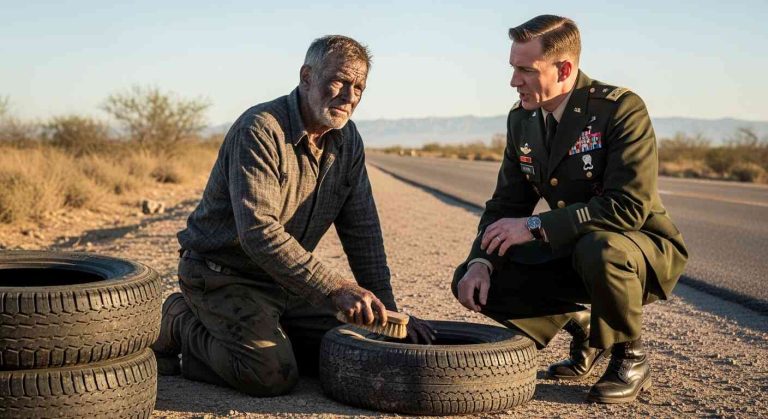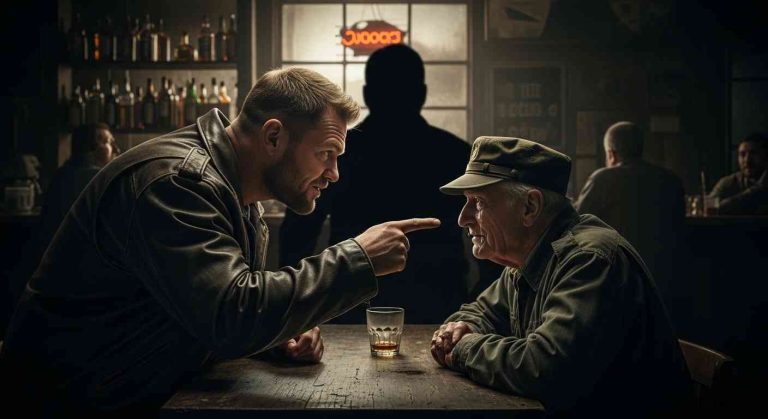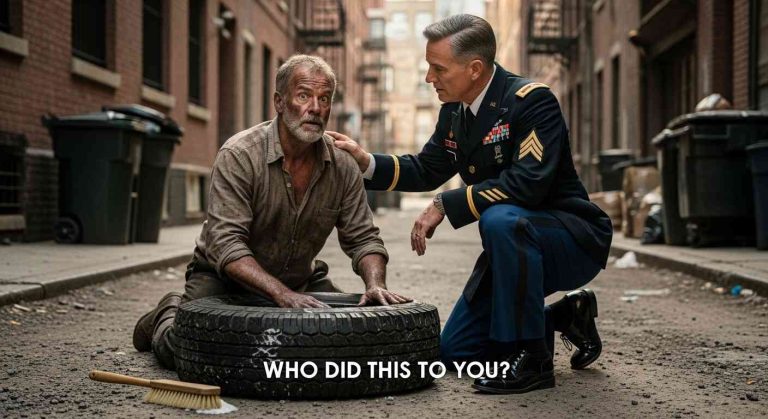
The rain in Ohio doesn’t just fall; it bites. It was 3:00 AM, and the temperature had dropped into the low thirties. I had been on my feet for twenty hours straight, moving rusted steel drums for a company that didn’t even know my real name.
My hands were raw, the skin peeling back in wet strips. Every time I slowed down, Miller was there. Miller was the kind of man who wore a three-hundred-dollar North Face jacket to watch other men drown in the mud. He found a strange, sick joy in watching me—a guy he thought was a “broken vet” with no place to go—shiver until my teeth rattled.
“Keep moving, 402,” he barked, kicking a spray of slush onto my boots. “That oil isn’t going to transport itself.”
I didn’t look up. If I looked up, he’d see the fire in my eyes, and the mission required the fire to stay hidden. I was supposed to be a ghost. I was supposed to be dead. For three years, the world believed General Caleb Thorne had perished in a black-op betrayal in the mountains of Kyrgyzstan. I liked it that way. No more blood on my hands. No more lives on my conscience.
But then, the spill happened.
My grip slipped on a slick, fifty-five-gallon drum. It hit the concrete with a metallic scream, the lid popping off. Black crude oil rushed out, mingling with the freezing rain, staining the pristine white gravel of the executive parking lot.
Miller was on me in seconds. He didn’t just yell. He swung a heavy, industrial-grade flashlight into my ribs. I went down, the breath leaving my lungs in a white puff of agony.
“Do you have any idea what that costs?” Miller hissed, grabbing me by the hair and forcing my face toward the black puddle. “You’re going to clean this up. With your hands. And when you’re done, I’m going to make sure you never find work in this state again.”
Nine other supervisors stood in a semi-circle around us, their breath misting in the air. Some looked bored. Some looked amused. None of them moved to help.
Except Sarah. Sarah worked the manifest desk. She was a mother of two who shared her sandwiches with me when she thought I looked hungry.
“He’s hurt, Miller! Let him go!” she cried, stepping forward.
Miller didn’t even look at her. He just shoved me deeper into the oil. “Stay back, Sarah, unless you want to join him in the unemployment line.”
I lay there in the freezing muck, the smell of petroleum filling my nose. My body was screaming, but my mind was suddenly very, very calm. I reached into my soaked pocket and felt the small, waterproof transmitter I hadn’t touched in three years.
I had promised myself I would never turn it on. I had promised I was done with that life.
But as Miller’s boot connected with my kidney again, I realized some men only understand one language.
I pressed the button.
“FULL STORY
Chapter 1: The Weight of Silence
The freezing rain was a rhythmic hammer against the corrugated metal of the warehouse roof. It was the kind of cold that lived in your marrow, a deep, aching dampness that no amount of layers could ward off. For Caleb, it was just another Tuesday in a long string of days designed to make him forget who he used to be.
He was currently “”Employee 402″” at Raven-Cross Logistics, a sprawling shipping hub on the outskirts of a dying town in the American Midwest. To the people here, he was a drifter. A man with a scarred back and a quiet voice who never complained about the overtime or the sub-minimum wage pay. He lived in a trailer park three miles down the road, ate canned soup, and kept his head down.
It was a far cry from the Situation Room in D.C. It was worlds away from the tactical headsets and the weight of a thousand lives hanging on his every word.
“”Forty-two! You’re lagging!””
The voice belonged to Miller, a man whose entire personality was built on the shaky foundation of a middle-management title. Miller was short, thick-necked, and possessed the unique cruelty of a man who had never known true power, only the ability to bully those beneath him.
Caleb didn’t answer. He just adjusted his grip on the rusted iron trolley. He had been working for twenty hours straight. The warehouse manager, a man named Vance who spent most of his shifts betting on horse races in his office, had “”misplaced”” the schedule, forcing the night crew to stay through the morning and back into the evening.
Caleb’s muscles weren’t just sore; they were failing. He could feel the tremors in his thighs, the way his vision blurred at the edges. But he pushed. He had endured worse in the Hindu Kush. He had survived three days in a spider hole with a broken femur. He could handle a double shift in Ohio.
“”I’m talking to you, dirtbag,”” Miller said, stepping into Caleb’s path. He was flanked by two other supervisors—younger guys, kids really, who thought being mean was the same thing as being a leader.
Caleb stopped the trolley. He kept his eyes on the ground, watching the rain bounce off Miller’s polished leather boots. “”I hear you, Mr. Miller.””
“”Then move faster. This shipment of crude-derivative lubricants needs to be staged by 0400. If it’s not, it’s coming out of your pay. Which, considering how much you owe the company store for those boots, means you’ll be working for free until Christmas.””
Miller laughed, a wet, unpleasant sound. The two kids behind him chuckled dutifully.
Caleb moved. He put his weight into the trolley, his boots slipping on the slick concrete. The rain turned to sleet, stinging his eyes. He reached the edge of the loading dock, where a line of fifty-five-gallon drums sat waiting. The area was lit by a single, flickering halogen bulb that cast long, sickly shadows across the yard.
As he reached for the first drum, his foot hit a patch of black ice masked by an oil sheen.
His legs went out from under him. The trolley surged forward, slamming into the line of drums. One of them—a heavy, unsealed container meant for internal transfer—toppled over.
The sound was like a gunshot. The lid flew off, and five hundred pounds of thick, pungent industrial oil glugged out onto the white gravel, spreading like an ink blot in the moonlight.
The silence that followed was heavier than the rain.
“”Oh, you’ve done it now,”” whispered one of the supervisors.
Miller didn’t scream at first. He walked over slowly, his face turning a dark, bruised purple. He looked at the oil, then at Caleb, who was struggling to stand up, his clothes now soaked in the black sludge.
“”Do you have any idea,”” Miller said, his voice trembling with a terrifying, quiet rage, “”what the environmental fine for a spill this size is? Do you have any idea how much paperwork I’m going to have to do because you’re a clumsy, worthless piece of trash?””
“”It was an accident,”” Caleb said, his voice raspy from the cold. “”The ice—””
Miller didn’t let him finish. He swung a heavy, metal Maglite. The impact hit Caleb square in the ribs. He went back down into the oil, the breath escaping him in a jagged gasp.
“”Clean it,”” Miller hissed. “”Get on your knees and start scooping it back in. Now.””
From the shadows of the warehouse door, Sarah watched, her knuckles white as she gripped a clipboard. She was the only person in this godforsaken place who treated Caleb like a human being. She saw the blood starting to mix with the oil on his face, and for the first time in her five years at Raven-Cross, she felt something break inside her.
“”Miller, stop!”” she shouted, her voice echoing off the metal walls. “”He’s hurt! Call an ambulance!””
Miller turned, a sneer twisting his features. “”Get back inside, Sarah. This is man’s work. Or do you want to be the one to tell the CEO why his parking lot looks like an Exxon disaster?””
Caleb lay in the mud, feeling the sharp bite of his broken ribs. He looked up at the sky, the gray clouds swirling overhead. For three years, he had tried to be a nobody. He had tried to pay for the sins of his past by suffering in silence.
But as Miller raised the flashlight for another strike, Caleb realized that some people don’t want your silence. They want your soul.
He reached into his pocket. His fingers, numb and oily, found the small, recessed button of the beacon. He had carried it every day, a reminder of the life he’d left. He had never intended to use it.
Forgive me, Lord, he thought. I tried to be peaceful.
He pressed the button.
A hundred miles above the earth, a satellite picked up a localized burst of encrypted data. Within seconds, a red light began to flash in a subterranean bunker in Virginia. A man in a crisp uniform dropped his coffee cup, his eyes widening as he read the coordinates on his screen.
“”Sir?”” he whispered, his voice shaking. “”We have a Ghost Signal. Code Eagle-One. It’s… it’s the General. He’s alive.””
Chapter 2: The Ghosts We Carry
The pain in Caleb’s side was a dull, rhythmic throb, a familiar companion from a dozen different battlefields. But the cold… the cold was different. It was the kind of cold that reminded him of the mountains outside Kabul, the night his convoy had been hit by a coordinated IED strike.
That was the night Caleb Thorne had died. At least, that was the night the world thought he had died.
In reality, he had crawled out of the burning wreckage of his Humvee, his lungs filled with smoke and his heart filled with a devastating realization: the coordinates for their route had been leaked from within his own command. He had been sold out by the very men he’d shared whiskey with at the Pentagon.
So, he stayed dead. He had spent months recovering in a series of safe houses run by people who owed him favors, people who didn’t ask questions. When he was finally whole again—at least physically—he didn’t go back to D.C. to demand justice. He went to Ohio.
He wanted a life where the only thing he was responsible for was the weight on his shoulders. No more maps. No more “”acceptable losses.””
“”I said scoop it up!”” Miller’s voice tore through the memory.
Caleb was on all fours in the oily slush. He could feel the eyes of the other managers on him. There were ten of them now, a small army of petty tyrants who had come out to watch the show. They were bored men, men who felt small in their own lives, and seeing a man like Caleb—who, even in the mud, possessed a strange, quiet dignity—brought low gave them a thrill they couldn’t explain.
“”Look at him,”” one of the younger managers laughed, pointing a phone camera at Caleb. “”The big tough guy is crying. Look at the tears.””
Caleb wasn’t crying. The water on his face was rain. His eyes were clear, focused on a point about six inches in front of him. He was calculating. He was estimating the time of arrival.
If the beacon worked, the closest extraction team would be coming from Wright-Patterson Air Force Base. With the current weather, a ground team would take too long. They’d use the 75th Ranger Regiment’s high-altitude jump team if they were in the area for drills.
Six minutes, Caleb thought. Maybe seven.
“”Please, Miller, just let him go home,”” Sarah pleaded. She had moved closer, her face pale. She looked at Caleb, and for a second, their eyes met.
Caleb gave a nearly imperceptible shake of his head. Stay back, Sarah. This is about to get very loud.
“”He’s not going anywhere until this lot is clean,”” Miller said, stepping closer to Caleb. He reached out and grabbed Caleb’s ear, twisting it painfully. “”You hear me, 402? You’re going to spend the rest of the night on your belly. Maybe then you’ll remember who owns you.””
Caleb looked up then. For the first time in three years, he let the mask slip. The “”broken laborer”” vanished, and for a split second, Miller saw something else. He saw the man who had stared down warlords. He saw the man who had orchestrated the fall of regimes.
Miller flinched. He didn’t know why, but a sudden, primal fear shot through his nervous system. He let go of Caleb’s ear and stepped back, his hand shaking.
“”What are you looking at?”” Miller barked, trying to reclaim his bravado. “”Get to work!””
To cover his fear, Miller kicked Caleb again, this time in the shoulder. Caleb rolled with the blow, his body absorbing the impact.
“”Vance!”” Miller shouted toward the warehouse office. “”Get out here! This idiot just dumped five hundred gallons of product!””
Vance, the head manager, stepped out onto the dock. He was a large, balding man with a gambling debt that showed in the twitch of his eye. He looked at the mess, then at the clock.
“”The regional VP is coming in at dawn for a surprise inspection,”” Vance said, his voice cold. “”If this isn’t handled, Miller, it’s your head. Use whatever means necessary to get it cleaned.””
Miller grinned. “”You heard the boss, boys. ‘Whatever means necessary.'””
The ten managers closed in. They were picking up pieces of scrap wood, heavy flashlights, and lengths of chain used to secure the loading bay doors. They weren’t just going to make him work. They were going to break him for the sheer sport of it.
“”Caleb, run!”” Sarah screamed.
But Caleb didn’t run. He sat back on his haunches in the middle of the oil spill, his hands resting on his knees. He looked up at the black, swirling sky.
And then, he heard it.
A low, rhythmic thrumming. It wasn’t the wind. It was the sound of four T-56 turboprop engines cutting through the storm.
The managers stopped. They looked around, confused.
“”What is that?”” one of them asked, shielding his eyes from the rain.
“”Probably a cargo plane off course,”” Miller said, though he sounded uncertain.
The sound grew louder, a deep, bone-shaking vibration that made the oil in the puddles dance. Then, a massive shape emerged from the clouds—a C-130 Hercules, flying dangerously low, its lights off, a ghost in the rain.
Suddenly, the sky was filled with black shapes. They looked like seeds falling from a dark tree. Dozens of them.
“”Paratroopers?”” Vance whispered, his face going pale. “”What the hell is the Army doing here?””
Caleb stood up. He didn’t wobble. He didn’t wince. He stood straight, his shoulders broad, the oil dripping from his clothes like a discarded skin.
“”They aren’t the Army,”” Caleb said, his voice suddenly loud and clear, carrying over the roar of the engines.
He looked at Miller, who was staring at the sky in shock.
“”They’re mine.””
Chapter 3: The Descent of Kings
The first paratrooper hit the ground thirty yards away, landing with a soft thud on the gravel. Before the managers could even blink, the soldier had cut himself loose from his chute and moved into a low, tactical crouch, a suppressed carbine held with practiced ease.
Then another landed. And another.
They weren’t wearing standard-issue gear. They were in matte-black tactical suits, their faces obscured by ballistic masks with glowing red HUD displays. These were the Praetorians—the elite personal guard of the High Command, men hand-picked by Caleb himself years ago.
“”Don’t move!”” Miller screamed, his voice cracking. He lunged for Caleb, thinking he could use him as a shield, but he was too slow.
Caleb moved with a fluidity that shouldn’t have been possible for a man who had worked twenty hours. He caught Miller’s wrist, twisted it until the bone groaned, and sent him sprawling into the very oil spill he’d been so proud of.
The managers scrambled. Some tried to run toward the warehouse, but they were met by shadows emerging from the rain. Within seconds, all ten managers, including Vance, were forced onto their knees in the mud.
The Praetorians formed a perfect perimeter, their weapons trained on the shivering men in suits.
A final parachute opened directly above the loading dock. The figure steered it with surgical precision, landing inches away from Caleb. The soldier unclipped his helmet, revealing the scarred, weathered face of Major Elias Thorne—Caleb’s younger brother and most trusted officer.
Elias looked at Caleb. He saw the oil, the blood on his lip, and the tattered, cheap clothes. His jaw tightened, a vein throbbing in his temple.
“”General,”” Elias said, his voice thick with emotion. He snapped a crisp, razor-sharp salute. “”We’ve been looking for you for three years, six months, and twelve days.””
The thirty soldiers around them followed suit, their boots clicking together in unison. “”GENERAL!”” they roared, a sound that drowned out the rain.
Vance looked like he was about to have a heart attack. “”General? You… you’re just a temp. You’re a nobody!””
Caleb didn’t look at Vance. He looked at Elias. “”Status?””
“”The betrayal has been purged, sir,”” Elias reported. “”The men who sold you out are currently awaiting your judgment in a black site in the Atlantic. The Pentagon has been looking for you to lead the new coalition. The world is falling apart, Caleb. We need our strategist.””
Caleb sighed, the sound heavy with the weight of the world he’d tried to leave behind. He looked at his hands—the oil was starting to wash away in the heavy rain, revealing the steady, capable hands of a leader.
“”Who are these people?”” Elias asked, gesturing toward the managers with his weapon. “”And why are you covered in filth?””
Caleb looked at Miller. The manager was shaking so hard his teeth were literally chattering. He looked like a drowned rat, his three-hundred-dollar jacket ruined, his power evaporated.
“”These are managers,”” Caleb said quietly. “”They believe that because they have a title, they have the right to break the people who do the work. They believe that cruelty is a management style.””
Elias stepped toward Miller. The muzzle of his rifle hovered inches from Miller’s forehead. “”Is that right? You liked hitting him, didn’t you? You liked watching him shiver?””
“”I-I didn’t know!”” Miller sobbed. “”I was just doing my job! Please! I have a family!””
“”So did the men Caleb lost in Kyrgyzstan,”” Elias hissed.
“”Stand down, Elias,”” Caleb said.
The command was quiet, but it was absolute. Elias immediately lowered his weapon and stepped back.
Caleb walked over to Miller. He knelt in the mud, bringing his face level with the man who had spent the last six months trying to destroy him.
“”You told me earlier that I should remember who owns me,”” Caleb said.
Miller couldn’t even speak. He just let out a pathetic, whimpering sound.
“”The truth is, Miller, nobody owns anyone. We all have a choice. You chose to be a bully. You chose to be a coward. And now, you have to live with the consequences of those choices.””
Caleb stood up and turned toward the warehouse door. Sarah was still standing there, her hands over her mouth, tears streaming down her face.
Caleb walked up the ramp toward her. The soldiers stepped aside, clearing a path. He stopped in front of her and took her hand. It was small and warm, the only thing in this cold place that felt real.
“”Thank you, Sarah,”” he said softly. “”For the sandwiches. And for being the only person who saw me.””
He reached into his pocket and pulled out a small, heavy coin—his personal commander’s coin, made of solid titanium. He pressed it into her palm.
“”Take this to the bank on 5th Street tomorrow. Tell them you’re a friend of Caleb. They’ll take care of you and your kids. You don’t have to work for people like this ever again.””
Sarah looked at the coin, then back at him. “”Who are you, really?””
Caleb smiled, a sad, weary thing. “”Just a man who’s tired of the rain.””
Chapter 4: The Price of the Crown
The warehouse was now flooded with light—not the sickly halogen of the loading dock, but the blinding white tactical floods of the extraction team. A second C-130 was circling overhead, and the sound of approaching sirens suggested the local police were finally responding to the reports of “”an invasion.””
Vance was trying to negotiate. Even on his knees, with a rifle pointed at his spine, the man couldn’t stop trying to find an angle.
“”Listen!”” Vance shouted toward Elias. “”There’s been a misunderstanding! This man… Caleb… he’s a great worker! We’ll promote him! We’ll give him a bonus! Just tell your men to put the guns away. This is private property!””
Elias didn’t even look at him. He was busy handing Caleb a clean tactical jacket and a satellite phone.
“”The President is on Line One, sir,”” Elias said. “”He’s been informed of your recovery. He wants to apologize personally for the ‘clerical error’ that led to your status being listed as KIA.””
Caleb took the phone, but he didn’t press it to his ear. He looked at the managers. They were the small-scale version of the men he’d dealt with his entire career—men who sat in comfortable offices and made decisions that cost other people their lives, their dignity, and their health.
“”Elias,”” Caleb said. “”Call the Department of Labor. Call OSHA. Call the EPA. I want this facility shut down by sunrise. I want a full audit of every paycheck, every safety violation, and every instance of worker intimidation.””
“”Already in progress, sir,”” Elias replied. “”We’ve also seized the company’s digital servers. We found the gambling logs for Mr. Vance. It looks like he’s been skimming from the employee pension fund to pay off his bookies.””
Vance’s face went from pale to ghostly white. He slumped into the mud, the fight finally leaving him.
Caleb turned back to Miller. The man was still weeping, his face buried in his hands.
“”You’re not going to jail, Miller,”” Caleb said.
Miller looked up, a spark of hope in his eyes. “”I’m not?””
“”No. You’re going to stay here. You’re going to clean up every drop of that oil. With your hands. Just like you told me to do. And when you’re done, you’re going to walk into that warehouse and apologize to every single person on the night shift.””
“”And if I don’t?”” Miller whispered.
Caleb leaned in, his voice a low, terrifying growl. “”Then my brother and his friends will come back. And they won’t bring parachutes next time.””
Caleb turned and walked toward the edge of the parking lot, where a sleek, black helicopter was descending from the clouds, its rotors kicking up a storm of gravel and oil.
He stopped for a moment, looking back at the warehouse. It was a ugly, grey building in a town the world had forgotten. He had tried to find peace here, but he realized now that peace wasn’t something you found by hiding. Peace was something you fought for.
He climbed into the helicopter. Elias followed, closing the door behind them.
As the bird lifted off, Caleb looked down. He saw the tiny figures of the managers, still on their knees in the mud. He saw Sarah standing on the loading dock, holding the coin to her chest. And he saw the oil spill, a black scar on the earth.
He put the phone to his ear.
“”This is Thorne,”” he said, his voice echoing with the authority of a man reborn. “”I’m coming in. Get the maps ready.””