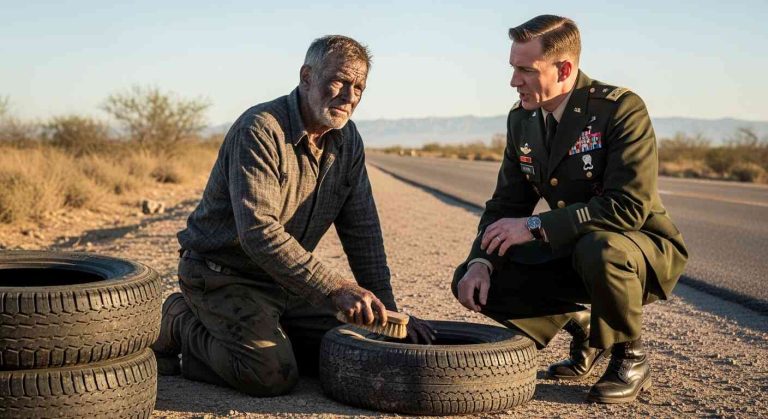
The heat in the Mojave doesn’t just burn your skin; it tries to eat your soul.
I was seventy-two years old, and my world had shrunk to the size of a rusted fuel nozzle and a paycheck that barely covered a trailer rental. I didn’t mind the work. I minded the silence. The kind of silence that comes when the world forgets you ever existed.
But Miller didn’t let it stay silent.
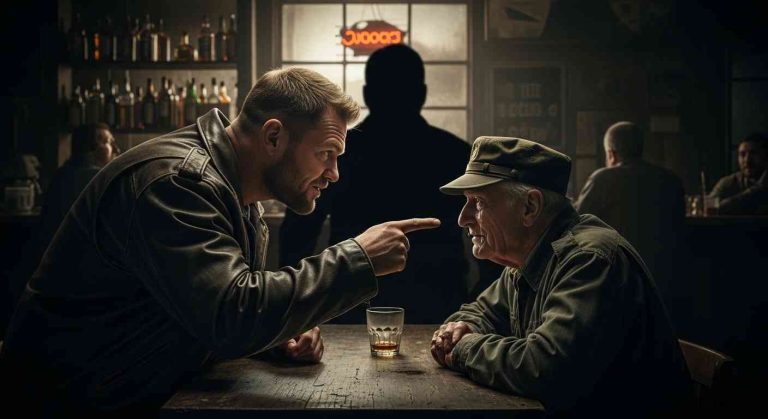
Miller was the kind of man who grew tall by stepping on the necks of those who couldn’t fight back. He stood over me, six-foot-four of cheap muscle and arrogance, his shadow blocking the only bit of relief I had from the sun.
“You spilled it, Thorne,” he barked, his voice like gravel in a blender. “Look at that. A whole damn gallon wasted because your hands are shaking like a leaf.”
It wasn’t a gallon. It was a single, iridescent drop that had beaded on the rim of the tank and fallen into the dust. One drop.
“I’ll clean it, Miller,” I said, my voice sounding like dry parchment.
He didn’t like that. He didn’t like the fact that I didn’t beg. He kicked the dust, sending a spray of grit into my eyes. “Clean it? With what? Your tears? You’re a useless old drunk. I don’t even know why the hell we keep you on the manifest.”
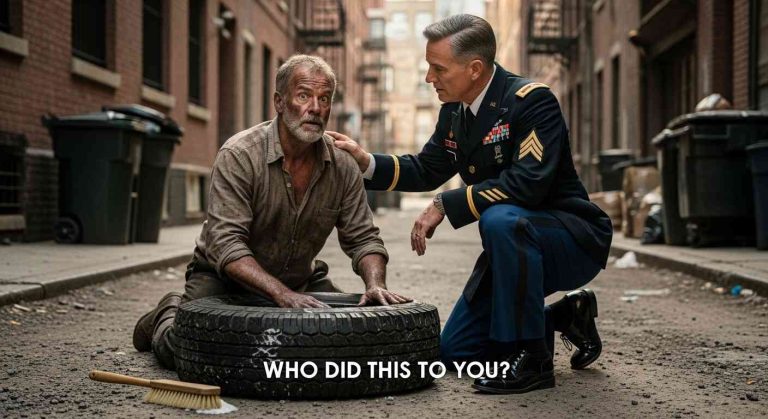
He pushed me. Not a playful shove, but a hard, two-handed strike to the chest that sent me sprawling into the dirt. My breath hitched, my lungs screaming as the heat from the ground seeped through my thin shirt.
Around him, the other nine supervisors—men half my age with hearts twice as hard—started to laugh. It was a cruel, rhythmic sound that drowned out the hum of the generators.
“Look at him,” Miller jeered, turning to his buddies. “The great Elias Thorne. Reaching for the dirt. That’s where you belong, old man. Six feet under it.”
I stayed down. Not because I couldn’t get up, but because I was tired. I was so incredibly tired of hiding. For fifteen years, I had lived as a ghost, a man with no past, paying for a sin I didn’t commit.
I closed my eyes and felt the vibration first.
It wasn’t the wind. It wasn’t the generators. It was a deep, tectonic shudder that started in the soles of my feet and raced up my spine. It was a sound I hadn’t heard in over a decade, but one I would recognize in my grave.
The laughter stopped.
Miller looked toward the horizon, his brow furrowing. “The hell is that? An earthquake?”
I pushed myself up onto my elbows, wiping the blood from my lip. “No, Miller,” I whispered, though he couldn’t hear me. “That’s not an earthquake.”
The horizon didn’t just shimmer with heat anymore. It darkened. A line of steel, cold and unrelenting, began to tear through the desert haze.
My boys were here.
“FULL STORY
Chapter 1: The Weight of a Single Drop
The Mojave sun was a physical weight, a shimmering hammer that beat against the corrugated tin roofs of the Fueling Station 4 outpost. At seventy-two, Elias Thorne felt every degree of it in his marrow. His hands, once steady enough to calibrate the guidance systems of long-range missiles, now felt brittle, like sun-bleached wood.
He was focused on the nozzle. It was a simple task—fueling the heavy transport trucks that moved through the desert corridor. But in the heat, simple tasks became endurance tests. A single bead of sweat rolled into his eye, stinging, and for a split second, his grip faltered.
A single drop of diesel fuel escaped the lip of the tank, falling through the shimmering air and landing with a tiny thud in the parched earth.
“”Hey! Old man!””
The voice was like a whip crack. Elias didn’t have to look up to know it was Miller. Miller was the site lead, a man who treated his position of minor authority like a divine right. He was followed by his “”Council””—nine other supervisors who spent more time leaning against air-conditioned trucks than actually working.
“”I saw that,”” Miller said, stomping over. His boots kicked up a plume of orange dust. “”You’re wasting company assets, Thorne. Do you have any idea what that fuel costs out here?””
Elias straightened his back, a ghost of his former posture flickering for a second before he remembered to slouch. “”It was a drop, Miller. I’ll cover the cost from my lunch break.””
“”Your lunch break?”” Miller laughed, a harsh, braying sound. He turned to the other nine men who had gathered in a semi-circle. “”He thinks he’s getting a lunch break. Thorne, you’re so slow a snail could outrun you. You’re already behind. You don’t get lunch. You get to work double shifts until that ‘drop’ is paid for with interest.””
“”That’s not in the contract,”” Elias said quietly.
Miller stepped into Elias’s personal space. He smelled of cheap cigarettes and stale coffee. “”I am the contract out here. You’re a ghost, Thorne. No family, no records before 2011, no nothing. You’re lucky I don’t just leave you in the scrub for the coyotes.””
Then came the shove.
It was sudden. Miller’s large palms slammed into Elias’s chest. Elias staggered back, his boot catching on a stray cable. He went down hard, his elbow barking against a rusted pipe. The pain was a hot flash, followed by the humiliating sensation of dirt filling his mouth.
The ten bosses roared with laughter. One of them, a younger man named Caleb who tried too hard to impress Miller, spat near Elias’s hand. “”Look at him. Can’t even stand up. My grandpappy has more spine than this guy, and he’s been in a casket for five years.””
Elias looked at them from the ground. He saw the cruelty in their eyes—the specific kind of cruelty that comes from men who feel small in the world and need someone even smaller to crush.
He didn’t feel anger. He felt a profound, weary sadness. Is this it? he wondered. Is this how the Great Architect of the Thorne Protocol ends? In the dirt, being mocked by men who couldn’t map a route to the grocery store?
He closed his eyes, pressing his cheek into the hot sand. He thought of the Pentagon. He thought of the tactical rooms filled with screens and the hum of high-stakes decisions. He thought of the faces of the young men and women he had trained—the ones he had taught to be lions.
And then, he felt it.
It started as a rhythmic thrum in the earth. A frequency that resonated in his chest. It was the sound of heavy treads. The sound of high-output turbine engines.
The laughter died away, replaced by a confused silence.
“”What is that?”” Miller asked, his voice losing its edge. He looked toward the northern ridge.
The ground began to dance. Pebbles hopped. The fuel in the glass gauges of the pumps began to ripple.
Elias didn’t move. He stayed in the dirt, a single tear carving a path through the dust on his face. He knew that sound. It was the sound of a debt finally being called in.
Chapter 2: The Ghost of the Pentagon
Fifteen years ago, Elias Thorne hadn’t been a “”fuel hand.”” He had been a myth.
As a Colonel in Special Operations, he was the man they called when a situation was deemed “”unsolvable.”” He had written the manual on asymmetrical warfare. But his greatest achievement was his students. He didn’t just teach them how to fight; he taught them how to think, how to lead, and how to remain human in the face of the inhuman.
Then came the Blackwood Incident.
A political scapegoating of the highest order. A mission had gone sideways due to faulty intel from the civilian side of the Department of Defense. Rather than let his team take the fall, Elias had shouldered the entire weight of the failure. He had walked away from his medals, his rank, and his life, disappearing into the vastness of the American West to live out his days in penance.
But he had forgotten one thing: Lions don’t forget who led them.
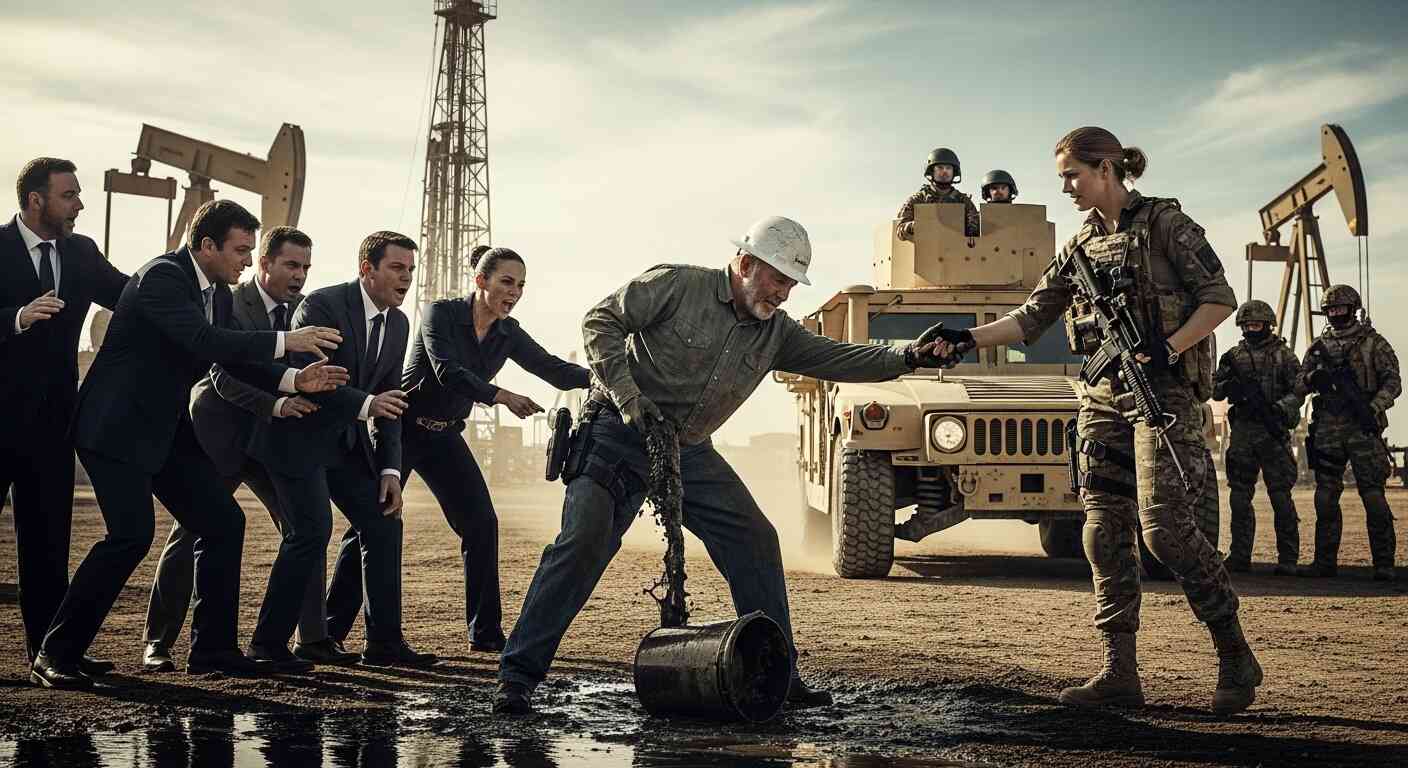
In the desert outpost, the vibration intensified into a roar. The ten bosses were no longer laughing. They were shielding their eyes against a sudden, violent wind.
Out of the heat haze, the first silhouette appeared. It wasn’t a truck. It wasn’t a civilian vehicle.
It was an M1A2 SEPv3 Abrams tank.
It crested the ridge like a prehistoric predator, its 120mm smoothbore gun pointed directly at the outpost. Then another appeared. And another. Six tanks in total, fanning out in a perfect tactical “”V”” formation.
Behind them, the sky was suddenly filled with the rhythmic thwack-thwack-thwack of rotors. Two AH-64 Apache attack helicopters dipped low, their sensor balls swiveling to lock onto every moving target on the ground.
Miller’s face went from pale to a sickly shade of grey. “”Army? Why the hell is the Army out here? We’re on private land!””
“”Miller,”” Elias said, his voice stronger now, more resonant. He pushed himself up to a kneeling position, ignoring the ache in his joints. “”I don’t think they’re here for the land.””
A black, up-armored SUV tore through the dust behind the tanks, drifting to a halt just yards from where Elias knelt. The doors opened with a heavy, mechanical thud.
The men who stepped out weren’t just soldiers. They were the elite. And the man in the lead wore four stars on his shoulders.
General Marcus Vance. The man they called “”The Hammer.””
Vance’s eyes swept the scene. He saw the fuel pumps. He saw the ten supervisors standing in a huddle of terror. And then, he saw Elias Thorne, kneeling in the dirt with a bloody lip.
The General’s face didn’t twitch, but the air around him seemed to drop twenty degrees.
“”General!”” Miller squeaked, stepping forward, his hands raised. “”Sir! There must be some mistake! We’re just a fueling station—this old man here, he’s a vagrant, he caused a spill—””
General Vance didn’t even look at Miller. He walked past him as if he were a piece of discarded trash.
He stopped in front of Elias.
Behind him, two other high-ranking officers stepped forward. Colonel Sarah “”Stone”” Jenkins, the head of Intelligence, and Sergeant Major Leo “”Ox”” Russo.
All three of them—the most powerful military minds in the country—did something that made Miller’s heart stop.
They snapped to attention. Their salutes were so sharp they seemed to cut the air.
“”Instructor Thorne,”” Vance said, his voice thick with a decade of suppressed emotion. “”We’ve been looking for you for a long time, sir.””
Chapter 3: The Price of Arrogance
The silence that followed was heavier than the desert heat.
Miller and his nine cohorts stood frozen, their mouths agape. The workers from the rest of the site had gathered in the distance, watching in stunned disbelief as the most powerful men in the military paid homage to the “”old drunk”” they had been kicking for months.
“”General?”” Miller whispered, his voice cracking. “”Instructor? You… you know this man?””
Sergeant Major Russo, a man built like a brick wall with a scar running down his left cheek, turned his head slowly toward Miller. The look in his eyes was predatory.
“”Know him?”” Russo growled. “”This man taught us everything we know. He’s the reason we’re standing here. And from the looks of it, you’ve been treating him like a dog.””
Russo stepped toward Miller. Miller recoiled, tripping over his own feet and falling into the same dirt where he had pushed Elias minutes before.
“”He… he spilled fuel!”” Miller cried, pointing a trembling finger. “”One drop! I was just… enforcing site discipline!””
Colonel Sarah Jenkins stepped forward, her eyes hidden behind dark aviators. She looked at the small dark spot in the sand where the fuel had landed. Then she looked at the bruise forming on Elias’s elbow.
“”One drop of fuel,”” she said quietly. “”And for that, you laid hands on a recipient of the Distinguished Service Cross? A man who saved three hundred lives in the Fall of Kabul while you were probably failing high school?””
She turned to her comms-link on her shoulder. “”Bring the transport around. And call the Department of Labor, the EPA, and the FBI. I want this site shuttered. I want every tax record, every safety violation, and every contract Miller has ever signed scrutinized under a microscope by sunset.””
“”You can’t do that!”” Miller yelled, though he was shaking so hard his teeth were chattering.
“”I can do whatever I want,”” Vance said, his voice calm and terrifying. “”Because as of five minutes ago, this entire sector has been designated a National Security Interest. You are currently interfering with a high-level extraction of a Tier 1 Asset.””
Vance reached down, offering his hand to Elias.
Elias looked at the hand. He looked at the stars on Vance’s shoulders. He remembered a young, headstrong lieutenant who used to struggle with land navigation. He had spent three days in the rain with that boy, teaching him how to read the stars.
“”Marcus,”” Elias said, his voice cracking.
“”I’ve got you, sir,”” Vance said, his grip firm and warm. He pulled Elias to his feet. “”The President has been briefed. The Blackwood records have been unsealed. The truth is out, Elias. We’re going home.””
Elias stood tall, his spine straightening, the years of exile falling away like a heavy cloak. He looked at the ten bosses. They weren’t bosses anymore. They were small, frightened men realizing that the world was much larger and much more just than they had imagined.
Chapter 4: The Ghost Awakens
“”Sir, we have a medical team on standby in the bird,”” Colonel Jenkins said, her voice softening as she looked at Elias. She reached out, gently wiping a streak of grease from his forehead with a clean handkerchief. “”You look like you’ve been through hell.””
“”The Mojave is a demanding mistress, Sarah,”” Elias said, a small, tired smile playing on his lips. “”But it keeps you sharp.””
“”Not sharp enough to avoid these vultures,”” Russo spat, gesturing toward Miller and the others, who were now being rounded up by a squad of MPs in full tactical gear.
The MPs didn’t use soft hands. They forced the ten supervisors onto their knees, zip-tying their wrists behind their backs. The arrogance was gone. Miller was sobbing now, a pathetic, wheezing sound.
“”Please!”” Miller cried out. “”Thorne! Tell them! I didn’t know! If I’d known who you were—””
Elias stopped. He turned back to look at Miller. The MPs paused, looking to Elias for a signal.
Elias walked over, his boots—the same battered, dust-covered boots he’d worn for years—stopping inches from Miller’s face. He looked down at the man who had tormented him.
“”That’s the problem, Miller,”” Elias said, his voice carrying across the quieted desert. “”You shouldn’t have to know who someone is to treat them with basic human dignity. You thought I was a man with no power, no friends, and no future. And because of that, you thought you could be a monster.””
Elias leaned in closer. “”The drop of fuel wasn’t the mistake. Your mistake was thinking that just because someone is down, they’ll never get back up.””
Elias turned his back on Miller for the last time.
“”General,”” Elias said, looking at Vance. “”The Pentagon is a long way from here. I hope you brought something better than C-rations.””
Vance laughed, a genuine, booming sound that broke the tension of the afternoon. “”Sir, we have a steak dinner waiting for you at 30,000 feet. And a tailor. We need to get you back into a uniform that fits.””
As they walked toward the SUV, the workers of the fueling station began to do something unexpected. One by one, they started to clap. The mechanics, the drivers, the office clerks—the people who had watched Elias endure months of abuse in silence—were now cheering.
It wasn’t just for the General. It was for the old man who had shown them that even in the dirt, you can keep your soul.
The sound of the cheering was drowned out by the roar of the Apaches as they banked over the site, their shadows sweeping across the desert floor like the wings of guardian angels.