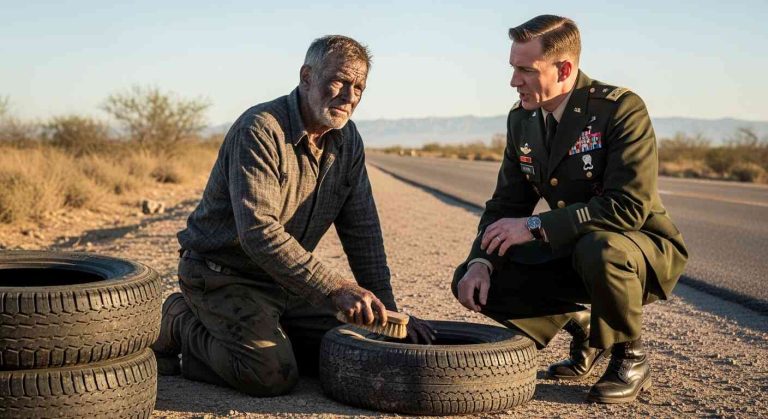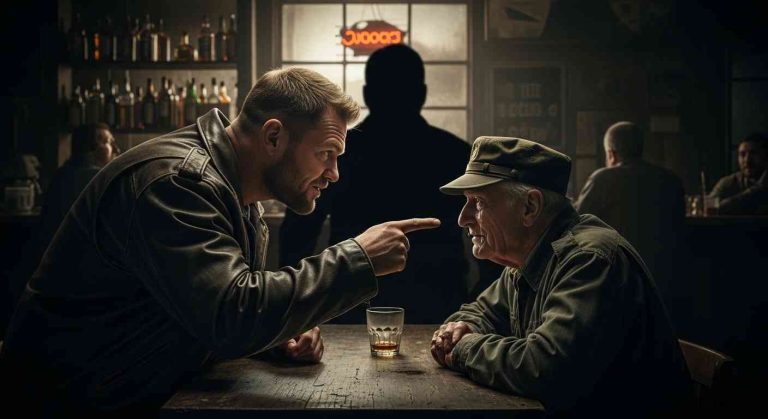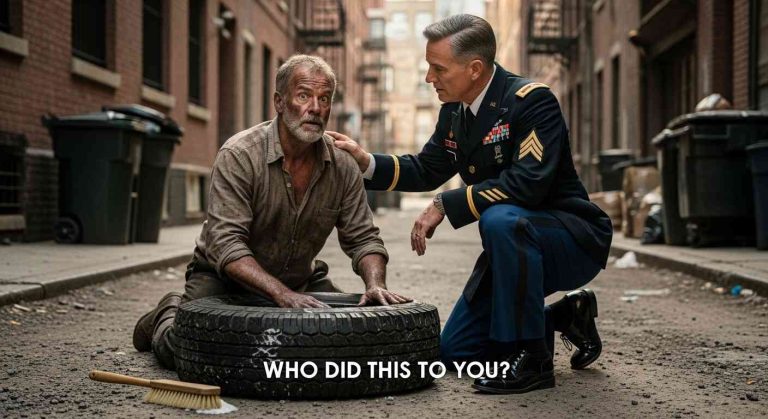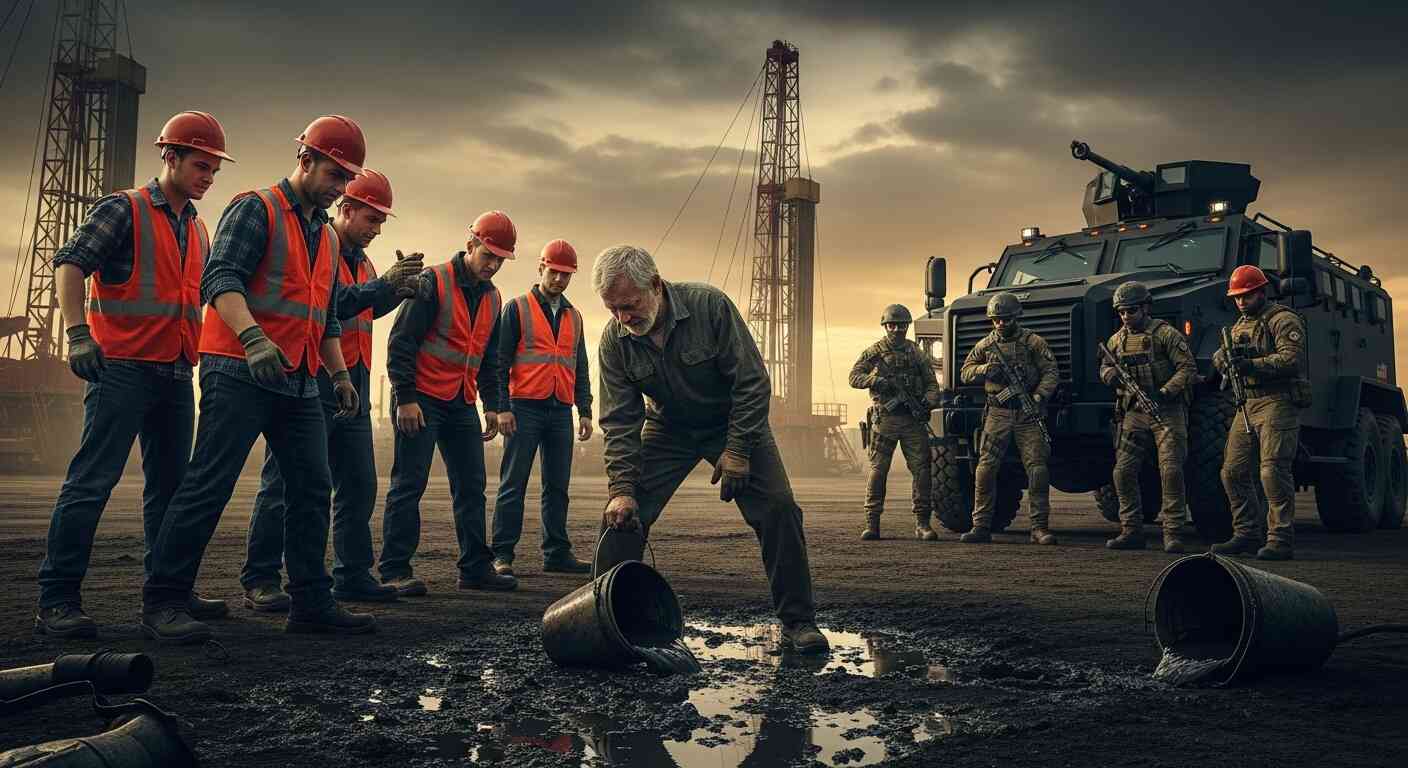
I felt the cold sting of the motor oil before I heard Mark’s laugh. It pooled around my scarred knees, soaking into the fabric of a jumpsuit that felt like a lead weight.
For three years, I had been the “Ghost of Building 4.” The guy who emptied the trash, mopped the spills, and stayed quiet. I wanted the quiet. After two decades in the “Grey Zones” of the world, I thought I’d earned the right to be nobody.
But Mark, a man whose greatest battle was a slow Wi-Fi connection, decided today was the day to remind me of my place.
“Look at him,” Mark sneered, his iPhone lens inches from my face. “The great American worker. Hey, Silas, you missed a spot. Or is your leg acting up again?”
Behind him, nine other managers—men and women in five-thousand-dollar suits—giggled and adjusted their cameras. They wanted a viral moment. They wanted to show how the “lowly” lived.
They didn’t know about the shrapnel in my left thigh. They didn’t know about the three medals I’d buried in a shoebox under my bed. They just saw a slow, limping man in a stained uniform.
I didn’t say a word. I just reached for the rag.
I didn’t know that while they were laughing at my shame, the perimeter of the world was collapsing. And I didn’t know that the SUV currently screaming toward the gates wasn’t coming for them.
It was coming for me.
“FULL STORY
Chapter 1: The Weight of Oil
The fluorescent lights of the ADS corporate parking garage hummed with a sick, buzzing energy that always reminded Silas of the drone swarms over Kandahar. He hated that sound. He hated the way it crawled under his skin, making the old shrapnel in his hip ache with a dull, rhythmic throb.
“”Are you deaf, Silas? I said get down there and fix it.””
Mark Henderson, the Senior VP of Logistics, stood over him. Mark was forty-five, smelled of expensive bourbon and desperation, and currently held a half-empty bottle of synthetic motor oil. With a casual flick of his wrist, Mark tipped the bottle.
The black sludge glugged out, splashing over Silas’s worn work boots and onto the pristine concrete.
Silas didn’t move. He looked at the oil, then up at Mark. His eyes were a flat, tired grey—the color of a winter sky over a graveyard. “”There’s a spill kit in the closet, Mr. Henderson. I can get it.””
“”No, no,”” Mark said, his voice dropping into a cruel, performative tone. He looked over his shoulder at the nine other managers who had gathered for their Friday afternoon “”debrief”” at the local bar. They were already filming. “”We don’t have time for kits. You’re the maintenance lead, aren’t you? Use your hands. Show us that ‘veteran grit’ you put on your resume.””
A few of the younger managers snickered. Sarah, an HR director who prided herself on “”corporate culture,”” didn’t stop them. She just adjusted her glasses, her phone held high.
Silas felt the familiar heat rising in his chest—the “”Red Mist”” his instructors had warned him about thirty years ago. He suppressed it. He breathed. In for four, hold for four, out for four. He was a civilian now. He was Silas Vance, the man who lived in a one-bedroom apartment with a dog named Buster and a collection of history books he never finished.
He slowly lowered himself to his knees. His left leg, the one held together by titanium and sheer stubbornness, groaned. He felt the oil soak into his jumpsuit.
“”That’s it,”” Mark mocked, leaning in. “”Get in there. It’s just like the dirt you used to play in, right?””
Silas began to wipe the oil with a rag, his movements slow and methodical. He didn’t look at the cameras. He didn’t look at their polished shoes. He looked at the reflection in the oil. He saw a man he didn’t recognize—a man who had once commanded five thousand lives, now being bullied by a man who couldn’t lead a horse to water.
“”Why do you take it, Silas?”” a voice whispered in the back of his mind. It sounded like Miller, his old XO.
Because I’m tired, Miller, Silas thought. I’m just so damn tired.
Suddenly, Mark’s foot moved. He kicked the rag out of Silas’s hand, sending it skittering across the garage floor.
“”I said use your hands, Janitor. I want this floor clean enough to eat off of before I get back from my drink.””
The humiliation was a physical weight. Silas looked at his bare palms, then at the black stain on the floor. The managers were laughing now, a chorus of high-pitched, entitled noise.
They had no idea that three miles away, at the National Security Agency, the screens were turning red. They had no idea that the “”Black Friday”” cyber-strike had just crippled the Eastern Seaboard’s power grid.
They just saw a broken man.
Until the screech of tires echoed through the garage like a gunshot.
Chapter 2: The Sound of Thunder
The sound wasn’t the squeal of a commuter car. It was the heavy, rhythmic grind of run-flat tires on reinforced axles.
Three black Chevy Suburbans, outfitted with Level 7 ballistic glass and brush guards, tore around the corner of the parking level. They didn’t slow down for the “”Reserved”” signs. They didn’t care about the speed bumps.
The managers scattered like pigeons. Mark nearly tripped over his own Italian loafers, dropping his phone into the very oil he’d forced Silas to clean.
“”What the hell?”” Mark yelled, his face turning a blotchy red. “”This is private property! Who is—””
The lead SUV slammed its brakes, pivoting in a perfect tactical J-turn that boxed in Mark’s Lexus. The doors flew open before the vehicle had even finished rocking on its suspension.
Four men in matte-black tactical gear, carrying suppressed short-barrel rifles, stepped out. They didn’t point the weapons at the managers—they didn’t need to. Their mere presence, the way they moved with the predatory grace of wolves in a sheepfold, silenced the garage.
Sarah, the HR director, let out a small, strangled whimper. “”Is this a robbery?””
One of the men, a giant with a jagged scar running from his ear to his jaw, stepped forward. This was Commander Miller. He looked at the line of terrified managers, his eyes dismissing them as if they were nothing more than static on a screen.
Then, his gaze fell on the man on his knees.
Silas hadn’t moved. He was still staring at the oil on his hands. He didn’t need to look up to know who was standing there. He knew the scent of CLP gun oil and stale coffee anywhere.
“”Miller,”” Silas said softly. His voice didn’t sound like a janitor’s anymore. It was deep, resonant, and carried the vibration of a man used to being heard over the roar of artillery.
“”General,”” Miller replied.
The word hit the garage like a thunderclap. Mark’s jaw literally dropped. Sarah gasped, her hand flying to her mouth.
“”General?”” Mark stammered, his voice cracking. “”No… no, this is Silas. He’s… he’s the maintenance guy. He’s a nobody.””
Miller turned his head toward Mark. It was a slow, terrifying movement. “”A nobody?”” Miller stepped into Mark’s personal space. Mark shrunk, appearing to lose three inches in height. “”This man designed the Iron Gate protocol. He led the 5th Battalion through the Siege of Oakhaven while you were probably crying about a C-minus in your MBA program.””
Miller looked down at the oil on the floor, then at the oil on Silas’s hands. His eyes darkened. A cold, lethal fury radiated from him.
“”Did you do this?”” Miller asked, his voice a low growl.
Mark couldn’t speak. He looked at his shoes. He looked at his fallen phone. He looked at the black-clad soldiers who were now subtly shifting their weapons.
“”It… it was a joke,”” Mark whispered. “”Just a joke.””
Miller didn’t hit him. That would have been too simple. Instead, he looked at Silas. “”The world is on fire, sir. The Beijing contingent broke the encryption. The satellites are blind. POTUS is in the bunker, and the Joint Chiefs are arguing about who to blame. They need the Architect.””
Silas closed his eyes. The “”Silence”” he had fought so hard to maintain was shattered. The civilian life—the quiet, the books, the dog—it was a dream he was waking up from.
“”I’m retired, Miller,”” Silas said, though the conviction was gone.
“”The world doesn’t care about your retirement, General,”” Miller said, kneeling down in the oil, heedless of his expensive gear. He reached out and took Silas’s hand. “”We need your mind. We need you back in the War Room. Now.””
Silas looked at his oil-stained hands. Then he looked at Mark, who was shivering in terror.
“”Mark,”” Silas said quietly.
Mark looked up, his eyes pleading. “”Yes, sir?””
“”You missed a spot.””
Silas stood up. His hip popped, his knee complained, but he stood straight. In that moment, the janitor vanished. A titan took his place.
Chapter 3: The Ghost Awakens
The ride in the SUV was silent. Silas sat in the back, a wet wipe in his hand, meticulously cleaning the black oil from beneath his fingernails. Miller sat opposite him, watching him with a mixture of reverence and anxiety.
“”How long do we have?”” Silas asked.
“”Six hours until the grid goes completely dark. Twelve until the tactical nukes in the Pacific lose their failsafes,”” Miller replied.
Silas nodded. He wasn’t scared. He didn’t feel the adrenaline he used to feel. He just felt a cold, analytical clarity. It was like a machine being switched back on after years of rust.
“”Who’s in the room?””
“”General Vance, Secretary Halloway, and the Vice President. They’re waiting for a miracle.””
“”They’re waiting for a ghost,”” Silas corrected.
They arrived at the Dulles auxiliary site—a nondescript office building that housed one of the most sophisticated command centers in the world. As Silas stepped out of the vehicle, the guards at the door snapped to an immediate, rigid salute.
He was still wearing his blue janitor’s jumpsuit, stained with oil and dirt. He looked like a man who had crawled out of a trench.
As he walked through the glass doors, he saw the corporate world he’d left behind. People in suits, frantic, clutching tablets, shouting into phones. He saw the fear. It was the same fear he’d seen in a dozen different countries, in a dozen different tongues.
He walked into the briefing room. The silence was instantaneous.
Secretary Halloway, a woman who had never liked Silas’s “”unorthodox”” methods, stood up. Her face was pale. “”General Vance. You look… well.””
“”I look like a man who was cleaning up after an idiot,”” Silas said, walking straight to the head of the table. He didn’t wait for an invitation. He tapped the glass screen of the main display. “”Show me the North-Tac feed. Now.””
The technicians scrambled. The map of the world flickered to life, covered in red blinking icons.
“”They used a back-door in the maritime shipping software,”” Silas muttered, his eyes scanning the data at a speed no one else could follow. “”It’s not a cyber-attack. It’s a shell game. They’re distracting us with the grid so they can move their subs into the Chesapeake.””
“”The Chesapeake?”” a young Admiral scoffed. “”That’s impossible. Our sensors would—””
“”Your sensors are looking for metal,”” Silas snapped, turning his gaze on the Admiral. The younger man flinched. “”They’re using bio-mimetic hulls. They look like whales on your screens. Turn on the acoustic resonance filters. Now.””
The room held its breath. The technician adjusted the dials.
Six white dots appeared on the map, less than fifty miles from the D.C. coast.
The Secretary of Defense gasped. The “”miracle”” had just begun. But Silas wasn’t smiling. He knew the cost of what came next.
Chapter 4: The Price of Command
For the next four hours, Silas Vance was no longer a man. He was a processor. He moved pieces across the global board with a cold, terrifying efficiency. He sacrificed a drone wing in the South China Sea to save a carrier group. He shut down the power to three major cities to trap a virus in a closed loop.
He made the hard choices. The choices that kept people like Mark Henderson safe in their beds, even if they never knew his name.
But as the sun began to rise, and the red icons on the map began to turn green, a different kind of problem walked into the room.
It was a young woman, no more than twenty-five, wearing a military uniform that looked too big for her. She was crying.
“”General?”” she whispered.
Silas didn’t look up from the screen. “”Report.””
“”The… the drone wing you diverted. My brother was one of the technicians on the ground at the relay station. He… they didn’t get out in time.””
The room went silent. The “”win”” suddenly felt very heavy.
Silas finally looked up. He looked at the girl. He saw the same pain he carried every day. The pain that had driven him to hide in a janitor’s closet for three years.
“”What was his name?”” Silas asked.
“”Cpl. Leo Rossi, sir.””
Silas stood up. He walked over to the girl and placed a hand on her shoulder. His hand was still stained with a faint trace of motor oil that wouldn’t wash off.
“”Leo Rossi saved seven thousand lives today,”” Silas said, his voice thick with a sudden, raw emotion. “”I will carry his name. I will carry it every day until I join him. Do you understand?””
The girl nodded, sobbing.
Silas turned back to the room. The Vice President was there now, looking at him with awe.
“”General,”” the VP said. “”The President wants to see you. He wants to give you the Medal of Freedom. He wants to make this public. The hero who came out of hiding.””
Silas looked at his blue jumpsuit. He looked at the high-tech screens. He thought of his dog, Buster. He thought of the quiet.
“”No,”” Silas said.
“”Sir?””
“”Tell the President to keep his medal. I have work to finish. And then… I have a floor to clean.””