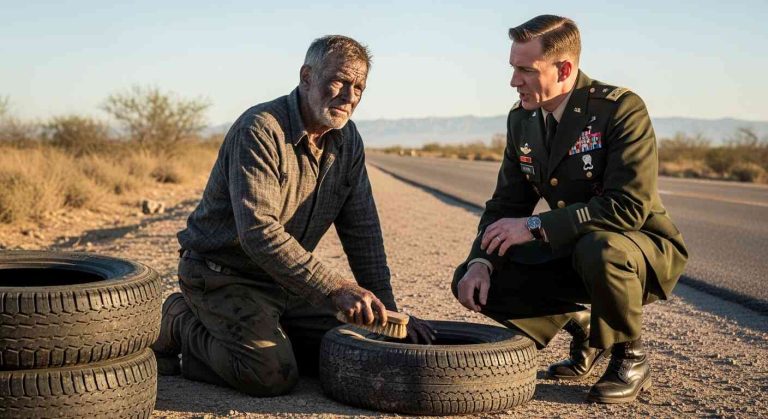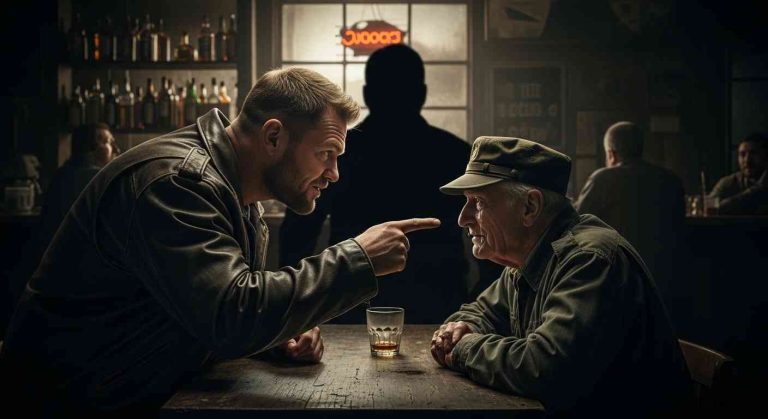
They called me “Dusty.” To the ten young executives at Aegis Dynamics, I was just the guy who emptied the trash and scrubbed the toilets. They didn’t know my real name. They didn’t know that while they were at Ivy League mixers, I was teaching men how to survive in places that don’t appear on maps.
It was a Tuesday morning, ten degrees below zero. Julian Vane, the CEO’s nephew, decided he wanted a show. “Cry for us, old man!” he laughed, pushing my face into the frozen mud while his friends cheered. He thought he was breaking a janitor.
He didn’t realize he was poking a sleeping god. He didn’t hear the hum of the engines or the clicking of safeties being turned off. He didn’t know that my “sons”—the deadliest men on the planet—were watching from the clouds.
And they were very, very protective of their father.
Chapter 1
The ice was the first thing I felt. It was a jagged, unforgiving skin over the asphalt of the Executive North Lot. It bit into my palms as I fell, the kind of cold that doesn’t just chill you—it warns you.
“Look at him,” Julian Vane sneered. I could see his Italian leather loafers just inches from my nose. They cost more than my monthly pension. “The Great Arthur Miller. Can’t even keep his balance. You’ve got mud on your jumpsuit, Artie. That’s a violation of the dress code, isn’t it?”
I didn’t answer. I reached for my glasses, which had skittered across the ice, but a polished heel crunched down on them. The sound of fracturing plastic was loud in the quiet morning air.
“I asked you a question, janitor,” Julian said, his voice dropping an octave. He reached down, grabbing a handful of my gray hair, and forced my face closer to the frozen slush. “The board is looking to cut costs. I told them we could start by replacing you with a Roomba. At least the vacuum wouldn’t smell like cheap tobacco and failure.”
The nine managers behind him erupted in laughter. It was a practiced, sycophantic sound. They were all young—thirty-somethings with white teeth and souls like hollowed-out gourds. They lived for these moments, these little exercises of power over the “unseen” people of the building.
“Cry for us, old man!” one of them shouted, a guy named Rick who I’d seen cheating on his expense reports for months. “Give us some salt for the ice! Cry!”
I closed my eyes and breathed. I didn’t feel anger. Anger is a luxury for the young. I felt a weary sort of disappointment. These were the men running the country’s largest defense contractor. These were the men responsible for the equipment I used to trust with my life.
“Julian,” I said, my voice raspy from years of shouting over mortar fire. “You should go inside. It’s cold out here. You’ll catch something.”
Julian’s face twisted. He didn’t like the lack of fear in my eyes. He pushed harder, grinding my cheek into the grit. “You’re pathetic. A broken-down relic cleaning up after your betters. You’re nothing.”
I looked past him, toward the tree line at the edge of the corporate campus. My vision was blurry without my glasses, but I didn’t need eyes to see what was coming. I felt it in my marrow—the subtle change in air pressure, the faint, high-pitched whine of a turbine engine being pushed to its limit.
“Something’s coming, Julian,” I whispered.
“Yeah,” Julian laughed, leaning in close. “Your termination papers.”
But then, the laughter stopped. It didn’t fade—it was severed. Rick, the loud one, was looking up at the sky, his mouth hanging open. The wind suddenly picked up, a violent, artificial downdraft that sent the managers’ expensive scarves whipping around their necks.
Then came the sound. The heavy, rhythmic thwack-thwack-thwack of a MH-60 Black Hawk, painted matte black with no markings, dropping out of the clouds like a bird of prey. It didn’t hover at a safe distance; it flared its tail and settled just twenty feet above the parking lot, the rotor wash screaming.
The managers scrambled back, shielding their eyes from the debris. Julian lost his grip on my hair, stumbling toward his Audi.
Three black Suburban SUVs tore through the security gate—not stopping for the badge reader, simply smashing through the wooden arm. They screeched into the lot, forming a perfect tactical perimeter around the circle of managers.
The doors flew open.
Men stepped out. Not mall cops. Not the “security” Aegis hired to walk the halls. These were men draped in MultiCam Black, wearing high-cut helmets and night-vision shrouds, carrying suppressed HK416s held in a low-ready position. They moved with a terrifying, synchronized fluidity.
One of the managers tried to run. A laser dot—a tiny, dancing red speck—appeared on the center of his forehead. He froze, his hands trembling as they went into the air.
The lead operator stepped forward. He pulled his balaclava down, revealing a face mapped with scar tissue and eyes that had seen the end of the world. He looked at the managers with utter, chilling indifference. Then his eyes found me, still kneeling on the ice.
His expression broke. It turned into something resembling grief.
He walked past Julian, who was hyperventilating against his car, and stopped in front of me. He didn’t say a word. He reached down, took my hand, and pulled me to my feet with a strength that felt like an anchor.
He picked up my broken glasses, looked at the crushed frame, and then looked at Julian.
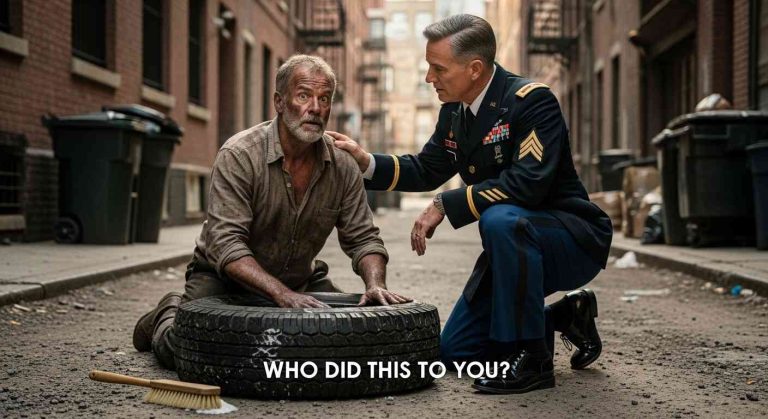
“Who did this?” the operator asked. His voice was a low growl that made the air feel heavy.
Julian tried to speak, but only a pathetic, wet wheeze came out.
The operator turned back to me, snapping to attention. He didn’t care about the cameras, the corporate bigwigs watching from the windows, or the police sirens in the distance.
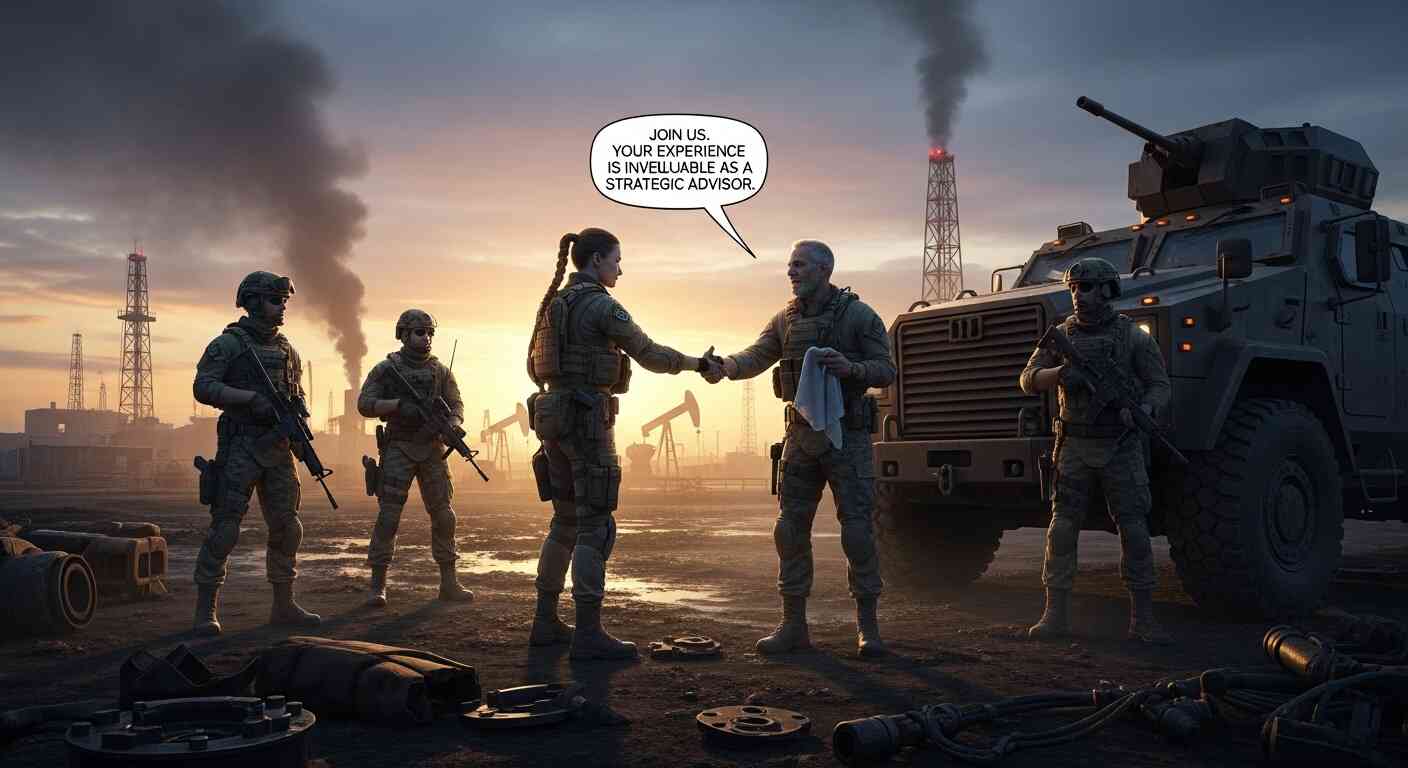
“The Architect is found,” he said into his comms. “Sector clear. All sons, pay respects.”
In unison, twelve elite soldiers—the most expensive and dangerous mercenaries in the private sector—slid their weapons to their backs and bowed their heads.
I wiped the mud from my face and sighed. “I told you to stay in Virginia, Jax.”
Jax, the man who had once cleared a room in Fallujah with nothing but a combat knife because I’d trained him to be a ghost, looked at me with fierce loyalty. “With all due respect, Sir… we heard you were taking out the trash. We figured you could use a hand.”
I looked at Julian. He was weeping now. Real tears.
“Read the full story in the comments,” I said to no one in particular, though I knew the world was watching.
“FULL STORY
Chapter 2: The Ghost in the Machine
The CEO’s office at Aegis Dynamics was a cathedral of glass and ego. Marcus Sterling, a man who built his empire on government contracts and backroom deals, stood by the floor-to-ceiling windows, clutching a scotch like it was a holy relic.
Below him, the parking lot looked like a war zone. The black SUVs were still there. The helicopter was idling on the helipad he usually reserved for his private jet. And his nephew—his favorite, hand-picked successor—was currently being held in a zip-tie restraint by a man who looked like he ate nightmares for breakfast.
“”Who is he, Marcus?”” the Chairman of the Board asked, his voice shaking. “”You said he was just a charity hire. A veteran with a sob story.””
Marcus didn’t turn around. He couldn’t. He was staring at the man in the gray jumpsuit. The man he had ignored for three years.
“”He’s not a veteran,”” Marcus whispered. “”He’s the veteran.””
I sat in a folding chair in the middle of the lobby, Jax standing behind me like a gargoyle. A young nurse, Sarah—my daughter—was rushing through the front doors, her face pale. She’d seen the news. Everyone had.
“”Dad!”” she screamed, pushing past the shell-shocked receptionists. “”Dad, are you okay?””
She reached me and immediately began checking my face, her hands trembling. “”What happened? I saw the video… those men… Julian…””
“”I’m fine, Sarah,”” I said, patting her hand. “”Just a little mud.””
“”A little mud?”” She looked up at Jax. She recognized him. Jax had been to our house a dozen times, years ago, back when my life was lived in the shadows. He was the “”uncle”” who always brought her strange wooden toys from overseas. “”Jax? What are you doing here? You’re supposed to be… retired.””
“”We don’t retire from the Architect, Sarah,”” Jax said softly. “”We just go on standby.””
The truth was a heavy thing. I had hidden it from her for as long as I could. I wanted her to have a normal life. I wanted her to be a nurse, to have a son, to worry about mortgage rates and soccer practice. I didn’t want her to know that her father was the man who designed the “”Obsidian Protocol””—the training regimen that turned ordinary soldiers into the most feared clandestine unit in history.
I had come to Aegis Dynamics for one reason: Leo. My grandson.
Leo was six years old and dying. A rare degenerative heart condition. The surgery was two million dollars. The post-operative care was another million. I didn’t have it. My “”private”” pension had been seized by a government that wanted to erase my existence after a mission in 2018 went sideways—a mission I took the fall for to protect my boys.
So, I made a deal with Marcus Sterling. I would give Aegis the schematics for the “”Viper”” drone system—a system I’d developed in my basement—in exchange for a job with full medical coverage for my family.
But Marcus was a shark. He took the schematics, buried my employment records, and put me in a janitor’s uniform. He knew I couldn’t sue him without revealing my identity and risking a treason charge. He thought he had me trapped. He thought I was a toothless lion.
“”Sir,”” Jax whispered, leaning down. “”The local police are at the perimeter. They’re terrified, but they’re here. And the CEO is on his way down.””
“”Let them come,”” I said. I looked at the broken glasses in my lap. “”I’m tired of being invisible, Jax. My grandson doesn’t have time for me to be humble anymore.””
The elevator dinked. Marcus Sterling stepped out, flanked by his legal team. He looked at Julian, who was still kneeling on the floor, sobbing. Then he looked at me.
“”Arthur,”” Marcus said, trying to regain his stature. “”This is a massive misunderstanding. We can fix this. We can talk in private.””
“”There’s nothing to talk about, Marcus,”” I said, standing up. My knees popped, a reminder of a jump in the Hindu Kush that didn’t go as planned. “”You broke the contract. You allowed your people to treat a human being like a dog. You thought because I didn’t fight back, I couldn’t.””
“”I’ll give you the money for the boy!”” Marcus shouted, his composure slipping. “”Five million. Right now. Just tell your… friends… to leave.””
Jax took a step forward, the light catching the edge of his combat knife. “”The money isn’t a gift, Sterling. It’s a debt. And we’re here to collect interest.””
Chapter 3: The Price of Silence
The lobby of Aegis Dynamics had become a surreal theater. Employees hung over the railings of the mezzanine, their phones out, capturing the downfall of their kingdom.
Marcus Sterling’s lawyers were whispering frantically into his ears, but he brushed them off. He was looking at me—really looking at me—for the first time. He saw the way I stood. He saw the way the men around me moved.
“”You’re the ghost,”” Marcus breathed. “”The one they talked about in the Pentagon. The man who trained the shadows.””
“”I’m just a guy who wants his grandson to breathe, Marcus,”” I replied. “”But you made it about something else. You made it about dignity.””
Sarah was holding my arm, her eyes wide. “”Dad, what is he talking about? What contract?””
“”I traded my life’s work for Leo’s heart, Sarah,”” I said, looking her in the eyes. “”And they tried to steal both.””
Suddenly, the front doors burst open again. A new group entered. Not mercenaries, and not police. These were men in dark suits with federal badges. The FBI? No. These were “”Cleaners””—the shadowy branch of the State Department that dealt with “”inconveniences”” like me.
The lead agent, a cold-eyed woman named Miller, walked straight to the center of the room. She looked at the mercenaries, then at me.
“”Arthur Miller,”” she said. “”You’re in violation of your non-disclosure agreement. And you,”” she pointed at Jax, “”are leading an illegal paramilitary operation on US soil. Lay down your weapons or we will authorize a kinetic response.””
Jax laughed. It was a dry, hollow sound. “”Agent Miller, you’re about three minutes too late to threaten us. Check your feed.””
She frowned, tapping her earpiece. As she listened, the color drained from her face.
The video of Julian Vane pushing me into the ice hadn’t just gone to social media. Jax’s team had hacked the Aegis server and broadcast it—along with my service record and the proof of Marcus Sterling’s contract fraud—to every major news outlet and the Senate Armed Services Committee.
“”The public knows who he is now,”” Jax said, his voice ringing through the lobby. “”They know that the man who saved the President’s life in 2012 was just assaulted by a billionaire’s brat while working for minimum wage to save his dying grandson. Do you really want to be the one who arrests him on live television?””
Agent Miller looked at the crowd of employees. Dozens of phones were pointed at her. She looked at me, her eyes flickering with a moment of genuine human hesitation.
“”Marcus Sterling,”” she said, turning away from me. “”You’re under investigation for contract fraud and human rights violations. Your assets are being frozen as of… five seconds ago.””
Marcus collapsed into a designer chair, his face gray. Julian let out a low moan of despair.
But I wasn’t done. I walked over to Julian. The young man who had crushed my glasses. He looked up at me, his eyes darting like a trapped animal’s.
“”I don’t hate you, Julian,”” I said softly. “”I pity you. You think power is what you can take from people. But real power… real power is what people are willing to give you. These men? They didn’t come here because I paid them. They came here because I taught them how to be men. Something your uncle clearly forgot to do for you.””
I reached into his pocket and pulled out his silk pocket square. I used it to wipe the last of the mud from my face.
“”Keep the change,”” I said, dropping the dirty cloth on his chest.
I turned to Sarah. “”Let’s go see Leo. We have the money now.””
“”But Dad,”” she whispered. “”How? Everything is frozen.””
Jax stepped forward, tapping a tablet. “”Actually, Sarah, the Viper drone system was patented under a trust in your name ten years ago. Your father just needed the fraud to be public to bypass the Aegis exclusivity clause. You’re currently the majority owner of the most valuable tech in the world.””
Sarah gasped, covering her mouth.
We walked toward the door. The police outside parted like the Red Sea. The mercenaries fell in behind us, a phalanx of steel and loyalty.
But as I reached the sidewalk, a black sedan pulled up. The door opened, and an old man—older than me—stepped out. It was General Vance, my former commander. The man who had signed the papers to erase me.
“”Arthur,”” he said, his voice trembling. “”Wait.””
Chapter 4: The Old Guard
General Vance looked like a man who had been carrying the weight of the world and was finally ready to drop it. He didn’t look at the soldiers or the cameras. He looked only at me.
“”You should have called me, Art,”” he said, stepping into my path.
“”I did,”” I said, my voice cold. “”Six months ago. When Leo’s first surgery was denied. Your secretary told me you were in a meeting. You stayed in that meeting for half a year, Vance.””
The General lowered his head. “”The politics… the oversight… I couldn’t move without risking the entire program.””
“”Then the program isn’t worth saving,”” I said. I started to walk past him, but he grabbed my shoulder.
Jax was on him in a heartbeat, a gloved hand gripping the General’s wrist. The air turned electric. The soldiers behind Jax shifted their weight, their eyes locking onto the General’s security detail.
“”Easy, Jax,”” I said.
I looked at Vance. “”You want to make it right? Don’t give me a medal. Don’t give me a parade. Just make sure the hospital in Baltimore has everything they need for Leo by 4:00 PM today. If a single nurse hesitates, if a single machine is missing, I’m going to let Jax finish his ‘tour’ of this city.””
Vance nodded quickly. “”It’s already done. I personally authorized the transfer. And Arthur… the treason charges… they’ve been vacated. The President is calling it a ‘clerical error.'””
“”A clerical error,”” I repeated, a bitter smile touching my lips. “”Convenient.””
We got into the Suburban. As we drove away from the Aegis campus, I looked back at the glass tower. It looked smaller than it had that morning.
In the car, Sarah was silent, holding my hand so tight her knuckles were white. “”Is it over?”” she asked.
“”For them? Yes,”” I said. “”For us? It’s just beginning.””
We arrived at the hospital an hour later. The lobby was already swarming with reporters, but Jax’s men cleared a path with quiet efficiency. We reached the pediatric ICU.
Through the glass, I saw him. Leo. He looked so small in that big bed, surrounded by tubes and monitors. He was wearing a faded t-shirt with a picture of a superhero on it.
I walked in, the smell of antiseptic hitting me like a physical blow. Leo opened his eyes and smiled. It was a weak smile, but it was the brightest thing I’d ever seen.
“”Hey, Grandpa,”” he whispered. “”Did you finish cleaning the big building?””
I sat on the edge of the bed and kissed his forehead. “”Yeah, Leo. I finished. And I brought some friends to help you get better.””
Leo looked past me at Jax, who was standing at the door. Jax, the man who had survived three tours in the sandbox and a dozen black-ops missions, looked like he was about to cry. He took off his tactical helmet and gave the boy a clumsy, shy wave.
“”Are they superheroes?”” Leo asked.
“”No,”” I said, looking at my daughter and my “”sons”” in the hallway. “”They’re just family.””