The rain wasn’t just falling; it was punishing the earth. In the heart of the Gulf Coast refinery, the air tasted like salt, oil, and impending doom.
I was on my knees in the freezing slush, my fingers buried in the guts of a ruptured high-pressure oil pipe. At sixty-two, the cold gets into your marrow and stays there. But it wasn’t the cold making my hands shake. It was the echoes.
“Look at him,” a voice drawled, cutting through the roar of the wind. “The Great Elias Thorne. Can’t even hold a pipe wrench straight. You’re shaking like a leaf, old man. Is it Parkinson’s, or just the realization that you’re a useless relic?”
That was Miller. Thirty-two years old, wearing a three-thousand-dollar suit under a designer raincoat, and carrying a clipboard he didn’t know how to use. Behind him stood nine other managers, all of them laughing, their clean faces illuminated by the emergency floodlights.
“He’s a liability, Miller,” another suit chimed in, stepping closer to avoid a puddle. “Why do we even keep him on the payroll? He’s a ghost. A flickering light. Move aside, Thorne. Let the real men handle the shutdown before you cost us another million.”
I didn’t look up. I couldn’t. If I looked up, they’d see the things I’d spent twenty years trying to bury. They didn’t know about the sand of Mogadishu. They didn’t know about the black sites in Eastern Europe. To them, I was just a grease monkey with a nervous tremor.
“I can fix it,” I rasped, my voice sounding like gravel under a boot.
Miller laughed, a high, irritating sound. “Fix it? You can barely hold your coffee, Elias. You’re done. In fact, consider this your official notice. You’re fired. Get your gear and get out of my sight before I have security drag your shaking carcass to the gate.”
I gripped the pipe harder. The pressure was building. If this valve didn’t turn in the next sixty seconds, the entire South Wing would go up in a fireball that would be seen from space. And these idiots were worried about my resume.
But then, the world changed.
The wind didn’t just howl—it screamed. But it wasn’t the storm. It was the rhythmic, chest-thumping beat of rotors. Not one. Not two. Dozens.
The sky above the refinery didn’t just turn dark; it turned black. The floodlights caught the underbellies of machines that shouldn’t exist—stealth-coated birds of prey descending like angels of death.
Miller’s laughter died in his throat. The managers looked up, their faces turning the color of ash.
They thought the storm was the most dangerous thing coming for them. They had no idea who was actually kneeling in the mud at their feet.
“FULL STORY
Chapter 1: The Tremor in the Mud
The refinery was a labyrinth of steel, steam, and corporate arrogance. It sat on the edge of the Louisiana coast, a behemoth of industry that never slept, even when the sky turned the bruised purple of a fresh hematoma. Elias Thorne had worked there for fifteen years, mostly in the shadows, mostly ignored. He was the man you called when the machines screamed, the one who knew the temperament of every bolt and the secret language of the high-pressure steam lines.
But today, the machines weren’t just screaming. They were failing.
“”Thorne! If you don’t get that bypass closed, the pressure surge is going to take out the main turbine!”” Miller shouted, his voice cracking with a mixture of fear and authority. He stood ten feet back, shielded by the overhang of the control room, his pristine Italian leather shoes hovering dangerously close to a pool of oily runoff.
Elias didn’t respond. He couldn’t afford the breath. He was shoulder-deep in the maintenance pit of Sector 7, the rain lashing against his back like a whip. His hands, gnarled and scarred, were wrapped around a valve handle that had rusted shut during the last administration’s budget cuts. His hands were shaking. Not the gentle vibration of age, but a violent, rhythmic tremor that seemed to originate from deep within his chest.
“”Look at those hands,”” whispered Jensen, one of Miller’s junior associates, loud enough for Elias to hear. “”He’s a walking safety hazard. Look at him twitch. My grandfather had more stability in his hands when he was ninety.””
“”He’s a relic,”” Miller sneered, checking his Rolex. “”A useless relic. We should have phased out these old-timers years ago. They’re slow, they’re expensive, and they’re broken. Hey, Thorne! Are you even listening? Or did you forget how to use a wrench along with your dignity?””
Elias closed his eyes for a fraction of a second. Inhale. Exhale. The scent of cordite. The sound of a desert wind. He pushed the memory back. He had spent two decades trying to be a “”relic.”” He had chosen the grease and the silence over the blood and the noise.
“”The valve is seized,”” Elias grunted, his voice a low vibration that seemed to come from the earth itself.
“”Everything is seized when you’re eighty percent rust and twenty percent cowardice,”” Miller mocked, stepping forward, emboldened by the silence of the other managers who had gathered to watch the “”show.”” There were ten of them in total—the executive board’s “”Efficiency Task Force.”” They were here to trim the fat, and Elias was the biggest piece on the chopping block.
“”You’re done, Thorne,”” Miller said, his voice dropping to a cruel, intimate level. “”I’ve already signed the paperwork. As soon as this storm passes, you’re out. No pension, no handshake. We’re citing physical incompetence. Those shaking hands are going to be your ticket to the soup kitchen.””
Elias felt a heat rise in his neck that had nothing to do with the steam. He looked at Miller—really looked at him. He saw a man who had never bled for anything, who had never known the weight of a life in his hands.
“”The pressure is at nine hundred PSI, Mr. Miller,”” Elias said calmly, though his hands continued their frantic dance. “”If I don’t turn this, the town three miles downwind is going to breathe toxic gas by midnight. Maybe focus on that instead of my pension.””
“”Don’t you dare lecture me on safety, you senile old—””
Miller’s insult was cut short by a sound that didn’t belong in a refinery. It was a low-frequency hum that vibrated the very teeth in their heads. It wasn’t the storm. It wasn’t the machines.
Elias stopped. He let go of the wrench. His hands suddenly went perfectly, terrifyingly still.
He knew that sound. He hadn’t heard it in twenty years, but you never forget the sound of a Reaper-class tactical transport.
“”What the hell is that?”” Jensen gasped, pointing toward the black clouds.
The sky didn’t just open up; it was invaded. Through the curtains of rain, dark shapes began to emerge. They didn’t have lights. They didn’t have markings. They were matte-black shadows that swallowed the floodlights of the refinery. One, then five, then twenty. A fleet of helicopters so advanced they looked like something out of a nightmare.
“”Is that the National Guard?”” Miller asked, his voice trembling now. “”Did someone call the Guard?””
Elias stood up. He wiped the grease from his face with a rag, his movements slow and deliberate. The “”useless relic”” was gone. In his place stood a man whose posture had suddenly shifted, shoulders squared, eyes locking onto the lead bird as it began its rapid descent.
“”No,”” Elias whispered, a ghost of a smile touching his lips. “”The Guard doesn’t move that fast.””
Chapter 2: The Sky Falls
The descent of the helicopters was a masterclass in tactical precision. They didn’t just land; they occupied the air. The downdraft from the rotors was so intense that Miller and the other managers were nearly blown off their feet. They scrambled backward, clutching their expensive coats, their eyes wide with a terror they couldn’t name.
“”What is happening?”” Miller screamed over the roar, his face pale as a ghost. “”This is private property! They can’t land here!””
Elias didn’t move. He stood in the center of the muddy yard, the rain slicking back his grey hair. The lead helicopter, a beast of a machine with rotating nacelles, hovered inches above the asphalt of the loading dock. A side door slid open with a hiss.
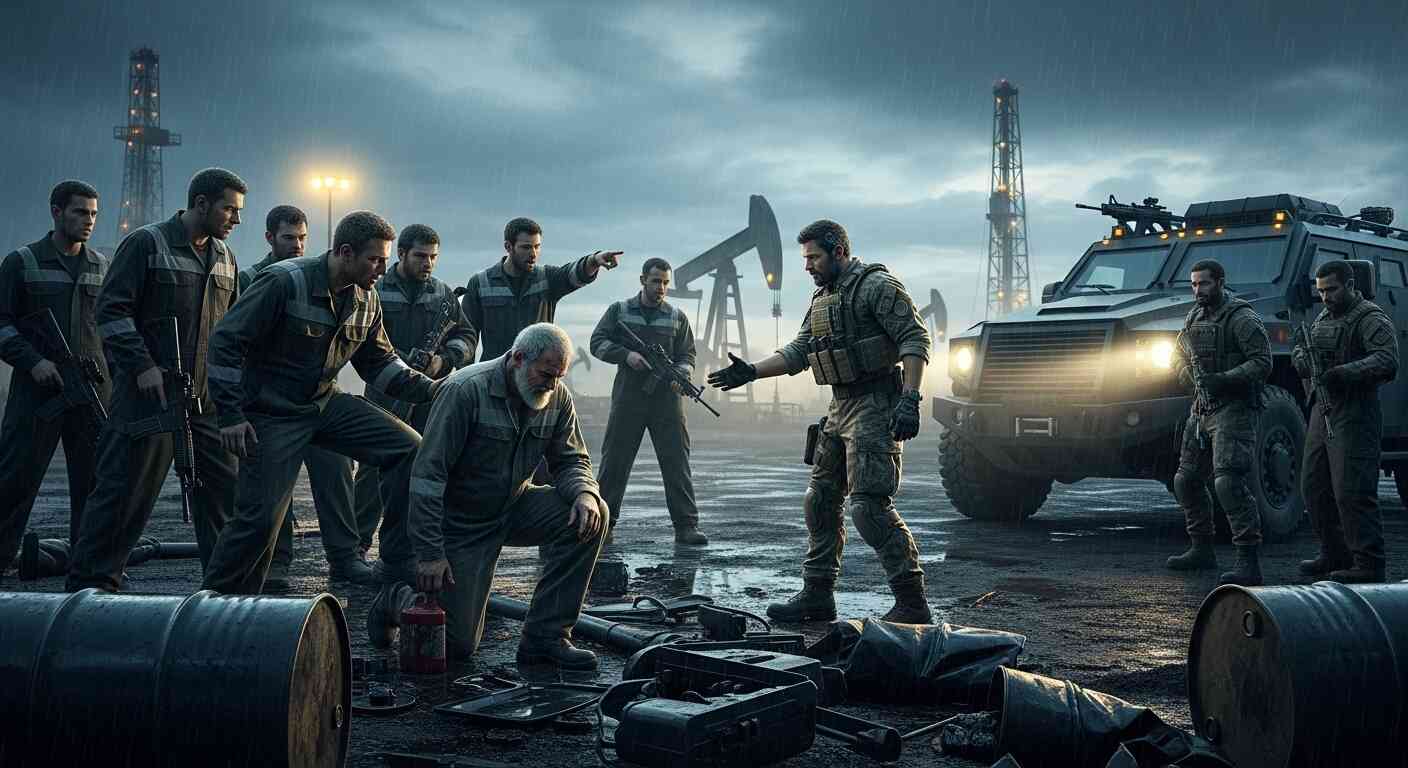
Ten men in charcoal-grey tactical gear, devoid of any national insignia, fast-roped to the ground. They moved with a predatory grace that made the refinery’s security guards look like children playing soldier. They didn’t point their weapons at anyone—they didn’t need to. Their presence alone was a threat.
The managers huddled together like a herd of panicked sheep. Miller, trying to reclaim some semblance of his vanished authority, stepped forward, his legs shaking visibly.
“”I… I am the Regional Manager of this facility!”” Miller shouted, though his voice cracked. “”I demand to know who is in charge here! You are interfering with a critical industrial—””
A man stepped out of the lead helicopter. He was tall, mid-forties, with a face that looked like it had been carved out of granite. He wore a simple black combat shirt and a tactical vest. On his shoulder was a small, embroidered patch: a silver sword crossed with a lightning bolt.
The man ignored Miller. He ignored the other nine managers. He didn’t even look at the leaking pipe or the impending disaster. His eyes scanned the mud, the grease, and the shadows until they landed on Elias.
The man froze. For a second, his hard expression shattered into something resembling awe.
He walked toward Elias, his boots splashing through the puddles that Miller had been so careful to avoid. Behind him, the ten managers watched in stunned silence. They expected an arrest. They expected Elias to be shoved aside.
Instead, five feet from Elias, the man stopped. He snapped his heels together and delivered a crisp, sharp salute.
“”Sir,”” the man said, his voice booming even over the rotors.
Elias sighed, a sound of profound weariness. “”I told you never to come here, Marcus.””
“”The world is on fire, sir,”” Marcus replied, his voice thick with emotion. “”And the Board decided that the only man who can put it out is currently being mocked by a man in a three-thousand-dollar suit.””
Marcus then did something that caused Miller’s jaw to literally drop. He knelt. One knee in the grease and the mud, right at Elias Thorne’s feet. He reached into a waterproof case at his side and pulled out a golden tactical tablet—a device that held the encrypted keys to a private military empire.
“”The Ghost Protocol has been enacted, Commander,”” Marcus said, looking up at Elias. “”We’ve been searching for you for six months. Your ticket home is waiting. The jet is fueled. We just need your thumbprint.””
Miller found his voice, though it sounded like a strangled squeak. “”Commander? This guy? You’ve got the wrong man! That’s Elias Thorne! He’s a maintenance tech! He’s… he’s got nerve damage! He’s useless!””
Marcus stood up slowly. He turned to look at Miller. The look in his eyes was so predatory, so devoid of mercy, that Miller actually stumbled back and fell into a puddle.
“”This ‘relic,'”” Marcus said, his voice a low, dangerous growl, “”has saved more countries than you have neckties. He didn’t have ‘nerve damage.’ He had the weight of the free world on his shoulders for thirty years. And if you speak to him again, I will ensure that your ‘efficiency task force’ starts with a lesson on how to breathe through a shattered jaw.””
Elias looked at the golden tablet. Then he looked at his hands. They were perfectly still now. The tremor was gone. It had never been age. It had been the suppression of a monster. And the monster was tired of being caged.
Chapter 3: The Price of Disrespect
The silence that followed Marcus’s threat was heavier than the storm. The nine managers behind Miller looked as if they wanted to melt into the refinery’s steel walls. Jensen, the one who had mocked Elias’s grandfather, was hyperventilating.
Elias walked over to the golden tablet. He didn’t look like a maintenance worker anymore. The way he moved—the economy of motion, the way his eyes tracked the perimeter—it was the movement of a predator. He pressed his thumb to the screen.
A soft green glow illuminated his face. IDENTITY VERIFIED: COMMANDER THORNE, ELIAS. RANK: OMEGA-1.
“”You’re really him,”” Miller whispered from the mud, his expensive suit ruined. “”The Thorne from the declassified Balkan reports. The one they said didn’t exist.””
Elias looked down at him. “”I tried not to exist, Miller. I liked the grease. I liked the quiet. I even liked fixing your pipes. But you just couldn’t let an old man have his peace, could you?””
“”We didn’t know!”” another manager cried out. “”Elias, please—we were just following company policy! We’ll give you a promotion! A bonus!””
“”A bonus?”” Marcus laughed, a cold, dry sound. “”Commander Thorne owns the holding company that owns the bank that holds your company’s debt. He doesn’t need your bonus. He needs his time back.””
Elias turned back to the leaking pipe. The pressure gauge was now vibrating in the red. The hiss of gas was becoming a roar.
“”Fix the pipe first, Marcus,”” Elias commanded.
“”Sir, the jet is—””
“”I said fix the pipe,”” Elias’s voice was like iron. “”There are families in the valley. If this goes, they go. Show these ‘managers’ what real efficiency looks like.””
Marcus barked an order. In seconds, the tactical team moved. They didn’t use rusted wrenches. They used hydraulic sealants and carbon-fiber wraps that looked like technology from fifty years in the future. In less than three minutes, the leak that Elias had struggled with for an hour was silenced. The pressure stabilized. The crisis was over.
Elias turned to Miller. “”You told me I was fired, right? Citing physical incompetence?””
Miller couldn’t speak. He just nodded, his eyes wide.
“”Good,”” Elias said. “”Because I was going to quit anyway. But since you fired me, I believe the severance package in my contract—the one your company inherited when they bought this plant—is quite substantial. It includes a controlling interest in the local land rights.””
Elias leaned in closer, his voice a whisper that only Miller could hear. “”This refinery is sitting on my land now, Miller. And I think I’m going to find your presence here… inefficient.””
“”Wait—”” Miller started, but Marcus stepped between them, his hand resting on the hilt of a combat knife.
“”The Commander is finished with you,”” Marcus said.
Elias walked toward the helicopter. He didn’t look back at the steel labyrinth. He didn’t look back at the men who had spent years treating him like a ghost. He stepped into the hold of the aircraft, the golden tablet in his hand.
“”Where to, sir?”” Marcus asked as the doors began to close.
Elias looked out at the dark, rainy horizon. “”Home, Marcus. It’s time to stop pretending I’m a relic and start reminding people why they were afraid of the dark.””
Chapter 4: The Shadow Returns
The flight away from the refinery was silent. Inside the sleek interior of the transport, the atmosphere was a world away from the grime of Sector 7. Here, the air was filtered, the seats were leather, and the screens displayed real-time global intelligence.
Marcus watched Elias. He had served under Thorne in three different theaters of war, and he knew the man better than anyone. He saw the way Elias’s eyes tracked the data on the screens—the troop movements in Eastern Europe, the fluctuating oil prices, the insurgencies in the Pacific.
“”You’ve been out too long, sir,”” Marcus said softly.
“”I was out just long enough to remember what it’s like to be human,”” Elias replied. He looked at the golden tablet. “”Who authorized the extraction? The Pentagon?””
“”Higher,”” Marcus said. “”The Council. They realized that without you, the Blackwood Initiative was falling apart. They’ve tried to replace you with ‘efficient’ men. Men like that Miller character back there.””
Elias scoffed. “”Men who know the cost of everything and the value of nothing.””
“”Exactly. The world is being run by accountants, sir. And the wolves are at the door.””
As the helicopter banked, Elias looked down at the sprawling landscape of America. He thought about the men he had worked with at the refinery—Jax, the old welder who shared his sandwiches; Sarah, the secretary who always made sure he had fresh coffee. They were the ones who would suffer when the ‘accountants’ failed.
“”We’re not going to the jet yet,”” Elias said suddenly.
Marcus blinked. “”Sir? The schedule is—””
“”Change it. We’re going to the regional corporate headquarters. If I’m going to be the Commander again, I’m going to start by cleaning my own house.””
The helicopter changed course. Below them, the lights of the city began to twinkle. Elias felt the familiar coldness settling over his heart. The shaking was gone completely now. He wasn’t a relic. He was a weapon that had been sharpened by fifteen years of silence.
The corporate headquarters of the refinery’s parent company was a glass-and-steel needle piercing the sky. At 2:00 AM, the top floor was still lit—the executives were likely celebrating the “”efficiency”” of their recent cuts.
The helicopter didn’t land on the pad. It hovered ten feet above it. Elias didn’t wait for the stairs. He jumped, his boots hitting the concrete with a solid thud that echoed his return to power.
The security guards at the door were elite, but when they saw Marcus and the tactical team—and more importantly, when they saw the man leading them—they stepped aside. They knew the legend. They knew the Ghost.
Elias walked into the boardroom. The CEO, a man named Sterling who had once been a junior officer under Elias decades ago, stood up, dropping his glass of scotch.
“”Elias?”” Sterling gasped. “”We heard… we heard you were dead. Or worse.””
“”I was a maintenance tech, Sterling,”” Elias said, walking to the head of the table. “”I spent fifteen years watching you turn my father’s company into a playground for bullies and bureaucrats.””
“”Now, Elias, let’s be reasonable—””
“”I’m done being reasonable,”” Elias said, slamming the golden tablet onto the mahogany table. “”I’ve just activated the ‘Relic Clause.’ I’m taking back the Chair. And your first order of business? You’re going to call a man named Miller at the Sector 7 refinery. You’re going to tell him he’s fired. And then, you’re going to tell him who’s taking his place.””