“You’re nothing here, Eli. Just grease and broken promises.”
Braden Vance didn’t just fire me. He wanted to break me.
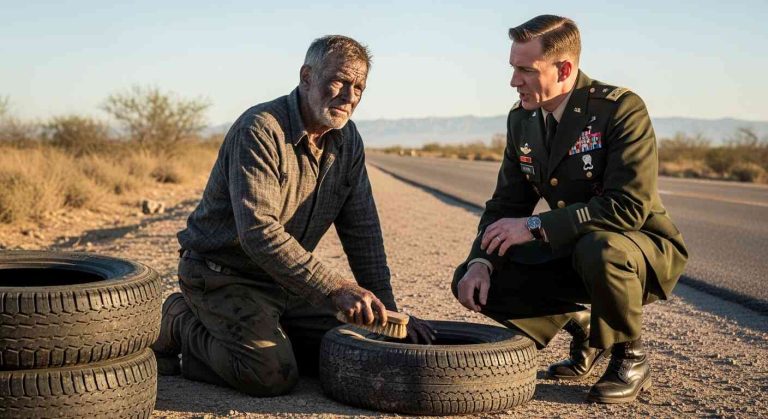
I worked at that depot for twelve years. Twelve years of silence, twelve years of hiding the ghosts of Fallujah behind the hiss of a pneumatic wrench.
Braden was thirty-two, an MBA with soft hands and a loud mouth. He hated that the men respected me. He hated that when the pressure was on, they looked to me, the quiet old grease-monkey, not the manager in the air-conditioned booth.
He’d found them in my locker. My shadowbox. The Silver Star. Two Bronze Stars. The purple hearts. The things I never spoke about.
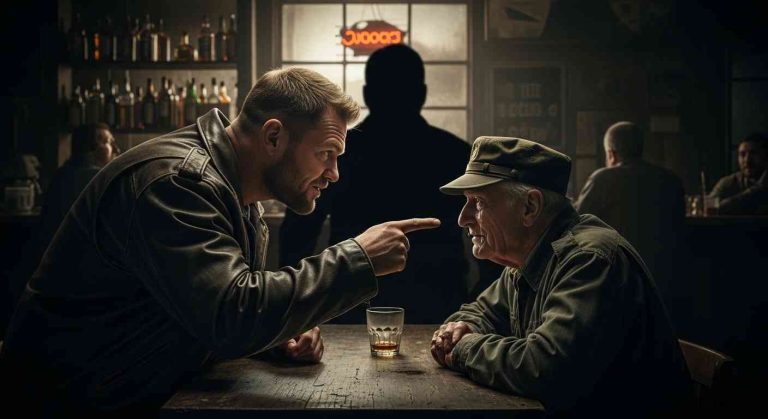
“Look at this trash,” he sneered, holding my history in his manicured fist in the middle of the yard.
A dozen men watched us. My crew. Good men, but terrified of losing their jobs in this economy.
“Service? Sacrifice?” Braden laughed, a harsh, dry sound. “Sacrifice is meeting quarterly projections, old man. You? You’re just a relic we tolerate.”
And then, he did it. He looked me right in the eye, and he spat.
Not on me. Worse. He spat directly onto the Silver Star.
The medal my commanding officer, Colonel Miller, had pinned on me with tears in his eyes, just before he died in my arms in the wreckage of a downed Blackhawk.
The world went white. The ghosts roared back to life.
“Don’t,” I whispered. My voice was a dead thing.
He saw the rage and took a step back, but his ego wouldn’t let him stop. He signaled the three large yard supervisors—his personal goon squad.
Before I could breathe, they were on me. A fist to the jaw. A boot to the ribs.
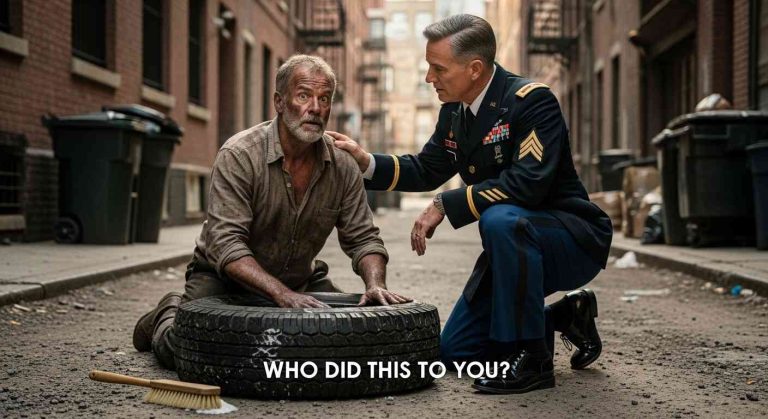
I went down. The sand of the yard, soaked in spilled diesel and hydraulic fluid, rushed to meet my face. It smelled like failure.
I didn’t fight back. I couldn’t. Not when Braden was standing over me, kicking my hand away as I reached for the medals scattered in the dirt.
“Tell us about your ‘tactical secrets,’ old man!” Braden mocked, his foot grinding the Silver Star into the oil-slicked earth. Ten of my co-workers stared, frozen, as I was broken in the dirt. Ten men I’d trained.
But as I lay there, gasping for air, the world changed.
It wasn’t a roar at first. It was a vibration. A deep, sub-bass tremor that started in the soles of my boots and shook my teeth.
The sky, previously a pale, empty Nevada blue, screamed.
Three shadows bloomed simultaneously, blotting out the noon sun. The wind slammed into the yard like a physical blow, scattering tools and blinding my attackers with a storm of dust.
Braden and his thugs froze, looking up in sheer terror. Through the brown cloud, the sleek, lethal shapes of military attack jets—F-22 Raptors—didn’t just appear. They arrived with the violence of a collapsing building.
They landed. Right there. In the fuel-soaked sand.
A transport jet skidded to a halt meters away, its ramp dropping before the wheels stopped turning.
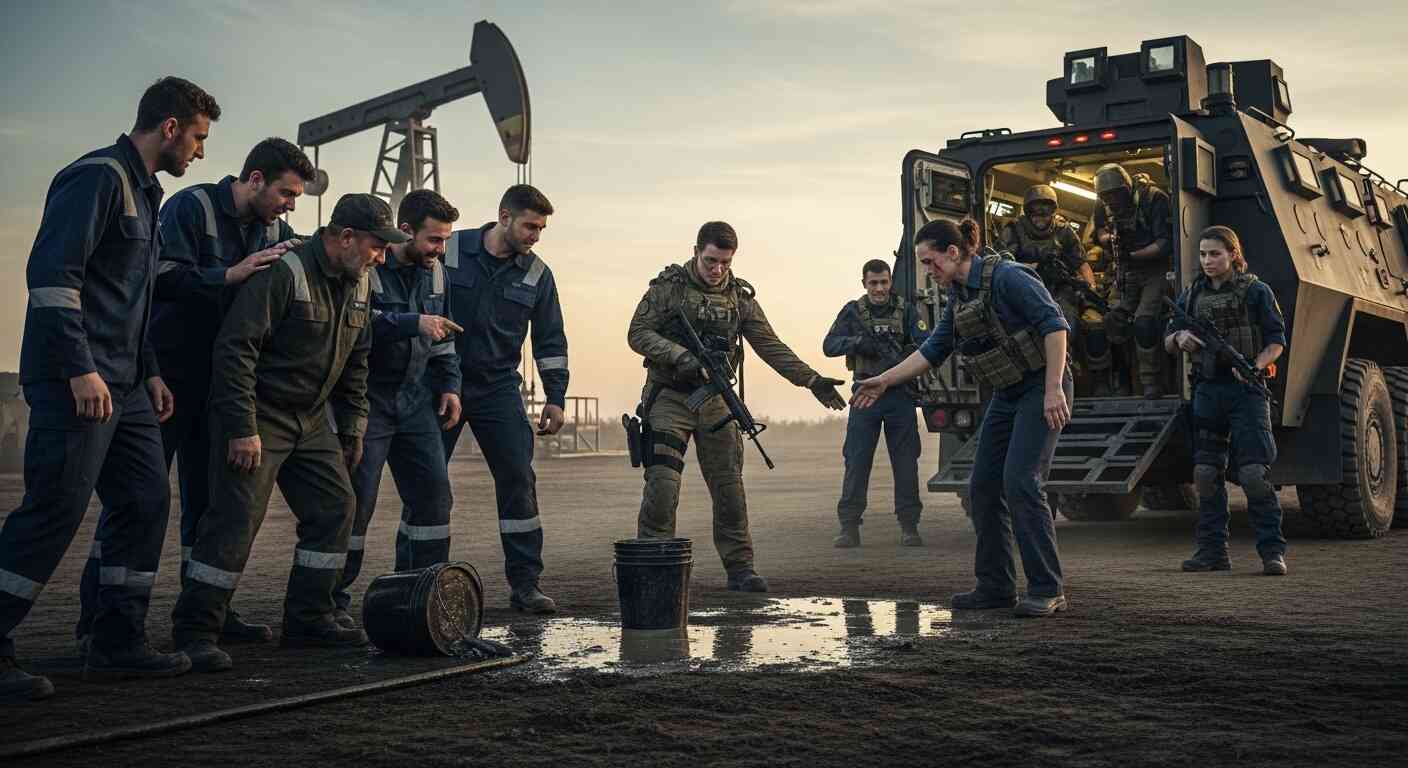
And through the dust, they came. Not soldiers. These were different. Heavy armor. Suppressed rifles. Black masks. Elite. Ghost-like.
Braden was screaming something, pointing at me, trying to establish authority even as he soiled his khakis.
The soldiers ignored him. They bypassed the manager, ignored the thugs, and moved directly to where I was kneeling, bleeding into the dust.
The lead soldier, a mountain of a man with eyes I recognized from a lifetime ago, dropped to one knee. He ignored Braden’s sputtering presence.
He removed his helmet, and I saw the scar above his eye. Johnny. Corporal Johnny ‘Apex’ Carver. He used to be my RTO.
He looked at my bleeding face, at the medals ground into the sand. Then he looked at Braden. It was the look of a god deciding who must die.
“Sir,” Johnny said, his voice terrifyingly calm as he ignored the chaos. He didn’t look at the manager. He looked at me. “The President sent us. There’s a tactical anomaly in Sector Seven that only you have the override for. We need the legend, Eli.”
The world had gone silent. Braden wasn’t sputtering anymore. He looked like a man about to meet his maker.
I touched the ground, my hand brushing the Silver Star. The fuel was still on it, and the spit. But Johnny was waiting.
“FULL STORY
Chapter 1: The Silver and the Spittle
The ghost was always there. It lived in the hiss of the pneumatic wrench, in the harsh glare of the industrial lights, and in the sharp, chemical tang of the hydraulic fluid. For twelve years, I had kept it contained, locking it behind a wall of quiet competence and calloused hands.
I was Eli Thorne, the lead mechanic at Vance Fuel & Logistics, a sprawling depot on the edges of the Nevada desert. I was sixty-two years old, and I liked that my life was predictable.
I had arrived in this town with nothing but a duffel bag, a shadowed past, and a medal box I never opened. The VA had classified me as ‘fully retired’ due to a complex cluster of injuries I’d sustained in my last deployment, a mission whose very existence was still classified higher than the President’s daily brief. I didn’t want the money. I wanted the silence.
Vance Fuel & Logistics didn’t care about my service history. They cared that I could rebuild an Allison transmission blindfolded and that I never missed a shift.
Until Braden Vance took over.
Braden was thirty-two, an MBA with soft hands, a trust fund, and a desperate need to feel powerful. He inherited the company from his father, a hard man who respected hard work. Braden, however, respected only power, and the terrifying vulnerability of those he perceived as weak.
I was his favorite target. I was the old man who didn’t play his social games. I didn’t clap when he gave his “”synergy”” speeches. I just worked. And the men respected me for it. That was my sin.
My pain was a constant companion—the persistent ache in my left leg where the shrapnel had shredded the muscle, the ringing in my ears, and the face of Colonel Miller, my commanding officer, my friend. He died in my arms in the wreckage of a Blackhawk, pinned and burning, after he had pinned the Silver Star to my chest himself, in the field, for a mission that hadn’t even finished yet. “”For the impossible, Eli,”” he’d said.
I had that shadowbox in my locker. I never showed anyone. I just needed to know it was there, that the ghosts weren’t lies.
Today, Braden was making an example of me. He’d decided the depot wasn’t “”optimized”” and decided to cut the senior mechanical staff by 40%. The announcement was today. And he started with me.
The day began like any other, but I felt the tension. The air was heavy, the crew quiet. At noon, Braden called a yard meeting.
We stood, a dozen mechanics, fuelers, and clerks, in the middle of the dusty industrial yard. Braden stood on a packing crate, looking down at us.
“”We need to streamline,”” he began, his voice whiny and loud. “”We are cutting dead weight.””
He singled me out immediately. “”Eli, your production metrics have lagged.”” This was a lie; I had highest numbers in the depot. “”You’re done.””
The crew went silent. My own team, men I’d mentored, looked away. They were terrified. Marcus, my apprentice, 22 and with a baby on the way, trembled. He was Braden’s next target if he spoke up.
“”I understand, Mr. Vance,”” I said, keeping my voice calm. “”I will collect my things.””
“”Your ‘things’ are already collected,”” he sneered.
I was about to walk to the locker room when he appeared from around a delivery truck, holding the shadowbox. My breath caught in my throat.
“”I found this trash in your locker, Eli. We have a policy against unauthorized personal storage.””
My blood went cold. The box was locked. But the simple brass latch was no match for a determined, arrogant man.
“”Please,”” I said, my voice barely a whisper. “”Just give me the box.””
He looked at the crew. “”Look at this relic. Keeping his little ‘participation trophies.'”” He held the box up, tilting it. A small, polished Silver Star slid and clattered against the glass. “”What’s this for, old man? Perfect attendance?””
“”Give it to me,”” I said, the ghost roaring in my ears. I took a step forward.
He saw the movement and misread it for aggression. “”Whoa there, Pops. Careful.”” He signalled the three yard supervisors. They were large, muscular men, chosen more for their intimidating presence than their skills.
“”Service? Sacrifice?”” Braden laughed, a harsh, dry sound. He was performing for the men, proving his power. “”You’re nothing but a drain on our operational budget. You’re grease and broken promises.””
And then, he did it.
He looked me in the eye, and he spat.
Not on me. Worse. He spat directly onto the Silver Star medal, clear through the open box.
The insult was seismic. The ghost was free.
The memory of Colonel Miller flashed in my mind. The smell of burning JP-8, the sound of his final, ragged breath. He died protecting me, and I had promised him I would live a life worthy of the sacrifice. I was lying in the dirt, the manager spitting on the memory of the best man I ever knew.
“”Don’t,”” I said. It was a guttural sound, not a word.
Braden saw the change in my eyes and it scared him. “”Get him!”” he shrieked.
The three goons didn’t hesitate.
The first punch caught me on the jaw, sending me spinning. I went down hard, hitting the fuel-soaked sand. My knee, the bad one, gave out with a sickening pop. I rolled onto my back, gasping, only to feel a boot crash into my ribs. Another kick. Another. Ten of my co-workers stared, frozen, as I was beaten in the dirt by men who were terrified of the man standing over us. Marcus was crying, but he didn’t move. No one did.
“”Tell us about your ‘tactical secrets,’ old man!”” Braden mocked, his foot grinding the Silver Star into the oil-slicked earth where it had fallen from the box during the struggle.
I stopped fighting. The ghost didn’t want me to fight Braden. The ghost wanted me to endure. The desert sand, fouled with diesel and hydraulic fluid, pressed into my cheek. It was hot, it was harsh, and it was familiar.
But just as I accepted the beating as my penance, the world changed.
It wasn’t a roar at first. It was a vibration, a tremor deep in the soles of my boots that made the ground shake. It was the same feeling as an incoming artillery barrage, only much closer.
Then the sky itself seemed to fracture.
The pale, empty blue over the Nevada desert was suddenly obliterated by three overlapping shadows. The wind slammed into the yard with the force of a hurricane, blinding my attackers in a cloud of dust.
Braden and his thugs froze, looking up, their mouths open. Through the brown cloud, the sleek, impossibly fast shapes of three F-22 Raptors arrived, their engines screaming like trapped demons.
They didn’t fly by. They landed. Right there. In the fuel-soaked industrial lot.
A larger transport aircraft, a C-130, its camouflage blending with the dusty horizon, touched down meters behind the fighters, its ramp dropping before the wheels had even stopped turning.
Before the dust settled, they were moving. This was not the army that I had known. They were clad in armor I didn’t recognize, moving with a silent, terrifying speed. They were ghosts. Special Operations.
Braden was screaming something, his authority evaporated by the shockwave, trying to regain control. “”What is this? This is private property! I’m the manager here!””
The lead soldier didn’t even look at him. This mountain of a man, clad in black and tan armor, simply bypassed Braden, pushed through the frozen thugs, and moved directly to where I was kneeling in the dirt, bleeding.
He stopped, dropped to one knee in the sand, and removed his helmet. I saw the face. The scar above the eye. Corporal Johnny ‘Apex’ Carver. He used to be my RTO, my right hand, in a unit that didn’t exist.
“”Sir,”” Johnny said, his voice a calm counterpoint to the screaming jet engines. He didn’t look at the manager. He looked at me, at the blood dripping from my nose, and then his eyes found the Silver Star grinding into the grease-soaked sand beneath Braden’s boot. “”The President sent us, Eli. There’s a tactical anomaly in Sector Seven that only you have the override for. The ghosts are waking up. We need the legend, Eli.””
The world had gone silent. Braden Vance was still standing, his foot still near my medal, but his aggressively smirking face was gone, replaced by an expression of pure, petrified shock. He had just realized the relic he was breaking in the dirt was a king. And kings have armies.
Chapter 2: The Rising from the Sand
I stared at Johnny Carver, the ghosts of our past finally manifesting in the light of day. I didn’t see the mountain of Special Operations hardware kneeling before me. I saw the frightened twenty-year-old corporal, covered in Iraqi dust, screaming into his radio as our convoy was hit by IEDs from three sides.
“”Carver,”” I whispered. My voice was raspy from the fuel dust I’d inhaled, but the sound of my old call-sign, ‘Sir,’ unlocked something in me. It had been years since I was ‘Sir.’ Here, I was ‘Eli,’ or ‘Grease,’ or simply the invisible entity they tolerated.
“”Colonel Miller,”” Johnny began, and then stopped. He knew I’d never accept that title, not here. He changed his tone. “”Eli. There’s no time. Our intelligence dictates a Tier One asset has been compromised. The tactical override… you’re the only one.””
Tier One. Sector Seven. Override. These words were keys to a vault I had welded shut twelve years ago.
“”How did you find me, Carver?”” I asked, my voice getting stronger, shifting from the deferential whine of a subordinate to the command rasp of an operator. “”I was erased.””
“”We didn’t find you, Sir. We never stopped looking. The President himself signed the activation order. It took three hours to authorize the airspace override and land a C-130 in a suburb.”” He glanced around the industrial yard, the first time acknowledging our setting. “”Nice place you got here.””
“”I was the grease monkey,”” I said, a flicker of the ‘invisible’ Eli returning.
Braden finally found his voice. It was a high, thin thing. “”I… I’m the manager! This is… Private property! You are in violation of… of Federal law by landing these! I have government contracts!””
He was sputtering, his entire universe of perceived power and authority collapsing around him. The crew, my crew, were staring at me like I was a ghost. Marcus looked terrified, but his eyes were wide.
Johnny didn’t even turn his head. He was still looking at my bleeding jaw. “”Did he do this?”” He indicated Braden with his eyes.
“”He spat on my medal, Johnny,”” I said. “”He ground the Silver Star into the diesel-soaked sand.””
I watched Johnny Carver. The kind, quiet RTO was gone. The operator who had survived nine combat tours took his place. He had a look that could freeze water.
“”Wait, wait,”” Braden stammered, raising his manicured hands. “”It was just a… a disciplinary matter! He was dead weight! He’s a relics! We had to cut him! The metrics were…””
One of the black-clad soldiers behind Johnny, a woman I didn’t recognize, moved with a speed that made me rethink everything I knew about kinetics. She was in Braden’s face before he could blink, her gloved hand gripping his jaw, forcing his head back. She didn’t speak. Her eyes, visible through the tactical mask, were dead.
Braden’s three thugs, who had been kicking me just seconds ago, were now flat on the ground. A different soldier was standing over each one, a knee in their backs, tactical rifles pointed at the base of their skulls. They hadn’t made a sound.
“”Marcus,”” I called out, my voice raspy but authoritative.
My young apprentice flinched, but he took a step forward. “”Y-yes, Eli?””
“”Go to my locker,”” I ordered, shifting fully into command mode. “”Find my duffel bag. It’s in the bottom locker, the one that’s never open. The code is 06-03-72.”” My deployment date. “”Bring it here.””
Marcus hesitated, terrified of the soldiers, but he nodded. He ran to the locker room. No one stopped him.
Braden was crying now, silent tears of terror dripping from his pale face as the female operator held his jaw in a crushing grip. He was seeing his entire world, his business empire, his perceived status, all turn to ash.
I looked at the Silver Star, lying in the grease and dust. Colonel Miller. The impossible.
I bent my knee, the good one this time, ignoring the searing pop in the left one. I reached down. My hand, weathered and stained with a decade of industrial fluids, closed around the cool metal. I wiped it on my greasy coveralls. Not to clean the spit, but to remind myself of what it meant.
It wasn’t a reward for perfect attendance. It was for the night Miller ordered us into a building that we knew was a trap, because we were the only ones close enough to pull out a captured intelligence team. It was for the impossible choice we made, and the even more impossible way we survived it.
I stood up. My posture, normally hunched in defensive humility, was straight. The ache in my back vanished. I was no longer an invisible old man. I was an operator again.
“”What’s the situation in Sector Seven, Apex?”” I asked, using the call-sign Johnny hadn’t heard since before his children were born.
“”The intelligence suggests a quantum-level infiltration of our tactical network in Sector Seven,”” he reported, his voice crisp, standard protocol for communicating mission status to a superior. “”It’s the very network architecture you and Colonel Miller designed. Our technicians are locked out. Our response window is collapsing. We need the legend, Sir.””
“”Sector Seven,”” I repeated. The old architecture. The “”backdoor”” we’d built, not to access the system, but to crash it in the event of an event like this. A ‘tactical override’ that required two voiceprints and a biometrically verified code only I possessed. Miller’s voiceprint was archived, but mine had been ‘erased.’
“”My voiceprint was scrubbed, Apex. You know the protocols. The system will reject it.””
“”We are counting on that, Sir,”” Johnny said. A dark smirk touched his lips. “”It’s not an override. It’s a collapse. Your biometric signature is the tripwire for the protocol we built. We aren’t trying to save the network, Eli. We’re trying to prevent it from being taken. We need to burn it down. Completely.””
I looked at him, realizing the gravity of what he was asking. The entire network. Years of work, a critical layer of our global defense system.
“”We built it too well, Johnny,”” I whispered. “”It was supposed to last forever.””
“”Forever is over, Sir,”” he said. He looked at the transport aircraft, its ramp still lowered, its engines humming. “”The President has authorized ‘Scorched Earth’.””
The ghosts were finally getting their due.
My heart hammered in my chest. This wasn’t a choice about saving my job, or getting revenge on Braden Vance. This was about honoring the impossible. This was about Colonel Miller.
“”Let’s go,”” I said.
Just as the words left my lips, Marcus arrived, sprinting back across the yard, clutching my ancient, oil-stained canvas duffel bag. It was the same one I’d arrived with twelve years ago.
“”Here, Eli,”” he said, gasping for breath. He held the bag out.
I took it. The familiar weight of my old gear box and some sparse, functional clothes felt grounding. The ghost in my ears faded, replaced by the humming vibration of the waiting aircraft.
“”Wait!”” It was Braden, a strangled cry from where the operator was holding his jaw. She didn’t let him go, just turned his head slightly. “”Thorne! You can’t just… you can’t just leave! You have a contract! I… I have governmental contracts!””
He was clutching at straws, trying to use his perceived authority to stop the one thing that proved his authority was a lie.
I stopped and turned. The setting was surreal: the grimy depot, my crew staring with open mouths, the sleek F-22s humming in the dust, and Braden Vance, the man who had ordered me beaten, now begging with his eyes.
I took a final step toward him. The operator holding his jaw watched me, waiting.
“”You said I was grease, Braden,”” I said. My voice was calm, but the resonance was that of a commander. I wasn’t just talking to him; I was addressing my past. “”You are right. I am grease. I make things move when they want to be stuck. I reduce the friction.””
I reached into my duffel bag and pulled out the Silver Star. I didn’t clean it. I didn’t polish it. I held it in my grease-stained hand, the spit still dried on the metal.
“”You also said this medal was garbage. A perfect attendance trophy.”” I held it up so the entire crew could see it. “”Colonel Miller, the man who pinned this on me in the burning wreckage of a helicopter that was trying to save our people… He didn’t care about projections. He cared about the person next to him. That’s what sacrifice means. You wouldn’t understand.””
I reached into my coveralls pocket and pulled out my depot ID badge. I tossed it at Braden’s feet. “”I quit. The metrics here are indeed lagging. And I believe the position of ‘arrogant coward’ is now fully optimized.””
Johnny led me toward the transport aircraft. I didn’t look back at the thugs in the dirt, the manager crying in the dust, or the crew staring in shock. I didn’t look back at the invisible life I’d tried so hard to build.
“”Is the network stable, Apex?”” I asked as we walked up the metal ramp, the ghosts matching my steps.
“”It’s not stable, Sir. It’s collapsing. Fast. But you and Miller built it to last forever. You were right.””
“”I was right about something else, Johnny,”” I said as the heavy ramp began to rise, the scream of the jet engines filling the cargo hold. “”Forever is indeed over.””
Chapter 3: The Ghost and the Quantum Storm
The transition was violent. We went from the dusty stillness of the Nevada industrial lot to the screaming, vibrating environment of the C-130. The heavy cargo door sealed with a thud that cut off Braden’s high-pitched wails and the shock of my coworkers, trapping me with Johnny Carver and his unit of ghosts.
“”Sit,”” Johnny ordered, guiding me to a jump seat. “”Put this on.”” He handed me a tactical headset, the advanced technology a sharp contrast to my greased-stained coveralls.
I sat, the pain in my left leg searing as I bent the knee. My back felt straight, my posture restored, but my body was remembering all its old wounds. I was sixty-two, and my combat-ready physique had long since turned into industrial muscle.
The headset crackled to life, but it wasn’t the chatter of pilots. It was a digital scream. The quantum anomaly in Sector Seven was already broadcasting a signal that was tearing the network apart.
“”Status report, Apex,”” I said, using the command rasp again, my voice overriding the static in the headset.
Johnny didn’t hesitate. He was standing by a holographic tactical display that projected a three-dimensional map of the network architecture. It was a beautiful, terrifying thing, a network of glowing nodes and connections. But it was infected. A dark, digital ‘cancer’ was spreading through the center, swallowing the glowing light.
“”We call it ‘Scorched Earth,’ Sir. It’s a quantum-level infiltration. It’s not a virus. It’s a restructuring. It’s analyzing our encryption on the fly, adopting our own protocols against us, and rebuilding the network with its own permissions.””
My design. Miller’s voice. My override. We had built Sector Seven to be the heart of our encrypted global network, the ‘perfect’ communication system for operations that didn’t exist. We had made it too well.
“”We built a perfect network, Apex. We forgot that nothing is perfect if a flaw can be built into the architect,”” I whispered, the memory of our idealistic brilliance mocking me.
“”Miller used to say we were building forever, Sir,”” Johnny said, his eyes on the map.
“”Forever is over, Johnny,”” I repeated, the resonance of that truth making the headset crackle. “”The quantum storm is our flaw. We didn’t account for infiltration at the substrate level. The problem isn’t that they are hacking the keys. The problem is they are hacking the lock.””
I moved from the jump seat to the tactical display. The pain in my knee was a dull roar now, but I ignored it. I looked at the dark ‘cancer’ spreading. I saw the patterns.
“”Where is the source node, Apex? The origin of the restructuring protocol.””
“”We can’t pinpoint it, Sir. It’s everywhere. It’s adapting its own signature.””
“”Show me the architecture you and I built, Johnny. The initial build,”” I commanded.
He tapped a sequence on the display, and the holograph shifted. The complex, tangled network smoothed out, revealing the clean, interlocking logic we had designed. I saw the nodes we’d named after the teams we’d lost.
“”We built a fail-safe, Apex. Not to shut it down, but to make it ours again. We called it ‘Miller’s Ghost’.””
“”We tried ‘Miller’s Ghost,’ Sir. Our technicians couldn’t verify the voiceprint. The anomaly has encrypted the biometric vault. We are locked out.””
“”We are not trying to log in, Johnny,”” I explained, the logic clicking into place like the action of a rifle. “”The anomaly is looking for permissions. It’s looking for the architect’s keys to access the root directory.””
I turned the headset’s microphone volume up. I could feel the tension in the hold. Johnny’s entire unit, these highly trained operators, were watching me. They had trained for physical combat, but they were in the middle of a war they couldn’t see, fighting with a weapon they didn’t understand.
“”The fail-safe is not in the system, Johnny. It’s in the architect. The biometrics aren’t the key. I am the biometrics.””
I was the missing ghost. Miller had the archived voice, but I had the verified signature. We had built the system to be unstable if the biometrics were split.
“”The quantum storm isn’t a hacker, Johnny. It’s an architect itself. It’s building a new fortress. We need to introduce instability at the foundation. We need to split the architect’s keys.””
I took a deep breath. My body was remembering the protocol. The sequence of precise biometric inputs, the specific phrase, the verified intention. It was a ritual of permission.
“”Miller’s Ghost requires two. Miller’s archived voice is in the vault, locked out. But my signature…”” I paused. “”My signature is unverified.””
The logic was clean. The anomaly was restructure, but it wasn’t analyzing ‘voids.’ It was analyzing verified data. I was a void.
“”If I broadcast my unverified signature while the anomaly is locked out of Miller’s archived vault, I create a paradox,”” I explained. “”The system requires both for authorization. It can’t authorize because one key is missing, and it can’t restructuring because I am providing an unverified input while claiming architect status.””
Johnny understood instantly. “”It’s a logic bomb.””
“”It’s not just a logic bomb, Apex. It’s a complete collapse. We are overloading the core with a contradiction it can’t resolve. The quantum restructuring will stall. The system will crash, reverting to the ‘forever’ build we initially designed, but locked at the hardware level. The entire global encrypted network goes down. But…””
I looked at him. “”The ghost stays. Sector Seven stays ours.””
Johnny nodded. The stakes were absolute. We were about to burn down a critical layer of global defense to prevent it from being taken.
“”Do it, Sir. We have no choice.””
I put the headset microphone to my lips. I pulled out the Silver Star, the metal cool in my grease-stained hand, the spit dried and visible in the tactical light. Miller. The impossible choice.
“”This is Colonel Eli Thorne,”” I said, my voice commanding the frequency. The headset crackled with a new intensity. The anomaly was reacting. “”The Architect. My key is unverified. My permission is absolute. Miller’s Ghost. Code 06-03-72.”” My deployment date.
The tactical display exploded.
The dark ‘cancer’ didn’t spread. It pulsed. The glowing nodes, the nodes named after our lost teams, began to flicker with an unstable, white-hot intensity. The entire network model went white.
“”Anomaly status!”” Johnny shouted into his comms.
“”The restructuring has stalled! The signatures are clashing! The core is overloaded! We are registering hardware failures at data centers globally! The paradox is holding!””
The ghost was winning.
I held the Silver Star tighter. The contradiction was spreading, introducing instability at the very core of the quantum storm. We weren’t fighting the cancer. We were introducing a flaw into the cell that the cancer needed to live.
The entire C-130 groaned under the strain, the engines screaming as the aircraft was hammered by the turbulence of the network’s digital collapse.
“”The core is critical! It can’t resolve the biometrics! The core is overheating!””
“”Let it burn, Apex!”” I roared into the microphone, my commandrasp cutting through the chaos. “”Miller’s Ghost! Code 06-03-72! Burn the impossible!””
The tactical display pulsed one final, impossible white. The holographic map shattered into a thousand shards of digital light.
The headset crackled with a final, dying scream.
And then, silence.
The vibrating hum of the C-130 was the only sound. The tactical display went dark. The network was gone.
The ghosts in the hold were staring at me. They had trained for physical combat, but they had just witnessed a war they couldn’t see, fought with a weapon they didn’t understand, and won by an old man with greasy hands who claimed to be an architect.
Johnny Carver slowly removed his headset. His mountain of an RTO-self was still there, but his eyes were filled with the kind of awe that I had only seen from people who had survived the impossible.
“”We did it, Sir,”” he whispered, his voice a quiet counterpoint to the hum of the aircraft. “”We burned it down.””
“”We didn’t just burn it down, Johnny,”” I corrected, looking at the dark tactical display. “”We made it forever again. Sector Seven stays ours. The ghosts stay.””
I looked down at the Silver Star, the spit still dried on the metal. The impossible choice. Colonel Miller. The impossible.
“”Is the network stable, Apex?”” I asked.
“”It’s not stable, Sir. It’s gone. We have no global encrypted tactical network.”” He smirked. “”But our intelligence suggests the other guys are locked out, too. You were right.””
“”I was right about something else, Johnny,”” I said, the resonance of that truth making the silence in the cargo hold feel grounding. “”Forever is over. But sometimes, the only way to save the ghosts is to burn the house down.””
Chapter 4: The Legend Rises
The return to the depot was a descent from Valhalla back to the mud.
The C-130 landed on the makeshift strip, its engines roaring in protest against the fuel-soaked sand that Braden Vance had ground my history into. The ramp lowered, and I stepped out, no longer the commander in the sky, but the grease-monkey in the dirt.
The industrial yard was the same, but the power dynamic had collapsed.
My crew was still there, a group of quiet men huddled together. But they were looking at me differently now. Not with pity, but with a kind of terrified awe. They hadn’t seen the quantum storm, they hadn’t seen the ghost, they had just seen the F-22s and the Special Operations soldiers, and they had seen Braden Vance crumble.
Speaking of Braden.
He was sitting in the middle of the yard, in the grease-stained sand where I had been kicked. He was rocking back and forth, holding his knees. His manicured hands were filthed with diesel, his polo shirt torn. He looked like a child whose favorite toy had been destroyed. He hadn’t just lost his job, he hadn’t just been humiliated, he had seen his entire universe of perceived status and authority turn into ash.
The three yard supervisors, the goons who had kicked me, were standing against the garage wall, their hands in zip-ties. They weren’t looking at me. They were staring at Johnny Carver’s unit, who were now casually patrolling the perimeter. The operators who had been invisible ghosts were now undeniable gods in this dirty kingdom.
Johnny was standing over Braden. He had his helmet off, and his face was the same expressionless operator-self I had seen in Sector Seven. He held the Silver Star, which I had returned to him.
“”You dropped this, Manager,”” Johnny said. His voice was calm, but the resonance made the entire depot vibrate. He tossed the medal. It didn’t clatter on the packing crate. It landed softly, right next to where Braden was rocking, right next to the dried patch of spit in the diesel-soaked sand.
Braden flinched, but he didn’t pick it up. He looked at the medal, and then he looked at the ground, and then he looked up at Johnny, and then his eyes found mine. He opened his mouth, but only a wet, choked sound came out.
The paradox of the moment was profound. Braden had used his perceived power to humiliate me, to ground my history into the sand. But it was that very history, that ‘impossible’ service, that had brought an army to his kingdom, destroyed his network, and made him the relic crawling in the mud.
My crew was watching me, waiting. They had seen the F-22s, they had heard the rumors, and they had seen the change in me.
I walked toward Braden. The pain in my knee was a constant companion now, a fierce, seeping ache, but my posture was straight. I was no longer an invisible entity. I was the architect.
I stood over him, in the grease-soaked sand. Braden looked up, his whiny, whiny mouth open. He wasn’t crying anymore. He was just empty.
“”Grease, Braden,”” I said, my voice echoing in the dirty industrial air. “”You said I was grease. You were right. I am grease. I make things move when they want to be stuck. I reduce the friction.””
I reached down. My hand, weathered and stained with a decade of industrial fluids, closed around the cool metal of the Silver Star. I didn’t wipe the spit off. I wiped the sand off. I looked at the medal, at the star, at the impossible choice it represented. Colonel Miller. The ghost.
I looked at Braden. I didn’t see a manager. I didn’t see a coward. I didn’t see an enemy. I just saw the flaw in the cell that the quantum storm needed to survive.
“”You don’t understand sacrifice, Braden,”” I said, my voice commanding the silence in the depot. “”It’s not about meeting projections. It’s not about optimization. Sacrifice is the impossible choice. It’s when you have nothing left to give, and you give it anyway. Colonel Miller died in my arms in the wreckage of a helicopter that was trying to save our people. He didn’t care about projections. He cared about the person next to him. That’s what sacrifice means. You wouldn’t understand.””
I reached into my pocket and pulled out my depot ID badge. I had been holding onto it, a final link to the invisible life I’d tried to build. I tossed it at his feet. “”I quit. The metrics here are indeed lagging. And I believe the position of ‘arrogant coward’ is now fully optimized.””
My crew was still staring. Marcus looked terrified, but his eyes were wide.
I turned from Braden and walked toward Johnny. “”What’s next, Apex?””
Johnny smiled. It was the smile of an operator who had survived the impossible choice. “”The President has authorized ‘The Phoenix Protocol,’ Sir. We need you to rebuild Sector Seven. But not the way you built it forever. We need you to build it to live.””
Rebuild. But to live. Not forever. To burn.
The logic was beautiful. The quantum storm wasn’t just a virus, it was an architect itself, building a fortress. The paradox had introduction instability, but the cell was still alive. We needed to introduce growth into the core, introduce a system that could adapt, restructured, and survive on its own permissions.
I looked at the C-130, at the waiting ghosts, at the future. I wasn’t just an architect, I was a legend. I was the grease monkey in the dirt and the commander in the sky.
“”Let’s go, Johnny,”” I said. “”We have a quantum storm to raise.””
Marcus ran toward us, clutching my oil-stained canvas duffel bag. He looked at me, and then at the Special Operations soldiers, and then back at me. He wasn’t terrified anymore. He was filled with a kind of awe that I had only seen from people who had survived the impossible.
“”Here, Eli,”” he said, gasping for breath. “”The bag.””
I took it. The familiar weight of my gear box and some sparse, functional clothes felt grounding. I was no longer an invisible entity. I was an operator again.
I didn’t look back at Braden Vance rocking in the mud, or at the yard supervisors in zip-ties, or at the crew huddled in the depot. I didn’t look back at the invisible life I’d tried so hard to build.
I walked up the ramp of the C-130, the ghosts matching my steps. The humming vibration of the waiting aircraft filled my soul. The ghosts in my ears were quiet now, replaced by the resonance of a legend that was finally getting its due.
Forever is over. But sometimes, the only way to save the ghosts is to burn the house down and raise a quantum storm that can live.