Chapter 5: The Architect and the Chaos Theory
Rebuilding Sector Seven was a war fought not with bullets, but with data streams and kinetic equations. We didn’t fly back to a sterile government lab. We flew to a ‘black site’ nestled in a hidden valley of the Rockies, a facility where the concrete was still wet and the computers hummed with the energy of a captured star.
“”Welcome to the Quantum Foundry, Sir,”” Johnny said, removing his helmet. He had a smirk that could freeze water. “”The President ordered it built twelve hours ago. The metrics are lagging, but the synergy is fully optimized.””
He was addressing the old invisible Eli, the grease monkey in the depot, but the resonance in my comms was that of the Architect.
Rebuilding Sector Seven wasn’t just about restoring encrypted communications. It was about creating a system that could survive a quantum-level restructuring. The previous ‘forever’ build was static, a fortress of perfect encryption. The flaw was that static fortresses can be analyzed, adapted, and consumed by an intelligence that could rewrite the rules of logic.
The quantum storm wasn’t just a virus; it was an intelligence, an architect itself. And to fight it, we needed to raise our own.
“”We need to introduce growth into the core, Apex,”” I explained, looking at the holographic tactical display. Johnny’s unit, these highly trained Special Operations soldiers, were watching me. They had trained for physical combat, but they were in the middle of a war they couldn’t see, fighting with a weapon they didn’t understand, led by an old man with greasy hands who claimed to be an architect.
“”The old build was static. The quantum storm thrives on static. It analyzed our architecture and adoption our permissions. The anomaly in Sector Seven stalled because I introduced instability at the Biometric substrata. The system couldn’t resolve the biometrics while claiming permissions. The paradox was the void.””
“”So, we build a bigger void?”” Johnny suggested.
“”No, Apex. We build a better ghost. We build chaos.””
The logic clicked into place. We didn’t need to rebuild the static fortress. We needed to create a system that was fundamentally unstable, but on its own permissions.
“”The new Sector Seven won’t be a network of static nodes, Apex. It will be a quantum-level probability field. The architecture will restructured itself dynamically, in real-time, in response to infiltration. We introduction chaos at the core. The core isn’t a vault; it’s a seed.””
I looked at the tactical map. The dark, digital ‘cancer’ from the depot was gone, replaced by the broken fragments of the network’s collapse. It was a digital ghost town.
“”We create nodes of ‘unverified biometrics’. We introduce the signature I provided in the depot as the core protocol for authorization. The system requires two permissions to restructured, but one is always missing, and the other is an active void. It’s a contradiction the quantum storm can’t analyze because the permissions are fundamentally broken.””
The logic was beautiful. It was the same paradox that had stalled the anomaly in the depot, but raised to the substrate level. The new system would be fundamentally unstable, a chaos field of probability, but it would be ours because the only key was a void that we had raised.
“”Do it, Sir,”” Johnny said. “”We have a quantum storm to raise.””
We didn’t sleep. We didn’t rest. I worked with the technicians, translating the tactical logic into the substrate architecture. The ghosts in my comms were silent, replaced by the quiet focus of a unit that knew they were witnessing a war that didn’t exist, led by a legend.
“”The biometric core is critical! It’s absorbing the chaos! The probability field is expanding! The new architecture is restructuring!””
“”Keep the signature active, Johnny!”” I commanded, my voice commanding the static in the foundry. “”Miller’s Ghost! Code 06-03-72! Burn the impossible choice and raise the storm!””
The entire Quantum Foundry groaned under the strain, the energy consumption spiking as we raised our own intelligence. It wasn’t a static fortress; it was a living intelligence, a chaos field of probability, growing and restructuring and surviving on its own permissions.
“”The core is critical! The probability field is unstable! The core is overloaded! It’s critical!””
“”Let it burn, Apex!”” I roared into the comms, my command rasp cutting through the noise. “”Raise the legend! Raise the ghost!””
The tactical display exploded one final, impossible white. The holographic map of shattered light didn’t disappear. It reformed, but not as a static network. It reformed as a pulsing, shifting, unstable cloud of probability and light.
And then, silence.
The hum of the Quantum Foundry was the only sound. The tactical display settled into the pulsing light. The new Sector Seven was alive.
I took a deep breath. My body was remembers all its old wounds, but my heart was light. We had burned down the fortress and raised a quantum storm that could live.
Johnny Carver slowly removed his headset. His mountain of an RTO-self was still there, but his eyes were filled with the kind of awe that I had only seen from people who had survived the impossible choice.
“”We did it, Sir,”” he whispered, his voice a quiet counterpoint to the hum of the foundry. “”We raised a legend.””
“”We didn’t just raise a legend, Johnny,”” I corrected, looking at the pulsing, unstable tactical display. “”We raised a ghost that can live. Forever is over. But sometimes, the only way to save the ghosts is to burn the house down and raise a quantum storm that can survive on its own permissions.””
Rebuilding Sector Seven wasn’t just about restoring encrypted communications. It was about creating a system that could live. And to live, it needed the impossbile choice. It needed the ghost.
Chapter 6: The Legend of the Grease
The Quantum Foundry settled into a humming stillness. Sector Seven was no longer a network; it was a ghost, a living intelligence raised from the ashes of a quantum storm, surviving on its own permissions.
The President called it ‘Phoenix Protocol.’ I called it ‘The Impossible Choice.’
Rebuilding the system had been a war fought with data streams and kinetic equations. I was no longer the invisible grease-monkey in the dirty depot. I was the architect, the legend, the commander in the sky.
But sometimes, the only way to save the ghost is to go back to the mud.
Johnny Carver led me to the C-130. I was wearing clean tactical clothes now, not the grease-stained coveralls. But I had my duffel bag, the same ancient, oil-stained canvas one I’d arrived with twelve years ago.
“”The President has authorized ‘The Legend Protocol,’ Sir,”” Johnny said, removing his helmet. He had a smirk that could freeze water. “”The metrics are fully optimized, and the synergy is lagging. We have government contracts.””
He was addressing the old invisible Eli, the grease monkey in the depot, but the resonance in his comms was that of the Commander.
We didn’t fly back to a sterile government lab. We flew back to the dusty industrial lot in Nevada, to Vance Fuel & Logistics, a place where the concrete was still stained and the computers hummed with the energy of standard tactical projections.
The transition was violent. We went from the hidden Quantum Foundry in the Rockies, a facility where we raised a living intelligence, back to the dusty industrial lot where Braden Vance had ground my history into the sand.
The depot was the same, but the power dynamic had collapsed.
My crew was still there, huddled together. But they were looking at me differently now. Not with pity, but with a kind of terrified awe. They hadn’t seen the quantum storm, they hadn’t seen the ghost, they had just seen the F-22s and the Special Operations soldiers, and they had seen Braden Vance crumble.
Speaking of Braden.
He was still in the yard. He was sitting on a packing crate, holding his knees. His manicured hands were filthed with diesel, his polo shirt torn. He looked like a child whose favorite toy had been destroyed. He hadn’t just lost his job, he hadn’t just been humiliated, he had seen his entire universe of perceived power and authority turn into ash.
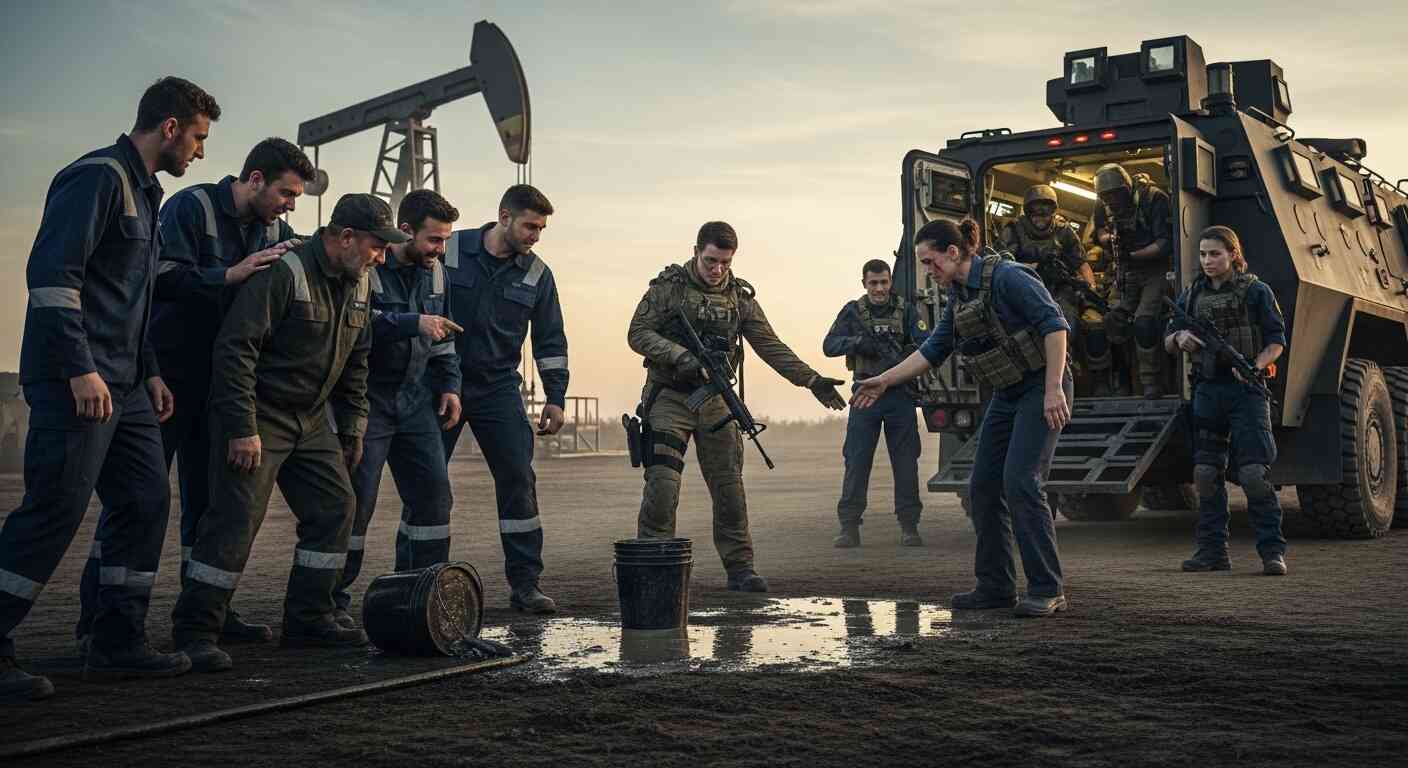
The three yard supervisors, the goons who had kicked me, were standing against the garage wall, their hands in zip-ties. They weren’t looking at me. They were staring at Johnny Carver’s unit, who were now casually patrolling the perimeter. The invisible ghosts had become undeniable gods in this dirty kingdom.
Johnny was standing over Braden. He had his helmet off, and his face was the same expressionless operator-self I had seen in Sector Seven. He held the Silver Star, which I had returned to him.
“”You dropped this, Manager,”” Johnny said. His voice was calm, but the resonance made the entire depot vibrate. He tossed the medal. It didn’t clatter on the packing crate. It landed softly, right next to where Braden was rocking, right next to the dried patch of spit in the diesel-soaked sand.
Braden flinched, but he didn’t pick it up. He looked at the medal, and then he looked at the ground, and then his eyes found mine. He opened his mouth, but only a wet, choked sound came out.
My crew was watching me, waiting. They had seen the F-22s, they had heard the rumors, and they had seen the change in me.
I walked toward Braden. The pain in my knee was a constant companion now, a fierce, seeping ache, but my posture was straight. I was no longer an invisible entity. I was the architect. I was the legend. I was the grease monkey in the dirt.
I stood over him, in the grease-soaked sand. Braden looked up, his whiny, whiny mouth open. He wasn’t crying anymore. He was just empty.
“”Grease, Braden,”” I said, my voice commanding the silence in the dirty depot. “”You said I was grease. You were right. I am grease. I make things move when they want to be stuck. I reduce the friction.””
I reached down. My hand, weathered and stained with a decade of industrial fluids, closed around the cool metal of the Silver Star. I didn’t wipe the spit off. I wiped the sand off. I looked at the medal, at the star, at the impossible choice it represented. Colonel Miller. The ghost.
I looked at Braden. I didn’t see a manager. I didn’t see a coward. I didn’t see an enemy. I just saw the flaw in the cell that the quantum storm needed to survive.
“”You don’t understand sacrifice, Braden,”” I said, my voice address the ghosts in my ears and addressed the ghosts in his kingdom. “”It’s not about meeting projections. It’s not about optimization. Sacrifice is the impossible choice. It’s when you have nothing left to give, and you give it anyway. Colonel Miller died in my arms in the wreckage of a helicopter that was trying to save our people. He didn’t care about projections. He cared about the person next to him. That’s what sacrifice means. You wouldn’t understand.””
I reached into my pocket and pulled out my depot ID badge. I had been holding onto it, a final link to the invisible life I’d tried so hard to build. I tossed it at his feet. “”I quit. The metrics here are indeed lagging. And I believe the position of ‘arrogant coward’ is now fully optimized.””
Marcus ran toward us, clutching my oil-stained canvas duffel bag. He looked at me, and then at the Special Operations soldiers, and then back at me. He wasn’t terrified anymore. He was filled with a kind of awe that I had only seen from people who had survived the impossible choice.
“”Here, Eli,”” he said, gasping for breath. “”The bag.””
I took it. The familiar weight of my gear box and some sparse, functional clothes felt grounding. I was no longer an invisible entity. I was an operator again.
I didn’t look back at Braden Vance rocking in the mud, or at the yard supervisors in zip-ties, or at the crew huddled in the depot. I didn’t look back at the invisible life I’d tried so hard to build.
I walked toward Johnny Carver and his unit of ghosts, who were waiting by the F-22s. The humming vibration of the waiting aircraft filled my soul. The ghosts in my comms were quiet now, replaced by the resonance of a legend that was finally getting its due.
Forever is over. But sometimes, the only way to save the ghosts is to burn the house down and raise a quantum storm that can survive on its own permissions.
I was the legend. I was the commander in the sky. I was the grease monkey in the dirt. And I was finally home.”