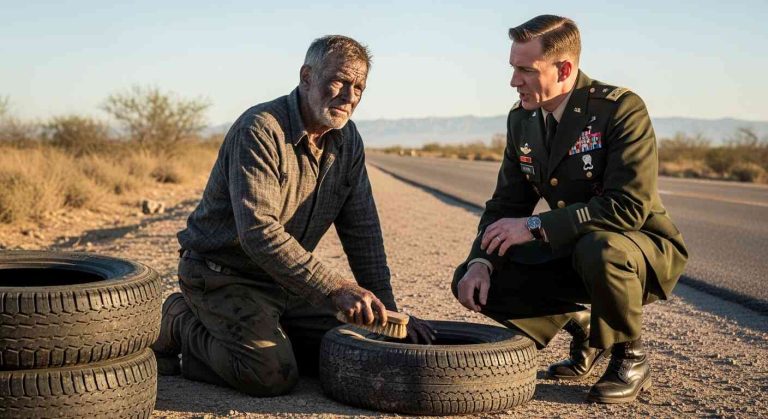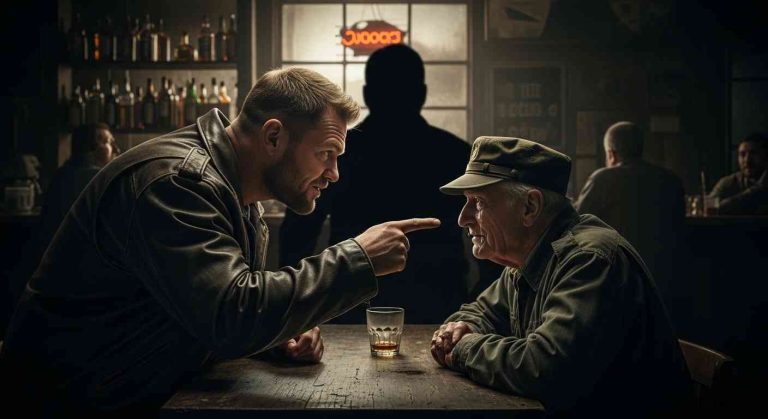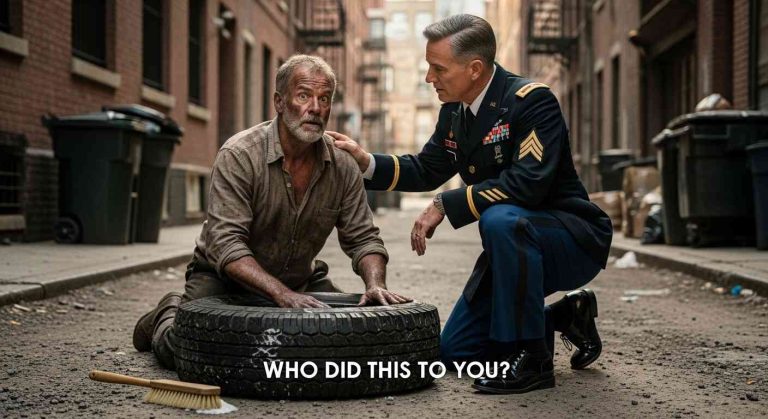
The Texas sun was a hammer, and Marcus Vane was the one swinging it.
I wiped the grease from my brow with a hand that wouldn’t stop shaking. It wasn’t fear—it was forty years of carrying a rucksack and three decades of holding the line. But to Marcus, the thirty-year-old regional manager with a degree he treated like a scepter, I was just “Unit 402.”
Or, as he liked to call me in front of the crew, “The Fossil.”
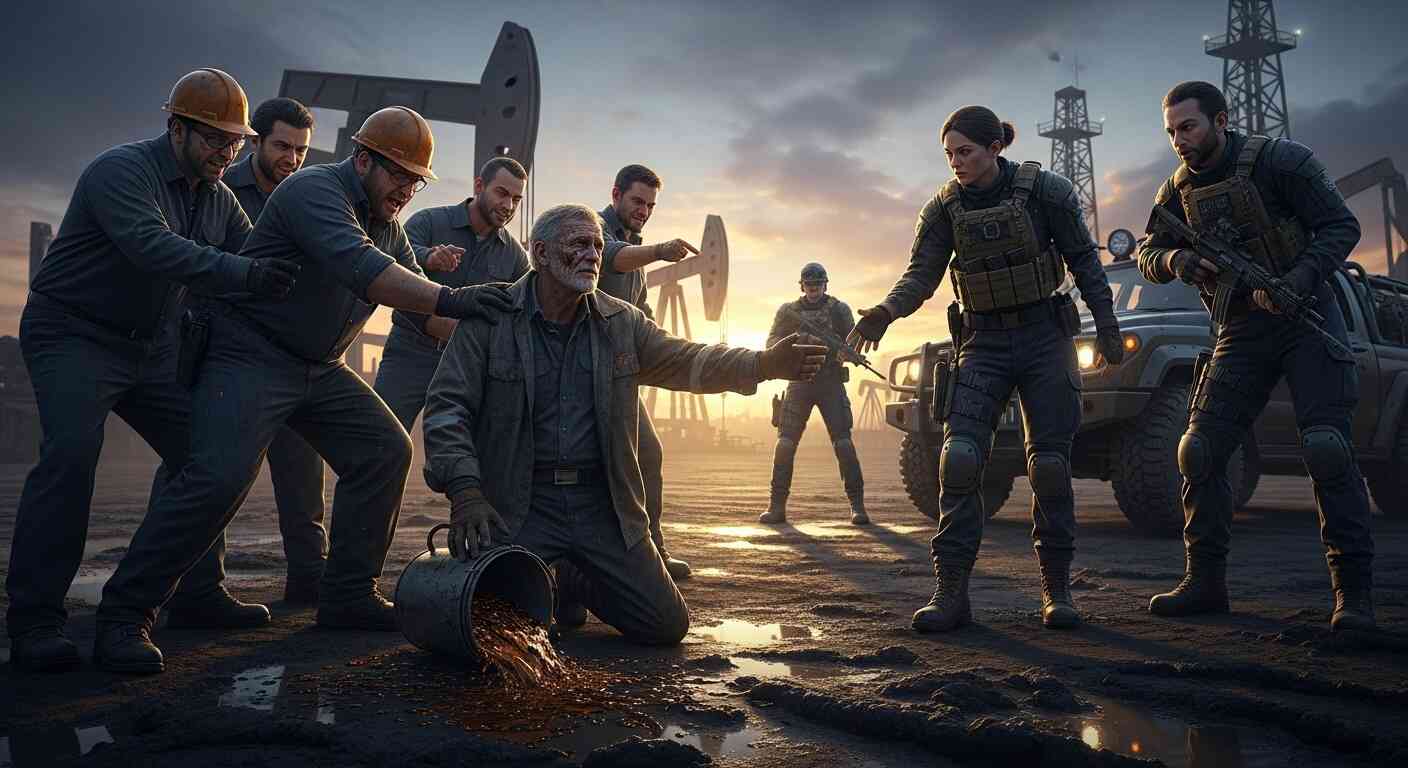
“Thorne! I told you to have those pressure valves cleared by noon,” Marcus barked. He stood there with nine other suits, all of them looking like they’d never broken a fingernail in their lives. They were out here for a ‘site inspection,’ which was really just an excuse to remind the roughnecks who owned them.
I didn’t look up. I kept my wrench on the bolt. “The seal is corroded, Marcus. If I force it, the whole line blows. It needs ten minutes of heat.”
“What it needs is a man who isn’t drawing Social Security while he works,” one of the other managers chimed in, a guy named Miller who wore loafers in a literal oil field. The group erupted in a chorus of snickering.
I felt the first shove then. It wasn’t heavy, just a dismissive palm to my shoulder. But at sixty-four, with a knee held together by titanium and prayers from a jump gone wrong in ’98, it was enough to make me stumble.
“Look at him,” Marcus laughed, stepping into my personal space. “The great Elias Thorne. You move like a turtle in peanut butter, Elias. Why are you even here? To pay for your heart medication?”
I straightened my back, feeling the familiar click in my spine. I looked him dead in the eye. I’d stared down warlords in Mogadishu and ghosts in the Hindu Kush. Marcus Vane was nothing but a mosquito with a paycheck.
“I’m here to do a job,” I said, my voice low and steady. “Something you wouldn’t understand.”
The laughter stopped. Marcus’s face turned a mottled shade of purple. He didn’t like the lack of fear in my eyes. He reached out, grabbed the collar of my sweat-soaked shirt, and jerked me forward.
“You think you’re special because you’ve got some ‘veteran’ bumper sticker on your truck?” Marcus hissed. He looked back at his cronies. “Let’s show the Fossil what happens when you talk back to the people who sign your checks.”
He shoved me. Hard.
I hit the dry, cracked earth, the impact jarring my teeth. Dust filled my lungs. Above me, ten men stood in a circle, their shadows stretching over me like vultures.
They didn’t know that three hundred miles away, the nation’s power grid was flickering out. They didn’t know that the Pentagon was currently screaming for a man who had gone off the grid five years ago.
And they certainly didn’t know that the men I used to lead were already in the air, coming to take their Commander back to the throne.
“FULL STORY
Chapter 1: The Weight of the Dust
The West Texas heat doesn’t just burn; it tries to erase you. It’s a dry, suffocating weight that settles into your pores and stays there until you forget what it’s like to feel clean. Elias Thorne didn’t mind the heat. It was honest. It was a physical price for a physical existence, a far cry from the shadowy rooms and whispered betrayals of his former life.
He was kneeling in the dirt of Sector 4, his hands slick with Grade A crude and sweat. To the world, he was a “”roughneck””—a man who had failed at life and ended up turning wrenches in the middle of nowhere. He liked the anonymity. He liked that no one here knew he had once commanded the “”Night Ghosts,”” a tier-one unit that officially didn’t exist.
“”Hey! Fossil! You deaf or just stupid?””
Elias didn’t flinch. He recognized the voice. Marcus Vane, the regional vice president, was a man who measured his self-worth by the price of his watch and the number of people he could make feel small. Today, Marcus was trailing a pack of ten “”efficiency consultants””—young men in crisp khakis who looked at the oil field like it was a dirty museum exhibit.
“”I asked you a question, Thorne,”” Marcus said, stepping closer. He kicked a wrench away from Elias’s reach.
Elias looked up slowly. His face was a roadmap of scars and sun-cracked skin. “”I heard you, Marcus. I’m just busy ensuring your quarterly profits don’t go up in a fireball because of a faulty valve.””
“”The only thing faulty here is your attitude,”” a consultant named Brian sneered. He was leaning against a support beam, scrolling through a tablet. “”According to the logs, you’re forty percent slower than the shift average. You’re a liability, old man.””
Elias stood up, his joints popping like small-caliber gunfire. He stood a head taller than Marcus, though his slight slouch hid the lethal frame beneath the grease. “”Speed kills in this business, son. I’ve seen three boys lose limbs this month because they were chasing your ‘efficiency’ metrics.””
Marcus stepped forward, his face inches from Elias’s. He smelled of expensive cologne and entitlement. “”Don’t ‘son’ us. You’re a relic. A broken-down piece of machinery we haven’t bothered to scrap yet. But I think today is the day.””
He turned to his colleagues. “”What do you think, guys? Does the Fossil look like he belongs on a professional site?””
The group laughed. It was a cruel, practiced sound. They began to circle him, a pack of wolves who had never tasted blood but thought they were predators.
“”I think he needs a nap,”” one said, tossing a half-empty water bottle at Elias’s feet.
“”I think he needs to learn his place,”” Marcus whispered.
Then came the shove.
It was Marcus’s hand, right in the center of Elias’s chest. Elias could have neutralized him in half a second. He could have shattered Marcus’s windpipe with two fingers. But he didn’t. He lived by a code now—the Ghost was dead. He let the shove take him.
He hit the dirt, the dry earth puffing up in a cloud.
“”Look at that,”” Marcus mocked, looking down at him. “”The hero of the oil field, down for the count. Stay there, Thorne. It’s where you belong. In the dirt.””
Elias stayed down. He felt the sting of a cut on his cheek where a rock had grazed him. He tasted the iron of blood. But more than that, he felt a strange, cold vibration in the ground. It wasn’t the machinery. It wasn’t the pumps.
It was the rhythmic thrum of something he hadn’t heard in five years. High-performance turbine engines.
Marcus and his crew were too busy laughing to notice. They were too busy taking photos of the “”old man”” in the dirt to see the horizon darkening.
“”You’re fired, Elias,”” Marcus said, spitting near Elias’s hand. “”Pack your trash and get off my land.””
Elias wiped his mouth, a ghost of a smile touching his lips. “”It’s not your land, Marcus. And I think you’re about to have a very bad afternoon.””
Chapter 2: The Ghost Protocol
While Elias was being ground into the Texas dirt, the world was quietly falling apart.
Deep inside the “”National Security Coordination Center”” in Arlington, Virginia, General Silas Miller was staring at a wall of monitors that were bleeding red.
“”General, the Trojan is moving through the Texas Interconnect,”” a technician shouted. “”If it hits the main hub, the entire Southern grid goes dark. We’re talking weeks without power. Hospitals, water, everything.””
Miller, a man whose skin looked like crumpled parchment, slammed his fist on the table. “”Where is he? Tell me you found him.””
“”We tracked the signal from his old service pension. He’s in a town called Odessa. Working an oil rig under an alias.””
“”Odessa?”” Miller growled. “”He’s hiding in plain sight. Get the Raptors in the air. Now. Tell them Ghost Protocol is in effect. If anyone interferes, they are authorized to use whatever force is necessary to secure the Commander.””
“”Sir, the extraction point is a private sector oil field. There are civilians.””
“”Those aren’t civilians,”” Miller snapped. “”Those are obstacles. Thorne is the only man who knows the backdoors to this specific architecture. He designed the defensive shell. If he doesn’t get to a terminal in two hours, we’re back in the Stone Age.””
Back at the oil field, the sun was dipping lower. Marcus Vane was still gloating. He had decided that firing Elias wasn’t enough; he wanted to humiliate him. He had called over the rest of the roughnecks—about fifty men, most of them young, most of them scared for their jobs.
“”Look at your idol!”” Marcus shouted to the crowd, gesturing to Elias, who was still sitting on the ground, leaning against a rusted pipe. “”This is what happens when you think you’re bigger than the company. You end up a broken old man with nothing but dust in your pockets.””
Among the roughnecks stood Jackson, a twenty-two-year-old kid Elias had been teaching how to read schematics. Jackson’s face was twisted in rage. “”He’s twice the man any of you are! He saved my life when the rig lurched last week!””
Marcus turned his cold gaze to Jackson. “”You want to join him? Step up. Otherwise, shut up.””
Jackson looked at Elias. Elias gave a tiny, almost imperceptible shake of his head. Don’t. Not yet.
“”That’s what I thought,”” Marcus sneered. He turned back to Elias and kicked his boot. “”Get up. I want to see you walk to the gate. I want to see you crawl out of here.””
Elias didn’t get up. He was looking at the sky. A low, rhythmic thrum-thrum-thrum was beginning to rattle the loose metal of the derrick.
“”You hear that, Marcus?”” Elias asked softly.
“”Hear what? The sound of you losing your pension?””
“”No,”” Elias said, standing up slowly. This time, his posture didn’t break. He stood straight, his chest out, his eyes turning into chips of blue ice. “”That’s the sound of the bill coming due.””
The sound grew into a roar. Suddenly, the wind whipped into a frenzy. Two black MH-6 Little Birds—stealth variants—screamed over the horizon, flying so low they sent the consultants’ tablets flying from their hands.
The managers scrambled back, shielding their eyes as the helicopters flared, hovering just twenty feet above the drilling floor.
“”What the hell is this?!”” Marcus screamed, his voice cracking with terror. “”This is private property! You can’t be here!””
He was answered by the sound of sliding doors and the hiss of fast-ropes hitting the ground.
Chapter 3: The Gathering Storm
The transition from a corporate bullying session to a military extraction took less than six seconds.
Four men hit the ground simultaneously. They were shadows in broad daylight—clad in matte-black carbon-fiber armor, faces obscured by ballistic masks, and carrying suppressed short-barreled rifles. They didn’t land like men; they landed like predators.
The ten managers froze. Marcus Vane, who seconds ago was the king of the world, was now shaking so hard his knees were knocking.
“”Hands! Show me your hands!”” one of the operators barked. The voice was like gravel in a blender.
The managers threw their hands up, some of them falling to their knees in sheer panic. Brian, the efficiency consultant, actually wet his pants, the dark stain spreading across his expensive khakis.
“”We’re with Vane Global! You’re making a mistake!”” Marcus shrieked, his voice reaching a glass-shattering pitch.
The lead operator, a man with a “”Ghost”” patch on his shoulder, ignored him completely. He walked through the circle of terrified managers as if they were ghosts. He stopped three feet in front of Elias.
The operator snapped a crisp, razor-sharp salute. “”Commander. We’ve been looking for you.””
Elias looked at the man. He recognized the gait. “”Leo? You’ve put on weight.””
The operator pulled off his mask, revealing a face mapped with scar tissue and a wide, grinning mouth. “”And you’ve put on a lot of grease, sir. General Miller sends his regards. He says the world is burning and he needs the fire department.””
The roughnecks stood back in stunned silence. Jackson’s mouth was hanging open. “”Commander?”” he whispered.
Elias sighed, a sound of heavy resignation. “”Is it the Trojan?””
“”It’s the Trojan, sir. Twenty minutes until the Southern hub goes dark. We have a mobile command center in the bird.””
“”Wait!”” Marcus yelled, emboldened by his own stupidity. “”I don’t care who you are! This man is fired! He’s a trespasser! I’m calling the police!””
Leo, the operator, turned his head slowly. He looked at Marcus like one might look at a particularly annoying insect. He walked over to Marcus, who shrunk back.
“”You’re Marcus Vane?”” Leo asked.
“”Y-yes. And I demand—””
Leo didn’t let him finish. He grabbed Marcus by the tie and jerked him forward, his face inches from the manager’s. “”This man,”” Leo said, pointing a gloved finger at Elias, “”has three Medals of Honor. He has saved this country more times than you’ve had hot meals. And I just watched you on the long-range feed shove him into the dirt.””
Leo’s grip tightened. “”In my world, that’s a capital offense.””
Marcus turned a ghostly shade of white. “”I… I didn’t know… he was just a worker…””
“”He was the man keeping your lights on,”” Elias said, stepping forward. “”But since I’m fired, I guess I don’t have to worry about your valves anymore.””
Elias looked at the derrick. “”In about five minutes, the pressure in Line 4 is going to hit critical. Since you’re so ‘efficient,’ Marcus, I’m sure you can fix it.””
“”What?”” Marcus gasped, looking at the vibrating pipes. “”I don’t know how to—Elias, please! I was just joking! We were just having some fun!””
Chapter 4: The Breaking Point
The air was thick with the smell of ozone and fear. The ten managers were huddled together now, their bravado stripped away like cheap paint. The roughnecks, sensing the shift in power, began to move closer, their faces set in grim satisfaction.
“”You were having fun?”” Elias asked, his voice deceptively soft. He walked over to Marcus. The “”old man”” limp was gone. He moved with a terrifying, fluid grace. “”You were having fun while I worked twelve-hour shifts to cover for the boys you fired? You were having fun when you kicked dust in my face?””
Elias reached out and took the phone Marcus was still clutching—the one he’d used to film Elias in the dirt.
“”Let’s see the footage,”” Elias said. He tapped the screen.
The video played. Marcus’s voice echoed across the quiet field: “”Look at the Fossil! Stay in the dirt, Thorne! It’s where you belong!””
Elias looked at the managers. “”You all thought this was funny.””
None of them looked him in the eye. Miller, the one in loafers, was sobbing quietly.
“”Commander, we don’t have time,”” Leo urged, checking his tactical watch. “”The grid is at 88% capacity. We need to move.””
“”One minute,”” Elias said. He turned to the roughnecks. “”Jackson! Step up.””
Jackson stumbled forward, his eyes wide. “”Yes, sir?””
“”You know how to bleed the line on Sector 4?””
“”Yes, Elias. I mean, Commander.””
“”Good. You’re the foreman now. Tell the Vane Global office that if they don’t confirm your salary at triple the current rate, I’ll let the General here know that this facility is a national security threat. He’ll have it bulldozed by morning.””
“”I… I can do that,”” Jackson said, a grin breaking across his face.
Elias then turned to Marcus. “”As for you. You wanted me to crawl to the gate?””
Marcus shook his head frantically. “”No, no, please—””
“”Leo,”” Elias said.
“”Sir?””
“”Mr. Vane here is very concerned about efficiency. Ensure he and his colleagues assist the crew in cleaning the spill in Sector 7. By hand. With rags. If they stop before the dirt is gone, treat it as a breach of military protocol.””
Leo grinned, a terrifying sight. “”With pleasure, sir. Boys, give the consultants some rags. And take their shoes. They wouldn’t want to ruin those nice loafers.””
As the operators began to herd the terrified managers toward the sludge pits, Elias turned toward the helicopter. But he stopped. He looked at the cut on his hand, the oil under his fingernails.
The old wound—the reason he’d left the service—flared in his mind. He’d left because he was tired of being the man who decided who lived and who died. He’d wanted to be a man who just fixed things.
But as the sound of the world’s digital heart failing echoed through Leo’s headset, Elias realized you can never truly bury a hero. You can only cover him in enough dust until someone kicks him hard enough to wake him up.