The sound of the steel bolt sliding home was a heavy, final thud that echoed in my bones. It was the sound of a world deciding I no longer mattered.
“Keep screaming, Elias!” Miller’s voice came through the thick insulation, muffled but dripping with that arrogant, youthful venom. “Maybe the frost will preserve you for the museum where you belong!”
I stood there in the dark, the temperature already plummeting toward zero. At sixty-eight, my joints ached on a good day. In here, they felt like they were being shattered by invisible hammers. I reached out, my fingers trembling as they touched the corrugated walls.
I had spent forty years in the shadows, serving a country that didn’t know my name. I had orchestrated coups, prevented nuclear meltdowns, and moved armies like chess pieces. But when I retired, I wanted quiet. I took a job at this shipyard in New Jersey just to keep my hands busy. I thought I could be normal.
I was wrong. To Miller, the thirty-two-year-old foreman with a chip on his shoulder and a steroid-induced temper, I was just “the old guy.” I was the slow link in his chain. I was the man who forgot to laugh at his jokes.
“Miller, please,” I rasped, my breath blooming in a thick white cloud. “The locks… they’re electronic from the outside. You know I can’t get out.”
“That’s the point, Gramps!” his lackey, Marcus, shouted. I could hear them walking away, their boots crunching on the gravel. “We’ll come back after our shift. Maybe by then, you’ll have learned how to move a little faster.”
The silence that followed was worse than the cold. It was the silence of being forgotten. I sank to the floor, my knees hitting the frozen metal. I closed my eyes, and for a moment, I wasn’t in a freezer. I was back in the Pentagon, 1998. I was in a bunker in Sarajevo. I was the man they called ‘The Architect.’
But as the shivering turned into a deep, rhythmic thrumming in my chest, I realized I was just an old man dying in a box because I had tried to hide my teeth.
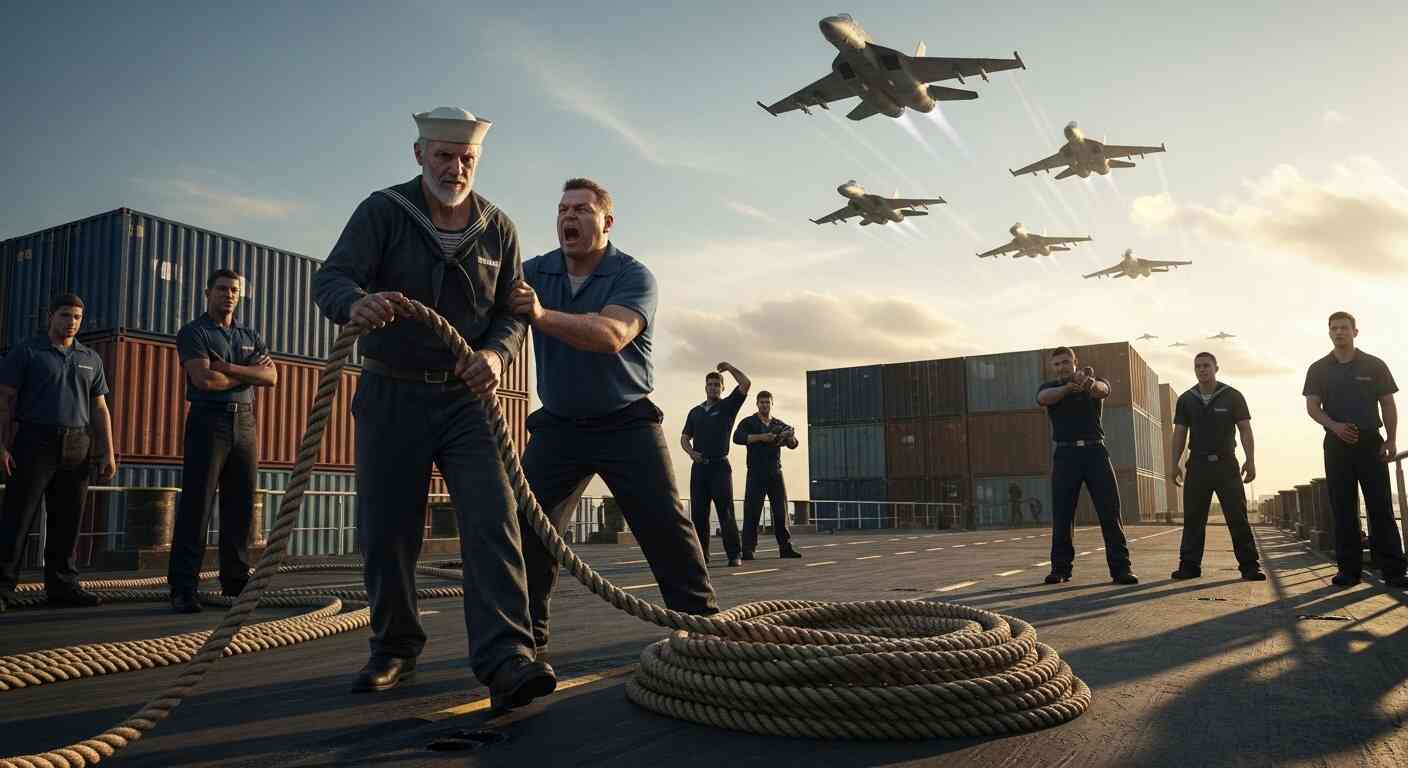
Then, the vibration started. It wasn’t my shivering. It was the container. The very air around me began to scream. It wasn’t the wind. It was the sound of four General Electric F110 engines screaming at low altitude.
I smiled, my lips cracking in the cold. They found me.
“FULL STORY
Chapter 1: The Cold Reality
The darkness inside the container was absolute, the kind of blackness that felt heavy against the skin. Elias Thorne sat with his back against the corner, drawing his knees to his chest. He could feel the frost beginning to crystallize on the wool of his thrift-store sweater.
Miller had been riding him for months. It started with small things—””accidentally”” losing Elias’s time card, assigning him the heavy lifting in the rain, making “”senile”” jokes in front of the crew. Elias had taken it all with a stoic, quiet grace that Miller mistook for weakness.
“”You’re a ghost, Elias,”” Miller had told him that morning, shoving a clipboard into his chest. “”You’re a relic of a world that doesn’t exist anymore. Efficiency is the only god we worship here, and you’re an atheist.””
Elias hadn’t responded. He couldn’t. How do you explain to a man like Miller that you’ve seen the rise and fall of regimes? How do you tell him that the “”efficiency”” he prides himself on is child’s play compared to the logistical nightmares Elias had solved while Miller was still in diapers?
Now, the “”ghost”” was literally being laid to rest.
The cold was an old enemy. Elias remembered a winter in the Ural Mountains, hiding from a Spetsnaz patrol in a hollowed-out log. He had learned then that the cold doesn’t just freeze your blood; it freezes your will. It whispers to you to just close your eyes and sleep.
“”Not today,”” Elias whispered, his voice a jagged edge of sound.
He thought of Sarah, the girl in the shipping office. She was twenty-four, bright-eyed, and the only person who treated him like a human being. She’d bring him extra coffee and ask about his “”grandkids,”” even though Elias had no one left. He hoped she wouldn’t get in trouble for this. He hoped she wasn’t watching Miller and the others high-five as they walked away from his icy tomb.
Suddenly, a low-frequency hum rattled the metal. It grew into a roar that shook the very foundation of the shipyard.
In the shipyard outside, the atmosphere shifted from cruel levity to sheer terror. Workers dropped their tools, shielding their ears as a black silhouette blotted out the sun. It wasn’t a commercial plane. It was a modified C-17 Globemaster, flying dangerously low, its shadow sweeping over the rusted cranes like a predator.
Miller stood in the center of the yard, his mouth agape. “”What the hell is that? Is that… is that military?””
Marcus, his face pale, pointed toward the roof of Elias’s container. “”Miller… look!””
Four black tactical helicopters, swarming like hornets, detached from the jet’s perimeter. One of them hovered directly over the blue container. A heavy-duty steel grappling claw lowered on a high-tension cable.
Inside, Elias felt the container jerk. He heard the screech of metal on metal—a sound so violent it made his ears bleed. Then, with a roar of mechanical power, the entire roof was peeled back like a sardine can.
The blinding light of the afternoon sun hit Elias’s eyes. He squinted, looking up.
A man in full tactical gear, wearing a headset and carrying a suppressed carbine, rappelled down the side of the container. He landed softly on the frozen floor, his boots crunching on the ice. He didn’t look at the foreman. He didn’t look at the crowd. He walked straight to Elias and dropped to one knee.
“”Architect,”” the soldier said, his voice thick with relief. “”Forgive the delay. The world is falling apart, and the Joint Chiefs realized they can’t put it back together without you.””
Elias looked at the soldier—a man he recognized as Colonel Vance, a man he had mentored a decade ago.
“”You’re late, Vance,”” Elias said, his voice raspy but regaining its iron core.
“”We had to clear the airspace, sir,”” Vance replied, reaching out to help him up. “”The President is on the line. We have fifteen minutes to get you to the War Room.””
Elias stood, his old bones popping. He turned his head slowly, looking over the jagged, torn edge of the container. He saw Miller standing twenty feet away, paralyzed, his face a mask of pure, unadulterated shock.
Elias didn’t say a word. He didn’t have to. The roar of the engines said everything for him.
Chapter 2: The Resurrection of a Legend
The transition from the freezing darkness of the container to the pressurized, high-tech interior of the extraction jet was a blur of motion and heat. As the C-17 banked hard over the Atlantic, Elias sat in a plush leather seat, a thermal blanket draped over his shoulders. A medic was checking his vitals, but Elias’s eyes were fixed on the digital map flickering on the bulkhead.
“”Vitals are stable, sir. You’re lucky. Another thirty minutes and the hypothermia would have been irreversible,”” the medic whispered.
Elias ignored him. He looked at Colonel Vance. “”Tell me.””
Vance didn’t waste time. He opened a secure tablet, projecting a 3D hologram of the Middle East and Eastern Europe. Red zones were blooming across the map like spilled wine.
“”The ‘Serpent’s Head’ protocol has been activated, sir. It’s a synchronized cyber-physical collapse. Three major power grids are down. Two carrier groups have lost communication. The Pentagon is flying blind, and the AI-driven response systems are being fed corrupted data. They’re making mistakes, Elias. Big ones.””
Elias felt the old familiar fire stir in his gut. The “”Serpent’s Head”” was a theory he had written twenty years ago as a warning—a “”doomsday”” scenario that everyone said was impossible.
“”Who’s running the response?”” Elias asked.
“”General Halloway,”” Vance replied.
Elias scoffed. “”Halloway is a hammer. He’s going to try to beat this into submission with force. You can’t shoot a ghost, Vance. You have to starve it.””
“”That’s why we’re here,”” Vance said. “”Halloway wanted to launch a retaliatory strike. The President vetoed it—on the condition that we find the man who designed the protocol’s countermeasures.””
Meanwhile, back at the shipyard, the world had turned upside down.
Miller sat on the dirty concrete, his hands cuffed behind his back. Local police and black-suited federal agents were swarming the facility. Marcus was crying, babbling about how he “”just did what Miller said.””
“”I didn’t know!”” Miller screamed as an agent hauled him to his feet. “”He was just a guy! He was just a freaking old man who couldn’t lift a crate!””
The agent, a woman with eyes like cold glass, stopped and looked Miller in the face. She leaned in close. “”That ‘old man’ has a security clearance higher than the Director of the FBI. You didn’t just lock a worker in a freezer, Miller. You attempted to assassinate a national asset during a global blackout.””
“”I… I…”” Miller stuttered.
“”The container is being impounded as a crime scene,”” she continued. “”And you? You’re going to a black site. We need to know if you were paid by a foreign entity to take him off the board before the strike.””
Miller’s face went white. “”Foreign entity? No! I just… I just hated him! He made me feel small!””
“”Well,”” the agent said, signaling for the officers to take him away. “”You’re about to feel much, much smaller.””
Up in the air, Elias watched the clouds through the reinforced window. He looked at his hands—rough, calloused, and stained with the grease of the shipyard. He had tried to be a ghost. He had tried to live a life where his decisions didn’t result in body counts.
But the world wouldn’t let him go.
“”Sir?”” Vance asked. “”The President is ready for you.””
Elias stood up, shedding the thermal blanket. He stood tall, the slight slouch of the “”old man”” vanishing, replaced by the rigid, lethal posture of a commander.
“”Get me a suit,”” Elias said. “”And a cup of black coffee. We have a long night ahead of us.””
Chapter 3: The War Room
The “”War Room”” wasn’t a room at all; it was a subterranean city carved into the granite of the Blue Ridge Mountains. As the elevator descended, the air grew crisp and ionized. When the doors opened, Elias was met with a wall of sound—hundreds of voices, the frantic clicking of keyboards, and the low hum of supercomputers.
General Halloway was standing over a massive glass table, shouting into a headset. He was a man of silver hair and loud medals, the kind of soldier who looked good in a recruitment poster but struggled in the nuance of the grey zone.
When Elias walked in, the room didn’t go silent—it wasn’t a movie. But the people who mattered, the veterans of the intelligence community, stopped. They nudged their younger colleagues.
“”Is that…?””
“”The Architect. I thought he was dead.””
General Halloway turned around, his face reddening. “”Thorne. You look like hell.””
“”And you look like you’re about to start World War III because you can’t find the ‘off’ switch,”” Elias replied, walking straight to the table. He didn’t shake hands. He didn’t wait for an invitation.
“”This is a coordinated strike, Elias,”” Halloway growled. “”They’ve taken out our eyes. I’m moving the 7th Fleet into the Black Sea. We have to show strength.””
“”You move that fleet, and you’re playing right into the second phase of the Serpent’s Head,”” Elias said, his eyes scanning the data streams. “”The power grid failures aren’t the attack. They’re the bait. They want you to move your assets to those locations so they can decapitate your command structure while you’re in transit.””
Halloway leaned over the table. “”And you know this how?””
“”Because I wrote the attack profile,”” Elias said, his voice quiet and chilling. “”I wrote it as a stress test for the NSA in 2005. The attackers aren’t using a new weapon. They’re using my old notes.””
The room went deathly quiet.
“”Then tell me how to stop it,”” Halloway challenged.
Elias looked at the map. He saw the patterns—the subtle, rhythmic flickering of the data. To everyone else, it was chaos. To him, it was a symphony.
“”They’re not in Moscow or Beijing,”” Elias said. “”Look at the lag in the relay. They’re bouncing the signal through a decommissioned satellite array. They’re closer than you think.””
As Elias worked, his mind flashed back to the shipyard. He thought of the cold. He realized that the men who had locked him in that container weren’t just bullies. They were a symptom of a world that had forgotten the value of the foundation. They saw the old and the slow as obstacles, not realizing that the old and the slow were the ones who knew where the skeletons were buried.
“”Vance,”” Elias called out. “”I need access to the Deep Sea Cable array. And I need a direct line to the CEO of the New Jersey Port Authority.””
“”The Port Authority?”” Halloway asked. “”Why?””
“”Because,”” Elias said, a grim smile playing on his lips. “”I left my notebook in my locker at the shipyard. And in that notebook is the encryption key they’re using. They didn’t lock me in that freezer to be mean, Halloway. They did it because they knew I was the only one who could see them coming. Miller wasn’t just a foreman. He was an asset.””
The realization hit the room like a physical blow. The “”bully”” at the shipyard wasn’t just a jerk. He was a piece of the puzzle.
Chapter 4: The Puppet Master’s Shadow
While Elias was dissecting global cyber-attacks, the FBI was dissecting Miller’s life. And what they found was a trail of breadcrumbs that led straight into a nightmare.
Agent Kinsley—the woman who had arrested Miller—stood in the middle of Miller’s cramped, messy apartment. On the surface, he was a loser with an anger problem. But hidden behind a false wall in his closet was a high-end encrypted workstation and three passports with different names.
“”He’s not just a foreman,”” Kinsley whispered into her radio. “”He’s a handler. He’s been embedded at the shipyard for three years. His job wasn’t just to manage the crates—it was to monitor Elias Thorne.””
Back at the War Room, Elias was watching the monitor as Kinsley’s report came through. He felt a coldness in his chest that had nothing to do with the freezer.
“”He was watching me the whole time,”” Elias murmured. “”Every time I showed up for a shift. Every time I ate my sandwich on the pier. He was waiting for the signal to eliminate me.””
“”But why lock you in a freezer?”” Vance asked. “”Why not just a bullet?””
“”A bullet leaves a trace,”” Elias said. “”An old man ‘accidentally’ getting locked in a cold storage unit and dying of ‘natural causes’ or ‘senility’? That’s a tragic accident. It doesn’t trigger an investigation. It doesn’t bring a mercenary team to the yard. They underestimated the President’s desperation. They didn’t think anyone still cared about an old ghost.””
Elias turned back to the screen. “”Miller made a mistake. He let his personal hatred for me get in the way of the mission. He wanted me to suffer. If he had just shot me, I’d be dead, and the Serpent’s Head would be complete. But because he wanted to hear me scream, he gave you enough time to find me.””
“”Sir,”” a technician shouted. “”The satellite array is shifting. They’re initiating Phase Three!””
“”Cut the power to the New Jersey grid,”” Elias commanded.
“”What?”” Halloway roared. “”That’s millions of people! The hospitals, the—””
“”Do it now!”” Elias barked. “”The attack is using the shipyard’s local server as a hard-wired bridge. It’s the only way they can bypass the federal firewalls. If you don’t cut the power, they’ll have the launch codes for the silos in North Dakota in three minutes.””
Halloway hesitated. Elias stepped into his space, his face inches from the General’s.
“”I have been freezing for the last two hours, General. I have nothing left to lose. Cut the power, or I will walk out of here and let you explain to the survivors why you were worried about the lights in Newark.””
Halloway signaled his aide. “”Do it. Cut the New Jersey sector.””
The map on the wall flickered. A massive chunk of the Eastern Seaboard went black.
Elias watched the red lines on the map. They wavered. They stuttered. Then, they began to retreat.
“”We have them,”” Elias whispered. “”Vance, send the coordinates to the strike team. Miller’s apartment was just one node. The ‘brain’ is located in a warehouse three miles from the shipyard. It’s disguised as a data center for a logistics company.””
“”On it,”” Vance said, his voice tight with anticipation.
Elias sat back, his breath hitching. The adrenaline was fading, and the exhaustion of a seventy-year-old body was rushing back in. He felt a sharp pain in his chest.
“”Elias?”” Vance asked, noticing him pale.
“”I’m fine,”” Elias lied, clutching the armrest. “”Just… finish it.””