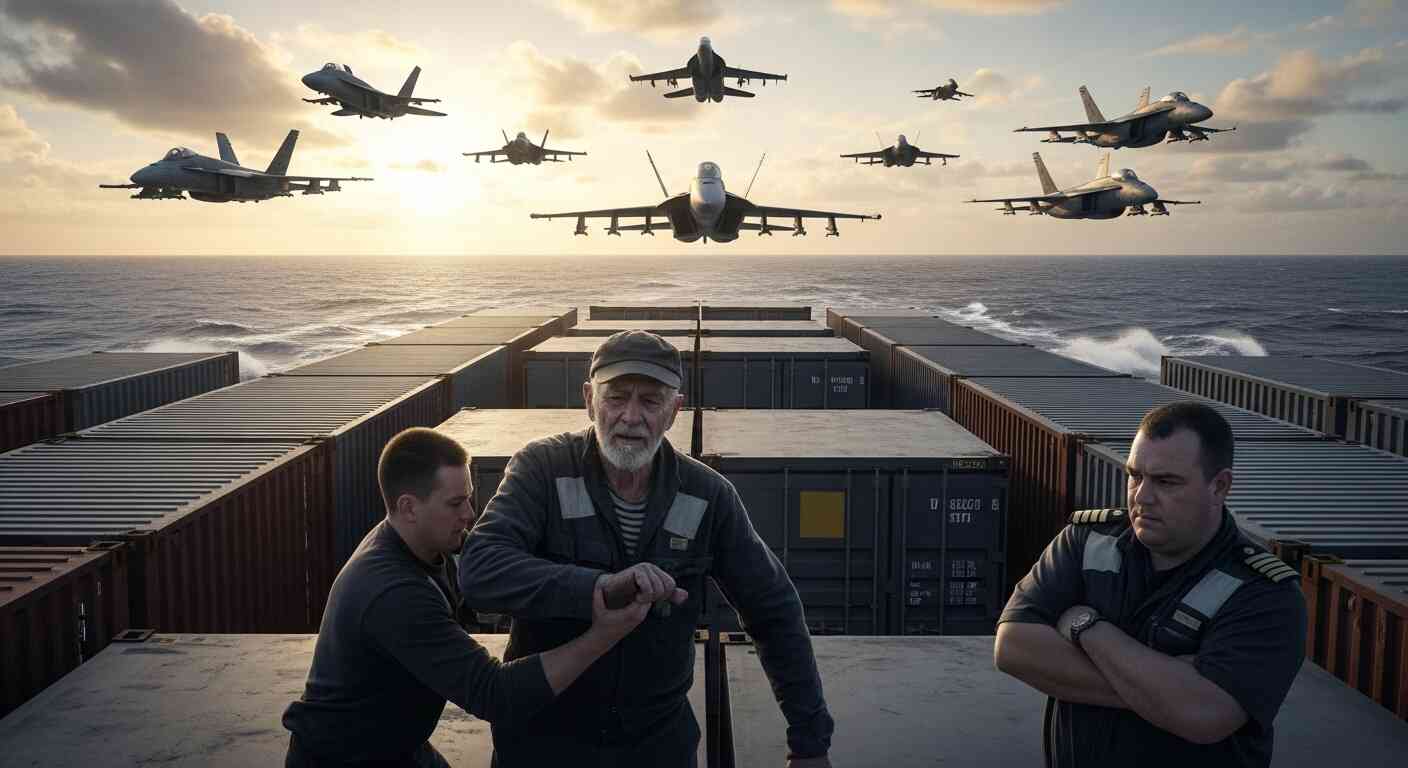
“You’re not a sailor, you’re a burden,” the first mate roared, the words hitting me harder than the bucket of dirty, freezing bilge water he’d just slammed across my back.
I stayed on my knees. I didn’t fight back. I didn’t even look up. I just kept scrubbing the salt-crusted deck of The Rusty Osprey while the mid-March Atlantic wind cut through my soaked shirt like a razor blade.
Ten men—men I’d shared bread and stories with for three months—stood in a semi-circle, howling with laughter. They called me “Ghost” because I never talked, but mostly they called me “The Burden.”
“Look at him,” Silas “Gator” Vance sneered, kicking my bucket over. “Third-grade education, no family, no spine. Why the Captain keeps you on this crew is a mystery to me. You’re nothing but extra weight we have to carry.”
I gripped the wooden handle of my brush until my knuckles turned white. He didn’t know that I’d survived three tours in the Hindu Kush. He didn’t know that my “lack of family” was because I’d lost them all to a shadow war he couldn’t even imagine. I wanted peace. I wanted to be nobody.
But peace is a luxury men like me aren’t allowed to keep.
The laughter died first. It didn’t fade; it was cut off like a throat being slit.
The sky above the Maine coastline didn’t just turn dark—it turned metallic. The screaming roar of four F-35 Lightning IIs tore through the atmosphere, flying so low the sea spray turned into a mist of diamonds.
Then came the “Reapers.” Blacked-out transport helis that didn’t show up on any civilian radar.
Gator stumbled back, his face turning the color of ash. “What is this? Coast Guard?”
“No,” I said, standing up for the first time in three months. I wiped the dirty water from my eyes and felt the old, cold fire wake up in my chest. “They’re late.”
The world’s most dangerous private military force was landing on a garbage scow in the middle of the ocean. And they weren’t here for the cargo. They were bringing their Commander home.
“FULL STORY
Chapter 1: The Weight of Silence
The Atlantic didn’t care about your resume. It didn’t care if you were a saint or a sinner; it only cared if you could hold your ground when the swells rose to fifteen feet. For three months, I had been holding my ground on The Rusty Osprey, a commercial hauler that smelled of diesel, dead fish, and broken dreams.
I was Elias Thorne, but to the crew, I was just “”Ghost.”” I was the guy who took the double shifts, the guy who cleaned the grease traps, and the guy who didn’t complain when the rations ran thin. I wanted the anonymity. After fifteen years of leading the Iron Phalanx—a Tier One shadow unit that officially didn’t exist—I was tired of the noise. I was tired of the screams, the briefings, and the weight of the dog tags I kept in a small velvet bag at the bottom of my locker.
“”Hey, Burden! I’m talking to you!””
Gator Vance’s voice was like gravel in a blender. He was a big man, built like a brick wall with a temperament to match. He’d taken a personal dislike to me from day one. Maybe it was because I didn’t flinch when he yelled. Maybe it was because he sensed I was hiding something he couldn’t understand.
I didn’t look up from the deck. “”I’m scrubbing, Silas. The job’s getting done.””
“”It’s Sir to you,”” he spat. He reached down and grabbed the back of my neck, his calloused thumb pressing into the scar I’d received from a sniper’s graze in Damascus. “”You think you’re better than us? With your quiet eyes and your fancy way of moving? You’re a stray dog we let on this boat out of pity.””
Behind him, the crew egged him on. There was Miller, a man who owed ten grand in child support and took his frustration out on anyone smaller than him. There was Jax—not my Jax, but a scrawny kid who thought being a bully made him a man.
“”Leave him be, Gator,”” Sarah, the ship’s cook, called out from the galley door. She was the only one who saw me as a person. She had a daughter back in Portland she was trying to put through nursing school. She had kindness in her eyes that reminded me of a life I used to have.
“”Shut it, Sarah!”” Gator barked. He turned back to me, his face inches from mine. “”You’re a burden on this ship, Ghost. And burdens get thrown overboard.””
He picked up the bucket of gray, icy slush and dumped it over my head.
The cold was a shock, a physical blow that sent my body into a survival reflex I had spent months trying to suppress. My muscles coiled. My heart rate dropped—not out of fear, but into the “”combat zone,”” that icy plateau of focus where time slows down. I could see the sweat on Gator’s upper lip. I could see the pulse in his neck. I could have killed him in three seconds with the brush in my hand.
But I didn’t. I stayed down. I let the laughter wash over me along with the filth.
Just two more weeks, I told myself. Two more weeks and we dock in Boston. Then I disappear into the mountains of Montana. No more blood. No more orders.
Then, the vibration started.
It wasn’t the engine. The Osprey’s engine was a rhythmic thrum; this was a high-frequency scream that rattled the teeth in my skull. The horizon, which had been a flat line of gray, suddenly erupted.
Four black shapes tore through the clouds, moving at speeds that defied physics. They weren’t Coast Guard. They weren’t Navy. They were “”Phantoms””—the custom-built stealth fighters belonging to the Iron Phalanx.
The laughter on deck stopped as if a switch had been flipped. The crew looked up, their mouths hanging open. The jets banked, circling the ship in a tight, aggressive formation that sent massive wakes rippling across the water.
A heavy-lift transport helicopter appeared from the mist, its rotors beating the air into a frenzy. It bore no markings, just a matte black finish that seemed to swallow the sunlight.
“”What the hell is this?”” Gator whispered, his bravado vanishing as he stumbled back against the railing. “”Is this a drug bust? We ain’t got nothing!””
I stood up slowly. I didn’t look like a deckhand anymore. I wiped the water from my face and pulled my shoulders back. The “”Burden”” was gone. The Commander was back.
“”They’re not here for drugs, Silas,”” I said, my voice carrying over the roar of the engines.
The helicopter hovered directly over the deck, the prop-wash nearly knocking the sailors off their feet. Ropes dropped. And then, the shadows descended.
Chapter 2: The Kneeling of Giants
The first man down the rope didn’t hit the deck; he landed on it with the practiced grace of a predator. He was clad in full carbon-fiber tactical gear, a thermal-optical mask hiding his face. He held a suppressed carbine with the ease of an extra limb.
Five more followed in rapid succession, forming a perfect tactical circle. They moved with a synchronization that made the Osprey’s crew look like a group of toddlers.
Gator Vance, ever the idiot, tried to assert his authority. “”Now see here! You can’t just board a private vessel! I’m the first mate of—””
The lead mercenary didn’t even look at him. He took one step forward, and with a movement too fast for the human eye to follow, he jammed the muzzle of his rifle into the soft space under Gator’s chin.
Gator’s knees buckled. He let out a pathetic whimper, his eyes bulging. “”Please… don’t…””
“”Secure the perimeter,”” a voice boomed over the comms, audible through the lead man’s external speakers.
The man with the rifle—Jax, my second-in-command for a decade—looked at me. Even through the mask, I knew he was smiling. He lowered the rifle from Gator’s throat and did something that made every man on that ship freeze in absolute terror.
He unclipped his helmet, tucked it under his arm, and dropped to one knee.
The other five men followed suit instantly. Six of the world’s most expensive and dangerous soldiers were kneeling in the filth and fish scales of the Osprey’s deck.
“”Commander Thorne,”” Jax said, his voice thick with emotion. “”The world is burning, and we’ve been looking for you for ninety days. It’s time to come home, sir.””
The silence that followed was heavier than the roar of the jets. I looked at the crew. Miller was shaking so hard he had to hold onto the crane. Sarah was staring at me from the galley, her eyes wide with a mix of fear and realization.
And then there was Gator.
He was still on the floor where he’d collapsed. He looked at me, then at the kneeling soldiers, then back at me. “”Commander?”” he whispered, his voice cracking. “”You… you’re a…?””
I walked over to him. The water from his bucket was still dripping off my chin. I leaned down, mirroring the way he had bullied me only minutes before.
“”You were right about one thing, Silas,”” I said quietly. “”I was a burden. But not to this ship. I was a burden to the men who tried to kill me, and to the enemies of this country. And you?””
I glanced at Jax. Jax raised his rifle slightly.
“”You’re just lucky I’m retired,”” I finished.
I turned to Jax. “”Why now, Jax? I told you I was done. I signed the papers. I gave you the unit. Why break the silence?””
Jax stood up, his face turning grim. “”Because of ‘The Broker,’ sir. He found the list. The real list. He knows where the families are. Sarah’s daughter in Portland? She’s on it. Miller’s kids? On it. He’s using your retirement as a window to wipe the slate.””
My heart went cold. My retirement wasn’t just a personal choice; it was supposed to be a shield. If the Broker had the list, then my crew—my new crew, these idiots who hated me—were all dead men walking.
“”He followed you here, Commander,”” Jax said, looking at the horizon. “”He didn’t know which ship you were on, so he sent a hit team to intercept every vessel in this corridor. They’re ten miles out, disguised as a salvage crew.””
I looked at Sarah. She was clutching a photo of her daughter. I looked at the men who had mocked me. They weren’t my friends, but they were under my protection now.
“”Jax,”” I said, my voice hardening into the tone that had directed a hundred missions.
“”Sir?””
“”Get the gear out of the bird. We’re not leaving yet.””
Gator looked up, confused. “”You’re… you’re staying?””
“”I’m saving your lives, Silas,”” I said, stepping over the bucket. “”Now get up. You’re going to help me prep the kill zone.””
Chapter 3: The Ghost of the Phalanx
The transformation of The Rusty Osprey began. In the space of twenty minutes, the rusted hauler became a floating fortress.
Jax and his team—Viper, Kael, Stone, and Ghost (they’d kept my callsign in my honor)—began mounting automated turrets behind the rusted bulwarks. They moved with a silent, lethal efficiency that left the ship’s crew paralyzed with awe.
I stood on the bridge next to Captain Miller. The old man was nursing a cup of black coffee, his hands finally steady.
“”I knew you weren’t a deckhand, Elias,”” Miller said, looking out at the foggy horizon. “”No man scrubs a deck with that much discipline unless he’s used to following orders he hates.””
“”I’m sorry for the deception, Captain,”” I said. “”I didn’t want to bring this to your door.””
“”Son, in this world, the door is always there. Some people just choose not to see the monsters knocking on it.”” He gestured to the deck where Gator was currently being forced by Stone to haul heavy ammunition crates. “”You’ve scared the hell out of my first mate. I ought to thank you for that.””
I didn’t smile. My mind was on the “”Broker.”” He was a ghost—a middleman for oligarchs and terrorists. He didn’t have an army; he had a checkbook that could buy one.
“”Commander,”” Jax’s voice crackled in my earpiece. “”Radar contact. Two fast-attack boats, low profile. They’re masking their signatures behind the swells. ETA six minutes.””
“”Rules of engagement?”” Jax asked.
I looked down at the deck. Sarah was in the galley, barricading the door as I’d instructed. These people were innocent. Gator was a jerk, but he didn’t deserve to be executed by a mercenary hit squad.
“”They’re coming for me,”” I said. “”But they’ll kill everyone to make sure they get the job done. This is a total defense. Neutralize the threats. No survivors.””
“”Copy that. No survivors.””
I walked down to the deck. Jax handed me a custom-built HK416, the weight of it familiar and grounding. I checked the chamber, the click of the bolt echoing in the sudden silence of the ship.
Gator approached me, his face pale. “”What do I do? Give me a gun.””
I looked him over. He was a bully, but he had the size and he knew the ship’s layout better than anyone. “”You don’t know how to use this, Silas. You’d just shoot your own foot off.””
I handed him a heavy flare gun and a tactical radio. “”Go to the engine room. If anyone who isn’t wearing black gear tries to come down those stairs, you fire that flare into their face and scream over this radio. Can you do that?””
Gator took the flare gun like it was a holy relic. He looked at me, and for the first time, there was no malice in his eyes. Only a desperate, pleading respect.
“”I won’t let ’em through, Commander. I promise.””
“”Go,”” I ordered.
As he ran for the hatch, I turned to the horizon. The fog was thinning. Two sleek, gray boats emerged from the mist, cutting the water like knives. They didn’t hail us. They didn’t ask for identification.
They opened fire.
Chapter 4: The Ransom of the Sea
The first round from a 20mm cannon tore through the Osprey’s crane, sending a shower of sparks and molten metal across the deck.
“”Engage!”” I roared.
The Iron Phalanx didn’t just fire back; they orchestrated a symphony of destruction. The automated turrets we’d hidden roared to life, chewing into the lead attack boat’s hull. Jax and Stone were on the upper deck, picking off the boarders before they could even throw their grappling hooks.
It was a bloodbath on the water, but the Broker’s men were professional. They used the first boat as a sacrificial shield, the second boat swinging around the stern to board from the blind spot.
“”Commander! They’re on the stern!”” Viper shouted.
I sprinted toward the back of the ship, my boots pounding on the metal I’d spent months scrubbing. Three boarders in gray tactical gear were already over the rail. They were fast—faster than your average mercenary. These were ex-Special Forces.
I didn’t think. I reacted.
I took the first one with a three-round burst to the chest. The second one lunged at me with a combat knife. I parried his arm, felt the familiar snap of a wrist breaking, and used his own body as a shield as the third man opened fire.
The world narrowed down to the front sight of my rifle and the rhythm of my breath.
Pop-pop. Down. Pivot. Pop-pop.
The stern was clear, but the ship was groaning. A fire had started near the fuel lines.
“”Gator! Report!”” I yelled into the radio.
“”They’re at the hatch! I fired the flare! It’s a mess down here, Commander! There’s smoke everywhere!””
I didn’t wait for Jax. I dove down the narrow stairs into the bowels of the ship. The heat was immense. Through the haze of smoke, I saw Gator. He was pinned behind a heavy steel cabinet, his arm bleeding. Two men in gray were advancing on him, their silenced pistols raised.
I didn’t have a clear shot without hitting the fuel pipes.
I dropped my rifle and pulled the serrated combat knife from my vest. I moved through the smoke like the ghost they’d named me. I was behind the first man before he could turn. One clean sweep across the throat.
The second man turned, but he was too slow. I drove the knife into the gap in his armor. He slumped to the ground.
Gator was staring at me, his eyes wide. He looked at the bodies, then at the man who had been his “”burden”” for three months.
“”You… you saved me,”” he choked out.
“”Get to the extinguishers, Silas! Now!””
He scrambled to obey. Together, the bully and the commander fought the fire in the dark, cramped heart of the ship while the war raged above them.
By the time we emerged, the sun was beginning to set, casting a bloody orange hue over the Atlantic. The attack boats were sinking, and the Iron Phalanx stood over a pile of discarded weapons.
It was over.