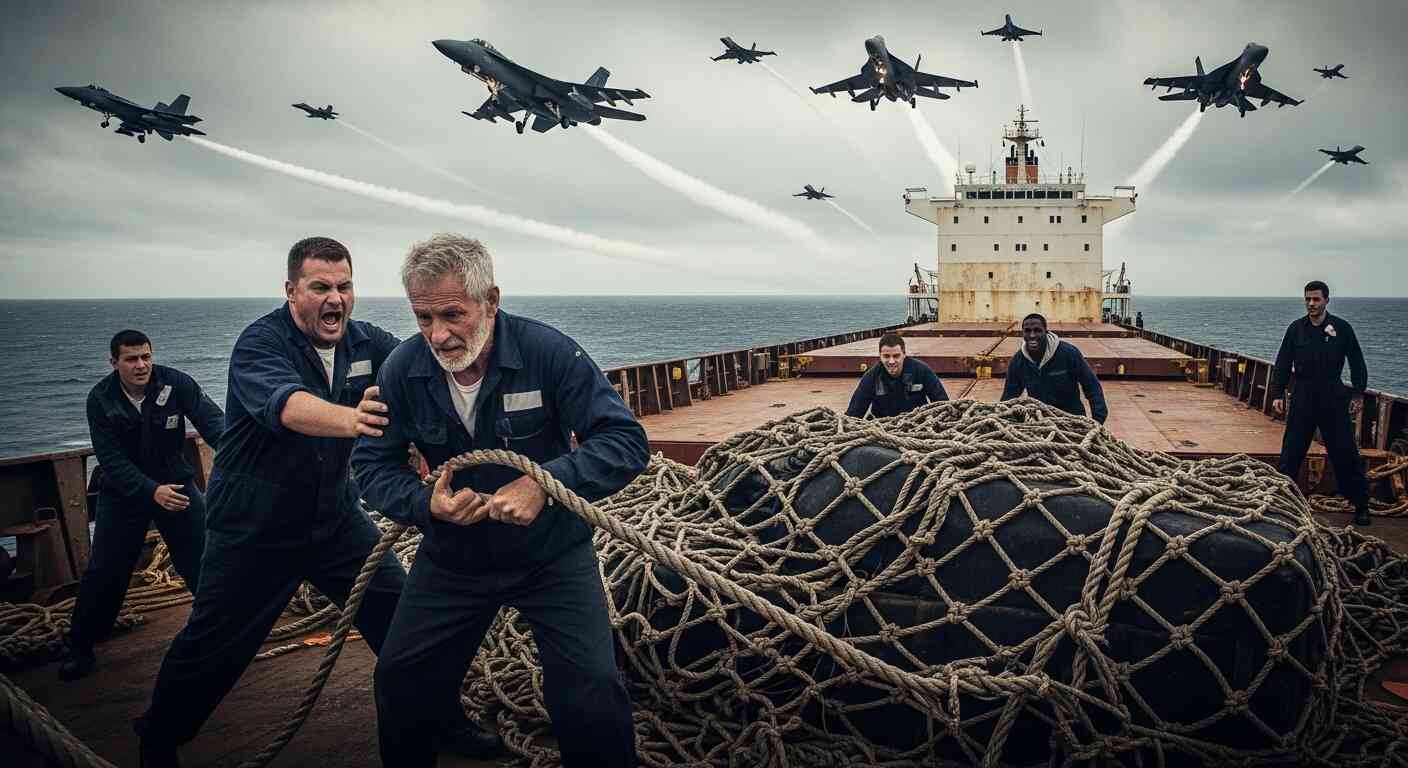
The salt water in my eyes wasn’t from the ocean; it was from the humiliation of watching a man who’d never seen a day of combat spit on the faces of the heroes who died for his freedom.
I didn’t fight back when Captain Miller shoved me into the rusted railing of the SS Ironwood. I didn’t say a word when he kicked my ribs or called me a “worthless drifter” in front of the entire crew.
But when he reached into my pocket and pulled out the only thing I had left—a crumpled, sweat-stained photo of my unit in Kabul—the world went cold.
“They were losers, Elias,” Miller spat, his breath smelling of cheap whiskey and arrogance. “Just like you. Dead weight. Trash.”
He dropped the photo onto the grease-slicked deck and ground his boot into the face of my brother, Caleb.
I looked up at him, my heart breaking for the thousandth time, and whispered, “You have no idea what you’ve just done.”
He laughed. He actually laughed. He thought I was a broken man with no one left in the world. He thought I was just another veteran lost in the system, working a deck-hand job for pennies.
He didn’t know about the red phone in my cabin. He didn’t know about the “Supreme Advisor” status that the Pentagon had been begging me to reclaim for three years.
And he definitely didn’t hear the sound of the F-35s until the sky itself seemed to scream in my defense.
“FULL STORY
Chapter 1: The Weight of Ghostly Paper
The SS Ironwood was a graveyard of ambition, a rusted heap of industrial steel that groaned with every swell of the Atlantic. To most of the crew, I was just “”Thorne””—the quiet guy who worked the double shifts and never complained about the moldy rations or the freezing spray. I liked the anonymity. Out here, two hundred miles from the nearest coastline, the ghosts of the past couldn’t find me quite as easily.
Or so I thought.
“”Hey, Ghost! I’m talking to you!””
Captain Miller’s voice was like a serrated knife across a whetstone. He was a man built of bluster and bad intentions, a small-time tyrant who ruled his ship with a combination of fear and petty cruelty. He stomped across the deck, his heavy boots clanging against the metal.
I didn’t look up. I was busy securing a loose winch, my fingers numb from the biting March wind. My hand instinctively brushed the pocket of my tactical jacket, feeling the thin, rectangular shape of the photograph hidden inside. It was my anchor.
“”I told you to clear the aft deck an hour ago,”” Miller growled, grabbing my shoulder and spinning me around. He was a head shorter than me, but he carried the authority of the paycheck. “”You deaf, Thorne? Or just stupid?””
“”The winch was a safety hazard, Captain,”” I said, my voice low and level. I had commanded battalions. I had briefed Presidents. I had survived three IED explosions. Miller was a mosquito, and I was trying very hard not to swat him.
“”Safety hazard? I’ll tell you what’s a hazard. You. Your attitude. Your pathetic, moping face.”” Miller shoved me. It wasn’t a hard shove, but it was enough to make me stumble back against the railing.
I saw Sarah, a twenty-two-year-old deckhand who reminded me too much of the sister I’d left behind, watching from the bridge stairs. Her eyes were wide with fear. She’d seen Miller do this to others, but I was his favorite target. He sensed something in me—a dignity he couldn’t break, and it drove him into a frenzy.
“”Look at you,”” Miller sneered, stepping into my personal space. “”Big man. Probably a deserter. Probably ran away when things got tough.””
He reached out with lightning speed, his hand diving into my jacket pocket. I reacted, catching his wrist, but I was half a second too slow. The photograph slid out, fluttering toward the wet deck.
I lunged for it, but Miller’s boot got there first.
The sound of his heavy sole grinding the paper into the grime was louder to me than the crashing waves. He picked it up, looking at the image of five men in desert camouflage, arms around each other, smiling in a land that wanted them dead.
“”These your boyfriends?”” Miller laughed, showing yellowed teeth. “”They look like losers. Just like you. Is this why you’re out here? Hiding because you let them die?””
The world narrowed to a singular point of white-hot heat. The air felt thin.
“”Give it back,”” I said. It wasn’t a request. It was a warning that the man I used to be—the man the Department of Defense called ‘The Architect’—was waking up.
“”They were losers!”” Miller shouted, his face turning a deep, ugly purple. He crumpled the photo in his fist and spat on it. “”And you’re the biggest loser of them all. You’re fired, Thorne. I’m putting you off at the next port with nothing but the clothes on your back. No pay. No references. Just your precious trash.””
He threw the crumpled ball of paper at my face. It hit my cheek and fell into the scupper.
“”You shouldn’t have done that,”” I whispered.
“”Oh yeah? What are you gonna do, cry? You’re nobody! You’re a ghost!””
At that exact moment, a sound began to rise from the horizon. It wasn’t the wind. It wasn’t the engine. It was a deep, guttural thrum that vibrated in the marrow of my bones.
I looked up. Miller followed my gaze, his arrogance flickering for the first time.
Three black dots appeared against the grey sky, moving at speeds that defied physics. They weren’t Coast Guard. They weren’t civilian.
“”What the hell is that?”” Miller stammered.
I stood up straight, my shoulders squaring, the “”loser”” persona falling away like dead skin. “”That,”” I said, “”is my ride.””
The first F-35 Lightning II broke the sound barrier directly over the ship. The boom was so violent it shattered the windows of the bridge. Miller was thrown to the deck, his hands over his ears, screaming in terror.
I didn’t flinch. I just walked over to the scupper, picked up the crumpled photo of my brothers, and smoothed it out against my thigh.
The sky had ripped open, and for the first time in three years, I felt like I could finally breathe.
Chapter 2: The Price of Silence
The silence that followed the sonic boom was heavier than the noise itself. Captain Miller lay on the deck, his eyes wide and unfocused, his chest heaving. The rest of the crew had emerged from the hold, huddled together like frightened sheep. Sarah was the only one who moved, taking a tentative step toward me, her eyes darting between me and the jets circling overhead.
“”Elias?”” she whispered. “”Who are they?””
I didn’t answer. I couldn’t. How do you explain to a girl who thinks you’re a drifter that those pilots are probably men I trained? How do you explain that the military doesn’t send twenty-billion-dollar aircraft to fetch a “”loser””?
I looked down at the photo in my hand. It was ruined. The image of Caleb, my younger brother, was smudged with grease and seawater. His smile, the one that had kept me sane through two tours, was almost gone.
“”You’re shaking,”” Sarah said softly.
I looked at my hands. She was right. But it wasn’t fear. It was the sudden, overwhelming weight of the world I had tried so hard to leave behind.
Three years ago, I was Elias Thorne, the Supreme Strategic Advisor to the Joint Chiefs. I was the man who saw the moves on the chessboard before the pieces were even carved. But in a valley in Kunar, my strategy had failed. A bridge was supposed to be clear. It wasn’t. My unit—my family—was wiped out in four minutes of fire and screaming.
I had resigned that night. I had vanished into the cracks of America, working odd jobs, trying to drown the screams of that valley in the manual labor of the mundane.
“”Stand up, Miller,”” I said, my voice carrying a new authority that made the crew flinch.
The Captain scrambled to his feet, his face a mask of confusion and lingering rage. “”I don’t care who they are! This is a civilian vessel! They can’t do this! You’re still fired! You hear me? You’re a trespasser now!””
He was trying to reclaim his power, but it was like watching a child try to stop a landslide with a plastic shovel.
A heavy-lift transport helicopter—a MH-47G Chinook—descended toward the deck, its dual rotors creating a localized hurricane. The wind tore at our clothes, forcing the crew to shield their eyes.
“”They’re landing!”” Sarah screamed over the roar.
“”They’re not landing for him,”” I muttered.
The helicopter hovered, and four figures in charcoal-grey tactical gear rappelled down with surgical precision. They hit the deck and fanned out, their weapons held in a low-ready position. They weren’t looking for threats; they were securing a perimeter.
A fifth figure descended. He wasn’t wearing a helmet. His hair was silver at the temples, and his uniform was crisp, decorated with more medals than Miller had brain cells.
Major General Marcus Vance. My old friend. My old conscience.
Vance stepped onto the deck, his boots clicking against the metal. He ignored the shivering Captain. He ignored the bewildered crew. He walked straight toward me, his eyes scanning my ragged clothes and the grease on my face.
Miller, ever the idiot, stepped forward. “”Sir! General! I’m Captain Miller of the SS Ironwood. This man is a terminated employee. He’s been disruptive—””
Vance didn’t even look at him. He raised his hand, and one of the tactical operators stepped in front of Miller, a silent wall of Kevlar and steel. Miller’s mouth snapped shut.
Vance stopped three feet from me. He looked at the photo in my hand, then up at my eyes.
“”The world is burning, Elias,”” Vance said, his voice barely audible over the idling rotors. “”And we can’t find the fire extinguisher without you.””
“”I’m retired, Marcus,”” I said, though the words felt hollow.
“”The President doesn’t accept your retirement. Not today. Not with what’s coming.”” Vance sighed, his expression softening. “”I’m sorry about the photo, Elias. We’ll get you a new one. The original is in the vault at Langley.””
I looked at the crew. I looked at Sarah. She was looking at me like I was a stranger. And in a way, I was. The Thorne she knew was a man who needed her help. The man standing before the General was a man who decided the fate of nations.
“”He called them losers,”” I said, nodding toward Miller.
Vance’s eyes went cold. He finally turned his gaze toward the Captain. “”Did he now?””
Miller looked like he wanted to melt into the deck. “”I… I didn’t know… I thought he was just a…””
“”You thought he was someone who couldn’t fight back,”” Vance finished. “”That’s the definition of a coward, Captain. And in about ten minutes, this ship is going to be boarded by the Coast Guard for a full ‘safety inspection.’ I imagine they’ll find quite a few things wrong with your operation.””
“”You can’t do that!”” Miller shrieked.
“”I’m a General in the United States Army, Miller. I can do things that would make your head spin.”” Vance turned back to me. “”The bird is waiting, Elias. Are you coming back to the land of the living, or are you going to stay out here and rot with this man?””
I looked at the crumpled photo one last time. Caleb wouldn’t want me hiding on a rust-bucket. He’d want me on the wall.
“”Give me a minute,”” I said.
I walked over to Sarah. She looked down at her boots, suddenly shy.
“”You’re a good kid, Sarah,”” I said, reaching into my pocket and pulling out a heavy silver coin—a challenge coin I’d kept hidden. I pressed it into her hand. “”If you ever get tired of the sea, call the number on the back of that. Tell them the Architect sent you.””
She looked at the coin, then at me, her eyes tearing up. “”You’re really him, aren’t you? The one they talk about in the news?””
“”I’m just a guy who lost his way,”” I said.
I turned and walked toward the helicopter. As I passed Miller, I stopped. I didn’t hit him. I didn’t scream. I just leaned in close to his ear.
“”The men in that photo died so you could be an arrogant prick,”” I whispered. “”Don’t ever waste their sacrifice again.””
I stepped into the Chinook. The door closed, and the SS Ironwood began to shrink beneath us.
Chapter 3: The War Room of Shadows
The transition from the salt-sprayed deck of a cargo ship to the sterile, high-tech interior of the Pentagon’s Command Center was enough to give anyone whiplash. I had been scrubbed, shaved, and fitted into a suit that cost more than I’d earned in the last three years.
I looked in the mirror of the executive washroom and didn’t recognize the man looking back. The beard was gone, revealing the scar on my jaw from the Kunar valley. The eyes, however, were still tired.
“”You look like yourself again,”” Vance said, leaning against the doorway.
“”I look like a liar,”” I replied, adjusting the silk tie. “”I told myself I was done with this.””
“”None of us are ever done, Elias. We just take intermissions.”” He handed me a tablet. “”Look at the feed. This is why we came for you.””
I swiped through the data. Satellite imagery showed a massive, unidentified fleet moving through the North Atlantic—not military, but something else. Privateers? A corporate shadow army? They were positioning themselves over the deep-sea fiber optic cables that carried 90% of the world’s data.
“”They’re going to cut the throat of the world,”” I muttered, my mind already spinning, calculating the logistics. “”They don’t want to occupy land. They want to occupy the cloud.””
“”Exactly,”” Vance said. “”And the only person who has run simulations on a total digital blackout is you.””
We walked into the “”Tank,”” the ultra-secure briefing room. A dozen generals and advisors stood up when I entered. It was a surreal moment. Three days ago, I was being kicked by a man named Miller. Now, the most powerful men in the world were waiting for me to speak.
“”Sit down,”” I said, skipping the formalities. “”We don’t have time for salutes. Show me the European response.””
For the next eight hours, I was back in the fire. My brain, which had felt sluggish and heavy for years, was suddenly firing on all cylinders. I saw the patterns, the weaknesses in the enemy’s formation, the “”old wounds”” in our own defense.
But as the sun began to rise over Washington D.C., a memory hit me.
In the middle of a heated debate about kinetic strikes, I saw a reflection in the glass partition. For a split second, I didn’t see the generals. I saw Caleb. I saw him sitting in the corner of the room, shaking his head.
‘You’re doing it again, Eli,’ his ghost seemed to say. ‘You’re looking at the map, but you’re forgetting the people on the ground.’
I stopped mid-sentence.
“”Elias? What is it?”” the Chairman of the Joint Chiefs asked.
I looked at the screen. My plan involved using a civilian port as a decoy. A port very much like the one the SS Ironwood was currently docked at.
If I moved the pieces the way I wanted to, the “”collateral damage”” would include people like Sarah. People who were just trying to survive.
“”I need to change the strategy,”” I said, my voice cracking slightly.
“”Change it? Elias, this is the most efficient path to victory,”” an admiral argued.
“”Efficiency is for machines,”” I snapped. “”I’m not sacrificing a single civilian to win a data war. We’re going to do this the hard way.””
I walked over to the map and pointed to a tiny, insignificant dot in the ocean. The location of the SS Ironwood.
“”They’re using the cargo lanes as cover,”” I said. “”I’m going back out there. But this time, I’m not going as a deckhand.””
Chapter 4: Return to the Ironwood
The flight back to the Atlantic was silent. I wore a tactical suit, a comms earpiece, and a weight in my chest that felt like lead. Vance sat across from me in the Osprey.
“”You’re taking this personally,”” Vance said.
“”Everything is personal, Marcus. That’s what I forgot in Kunar. That’s why my team died. I treated them like variables in an equation. I’m not doing that again.””
The SS Ironwood appeared below us, a dark speck in a sea of churning grey. But it wasn’t alone. Two sleek, black high-speed vessels were flanking it. The privateers had moved in sooner than we expected.
“”They’ve boarded her,”” Vance said, checking his HUD. “”They’re using the ship’s comms array to mask their signal. They think it’s a safe house.””
“”They picked the wrong house,”” I said, checking my sidearm.
I didn’t wait for a formal landing. I fast-roped onto the aft deck, the familiar scent of diesel and rust hitting me like a physical blow.
The ship was eerily quiet. I moved like a shadow, a ghost returning to haunt its own grave. I found the first guard near the engine room—a mercenary in high-end gear. He didn’t even see me. Two seconds, a quick pressure point, and he was unconscious.
I made my way toward the bridge. I could hear Miller’s voice. He wasn’t shouting anymore. He was pleading.
“”I don’t know anything! I’m just the Captain! Please, just take the cargo!””
I kicked the door open.
Three mercenaries had the crew lined up against the wall. Sarah was at the end of the line, her face bruised. Miller was on his knees, blubbering.
The mercenaries turned, their rifles swinging toward me.
“”Drop them,”” I said. My voice was calm. It was the voice of a man who had already seen the end of the world.
“”Who the hell are you?”” the lead merc asked, his finger tightening on the trigger.
“”I’m the guy who works here,”” I said.
Before he could react, the windows of the bridge exploded. Two snipers from the circling Osprey took out the two guards flanking him. I moved in, disarming the leader before his brain could process the flash of the muzzle.
I slammed him against the same bulkhead Miller had shoved me against.
“”Elias?”” Sarah gasped, her voice trembling.
I didn’t look at her. I looked at Miller. The Captain was staring at me, his mouth agape. He saw the gear, the precision, the lethal grace.
“”Get the crew to the lifeboats,”” I commanded. “”Now!””
“”But… but my ship…”” Miller stammered.
I grabbed him by the collar, hauling him to his feet. “”Your ship is a target, Miller. Move, or stay here and die. It’s your choice.””
As the crew scrambled for the deck, I turned to the mercenary leader. “”Who sent you? Is it the Volkov group?””
The man just spat blood at my boots.
Suddenly, the ship rocked violently. An explosion from below deck. The privateers weren’t just using the ship; they were scuttling it to cover their tracks.
“”The cables!”” I shouted into my comms. “”They’ve already deployed the cutters!””
I had to choose. Save the ship and the crew, or stop the blackout that would plunge half the world into chaos.
I looked at Sarah, who was helping an elderly engineer toward the lifeboats. She looked back at me, and for a second, the world stood still.
“”Go, Elias!”” she yelled. “”We’ve got this! Do what you have to do!””
She believed in me. Not the Supreme Advisor. Not the Architect. She believed in the man who had protected a photo of his fallen friends.
I turned and dove into the freezing black water of the Atlantic.