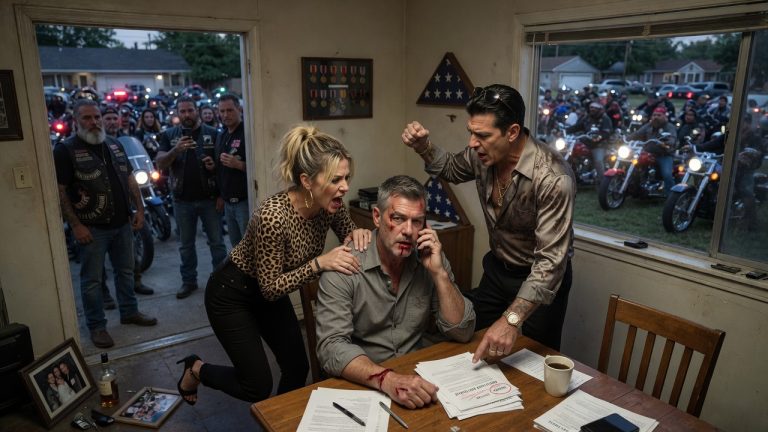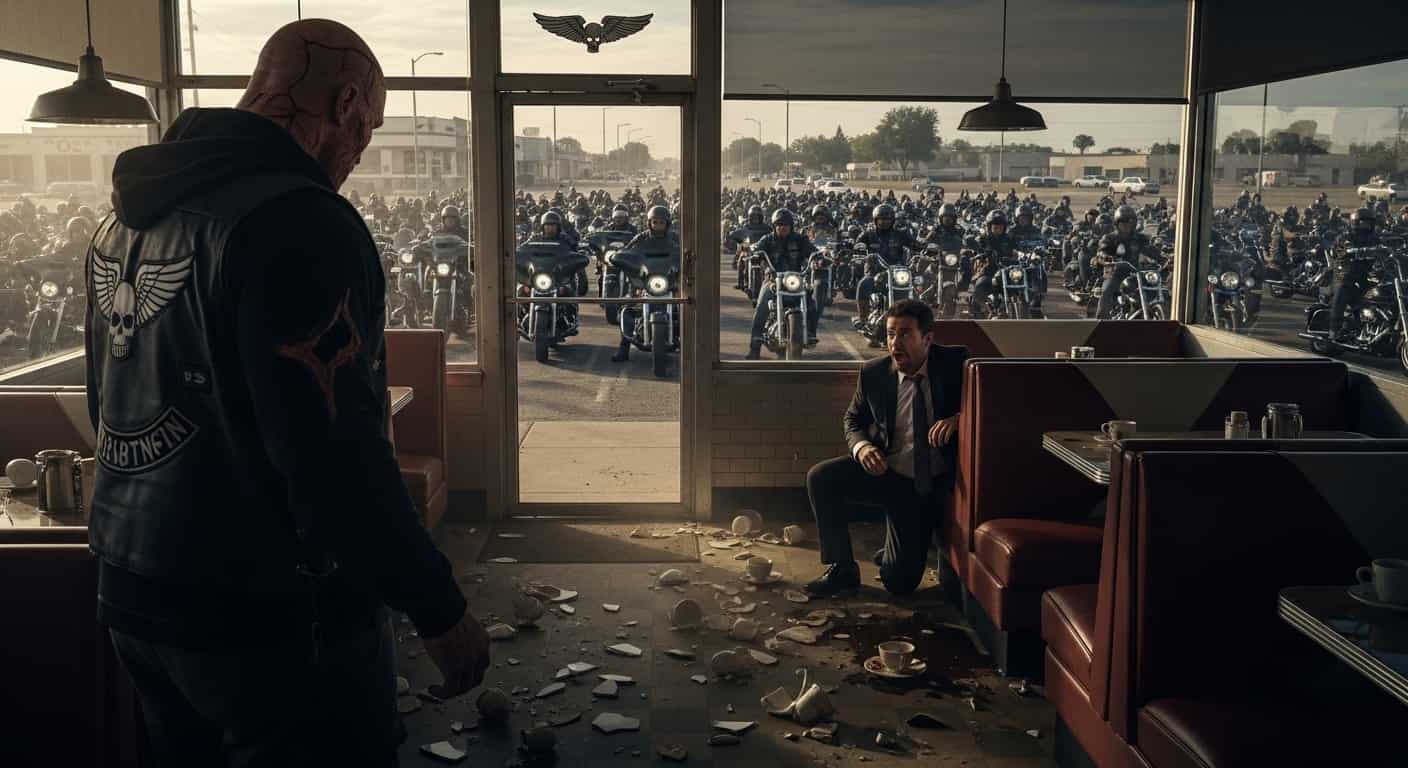
The sound of the table flipping was like a gunshot in the quiet of a Tuesday afternoon.
I’ve owned this diner for thirty years. I’ve served every soul in this town, from the mayors to the mechanics, and I’ve never asked for much. Just peace. But Marcus Thorne doesn’t understand peace. He understands power, or at least, the kind of power you buy with a real estate empire and a silver tongue.
“”You’re a clumsy old hag, Elena,”” Marcus spat. His face was inches from mine, his expensive silk tie dangling over the mess of broken porcelain and spilled gravy on the floor. “”I told you I wanted this property by the first of the month. This little ‘accident’ with the coffee? That’s the last straw.””
Before I could breathe, he pinned me. His forearm was a cold, hard bar against my throat, pressing me back against the industrial refrigerator. My lungs burned. The few customers left in the booths—mostly seniors and a young mom with a toddler—gasped, but nobody moved. You don’t move when Marcus Thorne is on a tear.
“”I’m going to raze this place to the ground,”” he hissed. “”And I’m going to enjoy watching you stand on the sidewalk with nothing but the clothes on your back.””
He reached out and spat on my clean floor. It was the ultimate insult.
“”Marcus,”” I managed to wheeze out. “”Please. Don’t do this.””
“”Who’s going to stop me?”” he laughed. It was a jagged, ugly sound. “”Your dead-beat husband? The Sheriff who’s on my payroll? You’re alone, Elena. You’ve always been alone.””
That’s when the chair in the far corner creaked.
I had almost forgotten he was there. He’d been sitting there for three hours, buried in a hoodie, nursing a single cup of black coffee. He hadn’t said a word since he walked in. He looked like just another drifter passing through our dusty corner of the world.
The man stood up. He was a giant. He had to be six-foot-five, with shoulders that seemed to take up the entire hallway leading to the restrooms. He pushed back his hood, revealing a face etched with the kind of scars you don’t get from falling off a bike—you get them from surviving things you shouldn’t.
“”Take your hands off her,”” the giant said. His voice wasn’t loud. It was a low, vibrating rumble that made the silverware on the tables hum.
Marcus didn’t let go. He actually tightened his grip on my throat, turning his head to sneer at the stranger. “”Stay out of this, Bruce Willis. You’re in the wrong town to be playing hero.””
The giant didn’t argue. He didn’t rush forward. He simply put two fingers to his mouth and blew.
The whistle was so sharp it made my ears ring. It was a signal. A call.
For three seconds, there was silence. Then, the earth began to shake.
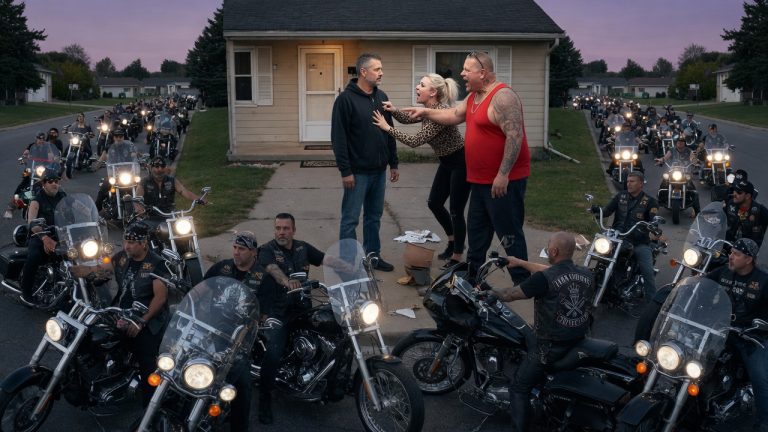
It started as a faint hum in the distance, like a coming storm. Then it grew into a rhythmic, soul-crushing thunder. I looked out the front window and saw them. A sea of black leather and chrome. Thousands of them. Bikers. They weren’t just passing through. They were swarming. They blocked the intersections. They filled the parking lot. They parked on Marcus’s manicured lawn across the street.
Five thousand men and women, all wearing the same patch on their backs: a silver skull with wings.
The “”Silent Giant”” in my diner didn’t look at the crowd. He looked directly at Marcus, who had finally let me go, his hands shaking so hard he had to grab the edge of a booth to stay upright.
“”That’s my mother you just touched,”” Jax said, his voice dropping an octave. “”And these are my brothers. Now, let’s talk about that property line again.””
“FULL STORY
Chapter 1: The Weight of Silence
The air in Greyson’s Creek always smelled of two things: parched earth and the metallic tang of the nearby interstate. It was a town that time had tried to forget, but Marcus Thorne had decided to remember. To Marcus, our town wasn’t a home; it was a spreadsheet. And my diner, Elena’s Kitchen, was a stubborn “”X”” in a box he wanted to check.
I had spent my morning the way I’d spent every morning for three decades—prepping the sourdough, wiping down the vinyl stools, and worrying about the mounting stack of bills on the back office desk. At sixty, my joints ached with every shift in the weather, but this diner was more than a business. It was the place where my husband, Thomas, had proposed. It was the place where our son, Jax, had learned to walk on the checkered linoleum.
Jax. My heart pained at the thought of him. He’d been gone for twelve years. Twelve years of postcards from places I couldn’t find on a map and the occasional, terrifying phone call in the middle of the night. He had left a boy with a quick temper and a golden heart and had returned three days ago a man I barely recognized. He was scarred, silent, and carried a heavy darkness in his eyes that made the local gossips whisper when he walked down the street.
He was sitting in the corner booth that morning, the “”Shadow Booth”” we called it. He hadn’t touched his breakfast. He just watched the door.
Then Marcus Thorne walked in.
Marcus didn’t walk; he conquered. He was followed by his usual retinue—two “”associates”” in cheap suits who functioned as his muscle and his ego-boosters. They didn’t sit. They just stood there, blocking the flow of the morning rush.
“”Elena,”” Marcus said, his voice dripping with faux-sincerity. “”Tell me you’ve looked at the papers my lawyers sent over. The offer is more than generous for a place that smells this much like old grease.””
“”The answer is still no, Marcus,”” I said, my voice steadier than I felt. “”I’m not selling. This diner stays in the Vance family.””
Marcus’s smile didn’t fade; it just turned sharper. He walked over to the counter, picked up a full carafe of coffee, and looked me in the eye. He didn’t say a word as he slowly tilted his hand. The steaming liquid poured out, splashing onto the floor, ruining the fresh mop job I’d finished ten minutes prior.
“”Oops,”” he mocked. “”Look at that. You’re getting careless, Elena. Maybe it’s age. Maybe you’re just losing your touch.””
“”Clean it up and leave, Marcus,”” I said, my hands trembling under the counter.
That was when he snapped. In one fluid, violent motion, he gripped the edge of a nearby four-top table and flipped it. The crash of breaking ceramic was deafening. Cassie, my twenty-year-old waitress, let out a small scream and ducked behind the pie display.
Marcus was on me before I could move. He lunged across the counter, grabbing the collar of my apron and slamming me back against the refrigerator. The impact knocked the wind out of me.
“”I’m tired of being nice, you old bat,”” he hissed, his forearm pressing into my windpipe. “”I have a thirty-million-dollar development project stalled because you want to keep serving eggs to losers. This ends today.””
I looked past his shoulder, my vision blurring. I looked toward the corner booth.
Jax hadn’t moved. He was still sitting there, but his posture had changed. He wasn’t leaning back anymore. He was coiled like a spring.
“”Marcus,”” I gasped, trying to find air. “”Stop… please…””
“”Who’s going to make me?”” Marcus sneered, looking around at the frightened patrons. “”These people? They work for me. They live in houses I own. They’re nobodies. Just like you.””
Jax stood up.
The movement was slow, deliberate, and terrifying. When he stood to his full height, he seemed to block out the light coming through the front windows. He didn’t yell. He didn’t run. He just walked toward the counter, each footfall sounding like a drumbeat.
“”Take your hands off her,”” Jax said.
Marcus turned, still holding me. He laughed when he saw Jax’s grease-stained hoodie. “”And who are you? The dishwasher? Get back in the hole, kid, before I have my boys show you what happens to people who interrupt me.””
Jax didn’t answer. He reached into his pocket, pulled out two fingers, and blew a whistle that sounded like a siren.
For a heartbeat, nothing happened. Marcus began to mock him again. “”What was that? A dog whistle? You think a puppy is going to save—””
Then, the floor began to vibrate.
It started as a low-frequency hum that you felt in your teeth. Then, the windows began to rattle in their frames. Outside, the bright morning sun was suddenly eclipsed. A wall of black leather and steel moved into the parking lot. The sound was a rhythmic, mechanical roar—the sound of five thousand high-displacement engines screaming in unison.
They didn’t just fill the parking lot. They filled the street. They filled the sidewalks. The “”Steel Phantoms,”” the most feared motorcycle club in the country, had arrived in Greyson’s Creek.
Jax looked at Marcus, his eyes cold as a winter grave. “”That’s my mother. And you just made the biggest mistake of your very short life.””
Chapter 2: The Siege of Greyson’s Creek
The roar of the engines didn’t stop. It just settled into a deep, predatory idle that made the very air in the diner feel thick, like you were breathing gasoline. Marcus had let me go, his hands hovering in mid-air as if he’d forgotten how to use them. He turned toward the windows, his mouth opening and closing like a fish out of water.
Outside, the scene was something out of a fever dream. The suburb of Greyson’s Creek, usually a picture of manicured lawns and quiet commerce, was now an armed camp. Five thousand bikers—men and women with faces like granite and jackets bearing the winged skull—had formed a perfect, suffocating perimeter around the diner.
The leader of the lead pack, a man they called Dutch, kicked down his kickstand and dismounted with a fluid grace. He was nearly as big as Jax, with a gray beard tucked into his belt. He didn’t look at the crowd; he looked at the diner.
Jax walked to the front door and pushed it open. The bell above the door chimed—a small, domestic sound that seemed ridiculous against the backdrop of the mechanical apocalypse outside.
“”Jax?”” I whispered, my voice returning in a shaky breath. I moved toward him, my hand reaching out to touch his arm. I needed to know he was real, that this wasn’t some nightmare born of my own fear.
He didn’t turn around, but his hand found mine, squeezing it gently. “”Stay behind me, Ma. Cassie, get in the back. Lock the kitchen door.””
Cassie didn’t need to be told twice. She vanished into the prep area.
Marcus’s “”associates”” were currently trying to merge with the wallpaper. One of them, a man named Leo who usually acted like he was the toughest guy in the county, was visibly sweating through his cheap suit.
“”You… you can’t do this,”” Marcus stammered, finally finding his voice, though it was two octaves higher than usual. “”This is illegal! This is… this is domestic terrorism! I’ll have the National Guard here in twenty minutes!””
Jax finally turned to look at him. A slow, terrifying smile spread across his face—a smile that didn’t reach his eyes. “”The National Guard? Marcus, the highway is blocked for ten miles in both directions. The cell tower for this sector just went into ‘maintenance mode.’ And as for the Sheriff…””
As if on cue, a police cruiser tried to turn into the parking lot. It was Sheriff Miller, the man who had been “”managed”” by Marcus’s donations for a decade. Miller got out of his car, hand on his holster, looking ready to command the situation.
Dutch walked up to him. He didn’t draw a weapon. He didn’t even raise his voice. He just leaned in and whispered something into Miller’s ear.
Miller’s face went from indignant red to a ghostly, chalky white. He looked at the sea of leather, looked at the diner, and then, without a single word, he got back into his cruiser, turned around, and drove away.
The silence that followed was heavier than the engine noise.
“”See, Marcus,”” Jax said, stepping closer. Marcus backed away, tripping over the table he had flipped earlier. He scrambled on the floor, his expensive suit now covered in gravy and dust. “”The problem with buying people is that there’s always someone who can offer them something better. Or something much, much worse.””
“”What do you want?”” Marcus whimpered.
“”I want you to apologize,”” Jax said.
“”I… I’m sorry! I’m sorry, Elena! I didn’t mean to—””
“”Not to her,”” Jax interrupted. He pointed to the floor—to the spot where Marcus had spat. “”Apologize to the floor. With your tongue. Clean it up.””
The diner was silent. The patrons watched with wide eyes. Marcus looked at the spit, then at Jax, then at the five thousand shadows waiting outside.
“”I won’t do that,”” Marcus whispered.
Jax nodded slowly. He didn’t lose his temper. He just looked out the door and raised his hand. “”Dutch! Bring the chains.””
The sound of Marcus’s dignity shattering was almost as loud as the bikes. He fell to his knees, his face twisted in a mask of pure humiliation. But as he lowered his head, I saw something in his eyes. It wasn’t just fear. It was a flickering, desperate spark of something else.
Marcus Thorne wasn’t just a bully. He was a man with a secret, and he was realizing that the secret was about to be dragged into the light.
“”Wait,”” I said, stepping forward. “”Jax, stop. This isn’t who you are.””
Jax looked at me then, and for a second, the darkness in his eyes flickered. “”You don’t know who I am anymore, Ma. I had to become someone else to make sure no one ever touched you again.””
“”But at what cost?”” I asked.
He didn’t answer. He just turned back to Marcus, who was now weeping on the floor.
“”This is only the beginning, Marcus,”” Jax said. “”We’re staying in town. We’re staying until every cent you stole from these people is returned. And if you try to leave… well, 5,000 bikes make a lot of noise. We’ll find you.””
Chapter 3: The Ghost of the Highway
By nightfall, Greyson’s Creek had transformed. The bikers hadn’t looted the stores or harassed the citizens. Instead, they had set up a massive, orderly camp in the vacant lot behind the diner—the very lot Marcus Thorne had planned to turn into a luxury condo complex.
I sat in the back office, the scent of lavender tea doing little to soothe my nerves. Jax was outside, sitting on the tailgate of a rusted pickup truck, talking in low tones with Dutch. Through the window, I watched them. They looked like kings of a forgotten empire.
A soft knock came at the door. It was Mrs. Higgins, the town’s oldest resident and my unofficial news correspondent. She was clutching a plate of cookies, her hands shaking only slightly.
“”Elena,”” she whispered, sitting down. “”The whole town is talking. They’re saying your Jax is… he’s the President. The big one.””
“”I don’t know what he is, Martha,”” I sighed, rubbing my temples. “”I just know he’s my son, and he’s brought a war to our doorstep.””
“”No,”” Martha said firmly. “”He brought a shield. Do you remember ten years ago? When the mill closed and Marcus started buying up the foreclosures for pennies? He took my sister’s house. He took the Parkers’ farm. We’ve been living under his thumb so long we forgot what the sun looked like. Your boy… he’s the only one who didn’t forget.””
I looked out at Jax. I remembered the night he left. He was eighteen, his face bruised from a run-in with Marcus’s father, the original “”King”” of the creek. Jax had promised me he’d find a way to protect us. I thought he meant he’d go to college, become a lawyer, fight them with books.
Instead, he’d found a different kind of law.
I walked outside, the cool night air hitting my face. The bikers were quiet, sitting around small fires, the chrome of their machines reflecting the flames. As I approached Jax, the men around him stood up. It wasn’t a gesture of aggression; it was a gesture of profound respect.
“”Ma,”” Jax said, standing up. “”You should be resting.””
“”We need to talk, Jax. Really talk.””
He nodded to Dutch, who squeezed Jax’s shoulder and melded back into the shadows. We walked toward the edge of the lot, where the creek gurgled over the stones.
“”Why now?”” I asked. “”Why after all these years?””
Jax looked out at the dark horizon. “”Because Marcus Thorne isn’t just a greedy developer, Ma. I’ve been tracking the money. The ‘development project’ he’s building? It’s a front. He’s working with a cartel out of the coast. They’re building a distribution hub right here, using the diner’s location as the main access point to the interstate.””
I felt a chill that had nothing to do with the wind. “”Drugs? Here?””
“”And worse,”” Jax said, his voice hard. “”They needed a town they could control. A town where the law was already in their pocket. Marcus has been prepping Greyson’s Creek for years. He didn’t just want your diner, Ma. He wanted you gone because you see everything. You know everyone. You’re the heart of this place, and they can’t have a heart where they’re going.””
“”Is that why you joined the Phantoms?””
Jax turned to me, and for the first time, I saw the pain he’d been hiding. “”I didn’t join them, Ma. I built them. I needed an army. I knew I couldn’t beat the Thorne family with a lawsuit. I needed a force so big, so loud, that they couldn’t bury it. I spent twelve years in the dirt, building this brotherhood, just for today.””
“”You sacrificed your life… for a diner?””
“”No,”” he said, taking my hands in his. His palms were calloused and scarred. “”For you. And for the home you gave me. But there’s something you need to know. Marcus knows I’m here. And he’s not going to go down without calling in his own friends.””
As if to punctuate his words, a black SUV with tinted windows sped past the diner, its headlights off. It was heading toward the Thorne estate on the hill.
“”The cartel?”” I whispered.
“”The cartel,”” Jax confirmed. “”The 5,000 bikers out there? They’re the only thing keeping this town from burning tonight.””
Chapter 4: The Breaking Point
The next morning, the tension in the air was so thick you could taste it. The townspeople were no longer hiding in their homes; they were gathered on the sidewalks, watching the standoff. On one side, the Steel Phantoms—an iron wall of brotherhood. On the other, Marcus Thorne’s estate, guarded now by men who didn’t wear suits. They wore tactical vests and carried submachine guns.
Sheriff Miller was nowhere to be found. He had officially checked himself into a hospital three counties away for “”stress.””
I was back in the diner, serving coffee to the bikers. They were the most polite customers I’d ever had. They used ‘ma’am’ and ‘please,’ and they tipped in hundred-dollar bills. But their eyes never left the windows.
Around noon, Marcus Thorne stepped out onto his balcony with a megaphone. He looked different—disheveled, desperate, and dangerous.
“”Listen up!”” he screamed, his voice echoing through the valley. “”This is my town! Jax Vance, you think you can bring your circus here and intimidate me? I have friends you can’t even imagine. If those bikes aren’t gone by sundown, I’m authorizing my security team to clear the streets by any means necessary!””
Jax didn’t use a megaphone. He walked into the middle of the street, alone. He looked like a speck against the massive estate.
“”You’re not authorized to do anything, Marcus!”” Jax shouted back. “”The SEC just froze your accounts. Your ‘friends’ on the coast? I sent them a message last night. Two of their shipments in the desert didn’t make it to their destination. They’re not coming to help you. They’re coming to reclaim their investment.””
You could see the moment the realization hit Marcus. He looked at the men standing behind him—the cartel soldiers. They weren’t looking at Jax anymore. They were looking at Marcus.
A heavy, dark realization settled over me. Jax hadn’t just brought an army to defend us; he had played a masterful game of chess. He had cut off Marcus’s resources and baited the wolves.
Suddenly, a gunshot rang out.
The sound shattered the windows of the diner. I hit the floor, pulling Cassie down with me. Outside, the world exploded into chaos.
The cartel soldiers opened fire from the balcony. But they weren’t aiming for the bikers. They were aiming for the crowd. They wanted to create a diversion, a massacre that would allow them to escape in the confusion.
“”Jax!”” I screamed.
I saw my son dive behind a car, pulling a woman and her child to safety. He didn’t draw a gun. He just looked at Dutch and nodded.
“”Phantoms! Protect the people!”” Dutch roared.
What happened next was a symphony of courage. The bikers didn’t return fire with guns. Instead, they used their machines. Five hundred bikes roared to life simultaneously, creating a literal smoke screen of exhaust and burning rubber. They rode in a circling formation, creating a moving wall of steel between the gunmen on the hill and the civilians on the street.
Under the cover of the smoke, the bikers moved with surgical precision. They scooped up the townspeople, pulling them onto the backs of their bikes and whisking them away to the safety of the diner’s brick walls.
Jax was in the thick of it. He was a blur of motion, carrying an elderly man over his shoulder, his hoodie soaked in sweat and grease.
Then, the second twist happened.
The front gates of the Thorne estate didn’t open to let Marcus out. They blew inward. A fleet of black SUVs—the real cartel—had arrived. But they weren’t there to fight the bikers. They were there to finish Marcus for losing their money.
Marcus Thorne was trapped between the family he had bullied and the monsters he had invited in.”