I’ve lived in Oak Creek for forty years. I taught most of the children here their ABCs, wiped their scraped knees, and watched them grow into men and women. I never expected that one of them would be the one to break my heart.
It was Tuesday morning at The Gilded Spoon. All I wanted was my usual black coffee and a moment to watch the birds. But then Chad Sterling walked in.
Chad doesn’t walk; he invades. He’s the man who’s been buying up our history to build glass condos no one can afford. He saw me at “”his”” favorite table and didn’t ask me to move. He didn’t even say hello.
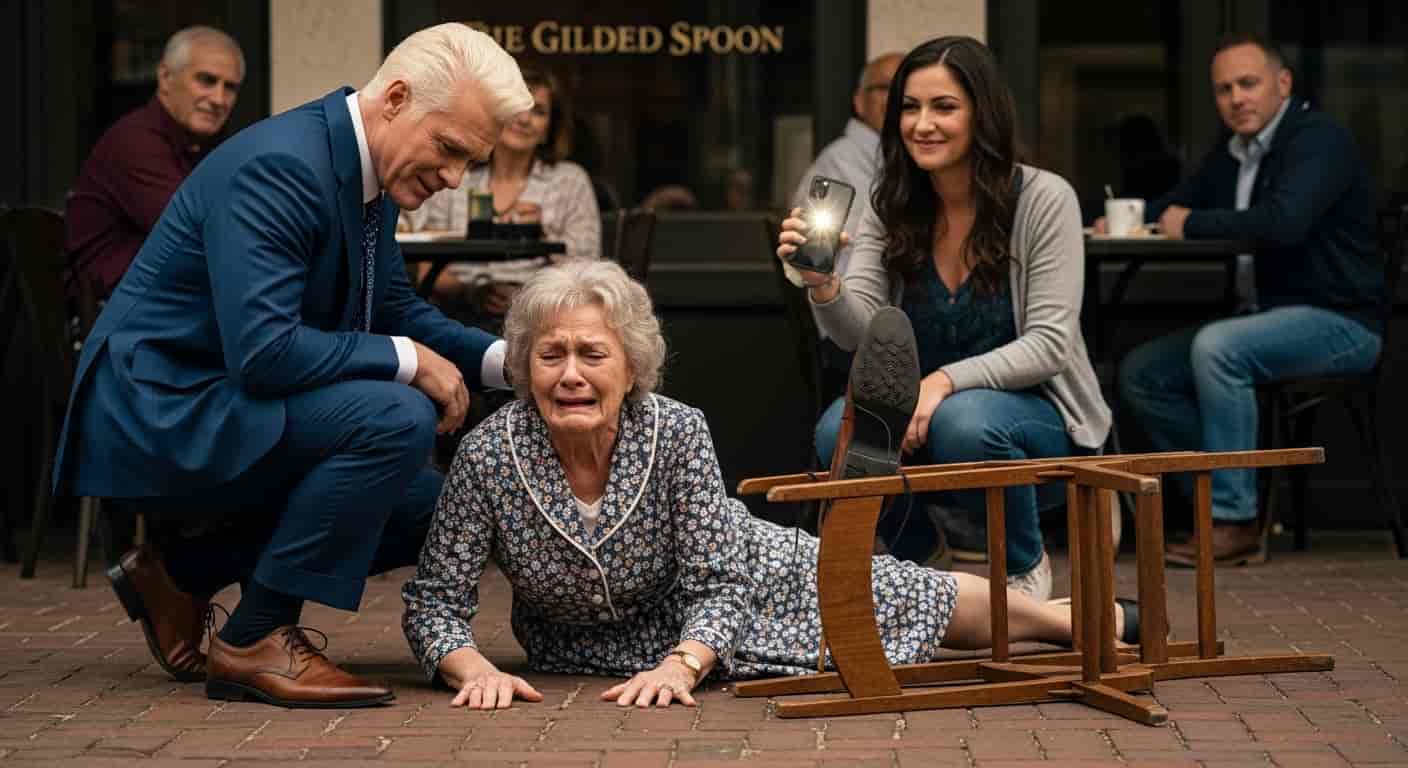
He just hooked his expensive Italian leather shoe around the leg of my chair and yanked.
I hit the brick patio hard. The sound of my old bones hitting the ground was nothing compared to the sound of his wife’s laughter.
“”The view is much better from down there, isn’t it?”” Tiffany sneered, her phone already out, recording my humiliation for her followers.
I looked around the café. People I’d known for decades looked away. They were afraid of his money. They were afraid of his influence. I felt smaller than I’ve ever felt in my life.
But Chad forgot one thing. He forgot about the boy I raised after his father died. He forgot about the boy who left this town fifteen years ago with nothing but a beat-up motorcycle and a heart full of fire.
He forgot about Jax.
And Jax has a lot of friends.
“FULL STORY
Chapter 1: The Weight of a Broken Chair
The morning sun over Oak Creek usually felt like a warm blanket, but today, it felt like a spotlight on my shame. I sat at the corner table of The Gilded Spoon, the same place I’d sat every Tuesday since my Henry passed away six years ago. It was a simple ritual: a medium roast, a blueberry muffin, and the local gazette.
At sixty-four, I’ve learned that the world moves faster than I do, and I’m okay with that. I like the slow pace. I like the way the steam rises from my mug. But the silence of the morning was shattered by the screech of high-performance tires.
A silver Porsche, the kind that costs more than my house, jerked into the handicapped spot right in front of the café. Out stepped Chad Sterling. He was wearing a suit that probably cost a teacher’s monthly salary, his hair slicked back with enough gel to withstand a hurricane. Beside him was Tiffany, his wife, a woman twenty years younger who looked like she’d been carved out of cold marble and expensive jewelry.
“”Ugh, it’s packed,”” Tiffany whined, her voice like a jagged piece of glass. “”I told you we should have called ahead.””
Chad scanned the patio like a general looking for a weak spot in the line. His eyes landed on me. Or rather, they landed on my table. It was the only one in the shade.
“”Don’t worry, babe,”” Chad said, his voice loud enough for everyone to hear. “”I’ll handle it.””
He marched over, his footsteps heavy on the pavers. He didn’t wait for me to look up. He didn’t offer a polite ‘excuse me.’ He simply stood over me, casting a long, dark shadow across my newspaper.
“”You’re done here, right?”” he asked. It wasn’t a question.
“”I’ve just started my muffin, Chad,”” I said softly, trying to keep my voice steady. I remembered him from third grade. He’d been a bully then, too—stealing lunch money and pulling hair. Some people never grow out of their worst traits; they just get bigger toys.
“”Your muffin can wait. We have a meeting,”” he snapped.
“”There are tables inside, dear,”” I replied, gesturing toward the door.
Chad’s face darkened. He looked around at the other patrons, many of whom were staring. He felt his ego being challenged by an old woman in a thrift-store dress. He leaned in close, the smell of expensive cologne and arrogance thick on him.
“”I’m the reason this town is still on the map, Martha. My developments pay the taxes that keep your measly pension coming. Now, move.””
“”No,”” I said. It was a small word, but it felt like a mountain.
That’s when it happened. In a flash of redirected anger, Chad hooked his foot behind the front leg of my chair. With a violent, practiced jerk, he kicked it sideways.
The world tilted. I didn’t even have time to put my hands out. I went down hard on my left side. My coffee mug shattered against the bricks, the hot liquid soaking into my skirt and stinging my skin. I felt a sharp, hot pain in my hip and a dull thud in my pride that hurt much worse.
I lay there for a second, the breath knocked out of me. The café went silent. I expected someone to gasp, to run over, to help. But when I looked up, I saw the faces of my neighbors. They were frozen. They saw Chad’s face—red and triumphant—and they saw the power he held over the town’s economy.
Then, the silence was broken by Tiffany. She didn’t gasp. She laughed.
“”Oh my god, Chad! Did you see her face?”” She pulled out her iPhone, the triple-lens camera pointing right at me as I struggled to find my footing on the slick, wet bricks. “”Post that to the neighborhood group. ‘Old trash finally took itself out.'””
Chad chuckled, adjusted his tie, and sat down in the chair he’d just righted. He didn’t even look at me as I crawled toward the edge of the patio, trying to find something to pull myself up with.
“”Clean that up,”” Chad barked at the young waitress who finally hurried over, though he wasn’t talking about the coffee. He was talking about me.
I managed to stand, my dignity in tatters, my knee bleeding through my stockings. I didn’t say a word. I couldn’t. If I spoke, I would have cried, and I wouldn’t give them the satisfaction. I limped toward my old Buick, the sound of their laughter ringing in my ears like a funeral bell.
I drove home in a daze, the steering wheel shaking in my hands. As I pulled into my driveway, I saw the “”For Sale”” sign on the house next door. Chad wanted my land. He’d been sending me letters for months, offering me pennies for the house Henry and I had built with our own hands. Today wasn’t just about a table. It was about showing me I didn’t belong anymore.
I walked into my quiet house and sat at the kitchen table. My eyes wandered to the photograph on the mantle. It was a picture of a young man with a defiant grin, his arm draped over a vintage Harley-Davidson.
Jax. My son.
We hadn’t spoken in three years. Not since he’d chosen the road over the quiet life I’d wanted for him. He was the President of the Iron Saints now—a name that brought whispers of fear and respect across the state. To the world, he was a ghost, a legend, a man of violence. To me, he was the boy who used to bring me wilted dandelions and promise to build me a castle.
I picked up the phone. My fingers trembled as I dialed a number I’d memorized but never dared to call.
I didn’t want revenge. I just wanted to feel like I wasn’t alone in the world.
The phone rang three times. Then, a voice like gravel and low-octane fuel answered.
“”Yeah?””
“”Jax?”” I whispered. My voice broke on the single syllable.
There was a long silence on the other end. I could hear the background noise of a bustling garage—the clink of wrenches, the roar of an engine being tested.
“”Ma?”” Jax’s voice lost its edge instantly. “”Ma, what’s wrong? Why are you crying?””
“”I’m okay, baby,”” I lied, a sob escaping anyway. “”I just… I had a fall. At the café.””
“”A fall? How?””
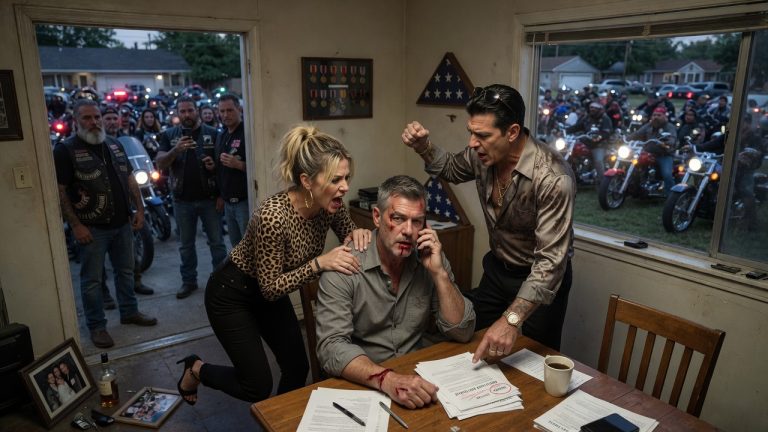
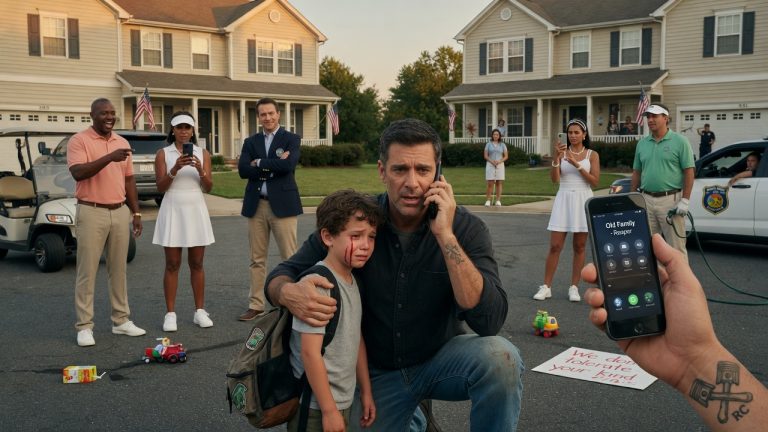
I told him. I told him about Chad. I told him about the chair. I told him about the laughter and the photos and how no one helped me up. As I talked, the line on the other end went deathly quiet. No more wrenches. No more engines. Just the sound of heavy, controlled breathing.
“”Chad Sterling,”” Jax repeated. He didn’t sound angry. He sounded like a storm that hadn’t broken yet. “”The real estate guy?””
“”Yes. But don’t do anything, Jax. Please. He’s powerful here. I just wanted to hear your voice.””
“”I hear you, Ma,”” Jax said softly. “”Go lay down. Put some ice on that hip. I love you.””
“”I love you too, son.””
He hung up. I thought that was the end of it. I thought I’d just shared my grief with my son and that would be it. I didn’t realize that in the world of the Iron Saints, a tear shed by a mother was a declaration of war.
Chapter 2: The Ghost of the Past
The rest of Tuesday was a blur of Ibuprofen and ice packs. My hip throbbed with a dull, rhythmic ache that reminded me of my age with every heartbeat. But the physical pain was nothing compared to the replay in my mind—the mocking curve of Tiffany’s lips, the coldness in Chad’s eyes.
I sat in my living room, the shadows lengthening across the worn carpet. This house was full of memories. Every scuff on the baseboard had a story. Henry’s recliner sat in the corner, empty but still holding his shape. And then there was Jax’s room.
I hadn’t changed it much. The posters of classic bikes were still on the walls. The trophies from his high school football days sat on the shelf, gathering dust. Jax had always been “”too much”” for Oak Creek. Too loud, too fast, too protective. When his father died, something in him snapped. He didn’t want to follow the rules of a world that took good men away.
“”The law didn’t save Dad,”” he’d told me the night he left. “”The law just watched him work himself into a grave. I’m going to find a different kind of brotherhood, Ma.””
I’d spent years worrying. I’d seen the news reports about the Iron Saints—the “”outlaw”” motorcycle club that had grown into a massive organization. They were called criminals by the papers, but I knew the truth was more complicated. They ran toy drives, guarded funerals for veterans, and, according to the whispers, dealt out a very specific kind of justice when the system failed.
By Wednesday morning, the video Tiffany had taken was all over the town’s Facebook group. The comments were heartbreaking.
“About time someone put her in her place,” one anonymous user wrote.
“Sterling is just doing what’s best for the town’s image,” wrote another.
A few people defended me, but they were quickly drowned out by the “”progress”” crowd. Chad Sterling owned the bank, the construction company, and half the local council. In Oak Creek, his word was gospel, and his laughter was a command.
Around noon, there was a knock at the door. I hobbled over, expecting it to be a delivery or perhaps a neighbor offering a half-hearted apology.
Instead, I found two men in expensive suits standing on my porch. They weren’t from the town. They looked like the kind of men who handled “”disagreements”” for corporations.
“”Mrs. Vance?”” the taller one asked, his eyes hidden behind dark aviators.
“”Yes?””
“”Mr. Sterling would like to make you one final offer for this property. He’s increased the price by ten percent. He thinks it would be in your best interest to take it and move to a nice assisted living facility in the city. Somewhere… safer.””
The threat wasn’t even veiled. It was draped over the conversation like a shroud.
“”I’m not selling,”” I said, my voice firmer than I felt.
“”Mr. Sterling is a very determined man, Martha,”” the shorter one said, stepping closer. “”He doesn’t like loose ends. And after the… incident yesterday… it’s clear you’re becoming a bit unstable. It wouldn’t be hard to have the county declare this house a public nuisance.””
“”Get off my porch,”” I said.
They smiled—that cold, shark-like smile of people who know they have all the cards. “”Think about it. You have forty-eight hours before we file the paperwork to condemn the structure for ‘safety violations.'””
They walked away, leaving me trembling in the doorway. I felt the walls of my life closing in. I was an old woman in a small town, and the giant was tired of stepping around me. He was ready to crush me.
I looked at the phone again, but I didn’t pick it up. I’d already burdened Jax enough. He had his own life, his own problems. What could a few bikers do against a man who bought judges for breakfast?
I went to bed early, but I couldn’t sleep. The wind began to pick up, whistling through the eaves of the old house. But as the night deepened, the sound changed. It wasn’t the wind.
It was a low hum. A vibration that I felt in my teeth before I heard it with my ears. It sounded like a distant thunderstorm, rolling in from the coast. But this storm didn’t have lightning. It had chrome.
I looked out my bedroom window toward the main highway that bypassed the town. Usually, it was silent at 2:00 AM. But tonight, a line of lights was snaking its way toward Oak Creek. A long, glowing ribbon of white and amber.
The rumble grew louder, a mechanical heartbeat that seemed to shake the very foundations of the house. I watched, mesmerized, as the lights began to exit the highway, heading straight for the industrial district where the old warehouses sat.
One bike, then ten, then fifty, then hundreds. They kept coming. The roar was deafening now, a symphony of internal combustion that sounded like a war cry.
I sat on the edge of my bed, my heart racing. I knew that sound. I knew the cadence of those engines.
Jax wasn’t just coming home. He was bringing the family with him.
Chapter 3: The Gathering Storm
Thursday morning in Oak Creek was different. The air felt heavy, charged with static. The usual morning commuters found their routes blocked by groups of men in leather vests, standing silently next to their machines at every major intersection.
They weren’t doing anything illegal. they were just… there.
I walked onto my porch with a cup of tea, my hip feeling slightly better, only to see two massive motorcycles parked at the end of my driveway. Two men, both looking like they were built out of granite and beard hair, stood guard. When they saw me, they didn’t sneer. They didn’t threaten. They both took off their sunglasses and nodded with deep respect.
“”Morning, Mrs. V,”” one of them said. His voice was like shifting gravel. “”The President says hello. We’re just making sure you aren’t disturbed today.””
“”Who are you?”” I asked, breathless.
“”I’m Bear. This is Stitch. We’re with the Mother Chapter. Don’t you worry about a thing, ma’am. We’ve got the perimeter.””
I looked down the street. Chad’s “”final offer”” men were nowhere to be seen. In fact, the whole neighborhood was eerily quiet, except for the occasional growl of a passing bike.
Down at the Town Hall, things were less peaceful. I heard later that Chad Sterling had tried to storm into the Sheriff’s office, demanding that the “”thugs”” be cleared out of town.
“”They’re blocking my construction site!”” Chad had screamed, slamming his fist on the desk. “”They’re intimidating my workers! Do your job, Miller!””
Sheriff Miller, a man who had taken many “”donations”” from Chad over the years, looked out his window. He saw forty members of the Iron Saints sitting on the curb across the street, calmly eating sandwiches.
“”They aren’t breaking any laws, Chad,”” Miller had said, his voice trembling slightly. “”They’re just parking. And as for intimidation… they haven’t said a word to anyone. My hands are tied.””
“”I pay your salary!”” Chad roared.
“”And they outnumber us fifty to one,”” Miller replied, pointing toward the outskirts of town. “”And more are coming. I’ve never seen anything like it. Every chapter from three states is rolling in. You really messed up this time, Chad. You picked the wrong woman to bully.””
Chad didn’t listen. He couldn’t. His ego was a fortress that wouldn’t allow for the possibility of defeat. He retreated to his mansion on the hill, the “”Sterling Estate,”” where he was planning a massive gala for Friday night to celebrate the groundbreaking of his new condo project.
By Thursday afternoon, the count was up to two thousand bikes. They occupied the old fairgrounds, the parking lots of closed factories, and the shoulders of the roads. The town felt like it was under a benevolent siege. The bikers were polite to the locals—they tipped 100% at the diners, helped old ladies cross the street, and didn’t leave a single piece of litter.
But their eyes were always on the hill. On Chad’s house.
I finally saw Jax that evening. A lone bike pulled into my driveway, the engine purring like a giant cat. He stepped off, and for a moment, I didn’t see the President of the Iron Saints. I saw my little boy.
He walked up the steps and pulled me into a hug that smelled of leather, tobacco, and home.
“”Hey, Ma,”” he whispered into my hair.
“”Jax… what have you done?”” I asked, pulling back to look at him. He looked older. There was a scar running across his jaw, and his eyes had seen things I didn’t want to know about.
“”You told me the town watched while you were on the ground, Ma,”” Jax said, his voice cold and hard. “”I just wanted to make sure they had something else to watch for a while. Something they won’t forget.””
“”Chad is dangerous, Jax. He has lawyers, police, money…””
Jax smiled, a slow, dangerous grin. “”He has money. I have a brotherhood. He thinks he owns the ground. My brothers and I? We own the road. And tomorrow, the road is coming for his front door.””
“”What are you going to do?””
“”Nothing illegal,”” Jax said, winking. “”We’re just going to attend his party. It’s a public celebration, isn’t it? We thought we’d bring some music.””
I watched him ride away, a lone wolf returning to his pack. I felt a strange mix of fear and pride. For years, I’d been ashamed of what my son had become. But seeing the way his men looked at him—with a loyalty that money couldn’t buy—I realized that Jax hadn’t become a criminal. He’d become a king.
And the king was about to protect his queen.
Chapter 4: The Sound of Five Thousand Hearts
Friday arrived with an oppressive heat. The “”Sterling Gala”” was the event of the season. Chad had spared no expense—caterers from the city, a professional orchestra, and a guest list that included every politician and socialite for fifty miles.
He wanted to show the town that he was still in control. He wanted to drown out the sound of the motorcycles with the sound of violins.
I stayed home, sitting on my porch. Bear and Stitch were still there, like silent gargoyles.
“”Are you going, Mrs. V?”” Bear asked.
“”To the party? I wasn’t invited,”” I said with a small laugh.
“”Oh, you’re the Guest of Honor,”” Stitch said, checking his watch. “”The President is on his way.””
At 6:00 PM, Jax arrived, but not on his bike. He was driving an old, pristine 1965 Cadillac—the same model Henry had always wanted.
“”Put on your best dress, Ma,”” Jax said. “”We’re going for a ride.””
I did. I put on the navy blue silk dress I’d worn to Jax’s graduation. I pinned my hair back and put on my pearls. As I stepped into that Cadillac, I felt a strength I hadn’t felt in years.
As we drove toward the Sterling Estate, I realized we weren’t alone.
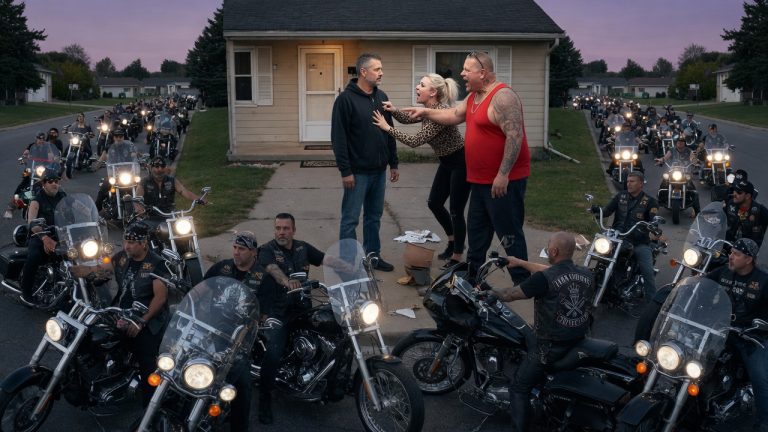
From every side street, from every parking lot, the bikes began to peel out. They formed a column behind the Cadillac. Two wide, four wide, ten wide. The sound was no longer a rumble. It was a roar that vibrated the air itself. It was the sound of five thousand engines, all synchronized, all moving toward one destination.
The police had tried to set up a roadblock near the entrance to the estate. Sheriff Miller stood there, looking at the approaching wall of chrome and leather.
Jax didn’t slow down. He didn’t speed up. He just kept the Cadillac rolling forward.
When we were fifty feet away, Miller looked at the sheer scale of the procession. He saw the “”Iron Saints”” patches from chapters as far away as California and Florida. He saw the grim, determined faces of five thousand men and women who lived by a code he couldn’t understand.
Miller stepped aside. He signaled his deputies to move the cars.
“”Let ’em through,”” Miller said into his radio. “”There’s no stopping this.””
We rolled up the long, winding driveway of the Sterling Estate. The house was a monstrosity of white pillars and manicured lawns. On the back terrace, hundreds of people in tuxedos and evening gowns were sipping champagne, listening to a string quartet.
The quartet didn’t stand a chance.
As the first wave of bikes crested the hill, the music was instantly devoured by the roar. Guests screamed, dropping their glasses. Tiffany, wearing a dress that cost more than my car, clutched Chad’s arm in terror.
Jax pulled the Cadillac right onto the grass, stopping inches from the buffet table. He got out, walked around to the passenger side, and opened the door for me.
The bikes didn’t stop. They began to circle the house. A literal ring of fire and steel. Five thousand motorcycles, engines revving in a rhythmic, deafening chant.
Vroom-vroom. Vroom-vroom.
It sounded like the heartbeat of a giant.
Jax took my arm and led me up the stairs toward the terrace. The crowd parted like the Red Sea. These people, who had spent their lives looking down on everyone, were now looking up in sheer, unadulterated fear.
Chad stood at the top of the stairs, his face pale, his expensive suit soaked in sweat.
“”What is this?”” he stammered. “”This is private property! I’ll have you all arrested!””
Jax stopped three feet from him. He was a head taller than Chad and twice as broad. The engines outside reached a crescendo, then, on a single hand signal from Jax, they all cut out at once.
The silence that followed was even more terrifying than the noise.
“”I heard you like to kick chairs, Chad,”” Jax said. His voice wasn’t loud, but in the silence, it carried to every corner of the estate.
“”It was an accident!”” Chad squeaked. “”A misunderstanding!””
“”My mother doesn’t have misunderstandings,”” Jax said. “”She has memories. And she remembers you laughing while she was on the ground. She remembers your wife taking pictures.””
Jax looked at Tiffany. She hid behind her husband, her phone nowhere to be seen.
“”I have five thousand brothers out there,”” Jax continued, gesturing to the sea of bikers that now covered the entire lawn, the driveway, and the surrounding fields. “”They all heard about what happened. They were very upset. They wanted to come and see the man who thinks he’s so big he can kick an old lady.””
Jax stepped closer, his shadow engulfing Chad.
“”Money is a funny thing, Chad. It buys you houses. It buys you influence. But it doesn’t buy you a spine. And it definitely doesn’t buy you protection from people who have nothing to lose and everything to protect.””
Chad looked around at the elite of Oak Creek. He looked for help. But every single one of his “”friends”” was looking at the ground, or at the bikers, or anywhere but at him. They were realizing that in the face of true power, Chad Sterling was just a small man in a large suit.”