The grease and the diesel fumes were the only things that stayed the same. At sixty-two, Elias Thorne moved with the slow, deliberate pace of a man who had seen too much and felt even more. He wore a faded blue jumpsuit with “Port Authority Maintenance” stitched over a heart that had been broken in more ways than a medical textbook could describe.
He didn’t mind the trash. He didn’t mind the spilled soda or the discarded gum. There was a certain peace in cleaning up the messes of the world, a penance he felt he owed for the years he spent making them in far-off deserts under a different name.
But today, the air in the terminal felt thick. Tense.
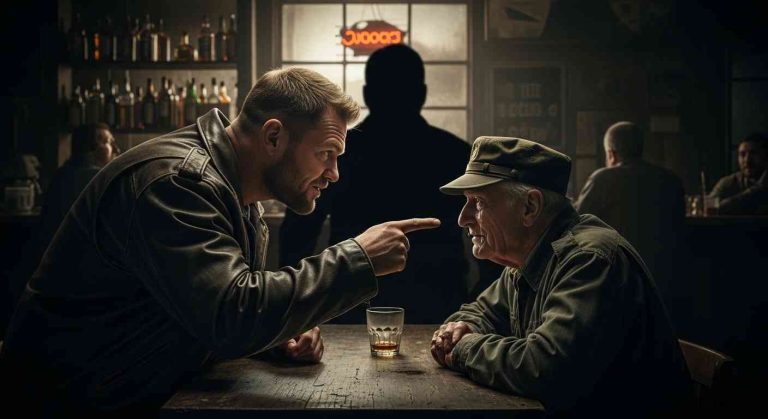
“Hey, Grandpa! You missed a spot. Or are you too busy dreaming about your social security check?”
Jax was twenty-three, smelled like cheap vape juice and unearned confidence, and worked the luggage bay for the cross-country liners. He had a crew of two other guys who thought bullying a man three times their age was the peak of suburban masculinity.
Elias didn’t look up. He just kept the mop moving in a rhythmic figure-eight. “Just doing my job, son. Move your feet so I can get the salt off the tile.”
“Son?” Jax stepped forward, his heavy work boot splashing right into the center of the clean patch Elias had just finished. “I ain’t your son. My old man actually amounted to something. He didn’t end up scrubbing toilets for minimum wage.”
The other two laughed, a hollow, grating sound that echoed off the high concrete ceilings of the station. A young mother nearby pulled her toddler closer, eyes averted. That was the thing about the city—people only looked when they wanted to see a train wreck, never when they wanted to help.
Elias stopped. He looked at the boot—a pristine, overpriced leather thing. Then he looked at Jax. Elias’s eyes weren’t angry. They were hollow. “I’ve seen men like you all over the world, Jax. You think the loudest voice in the room is the strongest. It’s a common mistake.”
Jax’s face flushed a deep, ugly red. “What did you say to me?”
Before Elias could answer, Jax reached into his bucket, grabbed the soaking, grey, chemical-heavy rag, and slapped it across Elias’s face.
The world went silent. The dripping water from the rag ran down Elias’s neck, stinging the old shrapnel scars that lined his collarbone.
“I said clean it up,” Jax hissed, leaning in so close Elias could smell the stale energy drink on his breath. “You’re a nobody. A ghost. A waste of space.”
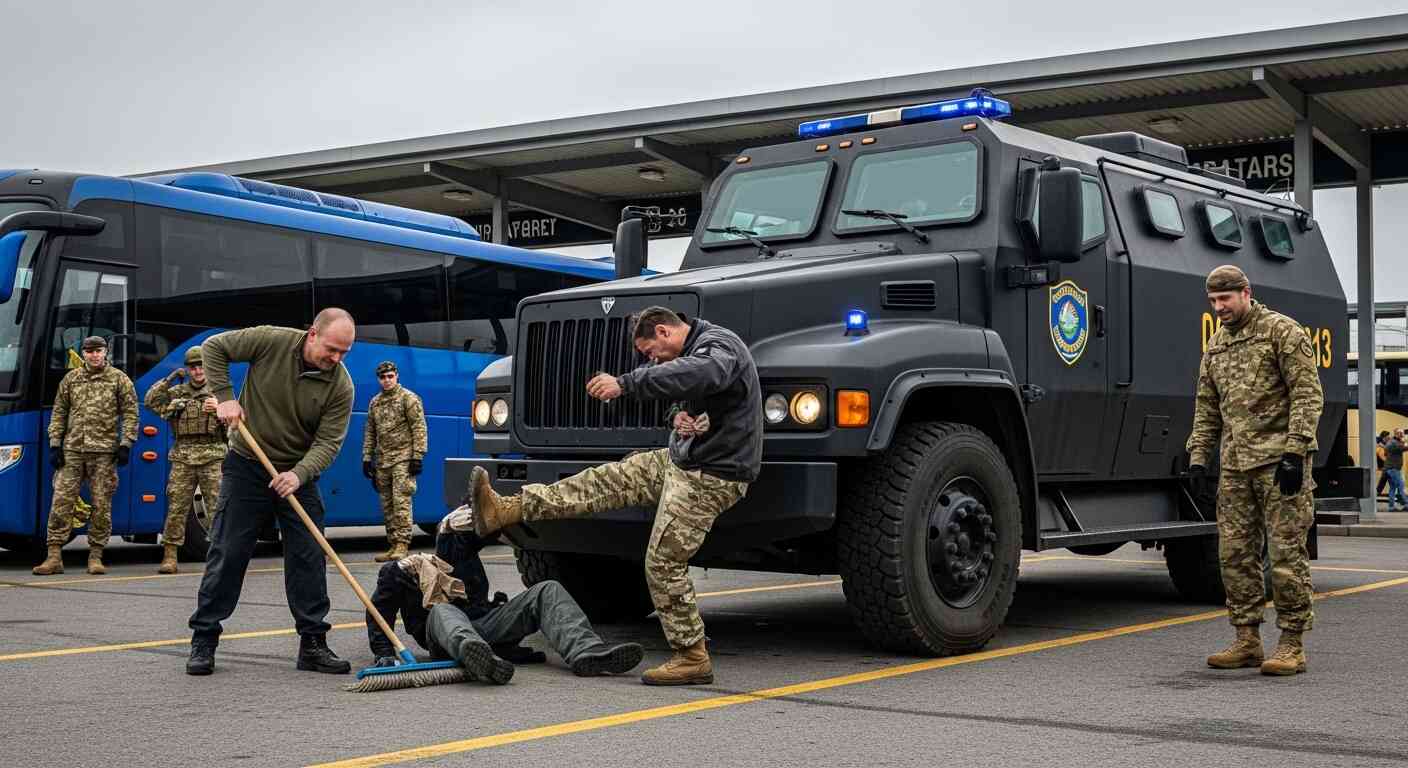
Then came the kick. It wasn’t a playful shove. Jax’s boot caught Elias square in the shin, the one held together by a titanium rod from a 2004 ambush in Fallujah. Elias’s knee buckled. He went down hard, his hands catching the cold, wet tile.
“Look at him,” Jax crowed to the growing crowd. “The big philosopher is begging for mercy now.”
He punctuated the sentence with a sharp jab to Elias’s ribs. Elias curled inward, not because he couldn’t fight back, but because he was terrified of what would happen if he did. He had spent twenty years learning how to be a janitor so he could forget how to be a killer.
But the universe, it seemed, was tired of him hiding.
From outside the terminal, the low hum of high-performance engines began to vibrate the glass. It wasn’t the roar of a bus or the rattle of a taxi. It was the synchronized growl of heavy machinery.
Suddenly, three blacked-out SUVs with government plates slammed over the curb, blocking the main entrance. Men in tactical gear, unbadged but carrying the unmistakable aura of federal authority, poured out.
Jax froze, his foot still poised for another kick. “What the hell is this? Cops?”
But they weren’t looking for the thugs. They were looking for the man on the floor.
“FULL STORY
Chapter 1: The Weight of the Broom
The Port Authority terminal in mid-winter was a special kind of purgatory. It smelled of wet wool, burning oil, and the desperate hopes of people trying to get somewhere else. Elias Thorne liked it that way. In a place where everyone was looking toward the horizon, nobody looked at the man sweeping the floor.
Elias was a master of being invisible. He lived in a studio apartment that contained exactly one bed, one chair, and a stack of books he’d read a dozen times. He didn’t have a television. He didn’t have a phone. He had a broom and a mission: to live out the rest of his days without causing another soul pain.
But the world had a way of finding you, especially when you were trying to disappear.
Jax was the lead attendant for the 6:00 AM express to Chicago. He was young, strong, and fueled by a toxic cocktail of boredom and insecurity. To Jax, Elias wasn’t a man; he was a piece of the architecture. An old, slow piece of architecture that made Jax feel superior every time he looked at him.
“”Move it, Pop,”” Jax barked, shoving a heavy luggage cart past Elias, nearly clipping the older man’s shoulder.
Elias stepped back, his joints popping like dry kindling. “”Morning, Jax. Busy day?””
“”Every day is busy for people who actually have a career,”” Jax sneered. He stopped the cart and looked at Elias’s hands—calloused, scarred, and stained with the grey water of the terminal floors. “”Doesn’t it bother you? Knowing this is it? This is the peak of your life?””
Elias leaned on his mop handle. He had a face like a map of forgotten wars—deep lines around the eyes, a jagged scar running from his ear to his jawline that he told people was from a car accident. It wasn’t.
“”There’s dignity in any work done well, son,”” Elias said softly.
“”Don’t call me ‘son,'”” Jax snapped. He hated the way Elias looked at him—not with anger, but with a weary kind of pity. “”You’re a janitor. You’re the guy people walk over to get to where they’re going. You’re the dirt I scrape off my shoe.””
Jax’s friends, Miller and Toby, drifted over. They were the kind of followers who only felt brave in a pack.
“”Hey Jax, I think he missed a spot over by the vending machines,”” Miller laughed, tossing a handful of crumpled napkins onto the floor Elias had just polished.
Elias sighed, a sound that seemed to come from his very bones. He walked over and began to sweep up the napkins. He didn’t complain. He didn’t argue. He just did the work.
That was the problem. His silence was an insult to Jax. Jax wanted a reaction. He wanted to see the old man break, to see him beg, to see some spark of life in those dead, grey eyes.
“”You know what I heard?”” Jax said, raising his voice so the departing passengers could hear. “”I heard he’s a vet. One of those guys who couldn’t cut it in the real world, so he came home and hid under a mop. Is that true, Elias? You a big hero?””
Elias froze for a split second. The name of a village in the Hindu Kush flashed through his mind—the smell of ozone, the sound of a rotor blade, the weight of a dying man in his arms. He pushed it down.
“”I served,”” Elias said, his voice level. “”A long time ago.””
“”Yeah? Well, look at you now,”” Jax said. He reached out and snatched the broom from Elias’s hand. “”Maybe you need a reminder of what heroes look like. They don’t look like you.””
Jax snapped the wooden handle over his knee. The sound was like a gunshot in the cavernous terminal.
“”Now,”” Jax grinned, dropping the broken pieces at Elias’s feet. “”Clean that up.””
Elias looked at the broken tool of his trade. He felt the old heat rising in his chest—the “”Shepherd”” trying to wake up. He took a deep breath, counting to ten in a language he hadn’t spoken in fifteen years.
“”I’ll get another one,”” Elias said, his voice trembling slightly.
“”No, you won’t,”” Jax said, his ego peaking. He grabbed a bucket of dirty, black mop water and tipped it. The liquid swirled around Elias’s boots, soaking his trousers. “”You’ll use your hands. Like the dog you are.””
The terminal went quiet. Even the announcements over the PA seemed to fade. Everyone was watching. And Elias Thorne, the man who had once commanded the most elite shadow unit in the United States military, stood in a puddle of filth, staring at a boy who had never known a day of real sacrifice in his life.
Chapter 2: The Breaking Point
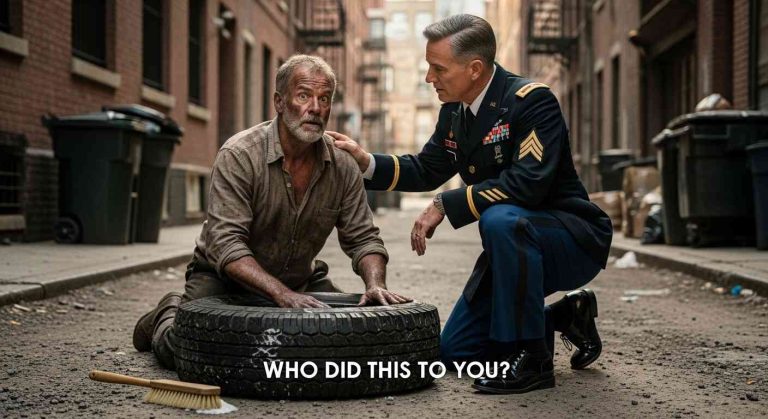
The pain in Elias’s stomach wasn’t from the kick Jax had delivered minutes ago. It was the phantom pain of a life he had tried to bury. He remained on his knees, the cold water seeping through his uniform. He could hear the whispers of the crowd—some sympathetic, most just curious.
“”Get up, old man,”” Jax sneered, looking down at Elias. “”What, you’re gonna cry now? Is that what they taught you in the army? How to sit in the dirt?””
Jax’s friend, Miller, looked a little uneasy. “”Hey, Jax, maybe that’s enough. He’s pretty old, man.””
“”Shut up, Miller,”” Jax snapped. “”He thinks he’s better than us. Look at his eyes. He still thinks he’s someone.””
Jax reached down, grabbing the collar of Elias’s jumpsuit. He yanked him upward, forcing Elias to stand on his shaky legs. Jax was taller, younger, and radiating a desperate need for dominance.
“”Tell them,”” Jax hissed into Elias’s ear. “”Tell everyone you’re nothing. Say it: ‘I am a nobody.'””
Elias looked at Jax. Up close, he could see the boy’s fear. It was masked by bravado, but it was there. Jax was a child playing with a blasting cap, having no idea how close he was to losing his hands.
“”I am a nobody,”” Elias repeated. His voice was sandpaper. “”I’m just the man who cleans the floor.””
Jax grinned, turning to the crowd. “”See? I told you. He’s—””
Jax’s sentence was cut short by a sound that didn’t belong in a bus terminal. It was a high-frequency chirp—the sound of a multi-channel encrypted radio.
Elias’s head snapped toward the entrance. He knew that sound. He hadn’t heard it in over a decade, but it was encoded in his DNA.
Three black SUVs with reinforced bumpers and tinted windows drifted to a halt just outside the glass doors. They didn’t park; they staged. They took up positions that cut off all exits.
The crowd began to murmur in confusion. “”Is that the FBI?”” someone whispered.
Jax let go of Elias’s collar, his bravado flickering. “”What the hell is going on? Is there a bomb or something?””
The doors of the SUVs opened in perfect synchronization. Six men stepped out. They weren’t wearing police uniforms. They were in “”low-profile”” tactical gear—black carbon-fiber vests, sidearms holstered high on the hip, and communication headsets. They moved with a lethal, fluid grace that made the terminal’s security guards look like mall cops.
They didn’t look at the crowd. They didn’t look at Jax. They moved in a wedge formation directly toward the center of the terminal.
“”Hey! You can’t park there!”” the terminal manager shouted, running out of his glass-walled office.
One of the men in black didn’t even turn his head. He held up a gold-bordered identification card. The manager stopped dead, his face turning the color of ash.
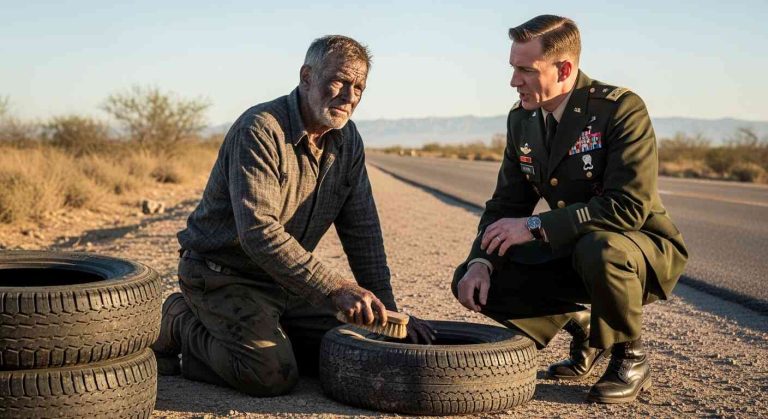
The lead man, a tall, silver-haired figure with the bearing of a Roman centurion, stepped into the light. This was Commander Vance. He scanned the room, his eyes lingering on the broken broom, the spilled water, and the dirty rag lying near Elias’s feet.
Then, his eyes found Elias.
Jax, trying to reclaim his territory, stepped between the Commander and the janitor. “”Look, officers, this old guy was causing trouble, I was just—””
Vance didn’t even acknowledge Jax’s existence. He didn’t push him; he simply walked through his space as if Jax were made of air. Jax stumbled back, tripping over the very mop bucket he had kicked.
Vance stopped three feet from Elias. The other five men formed a perimeter, their backs to Elias, facing the crowd. It was a “”Protective Diamond.””
The terminal fell into a silence so profound you could hear the hum of the neon lights.
Vance looked at Elias—at the grime on his face, the wet jumpsuit, and the bruise forming on his jaw. A flash of pure, unadulterated rage crossed the Commander’s face, gone in a heartbeat, replaced by a deep, somber respect.
Vance stood at attention. His heels clicked together with the force of a hammer strike.
“”Sir,”” Vance said, his voice booming through the terminal.
And then, the man who looked like he could command an army did the unthinkable. He lowered his head and bowed slightly, before snapping the most perfect salute the witnesses had ever seen.
“”The package is secure,”” Vance said into his lapel mic. “”I have eyes on The Shepherd.””
Chapter 3: The Secret in the Scars
Jax was frozen on the floor, his mouth hanging open. The crowd was a sea of raised cell phones, capturing a moment that made no sense. A janitor? “”The Shepherd””?
Elias stood there, the water still dripping from his sleeves. For a moment, he looked like he wanted to run. His eyes darted toward the service exit, calculating the distance, the timing.
“”Don’t do it, Elias,”” Vance said softly, his salute finally dropping. “”We’ve been looking for you for five years. You’re the hardest man in the world to find when you don’t want to be caught.””
Elias wiped a streak of dirty water from his forehead. “”I wasn’t hiding, Arthur. I was living. There’s a difference.””
“”Living?”” Vance gestured to the broken broom. “”You were the Architect of the Southern Shield. You have a Wing at West Point named after you. And you’re cleaning up after… this?”” Vance’s eyes flicked to Jax, who was trying to crawl away.
“”Stop,”” Vance commanded. Two of the tactical team members stepped in front of Jax. They didn’t touch him, but their presence was like a brick wall.
“”He didn’t do anything,”” Miller stammered from the sidelines. “”We were just joking around.””
Vance turned his head slowly. The look in his eyes was enough to make Miller burst into tears. “”Joking? You assaulted a recipient of the Distinguished Service Cross. A man who saved three hundred lives in a valley you can’t even pronounce.””
Vance turned back to Elias. “”The Senator is in the car, Elias. He wouldn’t take ‘no’ for an answer. The situation in the East… it’s happening exactly how you predicted. They need the Architect.””
Elias looked down at his hands. They were shaking. Not from fear, but from the sudden, violent re-entry of a world he had tried to burn. “”I told you, Arthur. I’m done. I made a promise to my wife before she passed. No more blood. No more ghosts.””
“”This isn’t about blood,”” Vance said, his voice dropping to a whisper. “”It’s about preventing it. There are four thousand boys in the 10th Mountain Division who are going to be sent into a meat grinder because the current advisors don’t have your eyes. You’re going to let them die because you’re mad at the world?””
Elias winced. Vance knew exactly where to twist the knife.
“”Let me change,”” Elias said after a long silence.
“”We don’t have time,”” Vance said. “”The bird is waiting at Teterboro.””
Vance turned to the two men holding Jax. “”Identify these three. Full background checks. Contact their employers. And notify the District Attorney. I want a full briefing on the assault of a federal asset.””
“”Asset?”” Jax squeaked. “”He’s just a janitor!””
Vance stepped toward Jax, his shadow lopping over the terrified young man. “”To you, he’s a janitor. To the United States government, he is a national treasure. You just kicked a man who has forgotten more about courage than you will ever learn.””
Vance reached into his pocket and pulled out a small, velvet box. He opened it. Inside was a silver pin—a shepherd’s crook intertwined with a sword. He pinned it directly onto the wet, stained fabric of Elias’s blue jumpsuit.
“”The Shepherd is back on the clock,”” Vance said.
Elias looked at the pin, then at the terminal. He saw the young mother with the toddler. He saw the tired commuters. He saw the world he had been trying to protect by staying invisible. He realized that by hiding, he was letting the wolves win.
He stood up straight. The slouch in his shoulders vanished. The weariness in his eyes transformed into a cold, terrifying clarity.
“”Arthur,”” Elias said.
“”Yes, sir?””
“”Find someone to finish sweeping Gate 9. I hate a job left half-done.””
Chapter 4: The Ghost Awakens
As Elias walked toward the exit, escorted by the tactical team, the terminal felt different. The air was no longer thick with the smell of diesel; it felt electric.
Jax was being detained by the terminal’s actual security now, who were suddenly very eager to please the men in black SUVs. “”Wait!”” Jax yelled as Elias passed him. “”I didn’t know! I swear, I didn’t know!””
Elias stopped. He looked at Jax one last time.
“”That’s the problem, Jax,”” Elias said, his voice calm and terrifyingly quiet. “”You should treat everyone as if they were a hero. Not because of what they’ve done, but because of the dignity they carry. You only respect power. That makes you a coward.””
Elias didn’t wait for a response. He stepped out into the biting winter air. The Senator was indeed in the middle SUV. The window rolled down just an inch, showing a pair of tired, expectant eyes.
“”Elias,”” the Senator said. “”It’s been too long.””
“”Save the pleasantries, Robert,”” Elias said, stepping into the armored vehicle. “”Show me the satellite feeds for the border. If I’m doing this, we do it my way.””
The door slammed shut with a heavy, pressurized thud. The SUVs roared to life, blue and red lights flashing briefly before they sped off, weaving through traffic with practiced precision.
Inside the terminal, the silence lingered for a full minute after they left.
The terminal manager looked at the broken broom on the floor. He picked it up slowly, his hands trembling. He looked at the spot where Elias had been kneeling in the dirt.
A teenager who had filmed the whole thing on his phone was already hitting “”Upload.”” The caption read: You never know who you’re looking at. Don’t mess with the janitor.
Back in the SUV, Elias looked out the window as the city blurred past. He felt the weight of the silver pin on his chest. He thought about his quiet life—the books, the silence, the simple act of sweeping. He knew he would never have that again.
“”You okay, Elias?”” Vance asked from the front seat.
Elias looked at his reflection in the tinted glass. He didn’t see the janitor anymore. He saw the man who had burned his own soul to keep his country warm.
“”I’m tired, Arthur,”” Elias said. “”But I’m awake.””
He reached out and took the tablet from Vance’s hand. The screen showed a map of a mountain range half a world away. Red dots—the enemy—were moving.
Elias’s finger traced a path through the peaks. “”They’re moving through the gorge. They think the snow will hide them. They’re wrong.””
Vance smiled. It was a grim, satisfied thing. “”Welcome back, Shepherd.””