“FULL STORY
CHAPTER 5
The gates of “”The Heights”” were designed to keep the world out. They were gold-leafed, reinforced steel, guarded by private security in polished uniforms.
When our lead bikes reached the gate, the guards looked like they were seeing a ghost. One of them actually dropped his clipboard as he looked at the horizon, which was now nothing but a shimmering line of motorcycles.
“”Open the gate,”” I said, idling my bike in front of the kiosk.
“”This is private property!”” the guard stammered, his hand hovering near his radio. “”You’re trespassing!””
“”We’re not trespassing,”” Sarah said, pulling up beside me. She held up a document. “”We’re here for the public board meeting of the Sterling-Vane Foundation. It’s held at the community center inside, and by law, it’s open to the public because of the city grants they receive. Open the gate, or we’ll have the city attorney here in ten minutes.””
The guard looked at the 5,000 bikers. He looked at the cameras. He opened the gate.
We didn’t rev our engines. We didn’t shout. We rode in total, haunting silence. The only sound was the clicking of gears and the low hum of tires on the pristine pavement.
The residents of The Heights came out onto their manicured lawns, clutching their coffee cups and their robes. They looked terrified, but as we passed, they saw something they didn’t expect. They saw Elena, smiling and waving. They saw Buster, his head out the sidecar, ears flapping in the wind. They saw men in leather vests helping an elderly woman cross the street.
We weren’t the monsters they’d been told we were.
We reached the Sterling-Vane estate—a sprawling mansion that looked like a museum. Julian and Victoria were standing on the balcony, their faces pale as they looked down at the literal army occupying their street.
Julian was on his phone, screaming at someone. Victoria was clutching a glass of wine, her hand shaking so hard the liquid was spilling onto her white silk robe.
I parked my bike directly in front of their driveway. One by one, the others parked behind me, filling the street, the sidewalks, and the neighboring lawns. Thousands of people dismounted and stood in silence, looking up at the balcony.
I walked to the center of the road, holding Elena’s hand.
“”Julian!”” I called out. My voice wasn’t loud, but in the silence, it carried like a bell. “”I think you have something that belongs to us.””
Julian stepped to the railing, his face contorted in a mask of fading bravado. “”Get off my property! I’ve called the National Guard! You’re all going to prison!””
“”No one’s going to prison, Julian,”” I said. “”But we are going to talk about ‘worthless’ things.””
At that moment, a car pulled up to the edge of the crowd. A man in a suit stepped out—not one of Julian’s lawyers, but a man I’d spent the last forty-eight hours talking to. He was an investigator from the State Auditor’s office.
Hammer had spent all week digging. It turns out, when you have 2,000 brothers, some of them work in banks. Some of them work in government offices. And some of them have been watching Julian Sterling-Vane’s “”pension fund”” for a long time.
“”Mr. Sterling-Vane!”” the auditor shouted. “”We have the warrants for your digital records! It seems there’s a multi-million dollar discrepancy in the city’s pension fund—the same one you’ve been using as your personal piggy bank.””
The color drained from Julian’s face. He looked at the auditor, then at me, then at the thousands of “”worthless”” people he had tried to crush.
“”You think you’re better than us because you have a bigger house?”” I asked. “”You tried to take my dog. You threatened my child. You tried to destroy my livelihood. But you forgot that a house built on lies can’t stand up to the truth.””
Victoria suddenly lunged at the railing, screaming at me. “”You’re still trash! You’ll always be trash! Look at you!””
I didn’t answer her. I didn’t have to.
From the crowd, a young girl—the daughter of one of our members—walked forward. She was holding a small bouquet of wildflowers she’d picked from the side of the road. She walked up to our bike and handed them to Elena.
“”For the baby,”” the little girl whispered.
Elena took the flowers, her eyes brimming with tears. She looked up at Victoria—who was still screaming, still bitter, still alone in her giant house—and Elena just smiled. It wasn’t a smile of triumph; it was a smile of pity.
“”I’m so sorry for you, Victoria,”” Elena said, her voice clear and soft. “”You have all this money, and you don’t have a single person who would stand in the rain for you. We have nothing, and we have everything.””
FULL STORY
CHAPTER 6
The downfall of Julian Sterling-Vane was swift and spectacular. The “”discrepancies”” in the pension fund turned out to be a full-scale embezzlement scheme. Within a month, the mansion was seized, the cars were auctioned off, and Julian was trading his tailored suits for an orange jumpsuit.
Victoria disappeared. Some said she moved back to her parents’ estate in Europe; others said she was living in a small apartment in the city, hiding from the creditors she once looked down upon.
The “”Condemned”” sign was taken off my garage by a city official who looked very embarrassed and apologized three times. The bank not only restored our credit but offered us a small-business expansion loan at a rate that made Hammer whistle.
But none of that really mattered.
Three months later, the roar of engines returned to our street. But this time, it was different.
The bikes were parked neatly, and the mood was one of celebration. We were holding a “”Welcome Home”” party in our backyard.
I was standing by the grill, flipping burgers, when Hammer walked up. He wasn’t wearing his vest today; he was wearing a t-shirt that said World’s Best Uncle (a gift from Elena).
“”Heard the news, Jax,”” Hammer said, grinning.
“”Yeah,”” I said, looking toward the porch.
Elena was sitting in the rocking chair, her face radiant. In her arms was a bundle wrapped in a soft pink blanket. Maya Rose Miller had arrived two days ago—eight pounds of perfection with a head of dark hair and a grip that could hold onto a handlebar.
Buster was lying at Elena’s feet, his chin resting on her slipper. He hadn’t left her side since we brought the baby home. Whenever Maya made a sound, Buster’s ears would perk up, and he’d give a soft, protective “”woof.””
“”She’s beautiful, Jax,”” Hammer said, his voice unusually soft.
“”She is,”” I said. “”And she’s priceless.””
I looked around my backyard. It was filled with “”The Trash”” of Oak Ridge. There was Sarah, who had just bought her first house with the help of the club. There were the mechanics from the shop, the veterans, the teachers, the people who actually made the world turn.
They were laughing, eating, and holding my daughter.
I realized then that the rich woman had been wrong about one thing. My dog wasn’t worthless. My baby wasn’t worthless. And neither were we.
The Sterling-Vanes had millions of dollars, but they were the poorest people I’d ever met. They had no brothers to call on. No family to catch them when they fell. They lived in a world of gates and walls, while we lived in a world of open roads and open hearts.
As the sun began to set, casting a golden glow over the backyard, I walked over to the porch. I leaned down and kissed Elena, then gently touched Maya’s tiny, velvet cheek.
Buster thilled his tail against the floorboards, a steady, happy beat.
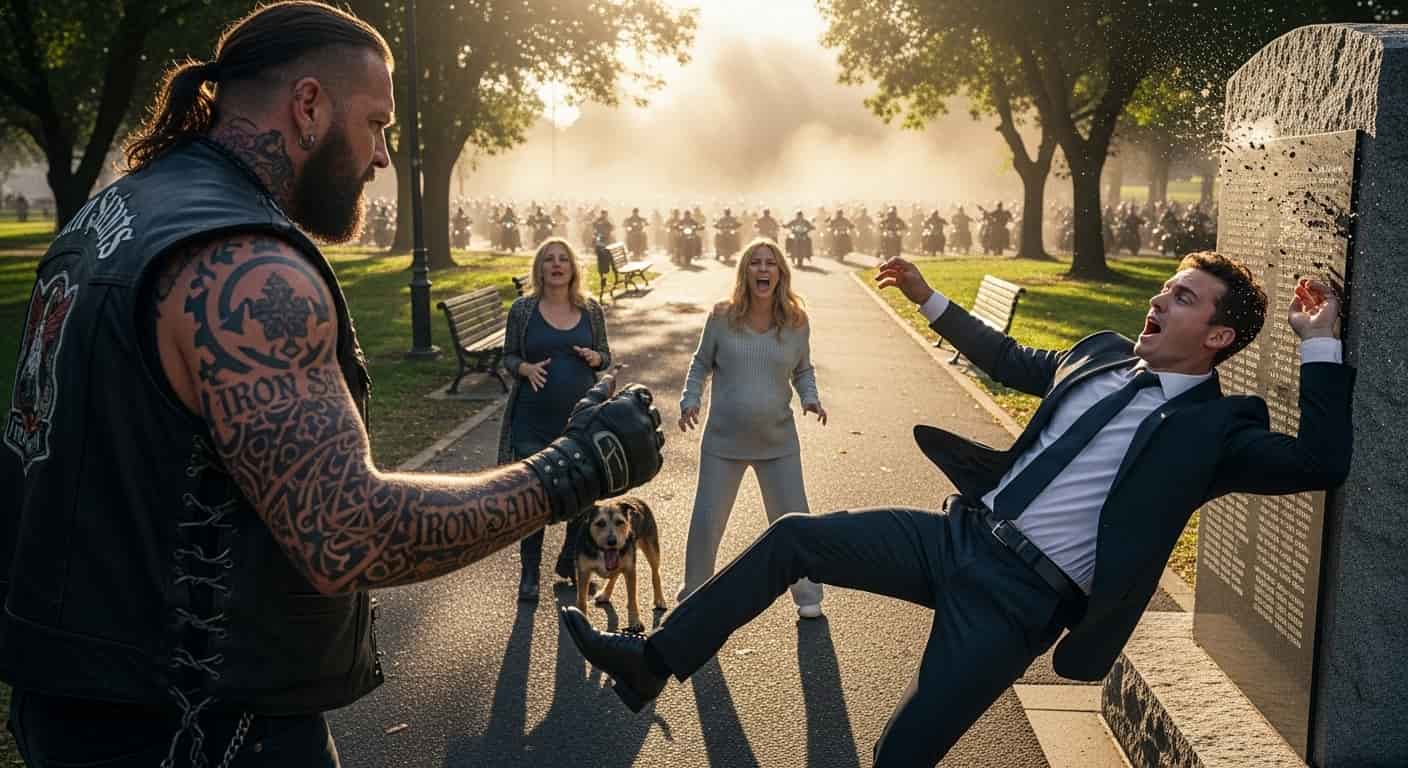
I looked out at my brothers and sisters, my heart so full I thought it might burst. I had launched a man into a wall to defend my honor, but I had won the war by building a bridge of loyalty that no amount of money could ever buy.
In the end, respect isn’t something you demand because of your bank account; it’s something you earn by the way you treat the ones who have nothing to give you in return.
And as I held my daughter, I knew she would grow up knowing exactly what she was worth.
She was a Miller. She was a Saint. And she was loved by two thousand of the best “”worthless”” people on Earth.
Real wealth isn’t found in what you have, but in who would stand beside you when you have nothing at all.”