The sound of the water hitting the pavement was louder than the splash. It was a heavy, wet thwack that echoed through the crisp October air.
My sister, Elena, didn’t even scream. She just gasped—a sharp, rattling intake of breath as the freezing slush soaked through her thin waitress uniform, pinning the fabric to her skin. She stood there, shivering so violently her teeth clicked together, while Sergeant Wade stood over her with an empty industrial bucket and a grin that made my blood turn to liquid fire.
“”You dropped my burger, Elena,”” Wade said, his voice dripping with a fake, Southern-fried concern. “”I figured you needed a little help cooling off that attitude. Consider it a public service. Now, pick up the mess and get inside before you catch a cold.””
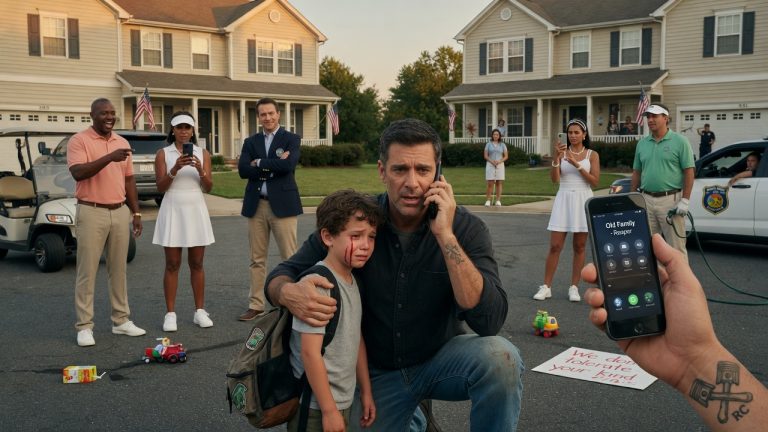
There were a dozen people on the sidewalk in front of the diner. Some looked away. Some pulled out phones, then quickly tucked them back when Wade rested his hand on his service belt. This was Oakhaven. Here, the badge wasn’t just the law; it was the crown. And Wade had been wearing it like a king for twenty years.
I was sitting on my bike across the street, the shadows of the old oak tree swallowing me whole. He didn’t see me. He never saw the people he thought were beneath him. He just saw a waitress who had dared to tell him he couldn’t smoke inside the “”No Smoking”” zone of the diner.
I didn’t move. I didn’t yell. I didn’t rush over to wrap my jacket around her, though every muscle in my body was screaming to do it. If I moved now, I was just one man. One man against a precinct full of brothers who protected their own, no matter how rotten the core was.
Instead, I reached into the pocket of my leather vest and pulled out my phone. I hit the group-send on a pre-written text to every chapter president from Maine to Virginia.
Two words: “”OAKHAVEN. NOW.””
I watched Wade walk back to his cruiser, whistling a tune. He thought the story ended there. He thought he’d shown the town who was boss. He had no idea that the ground beneath his feet was already starting to vibrate.
“FULL STORY
Chapter 1: The Weight of the Badge
The humidity in Oakhaven usually hung heavy, but that October evening, the air had turned brittle. It was the kind of cold that bit into your lungs. Elena had worked the double shift at Miller’s Diner, a place that smelled of burnt coffee and missed opportunities. She was twenty-two, putting herself through nursing school, and she was the only piece of my soul I had left after three tours in the sandbox.
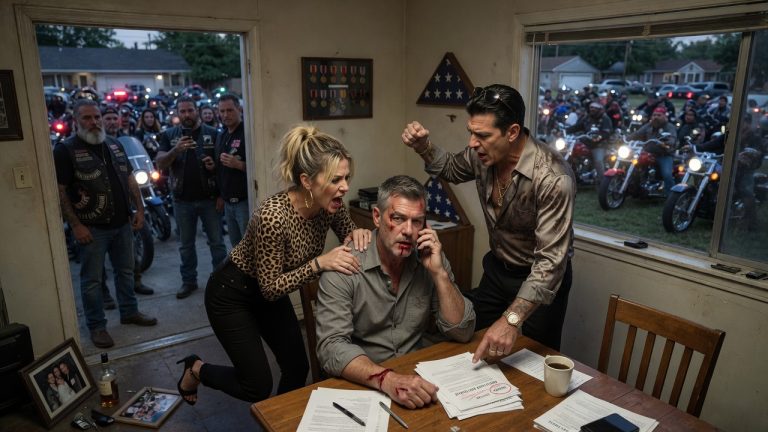
I sat on my Harley-Davidson Road King, a bike that had seen more miles than most people had seen sunsets. I was the President of the Iron Brotherhood, an MC that the media liked to call a “”gang,”” but the locals knew as the guys who ran the toy drives and fixed the roofs of widows. We weren’t looking for trouble, but we were damn good at finishing it.
I watched through the diner window as Sergeant Marcus Wade leaned over the counter. He was a thick-necked man with a buzz cut and eyes that always seemed to be looking for a reason to hit something. He was a bully with a pension.
Elena had brought him his usual—a double cheeseburger, extra onions. But when she told him he had to put out his cigar, Wade’s face went a dark shade of plum. He didn’t say a word. He just waited until she walked out the front door to take the trash to the bin.
He followed her. He grabbed the mop bucket from the porter’s closet on the way out.
The ice-water bath was a calculated move. It wasn’t just a temper tantrum; it was a performance. He wanted the town to see what happened when you told “”The Law”” no.
As Elena stood there, dripping and humiliated, Wade leaned in close to her ear. I couldn’t hear what he said, but I saw the way she shrank. I saw the way her hand went to her throat.
He climbed into his patrol car, tires crunching on the gravel, and drove two blocks down to the Oakhaven Precinct. He was probably going to go inside, grab a coffee, and laugh with the boys about the “”wet waitress.””
I walked across the street. My boots felt like lead.
“”Jax,”” Elena whispered, her voice a thin, vibrating reed. “”Please. Just… let it go. He’ll lose his mind if you do something.””
I took off my “”cut””—the leather vest that signified my rank—and wrapped it around her. It was heavy, smelling of gasoline and old leather, but it was warm.
“”Go inside, El,”” I said, my voice sounding like it was coming from the bottom of a well. “”Tell Sarah to give you some dry clothes and stay in the back.””
“”Jax, what are you doing?””
I looked toward the precinct, where the blue light of the police sign flickered against the darkening sky.
“”I’m calling for a tow,”” I said. “”This town has a bit of trash that needs hauling away.””
I pulled my phone out. The “”OAKHAVEN. NOW.”” text had already been seen by four hundred people. The Iron Brotherhood didn’t just have members; we had a network. We had the vets, the mechanics, the truckers, and the guys who were tired of seeing people like Wade treat the world like their personal footstool.
“”Get inside, Elena,”” I repeated.
She saw the look in my eyes—the one our father used to have before a storm hit the coast. She didn’t argue.
I sat back down on my bike. I didn’t start the engine. I just waited. I counted the seconds.
At the ten-minute mark, a low hum began on the horizon. It sounded like a swarm of bees at first. Then, it grew. It became a growl. Then a roar.
The first two bikes appeared from the north—Dutch and Big Sal. They didn’t stop at the diner. They rode straight to the precinct and parked their bikes diagonally across the main exit.
Then came four more from the south. Then ten from the east.
By the twenty-minute mark, the street was a river of black steel. The roar of two thousand engines began to vibrate the windows of the diner, rattling the spoons in their jars.
Wade had wanted to show everyone his power. Now, the Brotherhood was about to show him ours.
Chapter 2: The Gathering Storm
The Oakhaven Police Department was a small, two-story brick building that had stood since the fifties. It felt solid. It felt permanent. Until the Brotherhood arrived.
Dutch pulled up beside me, his long gray beard fluttering in the wind. He was sixty-five, a Vietnam vet who had more shrapnel in his leg than sense in his head. He looked at the precinct, then at the shivering girl inside the diner window.
“”Is that her?”” Dutch asked, his voice a gravelly rumble.
“”Yeah,”” I said. “”Wade drenched her. Called it a public service.””
Dutch spat on the pavement. “”I never did like the way that man wore his brass. Thinks it makes him a god. Gods don’t hide behind buckets of water.””
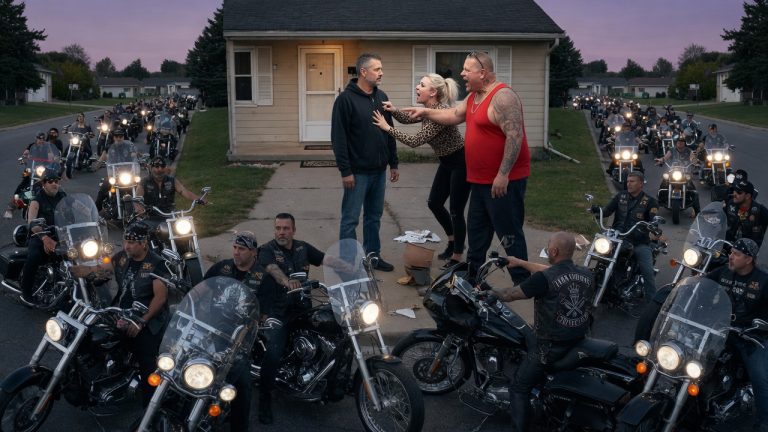
Within thirty minutes, the scene was surreal. Every exit of the precinct—the front doors, the sally port, the back alley—was blocked by a wall of motorcycles. There were men in their twenties and men in their seventies. There were women on cruisers and guys on choppers that cost more than Wade’s house.
The silence that followed when the engines finally cut out was more terrifying than the noise. Two thousand people stood in the street. No one was shouting. No one was throwing rocks. They just stood there, arms crossed, staring at the front door of the police station.
The glass doors of the precinct slid open. A young officer—maybe twenty-four, still had the “”new car”” smell on his uniform—stepped out. His eyes went wide. He looked at the sea of leather and denim stretching for four blocks in every direction.
“”Uh… can I help you guys?”” the kid stammered.
“”We’re here for Sergeant Wade,”” I said, stepping forward. I wasn’t wearing my cut anymore; it was still on Elena. I was just a man in a black t-shirt with grease on my knuckles.
“”The Sergeant is… he’s busy with paperwork,”” the kid said, his hand twitching toward his belt.
“”Tell him his paperwork can wait,”” Dutch yelled from the crowd. “”We want to talk about the ‘public service’ he performed at the diner.””
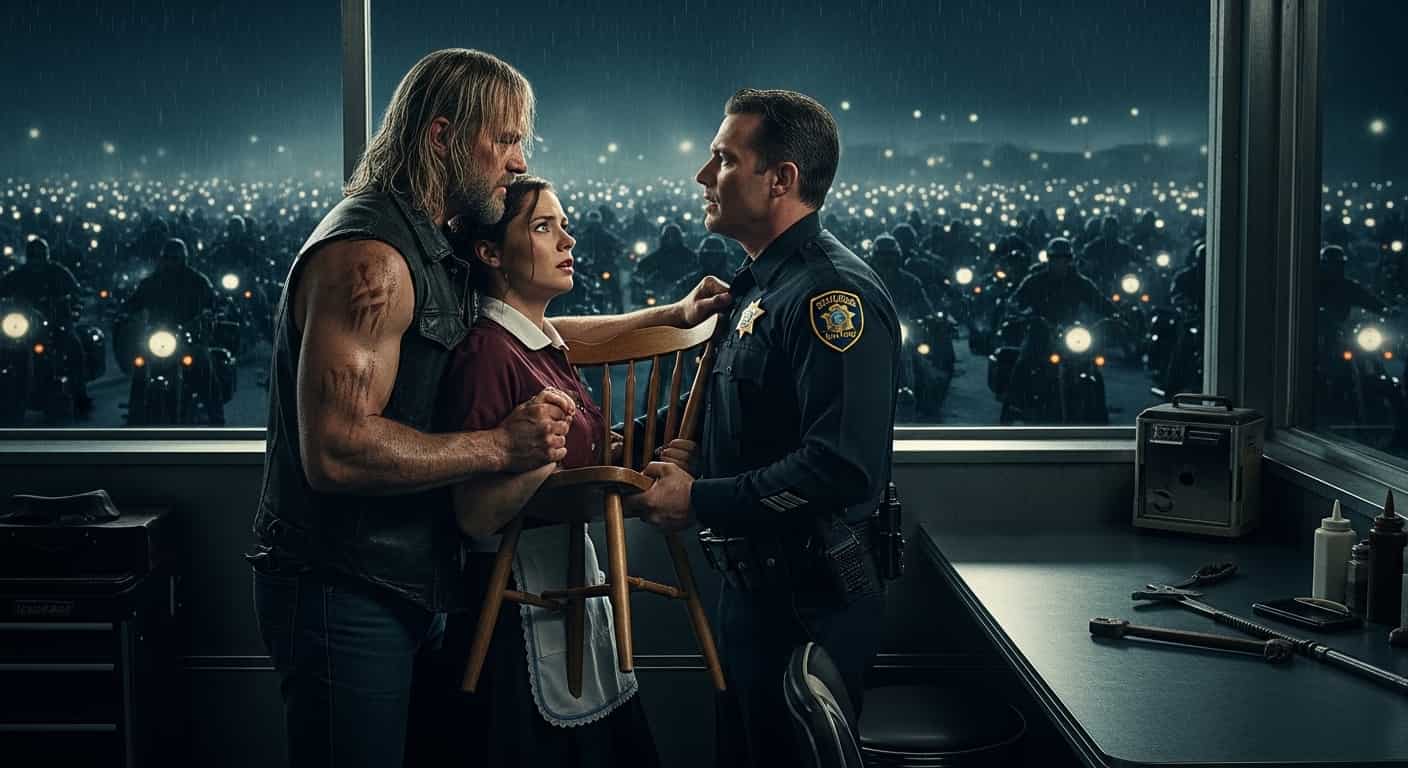
The kid looked back inside. Through the glass, I could see other officers gathering. They were confused, reaching for their radios, calling for backup. But the radio dispatchers were already telling them the same thing: every road into Oakhaven was blocked. A fleet of semi-trucks—driven by Brotherhood associates—had “”broken down”” at every major intersection three miles out.
The Oakhaven PD was on an island. And the tide was coming in.
I saw Wade then. He appeared behind the glass, his face pale as a sheet. He wasn’t laughing now. He was looking at the sheer scale of the response. He had bullied a girl. He had expected her to cry. He hadn’t expected the world to show up on his doorstep.
Chief Henderson, an older man with a tired face, pushed past the young officer. He looked at me, then at the crowd. He knew me. He’d known my father.
“”Jax,”” Henderson said, his voice weary. “”What is this? You’re blocking a government facility. That’s a federal offense.””
“”No, Chief,”” I said calmly. “”We’re just having a peaceful assembly. Exercising our First Amendment rights. It just so happens two thousand of my closest friends decided to join me.””
“”You need to clear the road.””
“”As soon as Sergeant Wade comes out here and apologizes to my sister on his hands and knees,”” I said. “”And as soon as he turns in that badge he’s been using to choke this town.””
Henderson looked back at Wade. The tension inside the precinct was visible. The other officers weren’t moving to support Wade. They were looking at him with a mix of disgust and fear. They knew what he’d done. They’d been letting him get away with it for years because it was easier than fighting the “”Blue Wall.””
But today, that wall had a lot of cracks in it.
Chapter 3: The Blue Wall Crumbles
The standoff lasted three hours. The sun dipped below the horizon, casting long, jagged shadows across the asphalt. The local news had tried to get a helicopter over the scene, but the Brotherhood’s drone pilots—vets who knew how to dominate airspace—had made it impossible for them to get a clear shot.
Inside the precinct, the lights were harsh and fluorescent. I could see the officers arguing. It wasn’t “”us versus them”” anymore. It was “”them versus Wade.””
I saw a woman officer—Officer Miller, no relation to me—walk up to Wade. She was shouting. She pointed toward the window, toward the sea of bikers, and then toward the diner. She knew Elena. Everyone in this town knew Elena.
“”You’re not worth it, Marcus!”” her voice carried through the glass. “”You think we’re going to go out there and start a riot for you? For a bucket of water?””
Wade was pacing like a caged animal. He grabbed his desk phone, probably trying to call the State Police. But the cell towers in this immediate area were suddenly “”experiencing technical difficulties.”” We had a few tech geniuses in the Brotherhood who knew how to create a digital dead zone.
I stood on the hood of a parked cruiser—one that hadn’t made it into the garage in time.
“”Chief!”” I yelled. “”The clock is ticking. My guys are getting hungry. And when they get hungry, they get restless. You want to see what happens when two thousand men decide they’ve had enough of the way you run your shop?””
Chief Henderson stepped out again. He looked broken. “”Jax, give me ten minutes. Just ten minutes.””
He went back inside. I watched him walk straight up to Wade. The Chief was a man who had tried to play both sides for too long. He liked the order Wade kept, but he hated the methods. Now, the order was gone, and the methods were being turned back on them.
Henderson grabbed Wade by the shoulder and shoved him toward the locker room.
The crowd of bikers began to rev their engines in unison. It wasn’t a roar; it was a heartbeat. Vroom-vroom. Vroom-vroom. A rhythmic, terrifying sound that felt like it was rattling the teeth in Wade’s head.
Suddenly, the front doors of the precinct opened wide.
Two officers walked out, but they weren’t leading the way. They were carrying something. It was a cardboard box. Inside were a belt, a holster, a can of pepper spray, and a silver badge.
They set the box on the top step.
Then, they stepped aside.
Wade was pushed out. He wasn’t wearing his uniform shirt anymore—just a white undershirt that made him look small and flabby. He looked at the crowd, and for the first time in twenty years, the man who held the power was the one who was afraid.
“”Do it,”” Henderson barked from the doorway.
Wade looked at me. Then he looked at the diner.
The crowd went silent. Not a single engine. Not a single whisper.
Wade began to walk down the steps. His legs were shaking. He had to walk through the lane we had opened for him—a lane lined with men who looked like they’d survived hell and were looking for a souvenir.
He reached the front of the diner. Elena was standing there, wrapped in my leather vest, her hair still damp.
Wade stopped three feet from her. He looked at the ground.
“”I’m… I’m sorry,”” he muttered.
“”I didn’t hear you, Marcus,”” I said, leaning against my bike. “”The wind is a bit loud tonight.””
Wade swallowed hard. He looked up at Elena, and I saw a single tear of pure, unadulterated terror track down his cheek.
“”I’m sorry, Elena,”” he said, louder this time. “”It was… it was wrong. I was wrong.””
Chapter 4: The Price of Silence
The apology was a start, but it wasn’t the end. Justice in Oakhaven had been a lopsided scale for far too long to be fixed with three words.
“”The bucket, Wade,”” I said.
He blinked, confused. “”What?””
“”The bucket. Get it.””
One of the guys from the Brotherhood, a massive dude named Bear, stepped forward and handed Wade the same industrial yellow bucket he had used on my sister. It was filled to the brim with slush and ice cubes from the diner’s machine.
Wade looked at the bucket, then at the thousands of eyes watching him. He knew the deal. This wasn’t about revenge; it was about balance.
He lifted the bucket. His arms were trembling so hard the ice rattled against the plastic. He looked at Henderson, who just looked away. He looked at his fellow officers, who were standing on the precinct porch like they were watching a stranger.
Wade closed his eyes and dumped the bucket over his own head.
The gasp he let out was identical to the one Elena had made. He shivered, the freezing water soaking his undershirt, his boots, his pride. He stood there, dripping and pathetic, while the town watched.
“”Now,”” I said, my voice cold. “”Get out of this town. You have one hour to pack your house. If you’re still within city limits by midnight, the Brotherhood won’t be ‘peacefully assembling’ anymore. We’ll be looking for our brother.””
Wade didn’t wait. He turned and ran toward his personal truck, parked in the side lot. No one stopped him. No one touched him. They just watched him go.
But the crowd didn’t disperse.
I turned my attention back to Chief Henderson. “”Now, about the rest of them, Chief.””
Henderson walked down the steps. He looked at the box containing Wade’s badge. “”I know, Jax. I’ve let things slide. I thought it was just ‘Marcus being Marcus.’ I didn’t realize how much the rot had spread.””
“”Rot doesn’t stay in one spot, Chief. It eats the whole fruit.””
I reached into my pocket and pulled out a thumb drive. “”On this drive are three years of dashcam footage and audio recordings. My guys have been ‘observing’ this precinct for a long time. It’s got every bribe, every illegal search, and every time Wade and his buddies used that badge to hurt someone who couldn’t fight back.””
Henderson took the drive. He looked at it like it was a live grenade.
“”If this goes to the District Attorney…”” Henderson started.
“”It’s already there,”” I interrupted. “”A copy was delivered to the DA’s office in the city an hour ago. We’re just giving you this one so you can decide who else needs to turn in their badge before the handcuffs arrive.””
The silence that followed was heavy with the weight of consequence. The officers on the porch started looking at each other. Some looked guilty. Some looked relieved.
I walked over to Elena. She looked at me, her eyes wide and wet. She reached out and took my hand.
“”Is it over?”” she whispered.
“”In Oakhaven? Yeah, El. The weather’s finally starting to clear up.”””