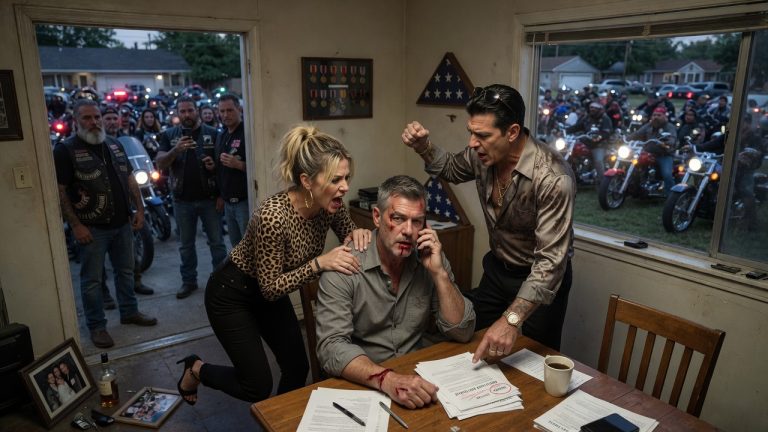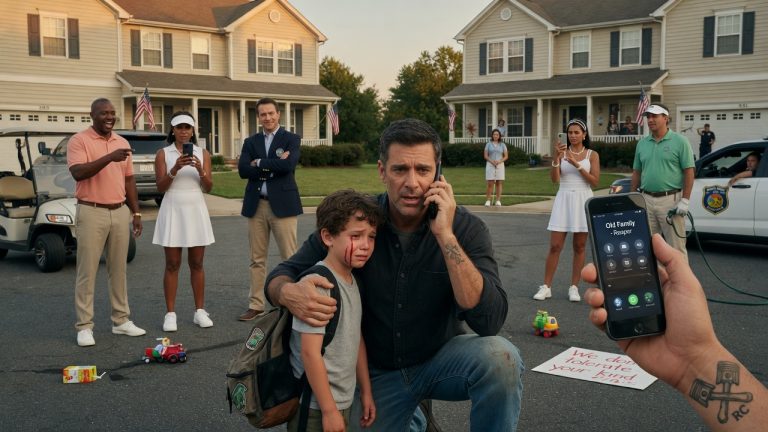
The coffee at Miller’s Diner always tasted like burnt hope and low-grade gasoline, but today, it tasted like salt.
I sat in the corner booth, my hands wrapped around a ceramic mug, watching Sarah’s hands shake as she wiped down the counter. She was twenty-four, working two jobs to keep her kid in a decent school, and she was the bravest person I knew.
But today, she looked like she’d seen a ghost. Or worse.
“He came by again, didn’t he?” I asked. My voice is a low rumble, the kind that comes from thirty years of smoking and ten years of leading the Iron Reapers.
Sarah didn’t look up. She just scrubbed harder at a spot on the Formica that had been clean for an hour. “It’s fine, Jax. It’s just… the ‘safety tax.’ He says the neighborhood is getting dangerous.”
I felt a heat rise in my chest that had nothing to do with the coffee. Marcus Sterling. He’d been a patrolman in this town since I was a teenager. Back then, he was just a bully. Now, he was a predator with a government-issued Glock and a pension plan.
He didn’t just take money. He took dignity. He targeted the ones who couldn’t fight back—the immigrants, the single moms, the shopkeepers who were one bad month away from the street.
“How much?” I pressed.
“Everything I had in the tip jar,” she whispered, finally looking up. Her eyes were red-rimmed. “And he told me… he told me if I was ‘extra nice’ to him during his late-shift patrol, he might give some of it back.”
The ceramic mug in my hand cracked. I didn’t even realize I’d squeezed it that hard until the hot liquid scalded my palm.
I didn’t wipe the coffee off. I just stood up.
In a town like Oak Creek, everyone knows everyone’s business, but nobody says a word. We’ve got the white picket fences, the Friday night lights, and the “”Best Small Town”” trophies. But under the surface, there’s a rot. And that rot has a name and a silver shield.
Sterling thought he was untouchable. He thought because he knew the Sheriff and shared beers with the Mayor, he could treat this town like his personal piggy bank and his private hunting ground.
He forgot one thing.
He forgot about the men and women who don’t go to the country club. The ones who spent their lives in the dirt, in the factories, and on the open road.
“Sarah,” I said, tossing a twenty on the counter. “Go home. Lock your doors. Tell your sister to watch the kid.”
“Jax, don’t,” she pleaded, her voice trembling. “He’s a cop. He’ll ruin you.”
I looked at her, really looked at her. I saw my own sister in her eyes—the one we lost twenty years ago because another “”good ol’ boy”” decided the rules didn’t apply to him.
“He’s not a cop,” I said, pulling my leather vest tight. “He’s a mistake. And tonight, we’re going to correct it.”
I walked out to the parking lot where my Road Glide was waiting. I pulled out my phone and hit a single contact. It was a group thread that stretched from the coast of Maine to the hills of California.
I only typed five words: Midnight. Sterling’s place. Full colors.
I knew the risks. I knew that by sunrise, I might be sitting in a cell or lying in a morgue. But as I kicked the starter and felt the engine roar to life between my legs, I didn’t feel fear.
I felt the kind of peace that only comes when you finally decide to stop running from the storm and start becoming it.
“FULL STORY
Chapter 2: The Paper Trail of Pain
By 3:00 PM, the word had spread through the local chapters like a brushfire. I wasn’t just calling the Reapers; I was calling the Vets, the independent riders, and anyone who had ever felt the weight of Sterling’s boot on their neck.
I spent the afternoon in the back of Joe’s Auto Body, the unofficial headquarters of the Reapers. Joe was sixty-five, a Vietnam vet with a prosthetic leg and a heart of gold. He’d been paying Sterling “”protection”” for his shop for five years.
“You sure about this, Jax?” Joe asked, wiping grease from his forehead. “The man’s got the law behind him. We’re just guys on bikes. To the world, we’re the villains.”
“The world isn’t watching yet, Joe,” I said, leaning over a map of Sterling’s suburban neighborhood. “But they will be. We’re not going there to break windows. We’re not going there to start a riot. We’re going there to be a mirror. We’re going to show him exactly who he is.”
I had been doing my homework. For months, I’d been documenting every shakedown, every “”random”” stop-and-frisk that ended with a missing wallet. I had a ledger—ironic, really—that mirrored the one Sterling likely kept.
But it wasn’t just the money. That was the “”Motivation”” he used to justify it to himself. “”I’m underpaid,”” he’d probably tell his reflection. No, the real darkness was what we called the “”Midnight Patrol.””
Sterling had a habit of finding women who were out past 11:00 PM—waitresses finishing shifts, nurses walking to their cars. He’d pull them over for a “”broken taillight”” and then suggest they could “”settle the ticket”” in the back of his cruiser.
I had three names. Three women who were too terrified to go to the Internal Affairs department because Sterling was the department’s darling.
One of them was my own cousin’s daughter, Mia. She hadn’t told anyone until she’d broken down at a family BBQ last month. The shame in her voice… it was a physical weight.
“He thinks he’s the king of this hill because no one has ever looked him in the eye and said ‘No,’” I told Joe. “Tonight, he’s going to hear two thousand people saying it at once.”
Around 6:00 PM, the first bikes started rolling in. They didn’t come in a pack—not yet. They trickled into the outskirts of town, parking at various gas stations and diners, keeping it low-key. We had guys coming from three states away.
I met with Tank, my sergeant-at-arms. Tank was six-foot-four and built like a brick smokehouse. He had a weakness for stray dogs and a hatred for bullies that bordered on pathological.
“Everything set?” I asked.
“The perimeter is mapped,” Tank said, his voice a low gravel. “We’ve got the ‘Silent Escort’ ready. No sirens, no shouting. Just the steel. Jax, the guys are fired up. Some of them want his head on a platter.”
“No,” I said firmly. “This isn’t a hit. It’s a reckoning. If we touch him, we lose. We let the weight of what he’s done crush him. We bring the evidence, we bring the community, and we bring the noise—until we decide to take it away.”
I looked at my watch. The sun was dipping below the horizon, casting long, bloody shadows over Oak Creek. In the suburban tract of Willow Creek, Officer Marcus Sterling was probably sitting down to a steak dinner, thinking about which “”tax”” he’d collect tomorrow.
He had no idea that the silent gears of justice had finally caught his sleeve.
Chapter 3: The Thin Blue Conflict
At 9:00 PM, a knock came at the garage door. It wasn’t the rhythmic heavy thud of a biker. It was a sharp, disciplined rap.
I opened it to find Deputy Miller. He was my younger brother’s kid, barely twenty-six, wearing the same brown uniform Sterling wore. He looked sick.
“Uncle Jax,” he said, stepping into the dim light of the shop. “I’m hearing things on the scanner. I’m hearing about a massive gathering. People are calling in ‘suspicious groups’ of riders at the 7-Eleven.”
“They’re just enjoying the night air, Leo,” I said, crossing my arms.
Leo sighed, rubbing his face. “Don’t do this. If you go to his house, the Sheriff will have to respond. I’ll have to respond. You’re putting me in a position where I have to choose between my blood and my badge.”
I walked over and put a hand on his shoulder. I could feel him shaking. Leo was a good kid—the kind of cop the world actually needed. But he was young, and he was being poisoned by the environment Sterling created.
“Leo, you already chose the badge,” I said quietly. “And that badge says ‘to protect and serve.’ Who are you protecting right now? The man who extorted Sarah from the diner? The man who cornered Mia in an alley? Or the people he’s supposed to be watching over?”
Leo looked away. “I didn’t know about Mia.”
“Now you do,” I said. “I’m not asking you to help us. I’m asking you to do your job. When the call comes in at midnight, don’t come as his friend. Come as a peace officer. Watch what happens. Look at the evidence I leave on his porch. Then you decide which side of the line you’re on.”
Leo stood there for a long time. The conflict in his eyes was agonizing. He knew the corruption existed; he’d seen the “”lost”” evidence files and the “”unreported”” cash. He’d just been too afraid to be the one to pull the thread.
“He’s got a gun in that house, Jax,” Leo warned. “He’s not going to go quietly. He’s a narcissist. He thinks the world owes him.”
“Then the world is coming to collect,” I replied.
Leo left without another word. I knew he was going to his cruiser to sit and wait. I hoped for his sake he made the right choice.
By 11:30 PM, the air in the staging area was thick with the smell of exhaust and anticipation. Two thousand bikes. It’s hard to imagine that many until you see them—a sea of chrome and leather stretching for blocks.
I climbed onto my bike and looked out at the faces. These weren’t the “”outlaws”” the movies portrayed. These were mechanics, accountants, veterans, grandfathers. They were the backbone of the country, and they were tired of seeing the small guy get stepped on.
“Tonight, we ride for Sarah,” I called out, my voice carrying through the cool night air. “We ride for Mia. We ride for every person who was told their voice didn’t matter. No violence. No fire. Just the presence of two thousand souls who refuse to look away.”
I kicked my bike into gear. The roar was deafening, a mechanical thunder that shook the very foundations of the garage.
We moved out.
Chapter 4: The Midnight Roar
The ride into Willow Creek was cinematic. Imagine a quiet, sleepy suburb where the most exciting thing that happens is a stray dog or a late-night grocery run.
Then, imagine the ground beginning to vibrate.
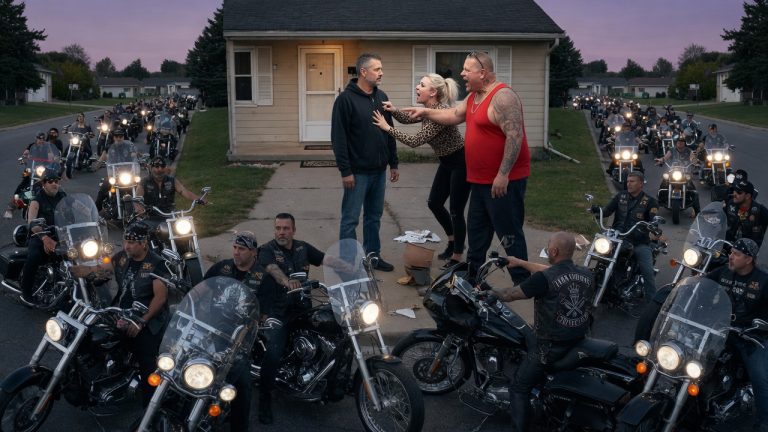
We didn’t ride in like a gang. We rode in a disciplined, two-by-two formation that stretched for miles. We bypassed the main lights and slid into the residential streets like a black ribbon of ink.
Windows began to fly open. Porch lights flickered on. People stood on their lawns in robes and pajamas, watching in stunned silence as a seemingly endless line of motorcycles rolled past.
We reached Sterling’s street—a cul-de-sac ending in a massive, two-story house that he definitely couldn’t afford on a patrolman’s salary.
I signaled the stop.
The coordination was flawless. We filled the cul-de-sac. We filled the side streets. We lined the curbs and the driveways of his neighbors. Two thousand bikes, engines idling. The sound was a physical force—a low-frequency hum that made your teeth ache.
I saw Sterling’s bedroom light snap on.
I hopped off my bike and started walking toward his front door. Behind me, Tank and four other chapter presidents followed. We weren’t carrying weapons. We didn’t need them.
I reached the edge of his lawn. The grass was perfectly green, probably watered with the money he took from Joe’s shop.
Suddenly, the front door burst open. Sterling stepped out onto the porch, wearing a white undershirt and his uniform trousers. He was holding his service weapon, pointing it wildly at the crowd.
“Get back!” he screamed, his voice cracking. “This is private property! I’ll shoot! I swear to God, I’ll shoot!”
I kept walking.
“You’re going to shoot two thousand people, Marcus?” I asked, my voice calm, projecting over the idle of the engines. “You don’t have enough bullets. You don’t have enough lies. And you don’t have any more time.”
He recognized me then. “Miller. You crazy son of a… I’ll have you in chains for this! This is harassment of a police officer!”
“No,” I said, stopping at the base of his porch steps. “This is a town hall meeting. And you’re the guest of honor.”
I reached into my vest and pulled out a thick envelope. Inside were the statements from the women, the ledgers of the stolen money, and a USB drive with footage from a hidden camera Joe had installed in his shop last month.
“I’m going to leave this right here,” I said, placing the envelope on his welcome mat. “Along with a little something else.”
I whistled. Tank stepped forward and heaved a heavy duffel bag onto the porch. It hit the wood with a heavy thud. The zipper was partially open, and stacks of five and ten-dollar bills spilled out.
“That’s the money you took from this town, Marcus,” I said. “We went around and collected from the ‘safety tax’ you’ve been running. Turns out, people are a lot more honest when you aren’t pointing a gun at them.”
Sterling’s eyes darted from the money to the sea of bikers. He was sweating now, the bravado starting to leak out of him like air from a punctured tire.
“You can’t prove anything,” he hissed.
“I don’t have to,” I said. “Because I’m not the one you have to worry about anymore.”
I raised my hand.
On my signal, every single biker hit their kill switch at the exact same moment.
The silence that followed was more terrifying than the roar. It was a vacuum of sound, a heavy, judgmental stillness that settled over the neighborhood.
In that silence, we heard the sirens.”