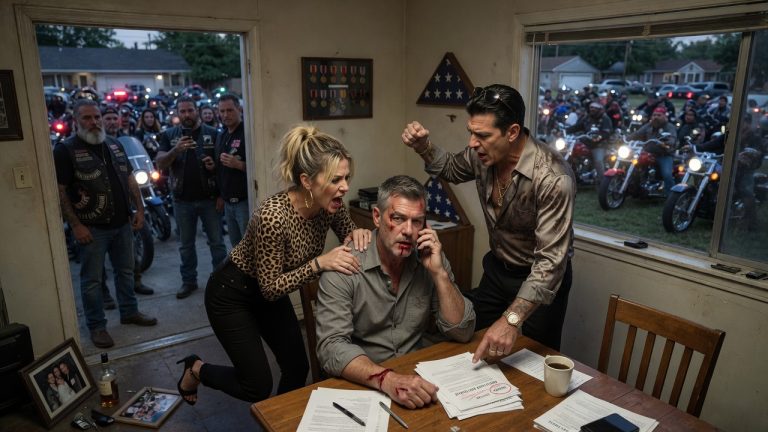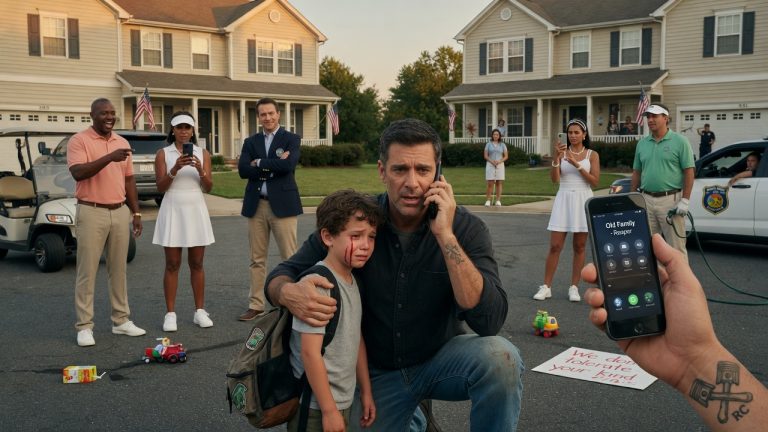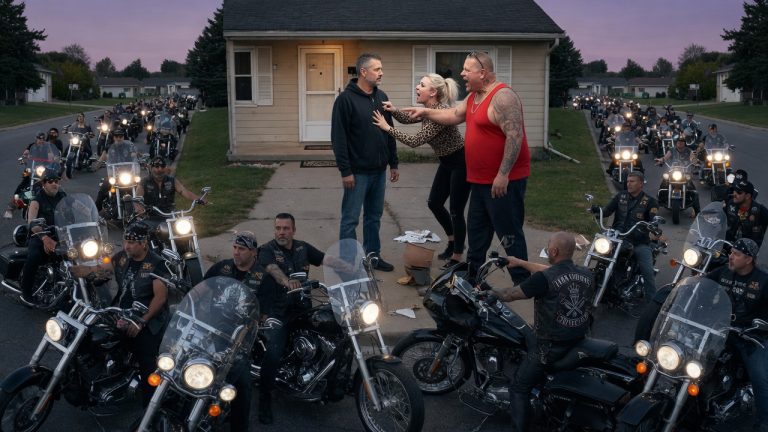
The sound of paper tearing is usually small. But in that cramped, humid office, it sounded like a bone snapping.
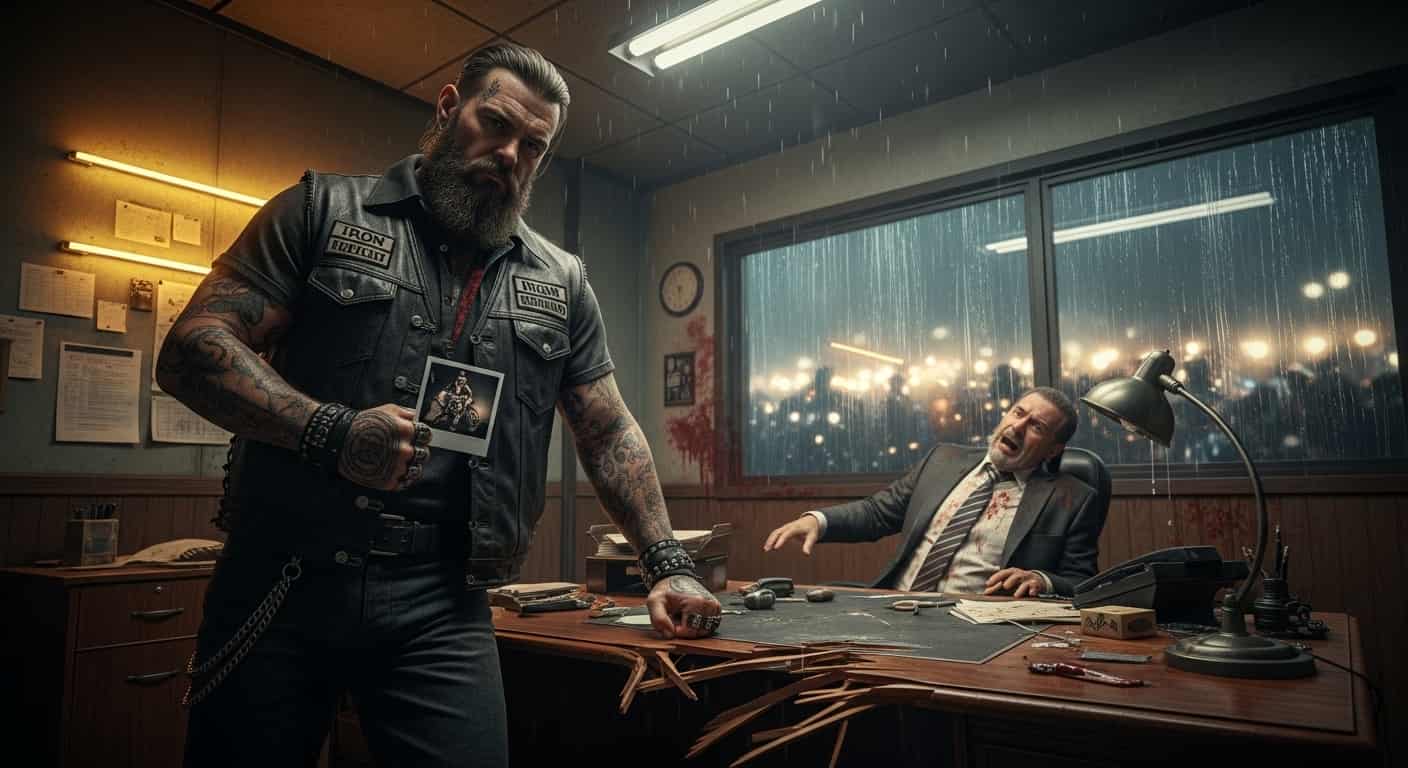
Detective Miller leaned back in his swivel chair, a jagged, yellow-toothed grin plastered across his face. He held up a Polaroid of a little girl in a sun hat, standing between two laughing parents. Then, with a slow, deliberate movement, he ripped it down the middle.
“”Illegal activities, Mia,”” Miller drawled, his voice oily and satisfied. “”The city doesn’t like ‘undesirables’ running shops on the corner. This flower shop? It’s mine now. Or rather, it’s the city’s. And these?”” He dropped the torn fragments onto the floor. “”Trash. Just like your old man was.””
Mia let out a strangled sob, reaching for the scraps of her only remaining memory. Her parents had died three years ago, and this shop—this tiny, smelling-of-lavender-and-old-books sanctuary—was all she had left.
“”Please,”” she whispered, her voice breaking. “”I paid the taxes. I have the permits.””
“”Permits can be lost,”” Miller said, standing up and towering over her. “”And girls like you can be lost, too. Now, get out before I find a reason to put you in a cage.””
He didn’t see the shadow in the doorway. He didn’t hear the heavy boots on the linoleum.
But he felt the air change.
Jax stepped into the room. He didn’t look like a hero. He looked like a storm that had been brewing for twenty years. He didn’t say a word as he walked toward the desk.
Miller’s hand went to his hip, to the gun that had protected his corruption for a decade. “”Hey! Outlaw! This is a restricted area. Get the hell out—””
BOOM.
Jax’s fist didn’t just hit the desk; it went through it. The mahogany splintered like dry kindling. Miller jumped back, his chair hitting the wall with a dull thud.
Jax leaned over the wreckage, his eyes locking onto Miller’s.
“”I lead two thousand outlaws, officer,”” Jax said, his voice a low, vibrating growl that seemed to shake the very foundations of the building. “”Two thousand people who have been stepped on, lied to, and robbed by men who wear that piece of tin on their chest.””
He reached down, picked up the torn photo of Mia’s parents, and looked at it with a tenderness that vanished the moment he looked back at the cop.
“”We’ve decided your badge doesn’t make you a man,”” Jax continued. “”It just makes you a target. And right now? Every single one of my people is waiting for me to give the word.””
Outside, the street began to hum. A low, rhythmic throb of thousands of engines, thousands of hearts, and one unified demand for justice.
“FULL STORY
Chapter 1: The Shattering
The morning had started with the scent of jasmine and the soft hum of the refrigerator in the back of Mia’s Petals & Pages. For Mia, the shop wasn’t just a business; it was a living, breathing scrapbook. Every shelf of weathered Hemingway novels and every bucket of fresh-cut roses was a tribute to the parents she’d lost to a hit-and-run three years prior. It was a quiet life, a suburban sanctuary in a world that felt increasingly loud and cold.
Then came Detective Miller.
He didn’t knock. He never did. He kicked the door open, the bell chiming a frantic, panicked warning. Behind him were two junior officers, their faces masked in the kind of practiced indifference that only comes from serving a corrupt master.
“”Shop’s closed, sweetheart,”” Miller announced, his voice cutting through the peaceful morning air like a serrated blade.
Mia stood behind the counter, her hands trembling as she clutched a watering can. “”Detective? What are you talking about? I have my inspection tomorrow, everything is—””
“”Everything is a lie,”” Miller interrupted. He walked toward her, his heavy boots tracking mud across the pristine tile. He began swiping items off the counter—a jar of pens, a display of bookmarks, a vase of lilies. They shattered on the floor, the water soaking into the wood. “”We received a tip. Narcotics. Hidden in the book bindings. We’re seizing the property as an instrument of crime.””
“”Narcotics?”” Mia’s voice rose to a scream. “”I don’t even smoke! You know that’s not true! You just want the land for that developer, Mr. Sterling!””
Miller paused, a dark flicker of amusement in his eyes. “”Smart girl. Too smart for your own good. Sterling pays well. You? You just provide flowers for funerals. It’s time you joined the guests of honor.””
He grabbed the framed photo sitting next to the register. It was Mia’s favorite—the one taken at the state fair when she was ten. Her father was wearing a ridiculous oversized foam finger, and her mother was laughing so hard her eyes were closed.
“”Give that back,”” Mia lunged forward, but Miller pushed her back with a meaty hand.
“”This?”” Miller looked at the photo. “”This is evidence of a life that’s over, Mia. Just like this shop.””
With a slow, sadistic deliberateness, he pulled the photo from the frame. Mia watched in horror, her breath hitching in her chest. Miller looked her right in the eye, his grin widening, and tore it. Once. Twice. The fragments of her father’s face fluttered to the floor like dead leaves.
“”You’re a monster,”” she whispered, collapsing to her knees, her fingers frantically trying to gather the pieces.
“”I’m the law,”” Miller corrected. “”And the law says you’re nothing.””
He started laughing then—a dry, hacking sound that filled the small space. He was so caught up in his own perceived power that he didn’t hear the heavy rumble of a motorcycle engine cutting out just outside. He didn’t notice the sunlight being blocked out by a massive silhouette in the doorway.
Jax walked in.
Jax was a man built of scars and silence. He was the leader of the Iron Brotherhood—a group the media called a “”gang,”” but the neighborhood called “”The Guard.”” They were the mechanics, the construction workers, the veterans, and the forgotten who had realized that when the police are for sale, you have to protect your own.
Jax didn’t look at the junior officers. He didn’t look at the mess. He looked at Mia, broken on the floor, and then he looked at the torn paper in her hands.
The temperature in the room seemed to drop forty degrees.
“”Miller,”” Jax said. It wasn’t a greeting. It was a sentence.
Miller turned, his laughter dying in his throat. He tried to puff out his chest, his hand hovering over his service weapon. “”Jax. You’re violating a crime scene. Get out before I add ‘obstruction’ to your long list of sins.””
Jax didn’t stop walking. He moved with a terrifying, predatory grace. He bypassed the junior officers, who stepped back instinctively, recognizing the look of a man who had nothing left to lose.
Jax reached the desk Miller had appropriated as his own. He looked at the fragments of the photo on the floor.
“”Her father was a good man,”” Jax said, his voice dangerously low. “”He fixed my first bike. He never charged a dime to a person who couldn’t afford it.””
“”He was a loser who raised a loser,”” Miller spat.
Jax didn’t argue. He didn’t shout. He simply lifted his right arm and brought his fist down with the force of a falling anvil.
The sound was explosive. The desk—a heavy, government-issue piece of oak—split down the center. Miller’s coffee cup shattered, and the detective scrambled backward, tripping over his own chair and hitting the wall.
Jax leaned over the broken wood, his shadow engulfing the terrified cop.
“”I lead two thousand outlaws, Miller,”” Jax said, his words sharp and cold as ice. “”Two thousand people who have watched you bleed this neighborhood dry for years. We’ve been patient. We’ve played by the rules even when you broke them.””
He leaned in closer, his eyes burning with a dark, righteous fire.
“”But you just tore the only thing this girl had left. And in doing that, you tore the last thread of my patience.””
Jax reached into his pocket and pulled out a heavy, iron coin—the symbol of the Brotherhood—and flipped it onto the broken desk.
“”That badge doesn’t make you a man,”” Jax whispered. “”It just makes you a target. Look out the window, Miller. See how many ‘undesirables’ are waiting for a reason to come inside.””
Miller looked. And for the first time in his life, he felt the true weight of the people he had spent a career crushing.
FULL STORY
Chapter 2: The Iron Line
The air outside the shop was thick with the scent of exhaust and the electric tension of a gathering storm. Miller peered through the glass, his breath fogging the pane. At first, he saw nothing but the usual afternoon traffic. Then, he saw the first bike. Then ten. Then fifty.
They weren’t just “”outlaws.”” He saw Silas, the seventy-year-old barber from three blocks down, sitting on a rusted Honda. He saw Sarah, a former public defender who had traded her suits for a denim vest after the system failed her one too many times. He saw faces he recognized from every corner of the district—the people who kept the city running, and the people he had shaken down for “”protection”” money for years.
“”You think they’re going to do something?”” Miller stammered, trying to regain his bravado. “”In broad daylight? In front of my officers?””
He looked to his junior partners, Deputy Hayes and Officer Grier. Hayes, barely twenty-four with a face full of idealism that was rapidly curdling into fear, wouldn’t look him in the eye.
“”Sir,”” Hayes whispered. “”There are… there are hundreds of them. And more are coming.””
Jax ignored the exchange. He knelt beside Mia, his movements surprisingly gentle for a man of his stature. He began picking up the pieces of the photo.
“”I’m sorry, Mia,”” Jax said. “”We should have been here sooner.””
Mia looked up at him, her eyes red and puffy. “”He’s going to take everything, Jax. The shop, the house… he says I’m a criminal.””
Jax shook his head. “”A man who calls the sun ‘darkness’ doesn’t make it so. You stay here. Sarah is coming in to sit with you. She’s got the paperwork that says this ‘seizure’ is as illegal as Miller’s soul.””
On cue, the door opened again. Sarah stepped in, carrying a thick leather briefcase. She didn’t look at Jax; she went straight to Mia, putting a protective arm around her. Sarah was the brains of the Brotherhood—a woman who knew the law better than the judges because she’d seen how easily it could be bent.
“”Detective Miller,”” Sarah said, her voice like a whip. “”I’ve already filed an emergency injunction with Judge Miller—no relation to you, thank God. If you touch one more item in this shop, you’ll be facing a federal civil rights lawsuit that not even Sterling can bribe you out of.””
Miller scoffed, though his hand was shaking. “”You’re all talk, Counselor. This is a drug bust.””
“”Then where are the drugs?”” Sarah asked, stepping over the broken desk. “”Where’s the K-9 unit? Where’s the warrant signed by a magistrate? Oh, wait. You don’t have one. You’re acting on a ‘verbal emergency,’ which only applies if there’s an immediate threat of destruction of evidence. Since you’ve spent the last ten minutes tearing up family photos and drinking coffee, that argument is dead in the water.””
Jax stood up, his presence filling the room again. “”The law is for people, Miller. Not for bullies. You’ve got five minutes to get your shadows out of this shop before my people decide that the sidewalk is a little too crowded and they need to come inside for some air.””
Miller looked out the window again. The crowd had doubled. They weren’t shouting. They weren’t throwing rocks. They were just standing there. A silent, immovable wall of human resentment.
“”This isn’t over, Jax,”” Miller hissed, gesturing for his officers to follow. “”You can’t protect her forever. Sterling wants this block, and what Sterling wants, he gets.””
“”Then Sterling should have picked a block that wasn’t protected by me,”” Jax replied.
As Miller walked out, the crowd parted for him like a wound opening. No one touched him, but the silence was louder than any scream. He felt every eye on him—hundreds of witnesses to his shame.
He climbed into his cruiser, his heart hammering against his ribs. He picked up his radio. “”Dispatch, I need backup at 4th and Main. We have a potential riot situation.””
“”Negative, Detective,”” the voice came back, sounding strained. “”All units are diverted to the interstate. Huge pileup. We’re shorthanded.””
Miller slammed his hand against the steering wheel. He knew it was a lie. He knew the dispatchers, many of whom had brothers or cousins in the Brotherhood, were simply looking the other way.
The “”outlaws”” weren’t just a gang. They were the infrastructure. And Miller had just realized he was standing on a bridge that was being dismantled beneath his feet.
FULL STORY
Chapter 3: The Midnight Raid
The victory at the shop was short-lived. Jax knew that men like Miller didn’t retreat; they festered.
That night, the Iron Brotherhood’s headquarters—a converted warehouse and garage on the edge of the industrial district—was quiet. The smell of oil and old leather hung heavy in the air. Jax was sitting at his workbench, carefully using archival tape to piece back together Mia’s torn photo. It was meticulous, frustrating work, but he felt he owed it to the memory of the man who had once fixed his bike for free.
Suddenly, the perimeter alarms chirped.
Jax didn’t reach for a gun. He reached for a heavy iron wrench. He signaled to the men sleeping in the bunks upstairs. Within seconds, a dozen brothers were on their feet, silent and ready.
The front doors didn’t burst open. Instead, a canister of tear gas shattered through the high windows, followed by another, and another.
“”Masks!”” Jax shouted, pulling a bandana over his face.
The warehouse filled with thick, acrid smoke. Through the haze, Jax saw figures in tactical gear. They weren’t wearing police uniforms. They were “”contractors””—private security hired by Sterling, the developer. These were men with no badges, no rules, and high-caliber weapons.
“”Where is he?”” a voice boomed. It was Miller. He had ditched the suit for a tactical vest. He wasn’t acting as a cop tonight; he was acting as an assassin.
Jax moved through the racks of motorcycles like a ghost. He knew every inch of this floor. He heard a contractor near the tool bench and swung the wrench in a wide arc. The man went down with a grunt.
“”Over here!”” Miller screamed, firing a shot into the ceiling. “”Burn the place! Burn it all!””
One of the contractors struck a flare and tossed it toward a pile of oily rags. Flames erupted instantly, licking at the tires of the vintage bikes.
Jax felt a surge of white-hot rage. This warehouse was more than a garage; it was a sanctuary for men who had nowhere else to go. It was a school for neighborhood kids who wanted to learn a trade. It was his home.
He charged through the smoke, ignoring the heat. He tackled Miller just as the detective was reloading his sidearm. They crashed into a row of tool chests, spilling wrenches and bolts across the floor.
Miller was older, but he was mean. He gouged at Jax’s eyes and slammed a knee into his ribs. “”You think you’re a king?”” Miller wheezed. “”You’re a cockroach, Jax! And I’m the boot!””
Jax gripped Miller’s throat, his fingers like iron bands. “”A boot only works if the person underneath stays down.””
He slammed Miller’s head against the concrete. Once. Twice. The detective’s eyes rolled back.
Around them, the Brotherhood was fighting back. Silas had appeared with a fire extinguisher, dousing the flames, while Sarah—armed with nothing but a heavy flashlight and a terrifyingly calm demeanor—was systematically recording the faces of the contractors with her phone.
“”We have your faces!”” Sarah yelled through the smoke. “”We have your serial numbers! This isn’t a police action, it’s an illegal raid! You’re all going to prison!””
The contractors, realizing they were being filmed and that their employer wouldn’t protect them from a felony kidnapping or arson charge, began to retreat.
Jax let go of Miller’s throat. The detective lay gasping on the floor, his face bruised and bloody.
“”Get out,”” Jax said, his voice a rasp. “”And tell Sterling that every time he strikes, we grow. You want a war, Miller? You’ve got one. But you’re fighting 2,000 people who have nothing to lose. And that makes us the most dangerous army on earth.””
Miller scrambled to his feet, his bravado utterly shattered. He fled into the night, leaving his “”contractors”” behind.
Jax stood in the middle of his smoking warehouse. His ribs ached, and his lungs burned. He looked down at his workbench. The photo of Mia’s parents was charred at the edges, but it was still in one piece.
He picked it up and held it to his chest.
“”We don’t just fix bikes here,”” he whispered to the empty room. “”We fix the world. One bully at a time.””
FULL STORY
Chapter 4: The Old Wound
The morning after the raid, the neighborhood looked different. The air didn’t just smell like smog and street food; it smelled like solidarity.
Jax sat in the back of a small diner, his ribs taped and a dark bruise blooming under his left eye. Across from him sat Silas. The old man was nursing a black coffee, his hands—calloused from fifty years of barbering—shaking slightly.
“”You remember my father, don’t you, Silas?”” Jax asked.
Silas nodded slowly. “”Big Jim. A giant of a man. Heart like a furnace. He was the first one to stand up to the city when they tried to bulldoze the South Side for that highway.””
“”And they killed him for it,”” Jax said, his voice flat. “”They didn’t use a gun. They used ‘the law.’ False building codes, harassment, frozen bank accounts. He died of a heart attack in a courtroom, trying to explain that a man’s home is his own. I watched him wither away, Silas. I watched the system eat him alive.””
“”That’s why you started the Brotherhood,”” Silas said. “”Not for the bikes. For the shield.””
“”I promised myself I’d never let it happen again,”” Jax said. “”Not to me. Not to a girl like Mia.””
Sarah walked into the diner, her face pale. She sat down and slid a folder across the table. “”I found it, Jax. The missing link.””
Jax opened the folder. Inside were copies of property deeds and offshore bank statements.
“”Sterling isn’t just a developer,”” Sarah explained. “”He’s a front. He’s been buying up the block using city funds—funds that were supposed to go to the new youth center. And Miller? Miller isn’t just a dirty cop. He’s the one who’s been ‘clearing’ the properties. He gets a 5% kickback on every title transfer.””
“”It’s a land grab funded by the taxpayers,”” Jax said, a grim smile touching his lips.
“”It’s worse,”” Sarah said. “”I found the hit-and-run report from three years ago. The one involving Mia’s parents.””
Jax froze. “”What about it?””
“”The driver was never found,”” Sarah said, her voice trembling. “”But the car description matched a black SUV registered to a holding company. That company? It’s owned by Sterling. And the lead investigator who closed the case due to ‘lack of evidence’ within forty-eight hours?””
Jax’s eyes darkened. “”Miller.””
The silence at the table was heavy, suffocating. The corruption wasn’t just about money anymore. It was about blood. They hadn’t just taken Mia’s shop; they had taken her family and then mocked her for the loss.
“”They didn’t just kill her parents,”” Jax whispered. “”They covered it up and then came back to finish the job.””
He stood up, the chair screeching against the floor.
“”Sarah, get this to the feds. Not the local office—the ones in the city. Tell them we have the paper trail and the witnesses.””
“”What are you going to do?”” Silas asked, his voice worried.
“”I’m going to call a meeting,”” Jax said. “”It’s time for the 2,000 to stop standing and start moving.””
He walked out of the diner and pulled his phone from his pocket. He sent a single text message to a massive distribution list:
The debt is due. 6:00 PM. The Precinct. Bring everyone.
Within minutes, the response came back in waves. Ready. Ready. Ready.
The suburbs were quiet, but beneath the surface, a machine was starting to turn. It was a machine made of people who were tired of being targets.”