I watched from the ridge, the cold mountain air biting at my lungs, as Commissioner Silas Vane poured the final gallon of gasoline onto the porch of the Blackwood Home for Children.
He was laughing. A thin, manic sound that got swallowed by the wind. He thought he was being smart. He thought that by burning this drafty, hundred-year-old sanctuary to the ground, he’d incinerate the ledger hidden in the floorboards—the one that proved he’d bled the county’s orphan fund dry to pay for his beach houses and gambling debts.
He didn’t see me standing in the shadows of the oak tree. He didn’t hear the 2,000 engines idling in the dark just over the rise of the hill, their riders sitting in a silence so heavy it felt like a physical weight.
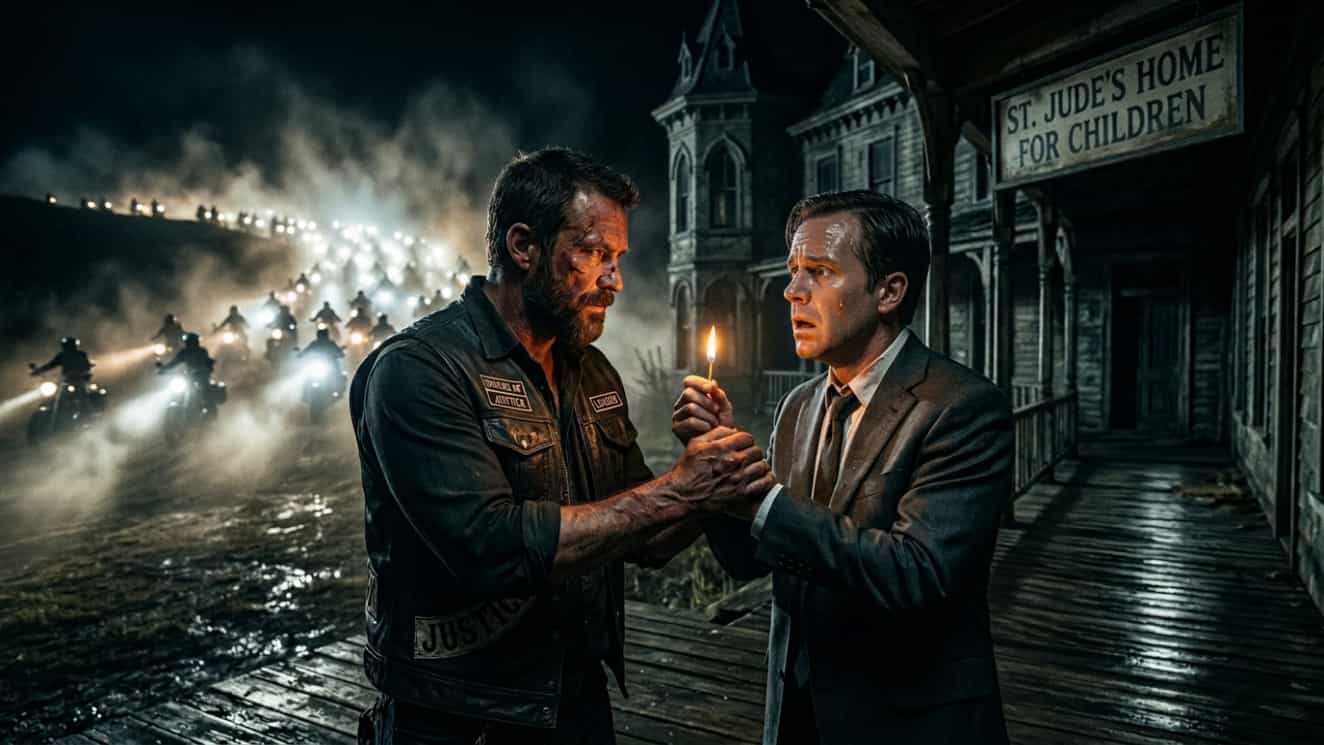
Vane pulled a box of wooden matches from his pocket. His hands were shaking, not from guilt, but from the adrenaline of a man who thinks he’s about to get away with murder. He struck the match. The flame flared bright, illuminating his greedy, sweat-slicked face.
I stepped out then. My boots didn’t make a sound on the gravel. I reached out and grabbed his wrist, my grip tight enough to make the bone groan. The flame was inches from his eyes, dancing in the reflection of his expensive glasses.
“”Burn this,”” I whispered, leaning close enough that he could smell the engine oil and old anger on my skin, “”and I promise you, Silas… you’ll burn with it.””
He looked at me, confused at first, then terrified. “”Thorne? You’re supposed to be in jail. I made sure of it.””
“”The thing about people like you, Silas, is that you forget about the people who actually keep this town running,”” I said. I looked up toward the ridge. “”Look up. Tell me what you see.””
He turned his head. On the horizon, a thousand pairs of headlights cut through the darkness all at once. The ground began to vibrate. The low, guttural growl of two thousand motorcycles and trucks echoed through the valley like the roar of a waking beast.
The match flickered out in his hand. But the real heat was just beginning.
“FULL STORY
Chapter 1: The Weight of Gasoline
The smell of gasoline is something you never quite get out of your clothes once it’s there. It’s heavy, cloying, and it promises a certain kind of finality. As I stood in the deep shadows of the Blackwood Home’s wraparound porch, watching Silas Vane douse the wood, I realized he wasn’t just trying to burn a building. He was trying to erase a hundred years of hope because it stood in the way of his next paycheck.
Silas was the kind of man who wore three-thousand-dollar suits to ribbon-cutting ceremonies for projects he’d already sabotaged. He had the smile of a predator and the heart of a ledger book. For twenty years, he’d run this county like his own personal fiefdom, and everyone—from the mayor to the local mechanics—knew you didn’t cross him if you wanted to keep your business or your freedom.
I had crossed him. Six months ago, I’d found the first discrepancy in the maintenance contracts for the orphanage. I’m just a guy who runs a shop at the edge of town, but I know how much a roof costs, and I knew Silas was charging the taxpayers triple and pocketing the difference. He’d tried to bury me for it. A planted bag of “”supplies”” in my garage, a quick arrest, and a “”warning”” from his pet deputies.
But I didn’t stay buried.
“”You’re making a mistake, Silas,”” I said, my voice cutting through the splashing sound of the fuel.
He jumped, the red plastic can slipping in his hands. He whirled around, fumbling for the matches. When he saw it was me, he didn’t run. That was his first mistake. He thought his title still protected him.
“”Dutch?”” he spat, trying to regain his composure. He wiped a bead of sweat from his forehead with his sleeve. “”You should be halfway to the state line if you had any sense. This place is a fire hazard. Everyone knows it. If it goes up tonight, it’s just a tragedy. A tragic accident that saves the county the cost of the demolition.””
“”The children are still inside the west wing,”” I said, my voice dangerously calm. “”Sister Mary is in the kitchen. You’re not just burning wood, Silas. You’re looking for a body count to make it look authentic.””
He sneered, his eyes darting to the ridge. “”Who’s going to stop me? The cops? I sign their checks. The neighbors? They’re all asleep, Dutch. They don’t care about a bunch of throwaway kids.””
That was the moment I grabbed him. His wrist felt thin, like a bird’s wing. I saw the flash of the match—that tiny, flickering spark that represented everything he was willing to destroy for his own comfort.
“”Look at the ridge, Silas,”” I commanded.
He looked. He saw the darkness. And then, he saw the light. One by one, then ten by ten, and finally by the hundreds, the headlights of the valley’s working men and women snapped on. The roar followed—a deep, rhythmic thrum of engines that shook the very foundation of the orphanage. It wasn’t the police. It was the people. The people who had been tired of his boots on their necks for two decades.
“”I didn’t come alone,”” I whispered. “”And they aren’t here to watch a fire. They’re here to see what happens to a man who tries to start one.””
Chapter 2: The Paper Trail of Blood
The story of how Silas Vane became the king of our small corner of the world started with a lie, as most stories of power do. Ten years ago, when the steel mill closed, the town was desperate. Silas stepped in with promises of “”urban renewal”” and “”infrastructure investment.”” We thought he was a savior. We didn’t realize he was a vulture.
Sarah, a soft-spoken social worker with eyes that had seen too much, was the one who first brought me the files. She came to my shop at midnight, her hands trembling as she handed me a manila envelope.
“”Dutch, I can’t go to the Sheriff,”” she had whispered, looking over her shoulder at every passing car. “”He’s Vane’s brother-in-law. But look at these numbers. The food budget for the orphanage has been cut by sixty percent in two years. The kids are eating gruel while Silas is buying a yacht in Florida.””
I spent three nights at my kitchen table, grease-stained fingers tracing the path of the stolen money. It was brilliant, in a sick way. He’d created a dozen shell companies, all of them “”consultants”” for the Blackwood Home. They were billing for repairs that were never made and staff that didn’t exist.
The most damning piece of evidence wasn’t the money, though. It was the land. Blackwood sat on a prime piece of real estate near the new interstate interchange. A developer wanted it for a luxury shopping mall, but the deed stated the land could only be sold if the orphanage was “”no longer viable.””
Vane wasn’t just stealing their food. He was planning to kill the institution itself.
I remember the day I confronted him in his office. He sat behind a mahogany desk that cost more than my house. He’d laughed in my face.
“”You’re a mechanic, Dutch. You fix engines. You don’t understand how the world works,”” he’d said, leaning back. “”People want that mall. They want the jobs and the tax revenue. Nobody cares about twenty kids who don’t have last names. Go back to your garage before you get grease on my carpet.””
That night, my shop was raided. Two weeks later, I was in a holding cell. They thought they’d broken me. But while I was sitting in that cell, the word was spreading. Every guy whose bike I’d fixed, every trucker I’d helped on the side of the road in a snowstorm, every mother whose car I’d kept running for pennies—they were listening.
Sarah had been moved to a different county, forced out of her job. But she’d left me one last thing: the location of the master ledger. Silas kept it at his house, but he was bringing it to the orphanage tonight. He wanted to see the evidence burn with the building. He wanted the satisfaction of watching his problems turn to ash.
But as he stood there in the gasoline-soaked grass, staring at the 2,000 headlights on the ridge, he realized that some things don’t burn so easily.
Chapter 3: The Silence Before the Storm
The tension in the air was so thick you could taste the ozone and the gas. Silas was hyperventilating now, the match long since extinguished, though I still held his arm. The roar of the engines hadn’t stopped; it was a constant, low-frequency growl that seemed to vibrate in my very teeth.
“”You think this changes anything?”” Silas hissed, though his voice lacked its usual bite. “”This is a mob. You’re leading a mob, Thorne. I’ll have the National Guard down here by morning. I’ll have every one of those bikers in chains.””
“”They aren’t a mob, Silas,”” I said. “”They’re witnesses.””
A figure stepped out from the lead truck on the ridge. It was Marcus, a man I’d served with in the 101st. He was holding a megaphone.
“”Commissioner Vane!”” Marcus’s voice boomed, amplified and echoing off the valley walls. “”We’ve got the live stream running. Five different platforms. Forty thousand people are watching you hold that gas can right now. Say hello to the voters.””
Vane looked at the ridge, then down at the red can at his feet. His face turned a ghostly shade of grey. In the digital age, a secret only stays a secret if nobody is looking. We had made sure the whole world was looking.
Suddenly, the front door of the orphanage creaked open. Sister Mary stepped out, her face lined with years of hard work and prayer. She looked at the gas on the porch, then at Silas. Behind her, the small, pale face of Leo, a six-year-old who had lost his parents in a car wreck a year ago, peered out from behind her habit.
“”Mr. Vane,”” Sister Mary said, her voice steady and clear. “”I believe you dropped something.””
She held up a small, leather-bound book. The ledger.
Silas lunged for it, momentarily forgetting I was holding him. I let him go, but I tripped him as he moved. He landed face-first in the gasoline-soaked grass. He scrambled up, his expensive suit ruined, smelling of fuel and failure.
“”That’s mine!”” he screamed. “”That’s private property!””
“”It’s evidence of grand larceny and attempted arson,”” I said, stepping between him and the Sister. “”And it’s been scanned and uploaded to three different servers in the last hour. You’re done, Silas. The only thing left to decide is how you want to leave.””
Vane looked around. The circle of people was closing in. The bikers were dismounting, walking down the hill in a slow, silent wave. The headlights stayed on, illuminating the scene like a stadium. He was a trapped animal, and for the first time in his life, his money couldn’t buy him a way out.
Chapter 4: The Truth in the Timber
The next hour felt like a slow-motion blur. The local deputies arrived, but they didn’t come to save Silas. They came because they had no choice. With 2,000 witnesses and a live internet feed, even Vane’s brother-in-law couldn’t protect him.
Sheriff Miller, a man who had looked the other way for far too long, stepped out of his cruiser. He looked at me, then at the ruined man shivering in the grass.
“”Dutch,”” Miller said, his voice tired. “”You could have just called me.””
“”I did, Miller. Three months ago. You told me to mind my own business,”” I reminded him.
The Sheriff looked down at his boots, then walked over to Vane. He didn’t use the gentle touch he usually reserved for his benefactors. He pulled Vane’s hands behind his back and clicked the cuffs shut. The sound was small, but to the people on the ridge, it was as loud as a gunshot.
A cheer didn’t go up. Instead, there was a profound, heavy silence. It was the silence of a fever breaking.
As they led Vane away, he passed by Leo, the young boy who was still standing on the porch. Vane stopped for a second, his eyes filled with a desperate, lingering hatred.
“”You’ll still lose the house, kid,”” Vane spat. “”The debt is real. The bank doesn’t care about ledgers.””
I walked over and put a hand on Leo’s shoulder. The boy was shaking, but he didn’t look away from the man who had tried to burn his world down.
“”The debt is gone, Silas,”” I said. “”One of the people on that ridge is a lawyer who specializes in forensic accounting. He found the ‘insurance’ policy you took out on this place. Between that and the civil suit for the embezzled funds, Blackwood is going to be the best-funded orphanage in the state.””
I watched the patrol car pull away, its red and blue lights fading into the distance. The 2,000 engines began to start up again, but the sound was different now. It wasn’t a growl; it was a salute. One by one, the lights on the ridge turned and began the long trek back down into the valley.
Sarah appeared from the crowd, her eyes red from crying. She hugged Sister Mary, then turned to me.
“”We did it, Dutch. We actually did it.””
“”No,”” I said, looking at the old Victorian house, still standing, still smelling of gas but safe. “”They did it. I just held the match.”””