“CHAPTER 5: THE RECKONING
The night was thick with the scent of impending rain. The streets of Oakhaven were eerily quiet, the kind of silence that precedes a storm. But this storm wouldn’t be coming from the clouds.
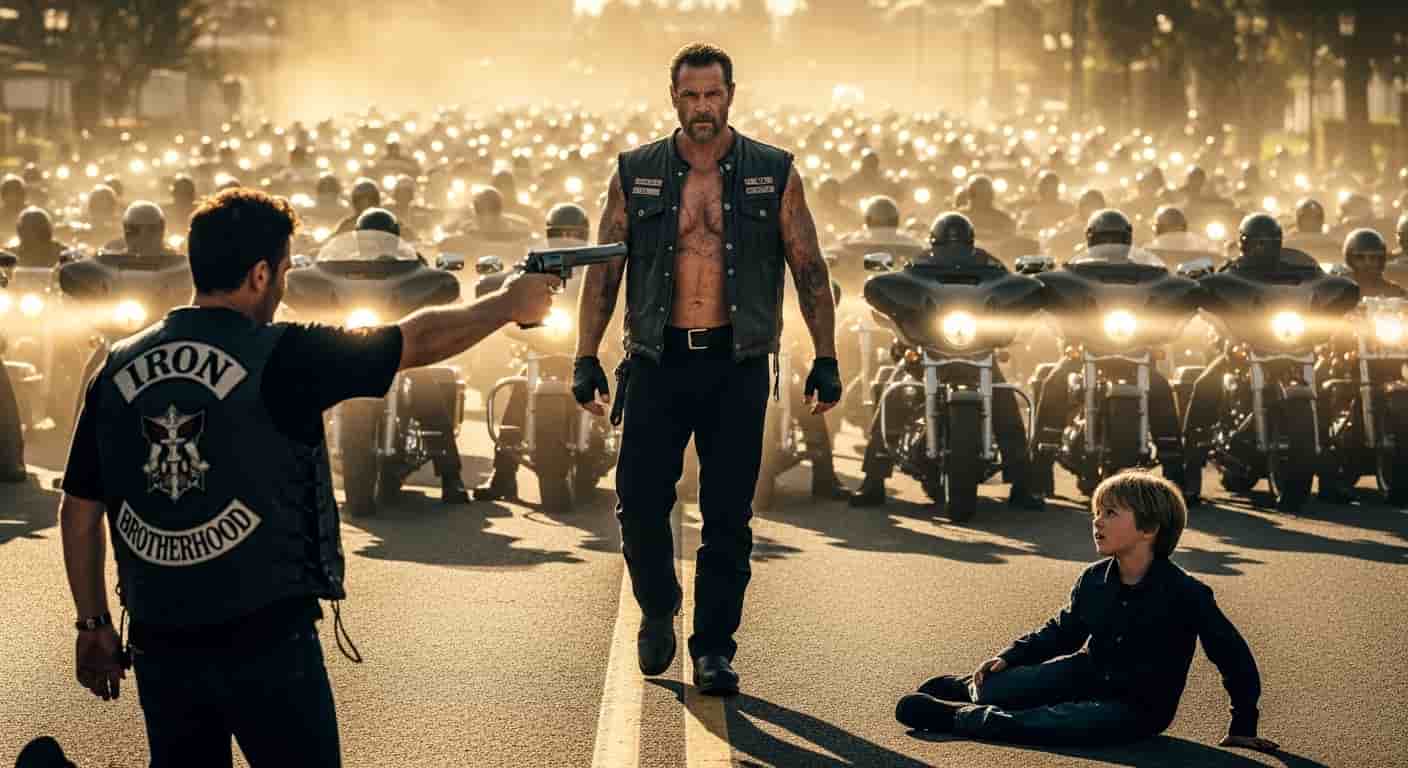
We met at the trailhead outside of town. Two thousand bikes. No lights. Just the low, rhythmic hum of engines that sounded like a collective growl.
“”The plan is simple,”” I told the gathered crowd, my voice amplified by the PA system. “”We don’t use violence unless they do. We are the witnesses. We are the evidence. Ghost has hacked the city’s digital billboards. In ten minutes, every screen in Oakhaven will show the bank transfers and the photos of Marcus Thorne handing that gun to Caleb.””
“”And what about Sterling?”” Mike asked, his hand resting on his hip.
“”He’s at the Town Hall tonight, trying to push through the final vote on the development. We’re going to give him an audience he didn’t invite.””
We rode in formation. A silent, black tide flowing through the suburbs. We didn’t rev our engines. We didn’t shout. We were a ghost fleet, moving with a purpose that felt older than the town itself.
As we reached the Town Hall, the digital billboards across the street flickered. The usual ads for jewelry and luxury cars vanished, replaced by a grainy photo of Marcus Thorne in an alleyway, handing a .45 to a terrified Caleb. Below it, in bold red letters: THE PRICE OF PROGRESS? AN ORPHAN’S LIFE.
The crowd outside the Town Hall—mostly protesters and local media—gasped. Cell phones were whipped out. The image went viral in seconds.
Inside the building, through the large glass windows, I could see Sterling standing at the podium. He saw the screens. His face went from smug to ghostly white in a heartbeat.
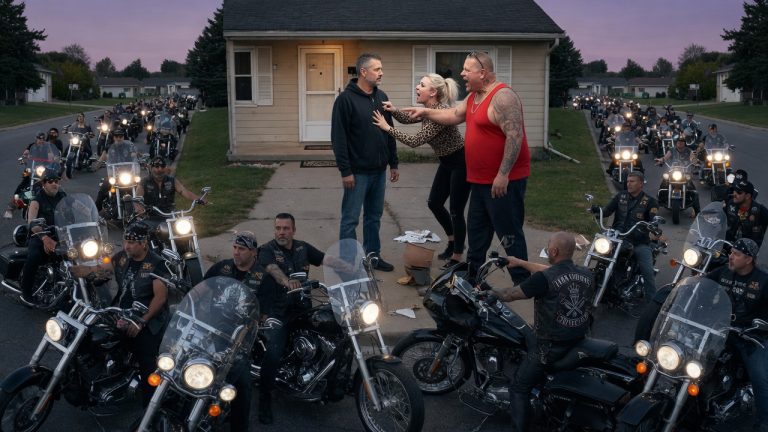
We pulled up to the curb, two thousand strong. We didn’t get off our bikes. We just sat there, our engines idling, a rhythmic thump-thump-thump that vibrated the windows of the hall.
Marcus Thorne and three other suits tried to exit through the side door. They were met by a wall of leather.
“”Going somewhere?”” Big Mike asked, his massive frame blocking the path.
Thorne reached for his jacket, but he was too slow. Two bikers grabbed his arms, pinning him against the wall.
“”Don’t,”” I said, walking up to him. “”There are a hundred cameras on you right now, Thorne. If you pull a weapon, you’ll be dead before you hit the ground, and it’ll be the most-watched video in history.””
Thorne spit at my feet. “”You think this changes anything? Sterling has the city in his pocket.””
“”Not anymore,”” I said. “”The city is watching. And the city doesn’t like it when you mess with their kids.””
Just then, Officer Miller pulled up in his cruiser. He looked at the billboards, then at me, then at Thorne. He didn’t look like a suburban cop anymore. He looked like a man who was tired of the lies.
“”Marcus Thorne,”” Miller said, stepping out with his handcuffs drawn. “”You’re under arrest for conspiracy, endangerment, and about a dozen other things I’m going to think of on the way to the station.””
Sterling came running out of the hall, his tie loosened, his eyes wild. “”This is a setup! This is harassment by a criminal gang!””
I stepped in front of him. I was taller, broader, and I carried the weight of a truth he couldn’t understand.
“”We’re not a gang, Sterling,”” I said. “”We’re a brotherhood. And we protect our own. That orphanage? It’s our own. Those kids? They’re our own. And you? You’re just a man who forgot that some things aren’t for sale.””
Sterling looked around at the two thousand bikers. He looked at the cameras. He looked at the people of Oakhaven who were starting to cheer. He realized his empire was crumbling into the asphalt.
“”You’ll pay for this, Miller,”” he hissed.
“”I’ve already paid,”” I said, thinking of the bullet wound in my shoulder and the hole in my heart where Toby used to be. “”And I’m debt-free.””
As the police led Sterling and Thorne away, the atmosphere changed. The tension broke, replaced by a sense of victory that felt like a cool breeze.
I sat on the steps of the Town Hall, my body suddenly feeling every bit of its forty-five years. Big Mike sat down next to me.
“”We did it, Jax,”” he said.
“”Yeah. We did.””
“”What now?””
I looked toward the East Side, where St. Jude’s was nestled among the trees. “”Now, I go see a boy about a motorcycle.””
I rode back to the orphanage. The “”Ride for the Forgotten”” was officially over, but for me, it was just beginning.
I found Leo in the same spot I’d left him. He was looking at the gate, waiting. When he saw my bike, he didn’t just walk. He ran. He threw his arms around my waist and squeezed so hard I could barely breathe.
“”You came back,”” he whispered.
“”I told you I would, buddy. I’m always going to come back.””
I looked up to see Sister Mary standing in the doorway. She was crying, but she was smiling.
“”The board just called,”” she said. “”The development is dead. The land is being deeded to the orphanage permanently. We’re safe, Jax. Because of you.””
“”Not because of me,”” I said, looking at the boy in my arms. “”Because of him.””
That night, for the first time in five years, I didn’t dream of the accident. I didn’t dream of the silence. I dreamt of the road. A long, winding road where the sun never set, and the sound of two thousand engines was the only lullaby a man ever needed.
CHAPTER 6: THE FINAL RIDE HOME
Six months later, Oakhaven was a different town. The high-rise condos were never built. Instead, the “”Iron Brotherhood Community Center”” was nearing completion right next to St. Jude’s. It was a place for kids to learn trade skills, for veterans to find a community, and for anyone who felt forgotten to find a home.
Caleb was there, too. He’d taken a plea deal—three years in a low-security facility with the possibility of early release if he stayed on the straight and narrow. I visited him every month. He was studying for his GED and working in the prison garage. He looked healthy. He looked like a man with a future.
But the biggest change was in my own house.
It wasn’t silent anymore.
The paperwork had been grueling. The background checks, the home visits, the endless interviews with social workers who were skeptical of a “”biker”” adopting a child. But Sister Mary had fought for me. Big Mike had fought for me. Even Officer Miller had written a letter of recommendation that would have made a saint blush.
I stood in the driveway, watching Leo try to ride a bicycle with training wheels. He was determined, his tongue poking out of the corner of his mouth as he pedaled furiously.
“”Keep your eyes up, Leo!”” I called out. “”Look where you want to go, and the bike will follow.””
He nodded seriously and steered straight into a rose bush. He tumbled off, but he didn’t cry. He just got up, dusted off his jeans, and looked at me.
“”I’m okay, Dad!””
The word still sent a jolt of electricity through my soul. Dad. It was a title I thought I’d lost forever, a privilege I’d assumed was revoked the day Toby died. But Leo had given it back to me. He had taken the shards of my broken life and helped me glue them back together, one silent moment at a time.
We were leaving today for the annual “”Ride for the Forgotten.”” But this time, I wasn’t riding alone.
I had installed a sidecar on my Heritage Softail. It was painted a brilliant, shimmering blue—Leo’s favorite color. It had a small Iron Brotherhood patch on the side and a custom seat that was as comfortable as a cloud.
“”Ready to go, buddy?”” I asked, handing him a small leather vest that matched mine. It had his own patch on the back: Little Brother.
Leo beamed, pulling the vest on with pride. He hopped into the sidecar and buckled his helmet.
As we pulled out of the driveway, I saw the “”Wall of Steel”” waiting for us at the end of the block. Two thousand bikers. But they weren’t just a wall anymore. They were an escort.
Big Mike was at the front, his bike idling with a deep, rhythmic thrum. He saw us and raised a fist in the air. A roar of two thousand engines answered him, a sound that shook the very foundations of Oakhaven.
We rode through the town square. People lined the streets, not in fear, but in celebration. They waved, they cheered, and they held up signs that said “”WE PROTECT OUR OWN.””
As we hit the open highway, the wind whipping past us and the sun warming our backs, I looked over at Leo. He was leaning out of the sidecar, his hand slicing through the air like a wing, a look of pure, unadulterated joy on his face.
I realized then that life isn’t about the scars you carry or the mistakes you’ve made. It’s not about the things you’ve lost or the silence that follows.
It’s about the people who stand with you when the world turns cold. It’s about the brotherhood you build from the ashes of your grief. And it’s about the one person who looks at you and sees a hero, even when you only see a ghost.
I reached out and squeezed Leo’s hand for a second before returning both hands to the handlebars.
The road ahead was long, and there would undoubtedly be more storms to weather. But as I looked at the sea of chrome and leather stretching out as far as the eye could see, I knew we would be okay.
Because I wasn’t just a biker anymore. I wasn’t just a ghost. I was a father.
And in the end, that is the only wall of steel that truly matters.
I once thought my heart was a graveyard, but a silent boy and two thousand brothers showed me it was actually a fortress.”