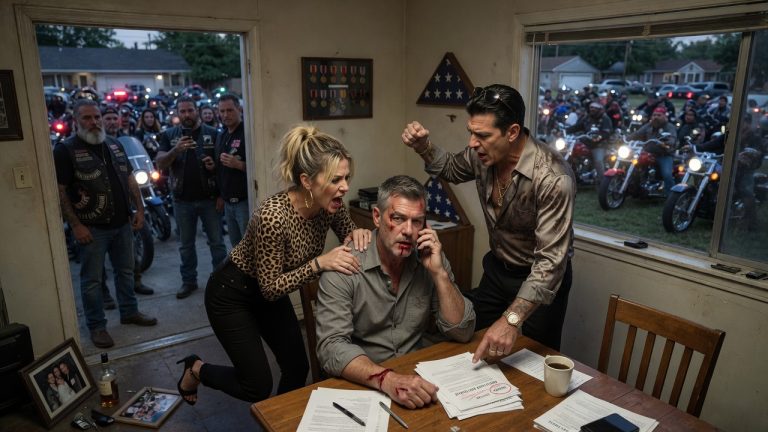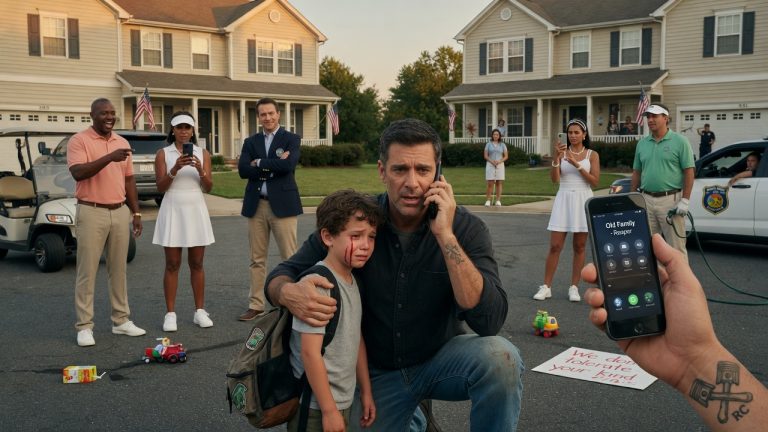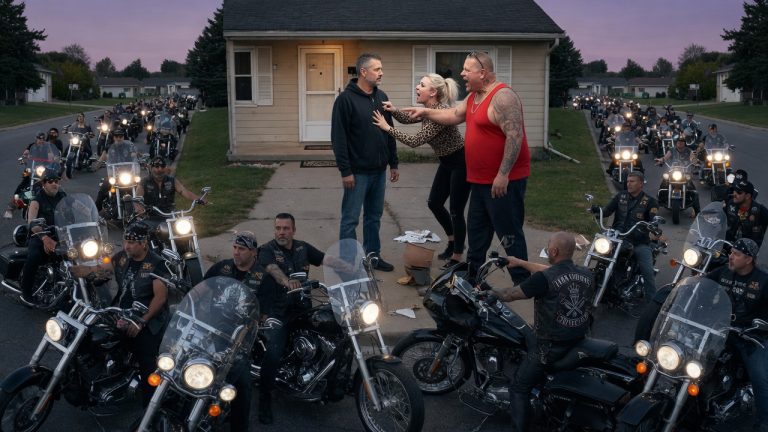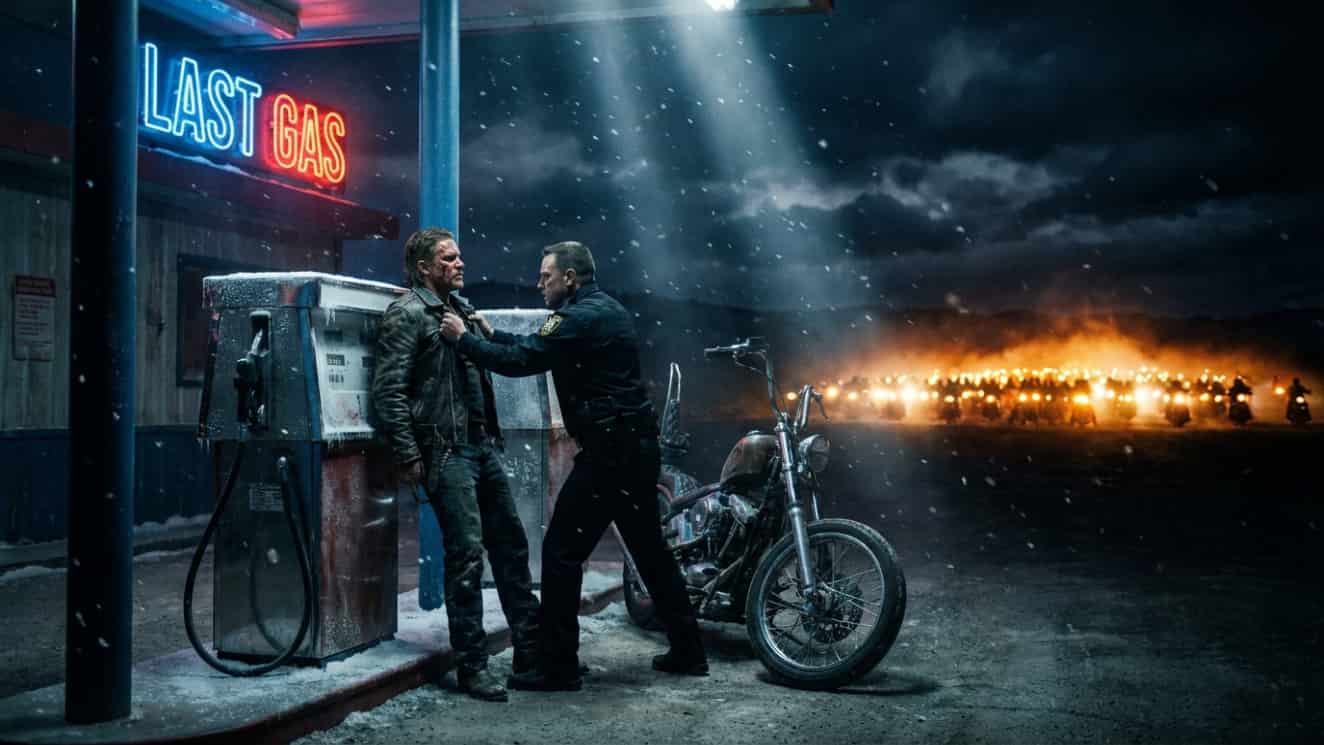
The wind in Oak Creek was the kind of cold that found the gaps in your leather and bit straight through to the bone. I didn’t mind it. I’d survived worse than a Montana winter.
I was just standing there, waiting for my coffee at the gas station, minding the business of a man who’d seen too much of the world. My bike, a custom Shovelhead that had been my only constant for twenty years, sat idling by the pump.
Then came the red and blue lights.
Officer Miller didn’t just pull up; he staged an invasion. He hopped out of his cruiser like he was storming a beach, his hand already resting on his sidearm. He didn’t see a man. He saw the leather, the faded patches of the Iron Sentry MC, and the jagged, silver scars that mapped the left side of my face from my jaw to my temple.
“”Hands where I can see ’em, ‘Reaper,'”” he spat, reading the road name on my chest. “”We don’t like your kind of garbage cluttering up our streets. This is a family neighborhood.””
I didn’t move fast. When you’ve been through what I have, you don’t move fast for anyone. I just looked at him. “”Just getting coffee, Officer. Then I’m on my way.””
“”You’re on your way to a cell if you don’t keep that mouth shut,”” he barked. He stepped into my personal space, the smell of cheap peppermint and arrogance rolling off him. He looked at my face, at the twisted skin that I’d earned in a burning Humvee outside Fallujah, and he laughed.
“”Look at that. Those aren’t war wounds. Those are the marks of a man who lives in the gutter. Probably got into a knife fight over a bag of meth, didn’t you?””
He reached out and shoved me. Hard. My back hit the cold metal of the pump.
“”Crawl back to whatever hole you came from,”” he hissed. “”Before I make sure you never walk again.””
He thought he was big. He thought he was the law. But Miller made one mistake. He thought I was alone.
I reached into my pocket, real slow, and pulled out my phone. I didn’t call a lawyer. I didn’t call the station. I hit a single button. The “”Gathering”” signal.
“”You’ve got an hour, Miller,”” I said, my voice as steady as a graveyard. “”Enjoy the silence while it lasts.””
“FULL STORY
Chapter 1: The Weight of Chrome and Scars
The air in Oak Creek didn’t just feel cold; it felt sterile. It was the kind of town where the lawns were manicured to the millimeter and the secrets were buried under layers of expensive mulch. I stood at the Shell station on the edge of the suburb, the heat from my coffee cup the only thing keeping my fingers from numbing.
My bike, a 1978 Shovelhead I’d rebuilt with my own two hands after the war, was ticking as it cooled. It was loud, it was black, and it looked like a bruise on the pristine white face of this town. I knew I didn’t fit here. I wasn’t trying to. I was just passing through on my way to the National Run in Sturgis.
Then the cruiser pulled in.
Officer Miller was a man who clearly loved his reflection. He was younger than me, maybe late thirties, with a build that suggested he spent more time at the gym than on the beat. He didn’t just park; he blocked my bike in.
“”License and registration,”” he said before he was even fully out of the car.
I sighed, the steam from my breath mixing with the exhaust. “”Is there a problem, Officer?””
“”The problem is you,”” Miller said, swaggering toward me. He didn’t look at my license. He looked at my vest. The Iron Sentry MC patch—a skull holding a shield—was a trigger for men like him. To him, it meant ‘criminal.’ To me, it meant the twelve men I’d pulled out of a burning wreckage in 2004.
“”We’ve had reports of ‘suspicious activity’ in the area,”” Miller lied. His eyes drifted to the left side of my face. I saw the familiar flicker of disgust. The scars are deep. They aren’t pretty. They pull at the corner of my eye and make my smiles look like snarls.
“”Suspicious activity? Like buying a dark roast?”” I asked quietly.
Miller’s face flushed. He didn’t like the tone. He liked people to tremble. “”Don’t get smart with me, Drifter. Those scars… what’d you do? Piss off the wrong dealer? Or did your ‘brothers’ decide you weren’t pretty enough for the clubhouse?””
He stepped closer, his chest inches from mine. He was trying to provoke me. He wanted me to swing. He wanted a reason to use the baton hanging from his belt.
“”I got these serving this country,”” I said, my voice dropping an octave. “”While you were probably bullying kids in high school.””
That was the breaking point. Miller lunged, grabbing me by the throat and slamming me against the gas pump. The coffee cup fell, splashing brown liquid across my boots. He leaned in, his breath hot against my ear.
“”I don’t care if you’re a veteran or a saint,”” he whispered. “”In this town, you’re a freak. You’re a stain on my sidewalk. If I see you here in sixty minutes, I’m going to lock you up and lose the key. And maybe, just maybe, I’ll give you a few more scars to match the ones you already have.””
He let go, shoving me one last time. He walked back to his cruiser, laughing with his partner, a young kid named Leo who looked like he wanted to be anywhere else.
I stood there for a long moment, the hum of the town ringing in my ears. I could have ridden away. I could have taken the insult and moved on. But I looked at my vest—the colors that my brothers had bled for—and I knew I couldn’t.
I pulled out my phone. I opened the encrypted app used by the Sentry.
Code Black. Oak Creek Shell. All Chapters. Full Colors.
I hit send. Then I sat down on the curb, lit a cigarette, and waited.
FULL STORY
Chapter 2: The Ghost of Fallujah
As I sat on that cold curb, the pain in my face began to throb. It always did when the temperature dropped. Most people see a scar and think of a moment of violence. I see a face I can’t recognize in the mirror.
I closed my eyes and I wasn’t in Oak Creek anymore. I was back in the sand.
The IED had been buried deep. We never stood a chance. The Humvee had flipped, the fuel line ruptured, and suddenly the world was orange and screaming. I remember the smell of burning hair and the sound of Silas—my Sergeant back then, my VP now—screaming for help.
I had been the driver. I was out, but they were trapped. I didn’t think. I just went back. Three times. The fire licked at my face, melting the skin, searing the memory into my bone. I got them out. All of them.
When I finally woke up in Landstuhl, the doctors told me I was a hero. They gave me a Purple Heart and a Bronze Star. But when I got home to the States, nobody saw the medals. They only saw the “”freak.””
That’s why the Iron Sentry started. We were all ‘freaks.’ We were all men and women who had given everything to a country that didn’t know how to look us in the eye anymore. We found our own country on two wheels.
“”Hey! I thought I told you to move!””
Miller’s voice snapped me back to the present. He was standing by his cruiser, fifty yards away, shouting through his megaphone. He was enjoying this. A few residents from the nearby townhomes had gathered on their balconies, watching the “”show.””
I didn’t move. I just took another drag of my cigarette.
“”That’s it,”” Miller muttered. I could see him reaching for his zip-ties. He started walking toward me, his pace purposeful. “”You’re resisting a direct order. You’re going down, Scarface.””
His partner, Leo, stepped out of the car. “”Sir, maybe we should just let him go? He’s not doing anything.””
“”Shut up, Leo,”” Miller snapped. “”This is how you keep a town clean. You remove the trash.””
Miller was ten feet away when the sound started.
It wasn’t a roar. Not yet. It was a vibration. A low-frequency hum that seemed to come from the very earth itself. The windows in the gas station convenience store began to rattle. A display of oil cans inside tipped over.
Miller stopped. He looked around, confused. “”What the hell is that? Is that a plane?””
I stood up, flicking my cigarette butt into the puddle of my spilled coffee. I checked my watch. Forty-five minutes. They were early.
“”That’s not a plane, Miller,”” I said, a grim smile tugging at my scarred cheek. “”That’s the sound of 1,500 engines. And they’re all coming to see you.””
The horizon at the end of the main road suddenly turned to fire as a thousand high-beams rounded the corner, cutting through the dusk like the eyes of a vengeful god.
FULL STORY
Chapter 3: The Iron Tide
It started with a single bike. Silas “”Hog”” Vance, a man built like a brick house with a beard down to his chest, led the pack. Behind him, the road disappeared under a sea of black leather and gleaming chrome.
They didn’t come in screaming. They came in with a disciplined, military precision that was far more terrifying than any chaotic gang. They filled all four lanes of the boulevard. The sound was deafening—a physical weight that made it hard to breathe.
Miller’s hand went to his gun, but he didn’t draw. He couldn’t. There were too many. He looked like a man trying to stop a tidal wave with a plastic bucket.
Silas pulled his massive Road King right up to the gas pump, inches from Miller. He kicked the kickstand down, the metal scraping the asphalt with a sharp clink. One by one, the bikes behind him did the same. The silence that followed when the engines cut out was even louder than the roar.
“”Reaper,”” Silas said, nodding to me. He ignored Miller entirely. “”You okay?””
“”I’m fine, Silas. Just had a little trouble with the local hospitality,”” I said.
Silas looked at Miller. Silas was six-foot-four and 280 pounds of pure muscle. He didn’t need a badge to be intimidating. “”This the one?””
Miller tried to find his voice. “”This… this is an illegal assembly! I’m ordering you all to disperse! Now!””
His voice cracked at the end. It was pathetic.
From the crowd of bikers, a woman stepped forward. This was Sarah, a former JAG officer and our club’s legal counsel. She was wearing her colors, but she carried a leather briefcase.
“”Actually, Officer Miller,”” she said, her voice clear and ringing in the quiet night. “”Under the First Amendment, this is a peaceful gathering in a public space. We are simply here to support a brother. Unless you’re planning on arresting 1,500 people for standing on a sidewalk?””
“”He threatened me!”” Miller shouted, pointing at me. “”He said I had an hour!””
“”I said you had an hour to enjoy the silence,”” I corrected him. “”And the hour’s up.””
By now, the suburbs were wide awake. People were standing on their lawns, filming on their phones. This wasn’t a hidden incident anymore. The world was watching.
Miller’s partner, Leo, had retreated to the cruiser and was frantically talking into his radio. He knew what Miller didn’t: this wasn’t a street fight. This was a siege of conscience.
“”Get off my property,”” Miller hissed, though he was backing away.
“”We aren’t on your property,”” Silas said. “”Yet. But we heard you had a real interest in Jax’s scars. We thought we’d come down and tell you the story of how he got them. Since you’re so fond of ‘keeping the town clean,’ we thought you’d like to know about the man who kept you safe while you were home sleeping.””
Silas pulled a heavy, velvet box from his saddlebag. He didn’t give it to me. He held it up so the neighbors—and the cameras—could see. Inside was the Silver Star.
“”He’s not a drifter,”” Silas shouted to the crowd of onlookers. “”He’s the man who walked into a burning grave to save my life! And this ‘officer’ just told him he belongs in the gutter!””
A murmur went through the crowd of neighbors. The narrative was shifting, and Miller could feel the ground slipping out from under him.
FULL STORY
Chapter 4: The House on Willow Lane
Miller tried to retreat. He got back into his cruiser, his face a mask of sweating fury. “”This isn’t over!”” he yelled over the PA system. “”Clear the road!””
But the bikes didn’t move. They formed a corridor, a silent, iron-walled path that led only one way: toward the heart of the suburb.
“”Where are you going, Miller?”” I called out. “”Going home? To 124 Willow Lane? The house with the white picket fence and the ‘Back the Blue’ sign in the yard?””
Miller froze. His eyes went wide. “”How do you know where I live?””
“”We’re the Iron Sentry,”” Silas said simply. “”We have members in the DMV, the utility companies, and the pentagon. We know everything. And we think your neighbors should know who they’re living next to.””
We didn’t use violence. We didn’t need to.
As Miller’s cruiser slowly pushed through the crowd to head home, 1,500 motorcycles followed him. We didn’t honk. We didn’t rev. We just rode at a walking pace, a funeral procession for a career that was about to die.
We arrived at Willow Lane ten minutes later. It was a beautiful street. Miller pulled into his driveway, his wife standing in the front door, clutching a robe to her chest, her face pale with terror.
“”Stay inside, Diane!”” Miller yelled, jumping out of the car.
We didn’t step on his grass. We didn’t touch his fence. We simply lined the street. Three rows deep, for three blocks in either direction. 1,500 men and women in black leather, standing silently under the streetlights, looking at his house.
The Mayor of Oak Creek, a man named Henderson who had built his reputation on “”safety and values,”” pulled up in a black SUV five minutes later. He looked like he wanted to vomit.
“”What is the meaning of this?”” Henderson demanded, approaching me and Silas.
“”The meaning, Mr. Mayor,”” Sarah said, stepping forward with her briefcase, “”is that one of your officers has been systematically profiling and harassing veterans and minorities under the guise of ‘neighborhood watch.’ We have three years of dashcam footage, civilian complaints, and internal memos that your department ‘lost.’ We were going to file a quiet lawsuit.””
She looked at Miller, who was standing on his porch, looking smaller by the second.
“”But then he touched our President,”” Sarah continued. “”He mocked the scars he earned in service to this country. So now, we aren’t being quiet. We’re going to stay right here, on this public street, until Officer Miller is relieved of his duties.””
“”You can’t do this!”” Henderson squeaked.
“”We can,”” I said, stepping forward. I took off my sunglasses, letting the harsh streetlights hit my scarred face. “”And we have enough supplies in those saddlebags to stay for a month. How do you think the property values on Willow Lane will look after a week of this?”””