CHAPTER 1
The smell of horse manure and wet straw was the only thing that kept the ghosts at bay.
Elias Thorne pushed the heavy wheelbarrow through the Saratoga stables, his breath hitching in his chest. At sixty-two, his joints screamed every time the temperature dropped below fifty, a parting gift from a decade spent in the mountains of the Hindu Kush. He didn’t mind the pain. Pain was honest. Pain was a reminder that he was still on the right side of the dirt.
“Hey, Leech! I’m talking to you!”
Elias didn’t look up. He knew that voice. Julian Vane was twenty-four, the son of the track’s wealthiest owner, and a man who had never spent a day in a pair of boots he hadn’t paid someone else to polish. Julian stood by the stall of ‘Midnight Ghost,’ a prize-winning stallion that Elias cared for with a tenderness he didn’t show himself.
“The stalls are still damp, Thorne,” Julian sneered, slapping a leather riding crop against his thigh. “What am I paying you for? To daydream about your glory days? Or are you just too old to move a shovel?”
Elias kept his head down, his eyes fixed on the muddy floor. “I’ll give them another pass, Mr. Vane. The humidity makes the straw heavy.”
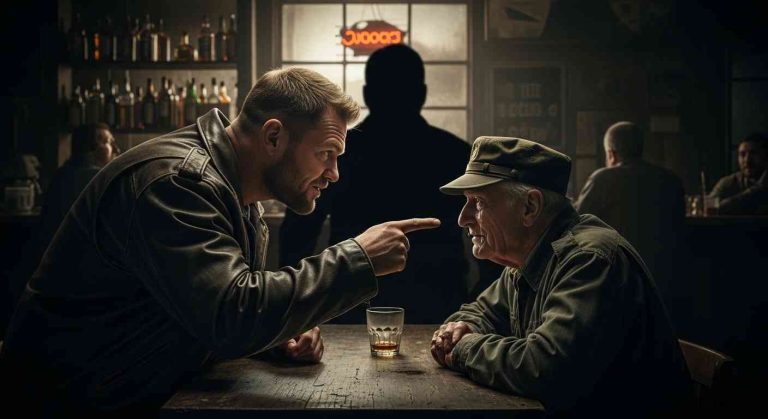
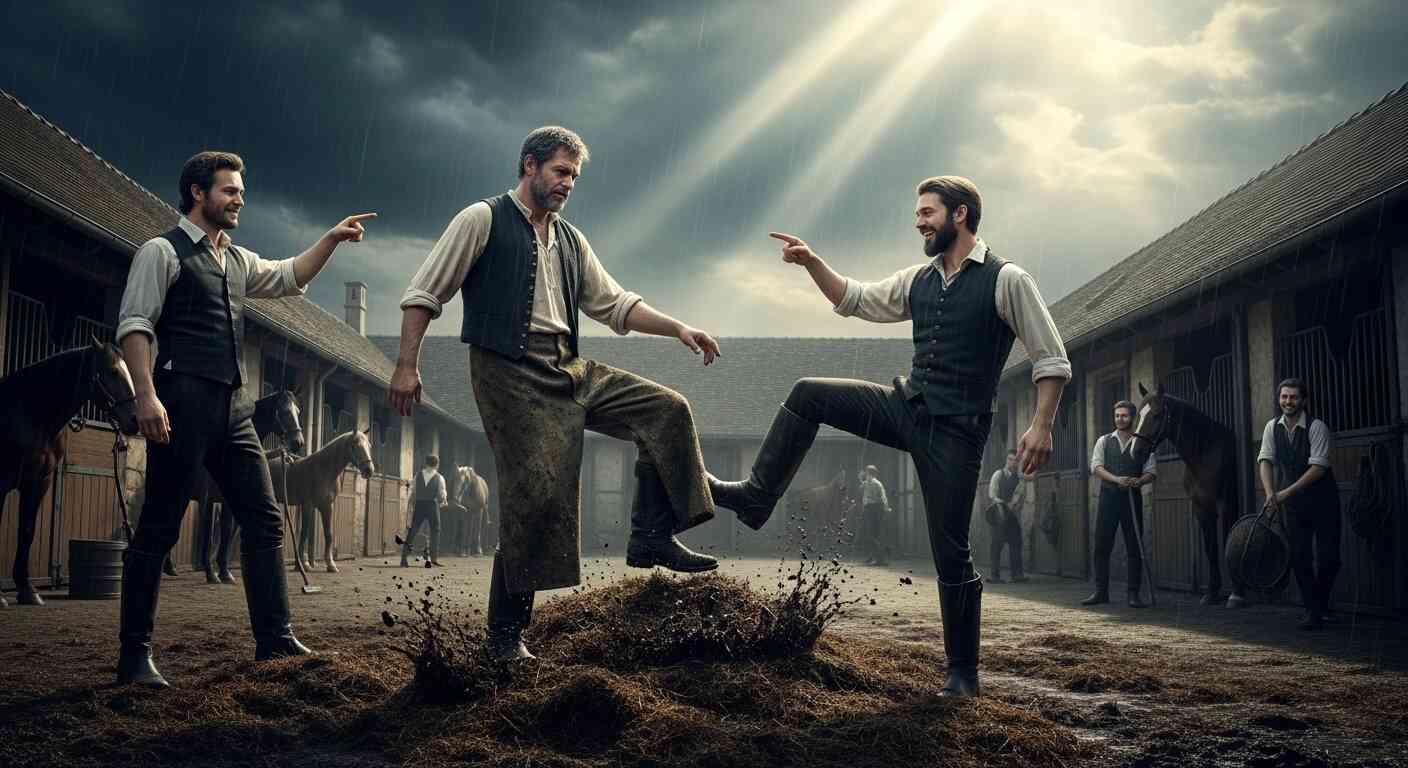
“Excuses are for losers,” Julian snapped. He stepped forward, his expensive Italian loafers splashing in the muck. Behind him, two of his sycophantic friends chuckled. “My father keeps you here out of some misplaced sense of charity for ‘the troops,’ but let’s be real. You’re a bottom-feeder. A drain on the payroll. You’re a leech, Elias. You suck the life out of this stable.”
Elias felt the familiar heat rising in his neck. It wasn’t anger—not exactly. It was the old instinct, the one that told him to find the nearest exit, identify the threat, and neutralize it in three moves. But he pushed it down. He had buried that man in a shallow grave in Virginia years ago.
“I just want to work, sir,” Elias said quietly.
“Then work!” Julian shouted. He swung the riding crop, not at the horse, but at Elias’s legs. The leather bit through the worn denim of Elias’s jeans, stinging the skin.
Elias flinched but didn’t fall. He stood there, a tall, gaunt man with a silver buzz cut and a face like a roadmap of American conflicts, taking the insult.
“Look at him,” Julian laughed, turning to his friends. “No fight left. Just a broken old dog. Hey, Thorne, you want to see what a real thoroughbred looks like?”
Before Elias could react, Julian grabbed a bucket of icy, grey wash water sitting by the stall door. With a smirk, he hurled the contents directly into Elias’s face.
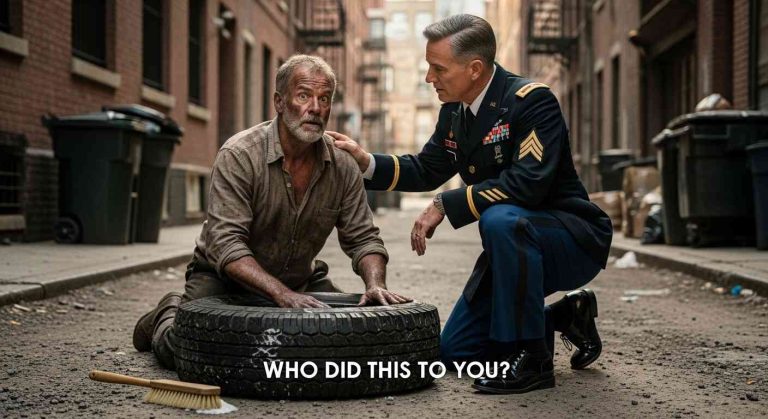
The shock of the cold hit like a physical blow. Elias stumbled back, his boots slipping on the slick concrete. He went down hard, his hands plunging into the filth of the drainage gutter. The world blurred—the smell of the mud, the sound of Julian’s high-pitched laughter, the stinging in his eyes. For a split second, he wasn’t in New York. He was in a ditch in Fallujah, the sound of mortar fire ringing in his ears.
“Stay there, Thorne,” Julian spat, looking down at him. “The mud is where you belong. It suits you.”
Elias stayed down. Not because he couldn’t get up, but because he was counting. One. Two. Three. He was waiting for the roar in his head to stop. He didn’t see the young groom, Sarah, running over with a towel, her eyes wide with horror. He didn’t hear the gasps of the other workers.
What he heard instead was a sound that didn’t belong at a racetrack.
A low, rhythmic thumping. A vibration in the soles of his feet that grew into a chest-rattling roar. The horses began to whinny in terror, kicking at their stall doors. The wind picked up, swirling hay and dust into a blinding cyclone.
Julian looked up, his arrogance instantly replaced by confusion. “What the hell is that? Is that a storm?”
But it wasn’t a storm.
High above the pristine green turf of the Saratoga infield, a shadow descended. A matte-black MH-60M Black Hawk, bristling with sensors and refueling probes, dropped out of the low clouds like a bird of prey. It didn’t head for the airport. It headed straight for the mud-slicked paddock where a broken old man sat in the dirt.
The world was about to find out that the man they called a leech was the only reason they were allowed to stand on that ground at all.
“FULL STORY
Chapter 2: The Ghost of Kandahar
The wind from the helicopter’s rotors was a physical force, flattening the manicured hedges and sending Julian’s expensive silk tie flapping wildly around his neck. He shielded his eyes, stumbling back against the stable wall.
“”What is this?”” Julian screamed over the roar, though no one could hear him. “”They can’t land that here! This is private property!””
Elias Thorne didn’t move. He sat in the mud, the cold water dripping from his chin, watching the black beast hover just twenty feet above the grass. He knew the tail number. He knew the pilot. Most of all, he knew why they were here. He had felt the “”itch”” in his thumbs for three days—the phantom sensation he always got before a call to action. He had ignored it, hoping it was just arthritis. He had been wrong.
As the Black Hawk touched down, its wheels sinking slightly into the turf, the side doors slid open. Four men in Multicam fatigues, wearing Ops-Core helmets and carrying suppressed carbines, fast-roped to the ground with practiced, lethal efficiency. They moved in a diamond formation, clearing the area with a speed that made the racetrack security guards freeze in their tracks, their cheap holsters feeling suddenly very heavy.
Julian, ever the entitled fool, tried to step forward. “”Hey! You’re ruining the track! Who’s in charge here?””
One of the soldiers, a man built like a brick wall with a jagged scar running through his eyebrow, stepped into Julian’s path. He didn’t say a word. He just shifted his rifle to a low-ready position. Julian turned pale and took three steps back, nearly tripping over his own feet.
The leader of the group, a man wearing a flight suit and carrying a helmet under his arm, walked straight toward the stables. It was Colonel Marcus Miller. Ten years ago, he had been a Captain, and Elias Thorne had pulled him out of a burning Humvee under heavy sniper fire.
Miller stopped ten feet from the mud-covered Elias. He looked at the dirty water, the overturned bucket, and then at Julian, who was still cowering nearby. Miller’s eyes turned into chips of blue ice.
“”Sir,”” Miller said, his voice cutting through the dying whine of the turbines.
Elias slowly stood up. He used the side of the stall to steady himself, his old knees popping. Sarah, the young groom, reached out to help him, but Elias gently brushed her hand away. He stood tall, the mud clinging to his flannel shirt like battle honors.
“”Marcus,”” Elias said, his voice rasping. “”You’re off course. The base is fifty miles south.””
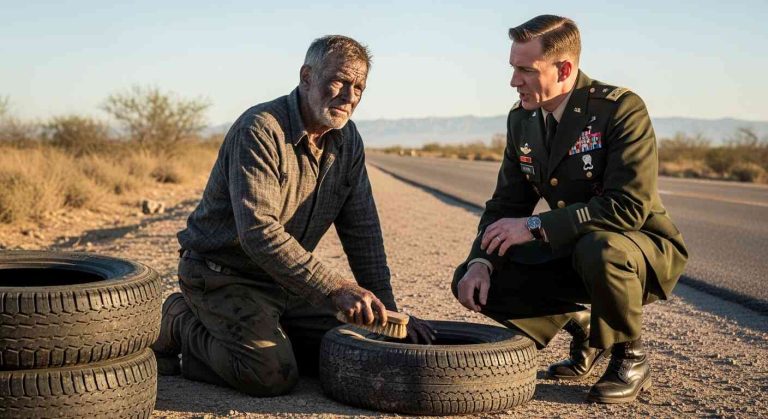
“”We aren’t lost, Master Chief,”” Miller replied. He stepped forward and did something that made the entire racetrack go silent. He snapped his heels together and delivered a salute so sharp it could have drawn blood.
The three other operators followed suit. They stood like statues, honoring a man the world had forgotten.
Julian’s mouth hung open. “”Master Chief? He’s a… he’s a janitor! He cleans up horse sh*t!””
Miller turned his head slightly, his gaze locking onto Julian. “”This man is a recipient of the Medal of Honor, the Navy Cross, and three Silver Stars. He has more confirmed saves than you have brain cells, son. If I were you, I’d stop talking before I decide that your presence is a threat to a national asset.””
Julian went silent, his knees literally shaking.
Elias sighed, wiping a streak of grime from his forehead. “”I told you I was done, Marcus. I found a quiet life. The horses don’t care about medals. They just want to be fed.””
“”The quiet life is over, sir,”” Miller said, his face darkening. “”The 22nd Team was hit in the Strait of Hormuz this morning. We lost the CO and the XO. The boys are rattled, and the mission is still live. The Pentagon doesn’t want a tactician. They want the tactician. They want the man who wrote the book on unconventional maritime boarding.””
Elias looked back at Midnight Ghost. The stallion was watching him, its large, dark eyes calm now that the noise had subsided. Elias thought about the peace he had found here—the simple rhythm of the stables, the anonymity of being ‘the leech.’
Then he looked at the soldiers. He saw the grief in Miller’s eyes. He knew those boys. He had trained half of them.
“”I’m an old man, Marcus,”” Elias whispered.
“”You’re the only man,”” Miller countered. “”The bird is hot. We leave in five.””
Elias looked at Julian, then at the mud on his hands. He realized then that he could never truly wash it off. Some men were built for the sun, and some were built for the shadows.
“”I need to change my shirt,”” Elias said.
Chapter 3: The Breaking Point
The locker room for the stable hands was a cramped, damp concrete box at the edge of the property. Elias walked toward it, his boots squelching. Behind him, the Special Forces team maintained a perimeter, their presence turning the Saratoga racetrack into a fortified zone.
Julian Vane, driven by a mixture of terror and wounded pride, followed at a distance. He saw his father, the elder Mr. Vane, sprinting across the lawn, his face a mask of panic.
“”Julian! What have you done?”” the father hissed, grabbing his son’s arm.
“”I didn’t do anything!”” Julian stammered. “”How was I supposed to know Thorne was some kind of war hero? He’s been living in a shack behind the barns for three years! He smells like manure!””
“”He’s a Thorne,”” the father whispered, his voice trembling. “”I knew his father. I knew Elias went into the service, but the records were all classified. I thought he was just a clerk who fell on hard times. If the military is landing a Black Hawk for him, Julian, we are in deep, deep trouble.””
Inside the locker room, Elias opened his dented metal locker. It contained a few spare shirts, a photo of his late wife, Clara, and a small, heavy cedar box. He took out a clean white t-shirt and pulled it on, the fabric stretched tight over a torso crisscrossed with scars—shrapnel bursts, exit wounds, and the long, jagged line of a surgical intervention that had barely saved his life in ’09.
He opened the cedar box. Inside lay a gold trident—the SEAL insignia—and a ribbon of blue silk with white stars. He didn’t put them on. He just touched them once, a silent apology to Clara for breaking his promise to stay out of the fight.
As he walked out, he found Julian and his father waiting.
“”Elias,”” the elder Vane said, stepping forward with his hand extended. “”My apologies for the… the commotion. My son is young and foolish. We had no idea of your stature.””
Elias ignored the hand. He looked at Julian, who was hiding behind his father’s shadow.
“”You called me a leech,”” Elias said quietly. “”You kicked me because you thought I was weak. You thought because I was cleaning up after your horses, I was beneath your notice.””
“”I… I was joking,”” Julian choked out.
“”No,”” Elias said. “”You weren’t. You were showing me who you are. And that’s the problem with people like you, Julian. You think power is something you’re born with. You think it’s the car you drive or the money in your bank. But real power is what you do when no one is looking. Real power is holding back when you want to strike.””
Elias stepped closer, and Julian flinched, expecting a blow. Elias simply reached out and plucked the riding crop from Julian’s hand. He snapped it over his knee with a single, effortless motion and dropped the pieces in the mud.
“”The horses deserve better than you,”” Elias said.
He turned to Sarah, the young groom who had been watching from the doorway. She was a hard-working girl from a town that had been gutted by the loss of the local mill. She worked three jobs to support her mother.
“”Sarah,”” Elias said.
“”Yes, Mr. Thorne?””
“”Midnight Ghost likes his apples sliced thin. Don’t let them overwork him on the turns. He’s got a weak fetlock on the left.””
“”I’ll take care of him,”” she promised, her voice thick with emotion.
Elias nodded. He turned back to Colonel Miller. “”Let’s go. Before I change my mind.””
As they walked toward the helicopter, the elite operators fell in behind Elias, shielding him from the cameras of the onlookers who had begun to gather. The “”stable boy”” was gone. In his place was a shadow, a man whose name was whispered in the halls of the Pentagon with a mixture of awe and fear.
The Black Hawk’s engines began to scream.
Chapter 4: The Sound of Thunder
The flight to the undisclosed location in Virginia was silent. Elias sat in the jump seat, the headset dampening the roar of the rotors. He stared out the window at the rolling hills of the American East Coast, thinking about how quickly a life can flip on its axis.
He thought about Clara. She had died of cancer while he was on a black op in the Philippines. By the time he got the word, she was already gone. He hadn’t even been able to attend the funeral because his existence was a state secret. That was when he had walked away. He had traded his rifle for a shovel, hoping that by cleaning up the messes of animals, he could forget the messes of men.
“”Sir?”” Miller’s voice came through the comms. “”We’re twenty mikes out from Langley. The Joint Chiefs are already in the tank.””
“”Give me the brief, Marcus,”” Elias said, his voice instantly switching into a cold, analytical tone. “”What are we really looking at?””
“”It’s a hostage situation, sir. A diplomatic vessel was seized by a rogue splinter group. They’ve got the Ambassador’s family. The 22nd tried a dry-hole approach and got ambushed. We think there’s a mole in the regional intelligence. The boys won’t go back in without a new set of eyes. They asked for you by name.””
“”Who asked?””
“”Jax,”” Miller replied. “”Your old spotter. He’s leading the remaining team.””
Elias felt a pang in his chest. Jax. The last time he’d seen Jax, he’d been dragging the boy through a minefield in the Helmand Province.
“”He’s still alive?”” Elias asked.
“”Barely. He’s the one who told the General that if they wanted this done right, they needed the man who taught the devil how to hide.””
The helicopter banked sharply, descending toward a high-security landing pad surrounded by men in dark suits. As the wheels touched down, Elias saw the array of black SUVs waiting for them.
He stepped out of the bird, his old boots hitting the asphalt. He was still wearing the mud-stained jeans and the cheap white t-shirt. He looked like a drifter who had wandered onto a movie set.
A General in a crisp Class-A uniform walked toward him, flanked by aides. “”Master Chief Thorne? I’m General Vance. We don’t have much time.””
Elias didn’t salute. He didn’t have to. “”I need a map, a satellite feed of the Strait, and a cup of coffee. Black.””
“”Follow me,”” the General said, not even blinking at Elias’s appearance.
As they walked into the command center, Elias felt the eyes of the young analysts on him. They saw a tired, elderly man. They didn’t see the predator beneath the skin. They didn’t see the man who had survived a dozen wars.
But then, the doors to the tactical room opened, and a man in combat gear stood up. It was Jax. He was older, his hair greying at the temples, a prosthetic arm gleaming under the fluorescent lights.
Jax looked at Elias, and for the first time in years, a smile broke across his scarred face. “”Took you long enough, Boss. The stalls that dirty?””
“”You have no idea, Jax,”” Elias said, stepping into the room. “”You have no idea.””
The mission was simple on paper, impossible in practice. Elias spent the next six hours tearing the original plan apart. He found the flaws, the points of failure, the places where the 22nd had been led into a trap. He spoke with a quiet authority that silenced the Room. He wasn’t just a soldier; he was a grandmaster playing a game of chess where the pieces were human lives.
“”We go in from the water,”” Elias said, pointing to a blind spot in the ship’s radar. “”Under the hull. No birds, no fast-roping. We use the current. They won’t see us until we’re breathing down their necks.””
“”That’s a four-mile swim in contested waters, Elias,”” the General noted. “”At your… age?””
Elias looked the General in the eye. “”I’m not swimming it. I’m guiding them. But if I have to go in, General, I promise you—I’ll be the last thing they never see.””