Chapter 5: The Unmasking
While Elias was deep in the war room, the world back at Saratoga was reeling.
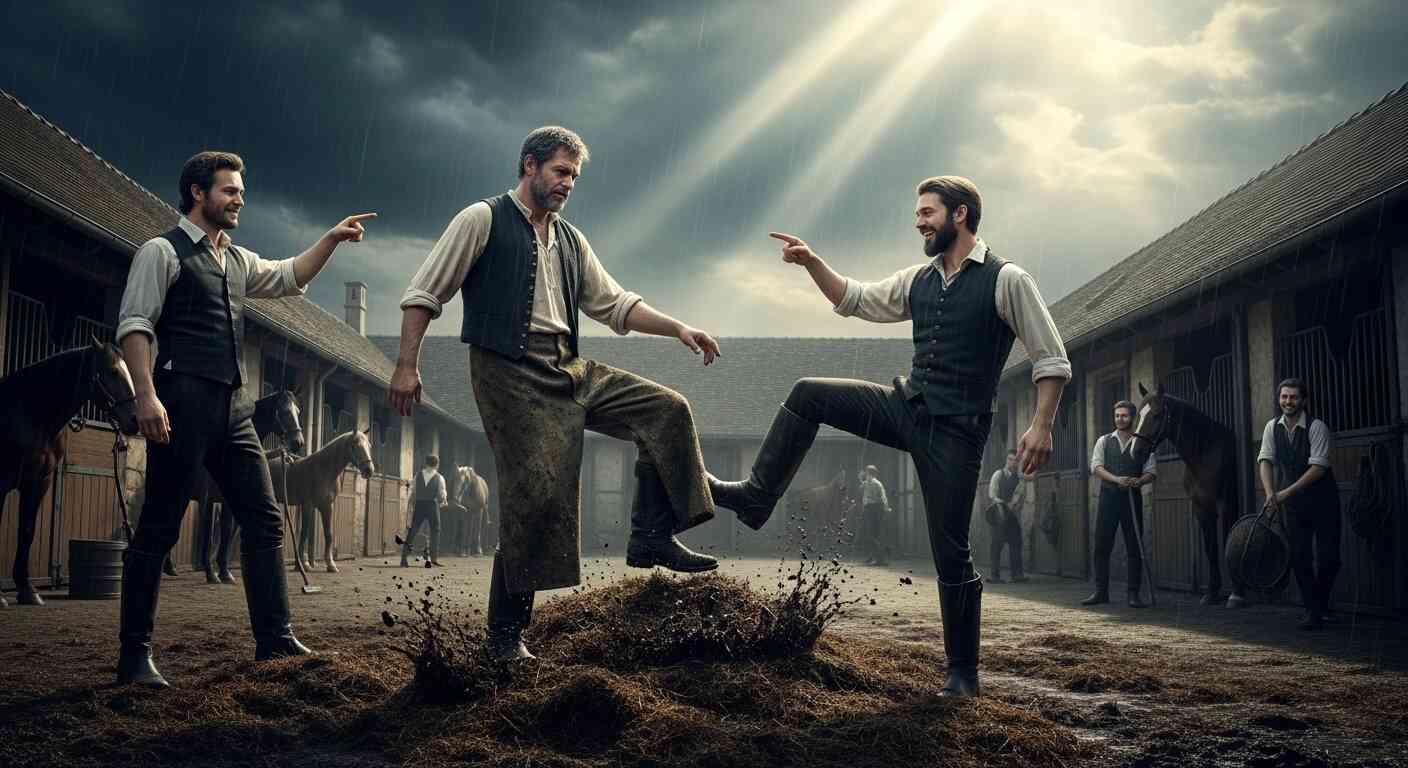
The video of the Black Hawk landing had gone viral. “”Stable Hand or Secret Agent?”” the headlines screamed. Julian Vane had tried to delete the security footage, but it was too late. The internet had already dissected every frame. They saw Julian’s cruelty, the water bucket, the kick.
By the next morning, the Vane family’s sponsors were pulling out. The prestigious racing syndicate issued a statement condemning the “”unacceptable treatment of a decorated veteran.”” Julian’s father sat in his office, his head in his hands, watching his empire crumble because his son couldn’t show a little bit of human decency to a man in a flannel shirt.
But Elias didn’t care about the news.
He was in the belly of a C-130, flying over the dark waters of the Middle East. He was wearing tactical gear now—lightweight, high-tech, and black as the night. He sat with the men of the 22nd. They were young, terrified, and looking at him like he was a god.
“”Listen up,”” Elias said, his voice low and steady over the drone of the engines. “”Fear is a liar. It tells you that you’re alone. It tells you that the enemy is bigger than you. But you have something they don’t. You have the man to your left and the man to your right. And tonight, you have me.””
He looked at Jax, who was checking his gear.
“”We do this clean. We do this quiet. And we all come home. Is that understood?””
“”HOOYAH!”” the team roared.
The back ramp of the plane lowered, and the cold, salt-laden air rushed in. Elias stood at the edge, looking down at the black expanse of the ocean. For a moment, he thought of the stables. He thought of the smell of hay and the quiet morning mist. He thought of Midnight Ghost.
Then, he adjusted his mask. The “”Leech”” was gone. The “”Janitor”” was gone.
“”Jump,”” Elias commanded.
The mission was a masterpiece of tactical violence. They moved through the ship like ghosts. Elias sat in the command boat, his eyes glued to the thermal feeds, directing his men with the precision of a surgeon.
“”Left corridor, Jax. Two tangos. Take them soft.””
“”Room 402. The family is there. Flash and clear on my mark.””
“”Mark.””
There was a muffled explosion, a burst of gunfire, and then silence.
“”Package secured,”” Jax’s voice crackled over the radio. “”Zero casualties. We’re coming out.””
Elias let out a breath he felt he’d been holding for three years. He looked at his hands. They were shaking, just a little. Not from age, but from the adrenaline—the terrible, addictive rush of being exactly where he was meant to be.
As the sun began to rise over the Persian Gulf, Elias stood on the deck of the recovery ship. The Ambassador’s wife walked up to him, clutching her young daughter. She didn’t know who he was. She just saw a man with tired eyes and a face that looked like it was carved from granite.
“”Thank you,”” she whispered, tears streaming down her face.
Elias just nodded. “”Just doing the job, ma’am.””
He walked to the rail and looked out at the horizon. He knew what came next. The medals, the debriefings, the pressure to stay and command. They would offer him everything—money, power, a seat at the big table.
But as the light hit the water, all Elias could think about was the smell of the New York morning and a horse that needed his apples sliced thin.
Chapter 6: The Long Walk Home
Three days later, a black SUV pulled up to the gates of the Saratoga racetrack.
The security guards, who had previously treated Elias like a nuisance, scrambled to open the gates. They stood at attention as the vehicle drove through.
Elias stepped out. He was back in his flannel shirt and his worn jeans. He looked tired, older than he had a week ago, but his eyes were clear.
The track was different now. There were no cameras, no helicopters. The owners had been quieted by the government, the story suppressed as a “”matter of national security,”” though the legend lived on in the stables.
Elias walked toward the barns. He didn’t go to the main office. He didn’t go to see the elder Vane, who was waiting with a fat check and a formal apology. He went straight to Stall 14.
Midnight Ghost whinnied as he approached, poking his nose over the gate.
“”Hey, boy,”” Elias whispered, reaching out to stroke the stallion’s velvet nose. “”Did they treat you right while I was gone?””
“”I made sure of it, Mr. Thorne.””
Elias turned to see Sarah. She was wearing a new jacket—the one he’d noticed she couldn’t afford a month ago. She looked at him with a new kind of respect, a quiet understanding.
“”Julian is gone,”” she said. “”His father sent him to a ranch in Montana to ‘learn some humility.’ They offered me his assistant trainer position.””
Elias smiled. It was the first real smile Sarah had ever seen on his face. “”You’ll be better at it than he ever was.””
“”Are you staying?”” she asked, her voice hopeful.
Elias looked around the stable. He thought about the C-130, the salt spray of the Gulf, and the weight of the trident in his locker. He thought about the men he’d saved and the men he’d lost.
“”For a little while,”” Elias said. “”I have some things to finish.””
He reached into his pocket and pulled out a small, red apple. He took out a pocketknife—the one he’d used to cut paracord in a dozen different countries—and carefully sliced the apple into thin, perfect wedges.
He fed them to the horse one by one.
Later that afternoon, a man in a suit tried to approach him. It was a recruiter from a private security firm, offering a seven-figure salary to “”consult.”” Elias didn’t even look at him. He just kept shoveling the straw, his rhythm steady and unbroken.
He had been a hero. He had been a ghost. He had been a savior.
But as the sun began to set over the track, casting long shadows across the mud, Elias Thorne realized that the greatest victory wasn’t the battles he’d won or the medals he’d earned.
It was the fact that he could finally stand in the mud, look at his reflection in a bucket of water, and not be ashamed of the man looking back.
He wasn’t a leech. He wasn’t a legend.
He was just a man who knew that even the dirtiest stalls could be cleaned, provided you weren’t afraid to get your hands dirty.
The world would always have its Julians—arrogant, loud, and hollow. And the world would always need its Eliases—the quiet ones who stood in the gap, mucking the stalls of humanity so that others could breathe the clean air of freedom.
Elias picked up his shovel and moved to the next stall. The work wasn’t done. It was never truly done.
The greatest strength isn’t found in the roar of the engines, but in the quiet resolve of a man who knows exactly who he is, even when the world is too blind to see it.”