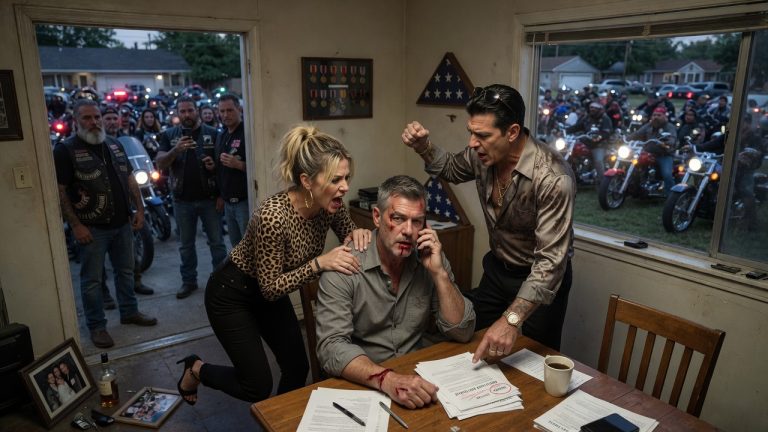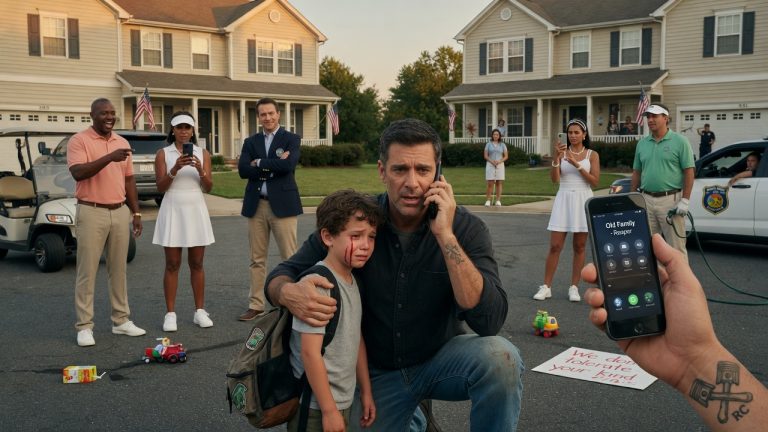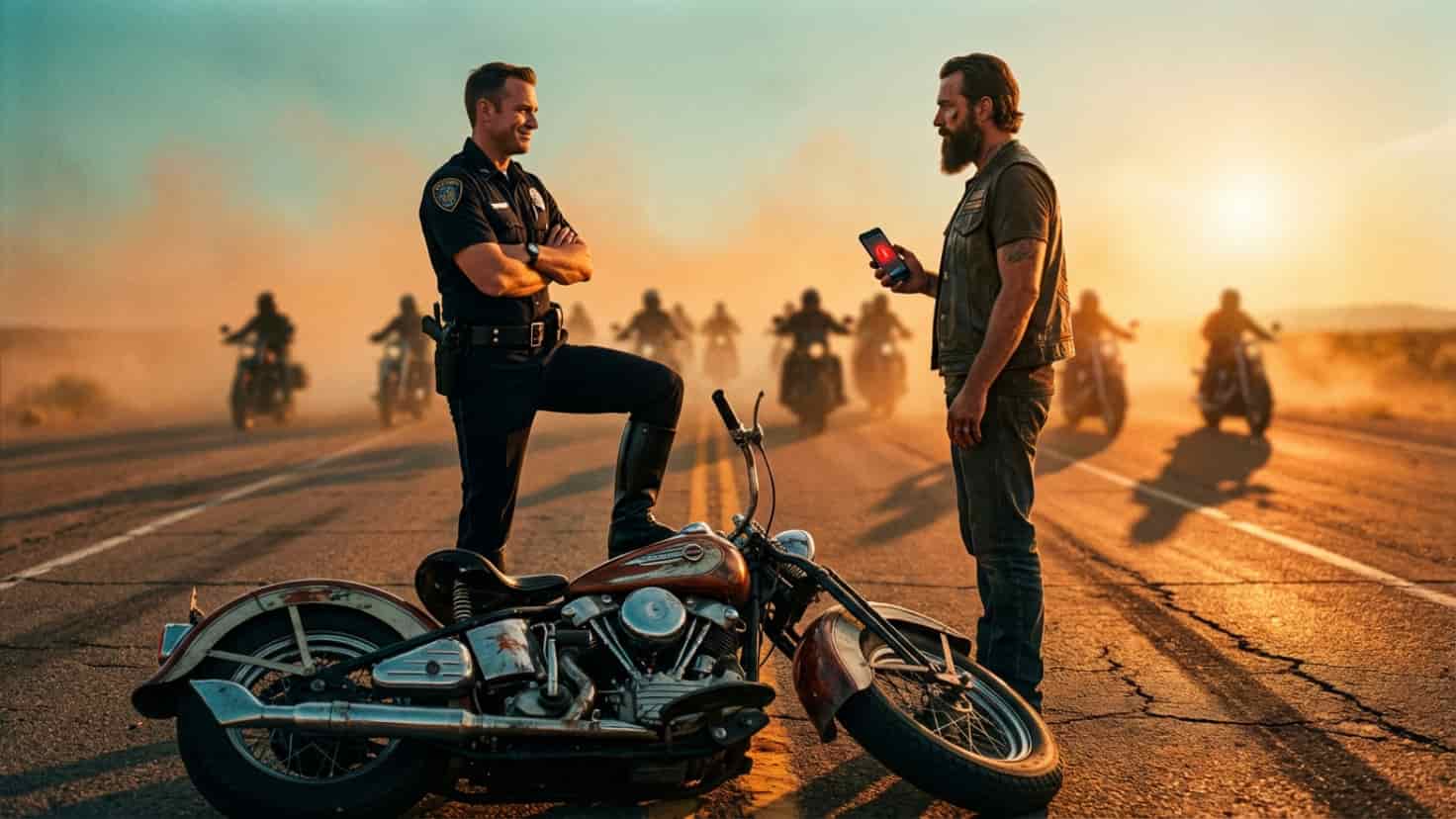
The chrome hit the pavement with a sound that felt like a gunshot to my heart. That vintage ’47 Knucklehead wasn’t just a machine; it was the last thing I had left of my brother, Elias, who didn’t make it back from the mountains of Afghanistan.
Officer Greg Vance stood there, his boots polished and his ego inflated, laughing as the Garcia family trembled behind me. He called them “”nuisances.”” He called my bike “”an obstruction of justice.”” He thought he was the apex predator in this small, quiet town because he wore a badge and a gun.
“”Oops,”” Vance smirked, adjusting his belt. “”Looks like your scrap metal is in the way of my investigation. Maybe if you weren’t hanging out with ‘these people,’ your property wouldn’t get hurt.””
I didn’t swing. I didn’t yell. I just looked at the scratched tank—the paint job Elias had finished the week before he deployed. I felt a coldness settle into my bones that I hadn’t felt since the war.
“”You should have just written the ticket, Vance,”” I said, my voice as steady as a heartbeat.
“”Or what?”” he challenged, stepping into my personal space. “”You gonna call your little biker friends? This is my town. I am the law here.””
I reached into my pocket and pulled out my phone. I didn’t call the police station. I didn’t call a lawyer. I hit a single button on a secure app—a distress signal that hadn’t been used in three years.
“”I’m not calling friends, Greg,”” I whispered, looking him dead in the eye. “”I’m calling a reckoning. You didn’t just kick a bike. You just declared war on fifteen hundred men who don’t care about your badge.””
He laughed then. He actually laughed. He thought he was safe behind his thin blue line. He didn’t realize that by sunrise, this town would be vibrating with the sound of a brotherhood that knows no borders and fears no bully.
The storm is coming, and I’m the one who pulled the trigger.
“FULL STORY
Chapter 1: The Weight of Chrome
The humidity in Oakhaven, Georgia, was the kind that stuck to your skin like a guilty conscience. I was sitting on the porch of the Garcia’s small, weathered bungalow, helping Maria figure out her late husband’s pension paperwork. Her son, Leo, was playing with a toy truck in the dirt. It was a quiet Tuesday until the black-and-white cruiser crested the hill, moving slow—like a shark in shallow water.
I knew that car. Everyone in Oakhaven knew it. Officer Greg Vance was the kind of man who used his authority as a scalpel to cut away at anyone he deemed “”lesser.””
He pulled up onto the curb, right next to my ’47 Knucklehead. I’d spent three years restoring that bike. It was more than a hobby; it was a sanctuary. Every bolt was a memory of my brother, Elias. We were supposed to ride across the coast together when he got back from his third tour. He came back in a flag-draped box instead, leaving me the bike and a hole in my chest that nothing could fill.
Vance stepped out, his aviators reflecting the afternoon sun. He didn’t look at me. He looked at Maria, who had gone pale.
“”Mrs. Garcia,”” Vance barked, not bothering to step onto the grass. “”I told you last week that those overgrown hedges are a city ordinance violation. And having ‘guests’ with unauthorized vehicles parked on the sidewalk? That’s a nuisance.””
“”Officer, please,”” Maria whispered, her hands shaking. “”The gardener comes on Friday. I cannot do it myself.””
“”Excuses don’t pay fines, Maria,”” Vance said. He turned his gaze to me, a slow, ugly grin spreading across his face. He hated me. He hated that I didn’t look away when he stared, and he hated that the locals respected me more than they feared him. “”Miller. I thought I told you to keep this grease-bucket in the garage.””
“”It’s on the street, Greg. Legal distance from the curb,”” I said, staying seated. My voice was calm, but my blood was beginning to simmer.
“”I decided it’s a safety hazard,”” Vance said. He walked over to the bike. He ran a gloved hand over the leather seat—the seat Elias had hand-tooled. “”Obstructing a clear view of the roadway. I think I’ll have it impounded.””
“”Don’t touch the bike, Vance,”” I said, standing up slowly.
He thrived on the challenge. He wanted me to swing. He wanted a reason to use that heavy Maglite on his belt. Instead of answering, he shifted his weight and delivered a brutal, calculated kick to the kickstand side.
The Knucklehead didn’t just tip; it slammed. The sound of metal meeting pavement made Maria scream. The custom teardrop tank dented against a protruding rock, and the glass of the headlight shattered into a thousand diamond-like shards.
Vance chuckled, a dry, rasping sound. “”Oops. Looks like it was top-heavy. My mistake. Now, clear this junk out of here, or the next thing I kick will be your front teeth.””
He thought he had won. He thought he had asserted his dominance over the “”biker”” and the “”immigrant.”” He saw the pain in my eyes and mistook it for defeat. He didn’t see the ghost of Elias standing right behind me. He didn’t see the 1,500 brothers I had spent a decade leading, building, and protecting.
“”You just broke the only thing that kept me peaceful, Greg,”” I said, my voice dropping to a register that made even Vance’s smile flicker for a microsecond.
I pulled out my phone and sent the “”Red Alert”” to the Iron Vanguard’s national server. One location pin. One message: The heritage has been desecrated. Oakhaven. All hands.
Vance got back in his car, throwing a mocking wave. “”See you around, Miller. Try not to cry over a little paint.””
I knelt in the dirt, picking up a piece of the shattered headlight. The war hadn’t started yet, but the first shot had been fired. And I was going to make sure Greg Vance was the one who surrendered.
Chapter 2: The Sound of Thunder
By 10:00 PM, Oakhaven was usually a ghost town. The single stoplight in the center of Main Street blinked a lonely yellow, and the only light came from the neon sign of “”Pete’s Diner.””
But tonight, the air felt electric.
I sat on my porch, the damaged bike now propped up, a silent witness to the insult. Beside me sat “”Pops,”” a man whose beard was whiter than the clouds and whose hands were scarred from forty years in the steel mills. He was the founder of the local chapter, the man who had taken me in when I was a broken vet with nothing but a rucksack.
“”You sure about this, Jax?”” Pops asked, lighting a hand-rolled cigarette. “”Once the floodgates open, there’s no closing ’em. The town won’t ever be the same.””
“”Vance has been bleeding this town dry for years, Pops,”” I replied, cleaning a smear of grease from the dented tank. “”He bullies the Garcias because they’re quiet. He shakes down the shopkeepers for ‘protection.’ But tonight, he touched the one thing that belongs to all of us. He touched the brotherhood’s history. If we don’t stand up now, we don’t deserve the patches on our backs.””
Pops nodded slowly. “”The boys are coming. I got word from the Florida chapters. They crossed the border an hour ago. North Carolina is right behind ’em. You called the Vanguard, Jax. You called the whole damn family.””
The first sign of the arrival wasn’t a sight, but a vibration. A low-frequency hum that started in the soles of my boots and worked its way up to my teeth. It sounded like a distant storm, but there wasn’t a cloud in the sky.
Then came the lights.
On the horizon of Highway 41, a single dot of white light appeared. Then two. Then ten. Then a solid, glowing ribbon of fire that stretched as far as the eye could see. The roar grew—a mechanical symphony of V-twins, a guttural, earth-shaking growl that announced the arrival of the cavalry.
They didn’t come in hot. They didn’t come in screaming. They came in a disciplined, terrifying formation. Two by two, a mile-long serpent of chrome and leather.
The first to pull into my driveway was Big Mike, a six-foot-five enforcer from the Atlanta chapter. He killed his engine, the silence that followed almost more deafening than the noise. He hopped off his bike, walked straight to my ’47, and touched the dent.
“”Elias’s bike?”” Mike asked, his voice like gravel.
“”Elias’s bike,”” I confirmed.
Mike looked toward the town center, where the police station sat. “”Where’s the man who did it?””
“”Sleeping,”” I said. “”For now. He thinks tomorrow is just another day of being a king. He doesn’t know the kingdom has changed hands.””
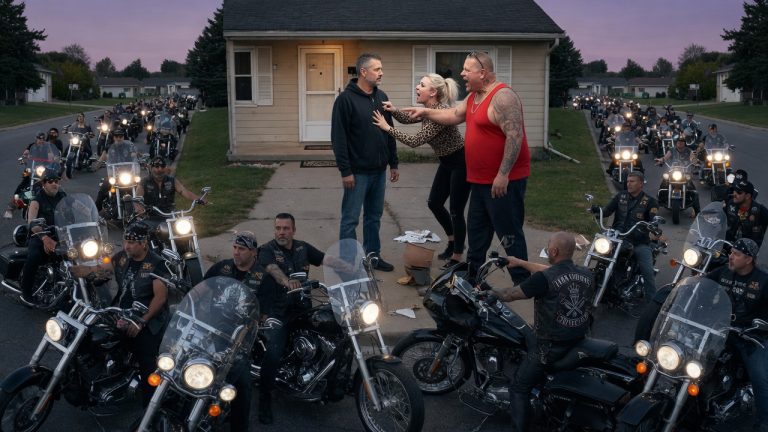
By midnight, my yard, the Garcia’s yard, and the entire street were packed. Men and women from all walks of life—mechanics, lawyers, veterans, teachers—all united by the vest and the code. We had 1,500 bikes parked in a town of 4,000 people.
I looked at the sea of faces, the flickering lighters, the quiet intensity. We weren’t a gang. We were a community that had been pushed too far.
“”Tonight, we rest,”” I told the crowd. “”Tomorrow, at 8:00 AM, we go to the station. No weapons. No violence. We just let them see us. We let them see exactly how many people Greg Vance offended when he decided to be a bully.””
As I walked back inside, I saw Maria Garcia watching from her window. She looked terrified, but when our eyes met, I gave her a small nod. For the first time in years, she didn’t look like a victim. She looked like someone who finally had a shield.
Chapter 3: The Siege of Silence
Wednesday morning in Oakhaven usually sounded like birds and the occasional tractor. This morning, it sounded like the end of the world.
At exactly 7:50 AM, fifteen hundred engines roared to life simultaneously. The sound was so massive it shattered a window at the local hardware store. We moved as one unit, a slow-rolling tide of steel toward the Oakhaven Police Precinct.
I led the pack, riding the dented ’47. It ran rough—the carburetor was slightly off from the fall—but it felt like a warhorse carrying me into battle.
As we rounded the corner onto Main Street, the townspeople were out on their porches. Some looked scared, but many were filming on their phones, their eyes wide. They saw the patches—The Iron Vanguard—and they knew our reputation. We weren’t the ones who started trouble, but we were the ones who finished it.
We reached the precinct and began to circle. We didn’t block the road; we just filled every available inch of parking. We stood in rows, ten deep, facing the front doors of the station.
Silence fell. Fifteen hundred men and women, arms crossed, staring at the glass doors.
Five minutes later, the doors swung open. Officer Greg Vance stepped out, his face twisted in a mask of bravado that was clearly crumbling. Behind him stood the Chief of Police, Arthur Henderson, an older man who looked like he hadn’t slept a wink.
“”What the hell is this?”” Vance shouted, his voice cracking. He reached for his holster instinctively. “”This is an illegal assembly! I’ll have every one of you arrested!””
I stepped forward, the heels of my boots clicking on the pavement. I stopped exactly three feet from him.
“”Morning, Greg,”” I said. “”Just thought we’d bring the ‘nuisances’ to you today. You said my bike was an obstruction of justice. We’re here to see if you can define ‘justice’ for all of us.””
“”Miller, tell these people to leave!”” Chief Henderson pleaded, stepping in front of Vance. “”You’re paralyzing the town!””
“”The town has been paralyzed by fear of that man for five years, Chief,”” I said, pointing at Vance. “”He doesn’t just kick bikes. He threatens families. He takes bribes from the developers trying to push the Garcias out of their homes. We have the ledger, Greg.””
Vance’s face went from red to a sickly, chalky white. “”You don’t have jack.””
“”My brother was a tech specialist in the Army, Greg,”” I said, leaning in. “”Before he died, he taught me a thing or two about digital footprints. You’ve been using a private server to coordinate with the real estate firm. We found it. We found the payments. We found the threats you sent to Maria’s husband before he ‘accidentally’ died in that hit-and-run.””
The crowd of bikers let out a low, ominous growl. The air pressure seemed to drop. Vance looked around, realizing he was surrounded by 1,500 witnesses. There were no cameras he could turn off here. There was no “”he said, she said.””
“”You’re lying!”” Vance screamed, drawing his sidearm.
Fifteen hundred sets of eyes didn’t flinch. Nobody moved. Nobody ran. We just stood there, a wall of human conviction.
“”Put the gun down, Greg,”” Chief Henderson said softly, his voice full of disappointment. “”It’s over.””
Chapter 4: The Hollow King
The moment Vance pulled his weapon, the dynamic of the entire town shifted. It was the ultimate reveal of his character—a man who, when faced with the truth, resorted to the only tool he truly understood: fear.
But fear doesn’t work on people who have nothing left to lose.
“”Put it down,”” I repeated, my voice a low tether to reality. “”Look around you, Greg. Who are you going to shoot first? The schoolteacher from Macon? The retired colonel from Savannah? The father of three who just wants his neighborhood back?””
Vance’s hand was shaking. He looked at the sea of leather vests, then at the townspeople who had begun to gather behind the bikers. He saw Sarah, the waitress from the diner who he’d harassed for months. He saw the local mechanic he’d extorted. He saw the “”justice”” he had built, and it was a house of cards in a hurricane.
Chief Henderson stepped forward and placed a hand on Vance’s wrist. “”Give me the piece, Greg. Don’t make this a bloodbath. You’re outmanned, outgunned, and out of time.””
With a sob of pure, pathetic rage, Vance let the gun fall. It clattered on the concrete—a hollow sound for a hollow man. Henderson immediately unclipped Vance’s badge and his belt.
“”You’re under arrest, Greg. Pending a full state investigation into the death of Hector Garcia and the racketeering charges,”” Henderson said. He looked at me, a silent apology in his eyes. He had known, or at least suspected, but he’d been too weak to act until we forced his hand.
As the deputies led Vance away in handcuffs, the silence of the 1,500 bikers finally broke. It wasn’t a cheer. It was a rhythmic thumping of hands against leather vests. A heartbeat.
Thump-thump. Thump-thump.
The sound echoed off the brick buildings of Main Street. It was the sound of a brotherhood acknowledging a debt paid.
I turned back to the crowd. “”He’s gone. But the damage he did stays. We don’t leave until the Garcia’s house is fixed, until the diner is painted, and until this town remembers what it feels like to breathe.””
For the next four hours, Oakhaven transformed. Bikers weren’t just riders; they were carpenters, painters, and gardeners. Big Mike led a crew to Maria’s house. By noon, the “”offending”” hedges were perfectly manicured. By 2:00 PM, the peeling paint on her porch was a fresh, vibrant white.
I stayed by my bike, watching the transformation. But I knew the biggest ghost hadn’t been laid to rest yet. I still had one more ride to make.”