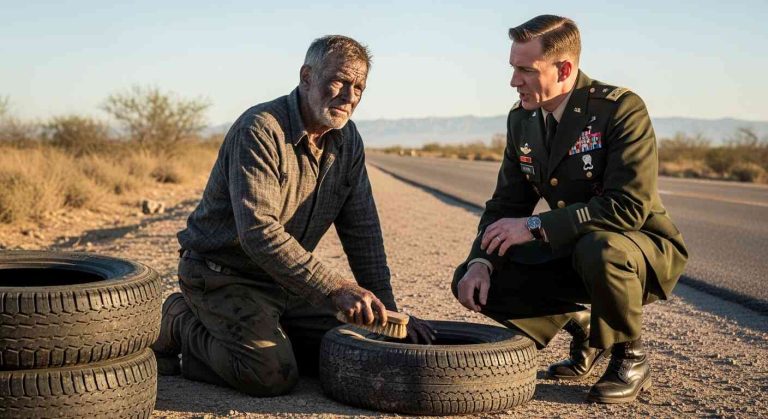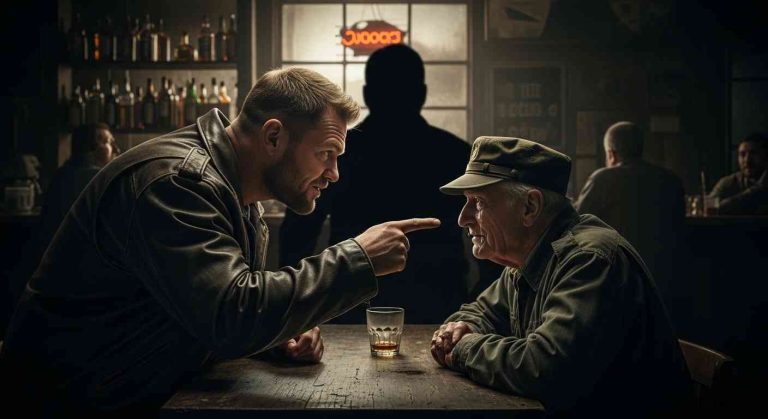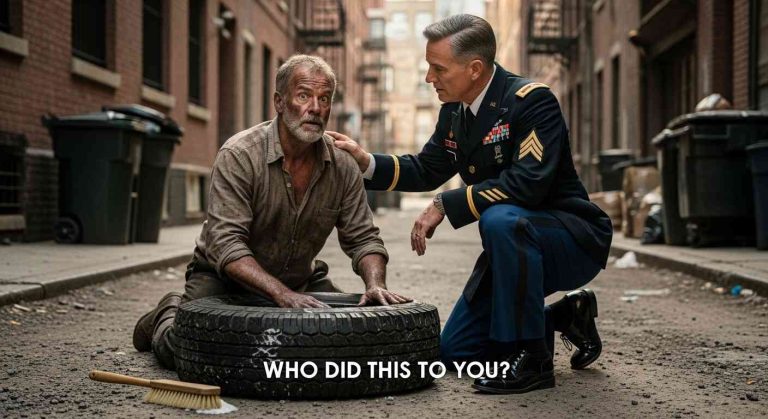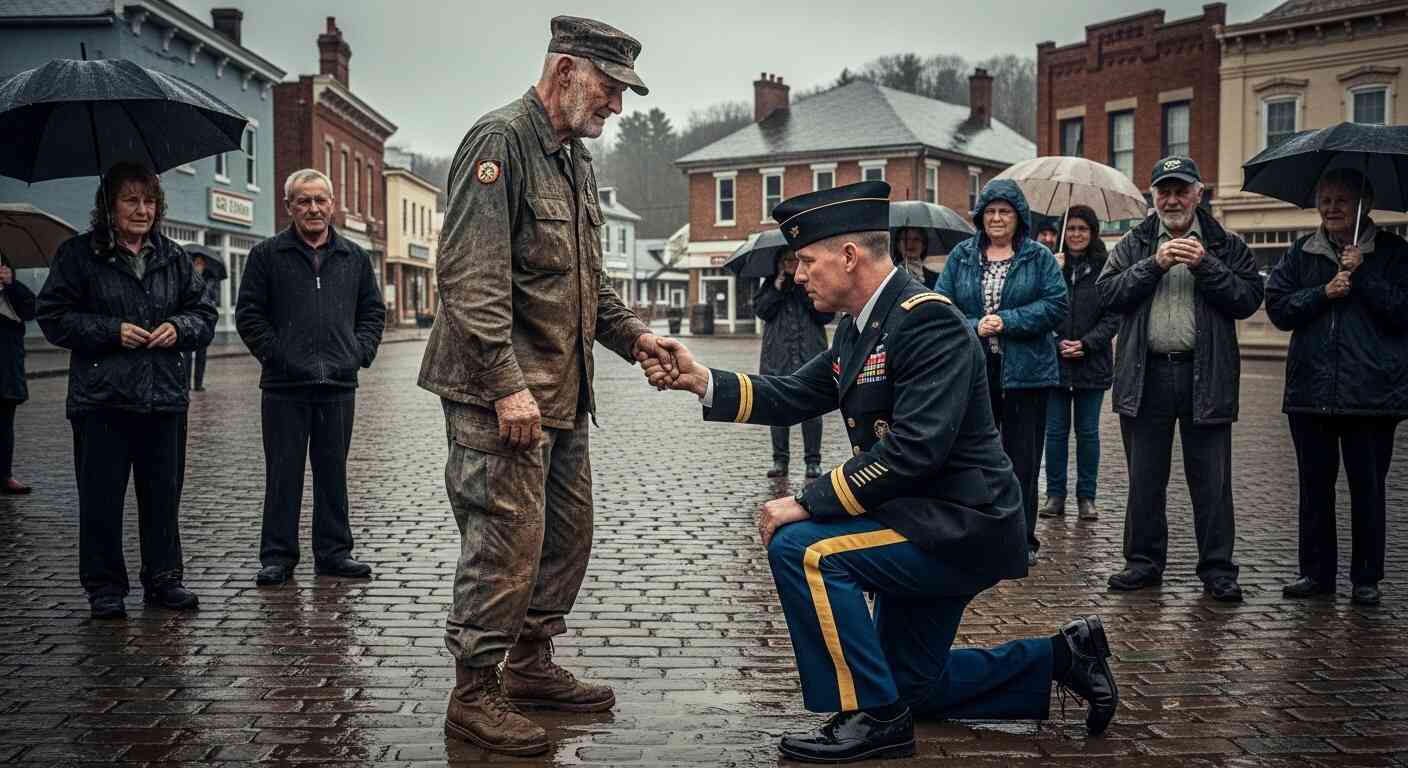
The pavement was hot, but the words were colder.
Arthur Vance had spent forty years trying to be invisible. At seventy-four, his only goal was to finish his shift at the Oakwood Heights Resort, go home to his small apartment, and look at the photograph of his wife, Elena, until he fell asleep.
He didn’t mind the heavy lifting. He didn’t mind the way the wealthy guests looked through him like he was made of glass. But today, the glass broke.
A luxury coach, the kind that costs more than Arthur had earned in a lifetime, hissed to a stop in the “No Parking” zone. When Arthur stepped forward to politely ask them to move to the valet station, the door swung open like a guillotine.
Julian Thorne stepped out. Young, rich, and smelling of expensive cologne and entitlement. He didn’t see a human being; he saw an obstacle.
With a sneer, Julian shoved Arthur. It wasn’t a tap—it was a full-chested strike. Arthur’s boots skidded on the gravel, and he went down hard, his temple clipping the heavy rubber wheel of the coach.
“You’re only fit to live in dirty water!” Julian screamed, his voice carrying across the manicured lawn. “Look at you. You’re a literal eyesore. Those scars on your face? They’re disgusting. Go back to the gutter where you belong.”
The crowd of socialites laughed. A few people pulled out their phones, not to help, but to capture the “drama” for their followers.
Arthur sat in the dirt, the old ache in his hip flaring like a signal fire. He touched the scars on his neck—marks earned in a jungle half a world away, pulling three boys out of a burning APC.
He didn’t fight back. He didn’t yell. He just looked at the ground, waiting for the world to finish its business with him.
He didn’t hear the black SUV pull up. He didn’t see the four stars glistening on the shoulder boards of the man who stepped out.
But when the General’s boots hit the pavement with the weight of a mountain, the laughter stopped. And when the most powerful man in the state knelt in the dirt next to a “trash” groundskeeper, the silence was deafening.
“FULL STORY
Chapter 1: The Weight of Silver and Dust
The sun over the Oakwood Heights Resort didn’t feel warm to Arthur Vance; it felt heavy. It was the kind of humid, late-August Georgia heat that settled into your bones and reminded you exactly how old you were. Arthur wiped sweat from his brow with a handkerchief that had seen better decades, his fingers lingering for a moment on the puckered, knotted skin that ran from his jawline down into his collar.
He was a groundskeeper. It was a title that sounded loftier than it was. In reality, he was the man who picked up the discarded champagne flutes, the man who buffed the scuffs off the marble entryways, and the man who moved the luggage when the younger valets were “”too busy”” checking their reflections in the glass doors.
“”Arthur! Move those hydrangeas to the West Wing. The wedding party is coming through in ten,”” barked Marcus, the twenty-four-year-old assistant manager who wore his suit three sizes too tight and spoke to Arthur like he was a malfunctioning appliance.
“”Yes, sir,”” Arthur said softly. His voice was like dry leaves skipping over a driveway—thin, but steady.
Arthur gripped the heavy ceramic planter. His hands were mapped with blue veins and age spots, but the grip was still there—the ghost of the man who could once carry a sixty-pound rucksack for twenty miles without breaking stride. He moved the flowers, his breath hitching only slightly.
That was when the coach arrived.
It was a Prevost, a literal mansion on wheels, midnight black with tinted windows that hid the faces of the elite. It didn’t pull into the designated unloading zone. Instead, it hissed to a stop right in the center of the fountain loop, blocking the entire flow of traffic.
Arthur knew the rules. The owners of the resort were sticklers for the “”Guest Experience.”” A blocked loop meant a delayed check-in, which meant a “”diminished experience.””
He approached the coach with his hat in his hand. He tried to look as non-threatening as possible, though his scarred face often made people look away before he could even speak.
“”Excuse me, sir?”” Arthur called out as the air-powered doors creaked open.
A man stepped out. He looked to be in his early thirties, wearing a navy linen suit and loafers with no socks. His hair was perfectly coiffed, and his eyes were already scanning the horizon for someone more important than the man standing in front of him. This was Julian Thorne, a man whose father owned half the zip code and whose ego owned the other half.
“”You can’t park here, sir,”” Arthur said, keeping his tone respectful. “”If you could just pull forward twenty yards, the valets will—””
“”Do I look like I care about the valets?”” Julian interrupted, stepping down onto the pavement. He looked at Arthur’s worn, sweat-stained uniform and curled his lip. “”Who are you? The trash collector?””
“”I’m the groundskeeper, sir. I’m just trying to keep the—””
“”You’re trying to annoy me,”” Julian snapped. Behind him, a young woman with a bored expression stepped off the bus, holding a tiny dog that cost more than Arthur’s car. “”Cami, look at this. They let actual gargoyles work the front gate now.””
The woman, Cami, giggled. “”He’s terrifying, Julian. Tell him to go away. He’s ruining my photo.””
Arthur felt a familiar sting—not of anger, but of a long-dulled shame. “”Please, sir. Just move the coach.””
Julian’s face darkened. He was used to people bowing. He wasn’t used to “”the help”” persisting. “”I told you to shut up. You’re only fit to live in dirty water, you old rat. Get out of my way.””
Before Arthur could react, Julian reached out. It wasn’t a nudge. It was a violent, two-handed shove.
Arthur, caught off guard and hampered by his bad hip, flew backward. His feet tripped over the edge of a stone planter, and he crashed into the side of the coach. His head bounced off the heavy metal rim of the tire, and he slumped into the gravel.
For a second, the world went grey. The sound of the fountain faded into a high-pitched ring. He felt the sharp bite of stones digging into his palms.
“”Julian, oh my god,”” Cami laughed, pointing her phone at the fallen old man. “”He went down like a sack of potatoes. Post that.””
Julian stood over him, adjusting his cuffs. “”Maybe next time you’ll learn your place, ‘Sarge.’ Or whatever you call yourself.””
Arthur didn’t move. He just looked at the oil stain on the pavement, feeling the blood start to trickle from a cut on his temple. He felt small. He felt forgotten. He felt like the trash they said he was.
But then, the air changed. The sound of a heavy engine—not a luxury coach, but something diesel, something disciplined—echoed through the loop.
A black SUV with tinted windows and government plates pulled up, followed by two more. They didn’t park. They converged.
The back door of the lead SUV opened.
The man who stepped out didn’t look like a resort guest. He wore the Army Service Uniform, the dark blue fabric crisp and intimidating. On his shoulders, four silver stars caught the afternoon sun, flashing like warnings.
General Marcus Sterling, Commander of the United States Army Forces Command, looked at the luxury coach. Then he looked at Julian Thorne. And then, his eyes fell on the old man bleeding in the dirt.
The General’s face went from professional calm to a mask of such terrifying intensity that the laughter from the coach crew died instantly.
“”Arthur?”” the General whispered, his voice cracking the silence of the resort like a whip.
Chapter 2: The Ghost of Firebase Sally
General Sterling didn’t wait for his security detail. He didn’t wait for the resort manager, who was currently sprinting out of the lobby with a look of pure panic on his face. He walked—no, he marched—straight toward the luxury coach.
Julian Thorne, sensing a change in the wind but too arrogant to understand the direction, straightened his tie. He assumed the General was a guest, someone of his own “”stature.””
“”Officer, thank God you’re here,”” Julian said, putting on a winning smile. “”This vagrant was harassing my party. I had to defend myself. These people they hire nowadays—””
General Sterling didn’t even look at him. He walked past Julian as if the young man were made of air.
The General reached the edge of the gravel where Arthur was struggling to sit up. Sterling’s boots, polished to a mirror shine, stopped inches from Arthur’s dirt-caked work shoes.
Then, the unthinkable happened.
The Four-Star General—a man who ate breakfast with senators and spent his afternoons moving divisions across maps—dropped to both knees in the dirt.
“”Arthur,”” Sterling said again, his voice thick with an emotion no one at Oakwood Heights had ever heard. “”Arthur, it’s me. It’s Marky.””
Arthur blinked, clearing the haze from his eyes. He looked at the man in front of him. He saw the stars. He saw the medals. But beneath the aging face and the heavy burden of command, he saw a nineteen-year-old kid with a radio strapped to his back, screaming in the mud of a jungle in 1972.
“”Marky?”” Arthur rasped.
“”I’ve been looking for you for twenty years,”” Sterling said. He reached out, his gloved hands trembling as he took Arthur’s calloused, shaking hand. “”I went to your old house. I went to the VA. Nobody knew where you went.””
“”I didn’t want to be found, sir,”” Arthur whispered. “”I just wanted some peace.””
“”Sir?”” Sterling let out a choked laugh. “”Don’t you ‘sir’ me. I wouldn’t be standing here to be called ‘sir’ if you hadn’t crawled back into that burning track to pull me out.””
The crowd had gone dead silent. The resort manager, Marcus, had stopped ten feet away, his jaw hanging open. Julian Thorne’s face had turned a sickly shade of grey.
“”General?”” Julian stammered, stepping forward. “”General, there must be some mistake. This man is just a—””
Sterling stood up. He didn’t do it quickly. He rose with a deliberate, predatory grace. When he turned to face Julian, the temperature in the loop seemed to drop twenty degrees.
“”You,”” Sterling said. The word wasn’t loud, but it carried the weight of a court-martial.
“”I… I was just…”” Julian began, his hands beginning to shake.
“”I saw what you did,”” Sterling said, stepping into Julian’s personal space. The General was a head shorter, but he looked like he could swallow Julian whole. “”I saw you shove a Medal of Honor nominee into the dirt. I heard you call him trash.””
The word Medal of Honor rippled through the crowd like an electric shock.
“”He… he’s a veteran?”” Cami whispered from the coach steps, her phone finally dropping to her side.
“”He is more than a veteran,”” Sterling barked, turning his gaze to the crowd. “”This man is Sergeant Arthur Vance. In 1972, at Firebase Sally, his unit was ambushed. He was wounded in the first three minutes. He spent the next six hours dragging men—including me—out of a literal hell. Those scars on his face? Those aren’t ‘disgusting.’ Those are the marks of a man who stayed in the fire so others could live.””
Sterling looked back at Julian, his eyes narrowing. “”And you shoved him? Because he asked you to move a bus?””
“”I didn’t know!”” Julian cried out, his voice cracking. “”I thought he was just… a worker!””
“”That,”” Sterling said, his voice dropping to a dangerous whisper, “”is the most pathetic thing I’ve ever heard. You think because a man wears a uniform of service instead of a suit of vanity, he is beneath you? You think his life is worth less than your convenience?””
Sterling turned to the resort manager. “”Who is in charge here?””
Marcus, the manager, stumbled forward. “”I am, General. Marcus Reed. I… I apologize profoundly. We had no idea of Mr. Vance’s history. He never said anything—””
“”Of course he didn’t,”” Sterling snapped. “”Heroes don’t have to bark to be felt. But you… you let this happen on your doorstep. You let your guests treat your staff like animals.””
“”We’ll fix it,”” Marcus promised, sweating through his shirt. “”Mr. Thorne, I’m afraid I’m going to have to ask you to leave the property immediately. Your reservation is canceled.””
“”You can’t do that!”” Julian yelled, desperation taking over. “”My father is a board member!””
“”I don’t care if your father is the King of England,”” Sterling said. “”You are going to do two things. First, you are going to write a check for ten thousand dollars to the Wounded Warrior Project, right now, in front of me. And second… you are going to get on your knees and apologize to this man.””
Julian looked at the General. He looked at the security detail, who had moved in closer, their faces like stone. He looked at the crowd, dozens of people now recording his humiliation.
He looked at Arthur, who was still sitting in the dirt, looking more tired than angry.
“”I’m waiting,”” the General said.
Chapter 3: The Ghost of the Girl He Left Behind
Julian Thorne didn’t kneel. Not at first. His pride was a thick, rotting timber that refused to snap. He looked at Arthur Vance—really looked at him for the first time—and saw the “”trash”” he’d described. But he also saw the four stars on General Sterling’s shoulders, and he knew that in this world, stars beat bank accounts.
“”I’ll write the check,”” Julian hissed. “”But I won’t kneel. This is America. You can’t make me kneel.””
General Sterling didn’t blink. “”You’re right, Mr. Thorne. I can’t make you kneel. But I can call the CEO of your firm, who happens to be a retired Colonel and a dear friend of mine. I can explain exactly why his lead analyst is currently trending on TikTok for assaulting a decorated war hero. I imagine your ‘America’ gets very small, very fast, when your reputation is at the bottom of a gutter.””
Julian’s face went from grey to white. The silence of the resort was broken only by the sound of the fountain and the distant chirping of birds.
Slowly, agonizingly, Julian’s knees hit the gravel. The sharp stones poked through his expensive trousers. He looked like a child caught in a lie.
“”I’m… I’m sorry,”” Julian muttered to the ground.
“”I can’t hear you,”” Sterling said.
“”I’m sorry, Mr. Vance,”” Julian said louder, his voice trembling with a mix of rage and shame. “”I shouldn’t have touched you.””
Arthur looked at the young man. He didn’t feel the triumph he expected. He just felt a deep, hollow sadness for a generation that had forgotten how to see people.
“”It’s okay, son,”” Arthur said softly. “”Just… try to remember that everyone you see is carrying a heavy pack. You don’t need to add your weight to it.””
Arthur turned to the General. “”Can you help me up now, Marky? My hip is starting to lock.””
Sterling’s hard expression vanished instantly, replaced by the face of the boy from the jungle. He reached down and hoisted Arthur up with a strength that belied his age.
“”Let’s get you inside, Arthur. Somewhere with AC and a chair that doesn’t belong in a garden,”” Sterling said, keeping a protective arm around Arthur’s shoulders.
As they walked toward the lobby, the resort manager, Marcus, scurried ahead, opening doors and barking orders to the staff to bring water, ice, and “”the finest cognac in the cellar.””
Inside the lobby, the cool air was a mercy. Arthur sat in a plush velvet armchair, feeling out of place in his dusty greens. Sarah, a nineteen-year-old waitress from the resort cafe who had always been kind to Arthur, ran over with a first-aid kit.
“”Arthur! Oh my god, I saw it from the window,”” she cried, her eyes wet. She began dabbing at the cut on his temple. “”I’m so sorry. I should have come out there.””
“”You have a job to do, Sarah,”” Arthur smiled. “”Don’t you worry about me. I’ve had worse than a bump from a bus.””
General Sterling stood nearby, watching Sarah tend to Arthur. He looked at the girl—young, hardworking, her eyes full of genuine concern—and then back at his old friend.
“”You’ve been working here long, Arthur?”” Sterling asked.
“”Ten years,”” Arthur said. “”After Elena passed… I couldn’t stay in the house. Too quiet. I needed to stay busy. I like the flowers. They don’t talk back.””
“”You shouldn’t be picking up trash and moving planters,”” Sterling said, his voice dropping. “”You’re a hero, Arthur. You have the Silver Star. You were up for the Medal. Why didn’t you push for it? Why did you disappear?””
Arthur looked at his hands. “”Because the men I couldn’t save didn’t get medals, Marky. They got headstones. It felt… wrong. To be celebrated for the worst day of my life. I just wanted to be Arthur again. Not ‘The Hero of Sally.'””
Sterling sat on the edge of a coffee table, leaning in close. “”I understand that. Better than most. But the world is different now. People… they’ve forgotten what it costs to have the lives they lead. They see a man like you and they see ‘the help.’ They need to know. Not for your sake, but for theirs.””
“”I don’t want the spotlight, Marky,”” Arthur sighed.
“”Maybe not,”” Sterling said. “”But you’re getting it. Look.””
He pointed to the large television in the lobby. It was tuned to a local news station. A shaky cell phone video—the one Cami had been filming—was already playing. But it wasn’t being used to mock Arthur. The headline scrolling across the bottom read: “”VIRAL: DISGRACED EXEC ASSAULTS LOCAL VETERAN, FOUR-STAR GENERAL INTERVENES.””
Arthur watched himself fall on the screen. He watched Julian Thorne sneer. He felt a lump form in his throat.
“”I just wanted to finish my shift,”” Arthur whispered.
“”Your shift is over, Sergeant,”” Sterling said firmly. “”Permanently. You’re coming with me.””
“”Where?””
“”To the gala tonight. The one this resort is hosting for the Veterans’ Fund. The one Julian Thorne was supposed to be the ‘guest of honor’ for because of his father’s donation.”” Sterling smiled, and it wasn’t a kind look. “”I think the program needs a last-minute change.””
Chapter 4: The Changing of the Guard
The ballroom of the Oakwood Heights Resort was a sea of black ties, silk gowns, and the clinking of crystal. This was the pinnacle of the social season—the “”Honor Our Heroes”” Gala. It was an event where the wealthy paid five thousand dollars a plate to feel good about themselves, while the actual veterans were usually relegated to the color guard or the kitchen.
In a small side room, Arthur Vance stood in front of a mirror. He wasn’t wearing his groundskeeper’s greens. General Sterling had sent his own driver to Arthur’s tiny apartment to retrieve a wooden box from under the bed.
Inside that box was Arthur’s Class A uniform. It was old, smelling of cedar and mothballs, but it had been kept with meticulous care.
Sarah, the waitress, was there too. She had insisted on helping him. She was currently pinning a row of ribbons over his left breast. Her hands were shaking.
“”Arthur,”” she whispered, looking at the Silver Star. “”You never told me. I’ve brought you coffee every morning for three years, and you never told me you were… this.””
“”I’m still just the guy who likes his coffee black and his mornings quiet, Sarah,”” Arthur said, adjusting the stiff collar. He looked at himself in the glass. He looked like a stranger. The uniform fit a bit loosely now—he’d lost weight since the seventies—but the man inside it was standing taller than he had in decades.
“”You look like a king,”” Sarah said, wiping a tear.
“”I feel like an old man in a costume,”” Arthur chuckled, though his heart was hammering against his ribs.
A knock came at the door. General Sterling stepped in, looking regal in his own dress blues. He looked Arthur up and down and simply nodded. “”It still fits, Sergeant. In more ways than one.””
“”Marky, I don’t know about this,”” Arthur said, his voice wavering. “”That boy, Julian… his father is out there. Half the people who sign my paychecks are out there.””
“”They don’t sign your paychecks anymore,”” Sterling said. “”I spoke to the Board an hour ago. The Thorne family has been ‘invited’ to withdraw their sponsorship. And as for you… you’re not an employee tonight. You’re the guest of honor.””
Sterling checked his watch. “”It’s time. You ready?””
“”No,”” Arthur said honestly.
“”Good,”” Sterling smiled. “”That’s how I knew you were ready at Sally. Let’s go.””
The doors to the ballroom opened. The roar of conversation was deafening until the master of ceremonies, a retired Admiral, stepped to the microphone.
“”Ladies and gentlemen,”” the Admiral announced, his voice booming. “”Tonight, we gather to honor service. But today, right here on these grounds, we were reminded that service is often invisible. We were reminded that sometimes, we look at a man and see only what he does for us, rather than who he is.””
The room went quiet. On the large projector screens, the video from earlier that afternoon began to play. The shove. The fall. The mockery.
A collective gasp went through the room. In the third row, Julian Thorne’s father, a man with white hair and a face like granite, sat with his head in his hands. Julian was nowhere to be seen; he had been escorted off the property by security hours ago.
“”This afternoon,”” the Admiral continued, “”a man was told he was only fit for dirty water. He was told he was a gargoyle. He was told he didn’t belong.””
The Admiral paused, his eyes scanning the wealthy crowd. “”That man is here tonight. And I would like to invite General Marcus Sterling to introduce him.””
The General walked onto the stage to a standing ovation. He held up a hand for silence.
“”I’m not going to give a long speech,”” Sterling said. “”I’m just going to tell you a story. In 1972, a young PFC was trapped under a burning vehicle in the A Shau Valley. He was nineteen, terrified, and calling for his mother. The world was on fire. His Sergeant, a man who had already been hit twice, didn’t run. He didn’t seek cover. He walked into the flames. He burned his face, his hands, and his soul to pull that boy out. And then he went back for two more.””
Sterling looked toward the side entrance. “”Sergeant Arthur Vance, front and center.””
Arthur stepped out.
The silence lasted for three heartbeats. Then, it broke. It wasn’t just applause; it was a roar. People stood on chairs. They cheered. They cried.
Arthur walked to the center of the stage, his limp evident, his scarred face illuminated by the bright stage lights. He looked at the sea of people—people who would have ignored him yesterday.
He didn’t look at the cameras. He looked at Sarah, who was standing in the back in her waitress uniform, cheering louder than anyone. And he looked at the General, who was standing at a rigid, trembling salute.
Arthur reached the microphone. He waited for the noise to die down. He looked out at the wealthy, the powerful, and the entitled.
“”My wife, Elena, used to say that the world is a garden,”” Arthur began, his voice surprisingly strong. “”And a garden doesn’t care if you’re rich or poor. The flowers grow for the person who tends to them with kindness.””
He looked at Julian’s father. “”I don’t want your apologies. And I don’t want your money. I just want you to go home tonight and look at the people who serve you. The person who cleans your floor. The person who pumps your gas. The person who guards your gates. Look at them. Really look at them. Because every one of them is a hero to someone. And every one of them has a story that would break your heart if you only bothered to listen.””
Arthur turned to the General. “”I’m ready to go home now, Marky.””