He was sixty-four years old, and most days, Elias Thorne felt every single one of those years in his marrow.
His “office” was the concrete lot of the Oakhaven Greyhound Station. His “colleagues” were the smell of diesel exhaust and the stinging bite of industrial degreaser.
And his “boss” was Derek “Dix” Miller, a man who had never seen a day of real struggle in his life and compensated for it by making everyone else’s life a living hell.
“Hey, Grandpa! You missed a spot. Again.”
Dix’s voice was like a jagged piece of glass. He stood over Elias, holding a lukewarm cup of coffee and a crumpled-up fast-food bag.
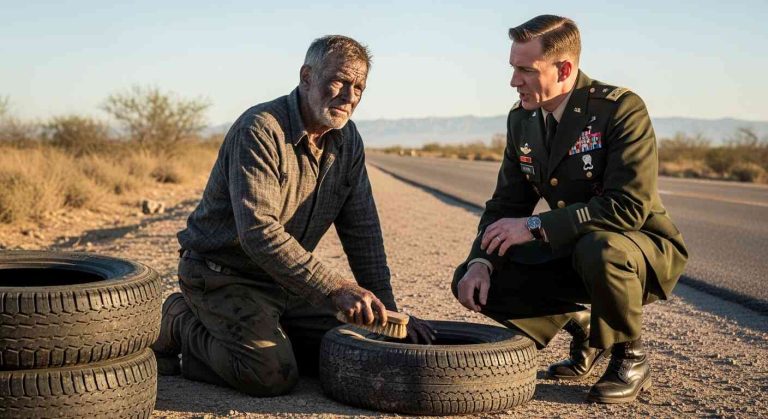
Elias didn’t look up. He couldn’t. His knees were locked into the cold, damp pavement, and his fingers were numb from the November chill. He just kept the brush moving against the grime of the 4:15 bus from Chicago.
“I heard you, Derek,” Elias said softly. His voice was like gravel under a boot—low, steady, and tired.
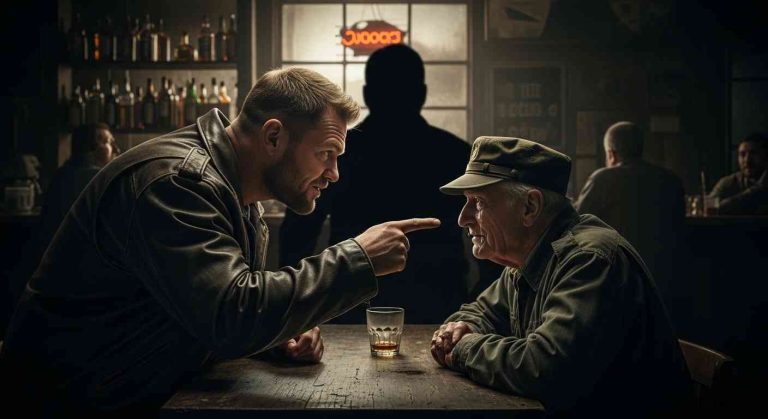
“That’s ‘Mr. Miller’ to you, grease monkey,” Dix snapped. He dropped the crumpled bag. It hit the puddle right next to Elias’s hand, splashing grey water onto his worn coveralls. “You’re lucky I even let a drifter like you hang around. Most people would have called the cops on a guy who looks like a walking heart attack.”
Elias paused. He looked at the bag. He looked at his own hands—scarred, calloused, and currently covered in the filth of a thousand miles of road. These were the same hands that had once held a sniper rifle in the Hindu Kush. The same hands that had pulled a bleeding young lieutenant out of a burning Humvee while RPGs whistled overhead.
But in Oakhaven, Oregon, nobody knew that. In Oakhaven, he was just the guy who scrubbed the wheels for five bucks an hour and a place to sleep in the back shed.
“I’ll get it,” Elias whispered.
“You’re damn right you will,” Dix laughed, turning to his two buddies who were loitering by the vending machines. “Hey boys, watch this. It’s like a circus act. The more you treat ’em like dogs, the more they wag their tails.”
One of the boys, a kid no older than twenty with a backwards cap, threw a handful of cigarette butts toward the tire Elias was cleaning. “Fetch, old man!”
Elias closed his eyes for a second. The humiliation didn’t sting as much as it used to. When you’ve lost everything—your wife to cancer, your pension to a corrupt lawyer, and your pride to a country that forgot you—a few cigarette butts don’t feel like much.
But then, the ground began to vibrate.
It wasn’t the rhythmic thrum of a Greyhound bus. This was deeper. Heavier. A low-frequency growl that shook the coffee in Dix’s hand and rattled the windows of the station.
A line of black SUVs, led by a massive military transport vehicle with government plates, swerved into the station lot. They didn’t park. They tactical-maneuvered, blocking the exit and the entrance, effectively turning the bus station into a fortress.
The laughter died in Dix’s throat. His face went from arrogant pink to a sickly, translucent white.
“What the hell is this?” Dix stammered, his voice jumping an octave. “We didn’t call for a parade.”
A door slammed. Then another. Men in crisp, desert-tan fatigues stepped out, their faces stone-cold. But it was the man from the lead SUV who stopped the world.
Four stars glinted on his shoulders. He walked with a limp—a limp Elias recognized.
The General didn’t look at the station. He didn’t look at the crowd of stunned travelers. His eyes were locked on the man kneeling in the dirt, surrounded by trash and dirty water.
Dix, trying to salvage his ego, stepped forward. “Excuse me, Officer… General… whoever you are. You can’t park here. This is a private—”
The General didn’t even look at him. He walked right past Dix, his polished boots splashing through the same puddle that had ruined Elias’s coveralls.
He stopped two feet from Elias.
The entire station went silent. The only sound was the idling engine of the lead SUV.
The General looked down at the brush in Elias’s hand. He looked at the trash scattered around him. He looked at the grease on Elias’s forehead.
And then, to the horror of Dix and everyone watching, the most powerful man in the regional command did something unthinkable.
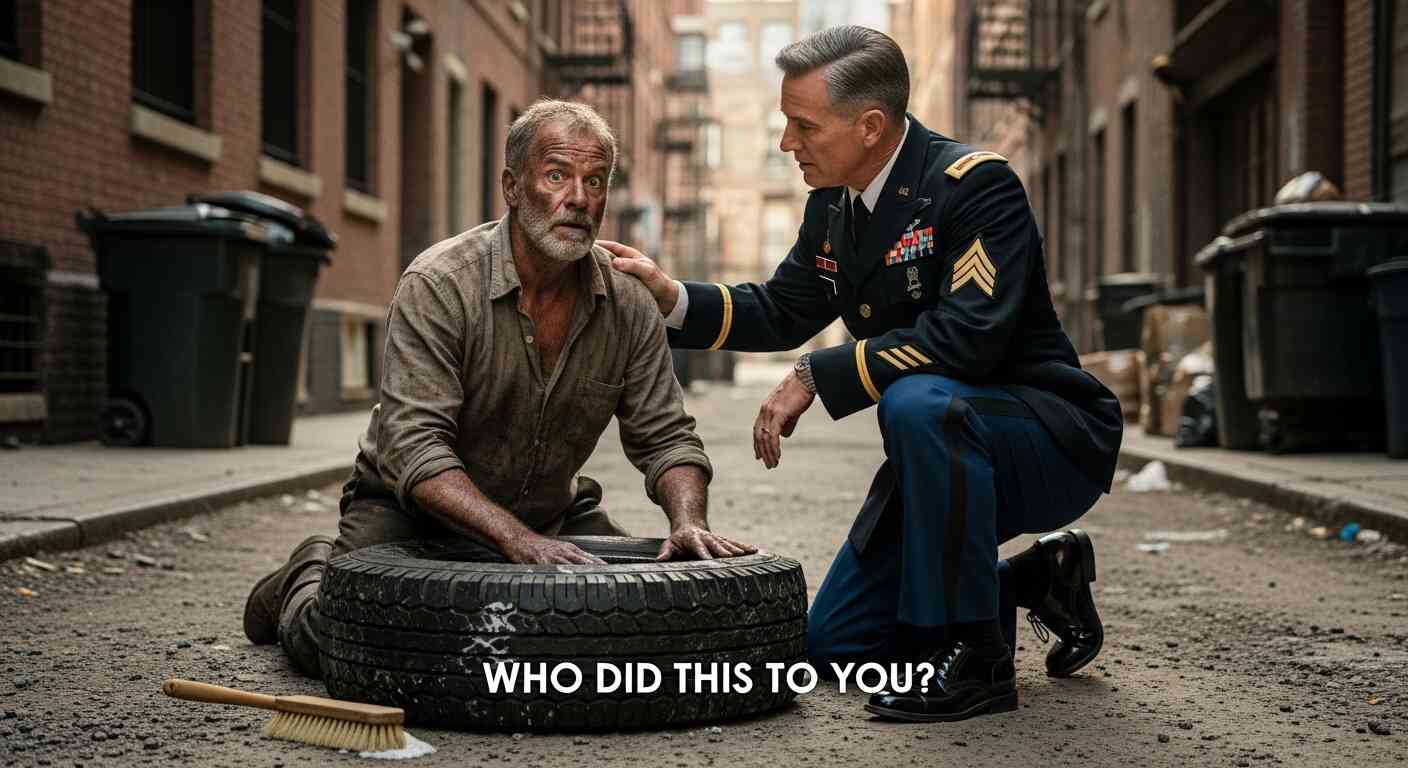
He knelt down. Right there in the mud.
“Master Sergeant Thorne?” the General asked, his voice thick with an emotion that sounded like heartbreak.
Elias finally dropped the brush. His voice trembled. “Marcus?”
The General’s jaw tightened. He looked at the trash on Elias’s shoulder. He looked back at Dix, who looked like he was about to faint.
“Who,” the General whispered, his voice vibrating with a terrifying, quiet fury, “laid a finger on my mentor?”
“FULL STORY
Chapter 1: The Weight of the Brush
Oakhaven was the kind of town people drove through on their way to somewhere better. It was a place of rusted swing sets, flickering neon signs, and people who had long ago traded their dreams for a steady paycheck and a numb heart.
Elias Thorne had arrived in Oakhaven three years ago with a duffel bag and a heavy silence. He hadn’t chosen it; his car had simply died there, and he didn’t have the energy to revive it. He’d taken the job at the bus station because it required no talking and no memories.
Every morning at 5:00 AM, Elias would walk from the small, unheated shed behind the station to the supply closet. He’d grab a bucket, a stiff-bristled brush, and a bottle of industrial-grade soap that smelled like a chemical fire.
The work was grueling. The buses came in coated in the salt of the Cascades or the red dust of the high desert. Elias’s job was to make sure the chrome shined and the wheels were black. It was honest work, but in the eyes of the town, it made him invisible. Or worse—a target.
Derek “Dix” Miller was the station manager by virtue of his father owning the franchise. He was a man who measured his worth by the height of his truck and the number of people he could make feel small. To Dix, Elias was a “”charity case.””
On this particular Tuesday, the air was damp and the sky was the color of a bruised plum. Elias was working on the rear tires of the Portland Express when Dix strolled out with his usual entourage of local hangers-on.
“”Look at him,”” Dix said, gesturing with a half-eaten donut. “”The human barnacle. Hey, Elias! I’m thinking of charging you rent for the puddle you’re sitting in.””
The boys with him laughed. One of them, a kid named Caleb whose father Elias used to buy hay from, looked away, but he didn’t stop the others.
Elias didn’t respond. He focused on the rhythm of the brush. Scrub, rinse, repeat. It was the same rhythm he’d used to clean his rifle in the valleys of Afghanistan twenty years ago. Back then, the rhythm meant survival. Now, it just meant dinner.
“”I’m talking to you, old man!”” Dix shouted, his ego pricked by the silence. He walked over and kicked the bucket. The soapy water surged over the rim, soaking Elias’s knees. “”You getting deaf? Or just stupid?””
“”I’m working, Derek,”” Elias said, his voice a low vibration.
“”You’re making a mess,”” Dix countered. He reached into his pocket, pulled out a handful of loose change, and tossed it into the dirty water. “”There. A tip. Now get on your knees and find it. I want to see you work for it.””
Elias looked at the coins shimmering at the bottom of the murky bucket. Something flickered in his chest—a spark of the man he used to be. The man who had commanded eighty soldiers. The man who had earned a Silver Star for holding a bridge alone for six hours.
But the spark died. That man was gone, buried under layers of grief and the crushing weight of a country that had no use for old soldiers who didn’t come home whole.
“”Leave it be, Derek,”” a voice called out.
It was Sarah. She ran the small diner across the street. She was one of the few people who ever looked Elias in the eye. Sometimes, she’d bring him a coffee and “”accidentally”” leave a sandwich on the bench.
“”Stay out of it, Sarah,”” Dix barked. “”Go flip a burger. This is station business.””
“”It’s bullying,”” she said, stepping onto the lot. She looked at Elias with a pity that hurt worse than Dix’s insults. “”Elias, come inside. I’ll get you some tea.””
“”He stays right here until these wheels are spotless,”” Dix sneered. He took a long drag of his cigarette and flicked the hot ash onto the back of Elias’s neck.
Elias flinched, the heat stinging his skin. He didn’t move. He just gripped the brush harder until his knuckles turned white.
“”You see that?”” Dix laughed to his friends. “”No spine. Just like I told you. You can do whatever you want to a guy like this, and he just takes it. He’s a born loser.””
That’s when the rumble started.
It wasn’t a sound at first. It was a vibration in the soles of their feet. The birds in the eaves of the station suddenly took flight. The glass in the diner windows across the street began to chatter.
A convoy of black vehicles rounded the corner, lights flashing but sirens silent. They moved with a terrifying precision, cutting off the exits like a closing trap.
Dix’s smirk began to fail. “”State police? What are they doing here?””
The lead vehicle, a massive armored SUV with a four-star flag on the fender, pulled to a stop exactly three feet from where Elias knelt in the dirt.
The door opened. A pair of highly polished jump boots hit the pavement.
General Marcus Vance stepped out. He was a man made of iron and scars. He looked around the drab, dirty station with a gaze that had scanned battlefields. When his eyes landed on Elias—on the grease, the trash, and the bucket of dirty water—his face transformed.
It wasn’t just anger. It was a profound, agonizing shame.
He walked toward them, his boots echoing like hammer strikes. Dix, realizing this was someone of immense importance, tried to put on his “”manager”” face.
“”Sir! Welcome to Oakhaven Station. If there’s some kind of security issue—””
The General didn’t even break stride. He didn’t look at Dix. He walked straight to the man in the dirt.
“”Master Sergeant?”” the General whispered, his voice cracking.
Elias looked up. For the first time in three years, the invisibility cloak was ripped away. He looked at the man he had trained, the man he had bled for, and the man he had once called a son.
“”Marcus,”” Elias said, his voice barely audible. “”You shouldn’t have come here.””
The General’s eyes swept over the scene—the cigarette ash on Elias’s neck, the coins in the bucket, the mocking faces of the local boys.
“”Who did this?”” the General asked. It wasn’t a question. It was an indictment.
He looked at Dix. Dix, who was now trembling so hard he nearly dropped his coffee.
“”I… I was just… he works for me…”” Dix stammered.
The General took a step toward him. The soldiers from the other vehicles moved in, a wall of camouflage and steel.
“”He doesn’t work for you,”” the General said, his voice a low, lethal growl. “”You aren’t fit to breathe the same air as this man. Do you have any idea who he is?””
Dix shook his head, his face a mask of pure terror.
“”This is the man who saved my life,”” the General said, leaning in until he was inches from Dix’s nose. “”And today, son, you’re going to find out exactly what happens when you disrespect a hero.””
FULL STORY
Chapter 2: The Ghost of the Valley
The silence in the bus station was absolute, save for the low hum of the idling SUVs. The townspeople who had gathered to watch the “”show”” now stood frozen, sensing the shift in the atmosphere. The air felt heavy, charged with the kind of electricity that precedes a lightning strike.
General Marcus Vance looked down at Elias again. The sight of his former mentor—the man who had been the bedrock of his military career—reduced to scrubbing tires in a backwater town was a knife to the heart.
“”Stand up, Elias,”” Marcus said, his voice softening but remaining firm.
Elias hesitated. He looked at his hands, then at the dirty pavement. “”I’m not… I’m not that man anymore, Marcus. Look at me.””
“”I am looking at you,”” Marcus replied. “”I see the man who carried me two miles through a live fire zone in the Helmand Valley. I see the man who taught me that a leader’s first duty is to his men, not his rank. Stand. Up.””
Slowly, painfully, Elias pushed himself off the ground. His joints creaked, and he had to steady himself against the side of the bus. Sarah, the diner owner, stepped forward to help, but a soldier gently blocked her path. This was a moment for the two men.
Once Elias was on his feet, Marcus turned back to Dix. The manager had backed up until he hit the brick wall of the station office.
“”You,”” Marcus said, pointing a finger that had signed deployment orders for thousands. “”What’s your name?””
“”D-D-Derek Miller, sir,”” Dix squeaked.
“”Well, Mr. Miller, I’ve spent the last eighteen months looking for Master Sergeant Thorne. He disappeared after his wife passed. He didn’t want the medals, he didn’t want the pension, and he certainly didn’t want the parades. He wanted to be left alone.””
Marcus took another step forward, his shadow looming over the smaller man.
“”But being left alone doesn’t mean being mistreated. It doesn’t mean being used as a footstool for a small-minded bully who thinks a little bit of authority gives him the right to be cruel.””
Marcus turned to one of his aides, a sharp-looking Colonel. “”Colonel, call the Department of Labor. Call the franchise headquarters for this station. I want a full audit of this facility’s employment practices. And call the local Sheriff. I want to discuss the harassment of a decorated veteran.””
“”Right away, General,”” the Colonel said, already reaching for his phone.
Dix’s eyes went wide. “”Wait! It was just a joke! We were just messing around. Elias knows that, don’t you, Elias?””
Elias looked at Dix. He saw the cowardice hidden behind the bluster. He saw the same kind of man who, in the heat of battle, would be the first to run and the first to claim credit for the victory of others.
“”It wasn’t a joke, Derek,”” Elias said quietly. “”You enjoyed it. You enjoyed making someone feel like they were nothing.””
The General nodded. “”The worst kind of cruelty is the kind directed at those who can’t fight back. But the thing you didn’t realize, Mr. Miller, is that Elias Thorne can fight back. He just chose not to. Because he’s a better man than you’ll ever be.””
The General turned to his men. “”Secure the perimeter. No one leaves this lot until the Sheriff arrives. I want statements from everyone who saw what happened here today.””
The two boys who had been with Dix tried to slip away toward the back of the station.
“”Stay right where you are!”” a Sergeant barked, his hand resting on his holster. The boys froze, their bravado evaporating instantly.
Marcus turned back to Elias. He reached out and placed a hand on Elias’s shoulder, right where the trash had hit him moments before. With a gentle motion, he brushed away a stray piece of paper and a bit of ash.
“”I’m sorry it took me so long to find you, Elias,”” Marcus whispered, his eyes shining with unshed tears. “”The world has a way of losing the people it needs the most.””
Elias looked at the General—the boy he’d trained, now a man of immense power. “”I didn’t want to be found, Marcus. I didn’t want to be a ‘hero’ anymore. I just wanted to disappear.””
“”I know,”” Marcus said. “”But heroes don’t get to disappear. Not while the rest of us still need to learn from them.””
The General looked around the drab station one last time. “”Pack your things, Elias. You’re coming with me.””
“”I don’t have much,”” Elias said with a faint, weary smile.
“”Good,”” Marcus replied. “”We’re going to start fresh. But first…””
The General turned his head toward Dix, who was now being questioned by two grim-faced soldiers.
“”First, we’re going to make sure Oakhaven remembers this day. Not as the day the General came to town, but as the day they realized they’d been throwing trash at a giant.””
FULL STORY
Chapter 3: The Broken Compass
While the soldiers processed the scene, Elias led Marcus to the small shed behind the station. It was a cramped, miserable space, smelling of damp wood and old oil. A single cot stood in the corner, covered by a thin, moth-eaten wool blanket. On a small crate served as a table, there was a single framed photograph—Elias’s wife, Martha, smiling in a garden that had long since turned to weeds.
Marcus stood in the doorway, his broad shoulders nearly touching both sides of the frame. He looked at the conditions his mentor had been living in, and his jaw set into a hard, pained line.
“”You lived here?”” Marcus asked, his voice strained. “”For three years?””
“”It’s quiet,”” Elias said, folding his few shirts with practiced military precision. “”No one asks questions. When Martha died… the house felt too big. The memories felt too loud. Here, there was nothing but the sound of the buses. It helped me forget.””
“”Forget what? That you matter?”” Marcus stepped into the room, his presence making the shed feel even smaller. “”Elias, after you retired, you had a full pension waiting. You had medical benefits. You had a community.””
“”I had a community of people who saw me as a symbol, not a man,”” Elias countered, looking up from his packing. “”Every Veterans Day, they’d want me to wear the uniform. They’d want me to tell the ‘glory’ stories. But they didn’t want to hear about the nights I couldn’t sleep because I could still hear the screaming. They didn’t want to see the man who couldn’t even walk through a grocery store without checking the exits.””
He picked up the photo of Martha and stared at it. “”She was the only one who saw the man. When she left… the symbol was all that was left. And I hated him.””
Marcus sat on the edge of the cot. “”I get it. More than you think. After the valley, after what you did for me… I spent years trying to live up to that. I became a General because I thought that’s what a man saved by Elias Thorne should do. But every day I sit in a meeting or sign a paper, I feel like a fraud. Because I’m not the one in the dirt anymore. You are.””
“”You’re not a fraud, Marcus. You’re the result of the sacrifice. That’s what we do. We give our youth so others can have a future. You’re the future.””
Elias zipped his duffel bag. It was barely half full.
“”Is that it?”” Marcus asked.
“”That’s it.””
They walked back out into the main lot. The local Sheriff had arrived—a man named Miller (no relation to Dix) who looked overwhelmed by the presence of the military. He was currently listening to Sarah, who was gesturing wildly toward the bus where the bullying had occurred.
“”I’m telling you, Sheriff,”” Sarah said, her voice loud enough for everyone to hear. “”Derek has been riding that man for years. Pushing him, calling him names, throwing things. We all saw it. And we all stayed quiet because we didn’t want trouble with the Millers.””
She looked at Elias as he approached with the General. Her eyes were red. “”I’m so sorry, Elias. I should have said something sooner. I should have done more than just bring you sandwiches.””
Elias stopped in front of her. For the first time, he smiled—a real, genuine smile that reached his tired eyes. “”The sandwiches kept me going, Sarah. Don’t apologize for being the only person in this town with a heart.””
The Sheriff stepped forward, tipping his hat to the General. “”General Vance, I’ve taken the statements. We’re looking at harassment charges, and possibly more given the employment situation. Mr. Miller’s father is on his way, but I can tell you right now, things are going to change around here.””
“”Good,”” Marcus said. “”Because I’ll be checking. Personally.””
Dix was sitting on a bench, handcuffed, his head in his hands. His “”friends”” were long gone, having been escorted off the property with a stern warning. The arrogance that had defined Dix for years had been replaced by a hollow, pathetic fear.
Elias walked over to him. The soldiers guarding Dix stepped back, giving Elias space.
Dix looked up, his face tear-streaked. “”Elias… please. Tell them it was nothing. I’ll give you a raise. I’ll make you the assistant manager. Just don’t let them ruin me.””
Elias looked at the man who had tormented him. He didn’t feel anger. He didn’t even feel satisfaction. He just felt a profound sense of pity.
“”You don’t get it, Derek,”” Elias said softly. “”You didn’t ruin me because you weren’t big enough to do it. And I’m not the one ruining you. You did that yourself the moment you decided that another person’s dignity was yours to play with.””
Elias turned his back on him and walked toward the General’s SUV.
“”Wait!”” Sarah called out. She ran over and handed Elias a small, brown paper bag. “”For the road. It’s the good ham. And extra pickles.””
Elias took the bag, his eyes glistening. “”Thank you, Sarah.””
As he climbed into the back of the armored vehicle, he looked out at the Oakhaven Greyhound Station one last time. He saw the bucket of dirty water, still sitting by the tire of the Portland Express. He saw the brush lying in the mud.
He realized then that he wasn’t just leaving a job. He was leaving a grave he had dug for himself.
“”Where to, Master Sergeant?”” Marcus asked as the driver started the engine.
Elias leaned back against the leather seat, the first comfortable thing he’d felt in years. “”Somewhere with a garden, Marcus. Martha always wanted a garden.””
The convoy began to move, the black vehicles gliding out of the lot with the same precision they had arrived with. Behind them, the town of Oakhaven watched in stunned silence as the man they thought was “”just a bum”” disappeared into the sunset, flanked by the power of the nation he had served in silence.
FULL STORY
Chapter 4: The Sound of Silence
The drive out of Oregon was quiet. The hum of the SUV was a stark contrast to the rattling, coughing engines of the Greyhound buses Elias had spent years cleaning. For the first hour, he simply stared out the window, watching the rainy pines of the Northwest give way to the rugged beauty of the mountains.
Marcus sat beside him, typing occasionally on a secure tablet but mostly just being present. He knew Elias needed the silence. He knew that for a man who had been “”invisible”” for so long, the sudden transition back into the world of importance was jarring.
“”We’re heading to a VA-certified recovery center in Virginia first,”” Marcus said eventually, breaking the quiet. “”Not the kind you’re thinking of. It’s a quiet place. High security, but lots of land. They specialize in ‘re-entry’ for guys like us.””
Elias nodded. “”The ‘Broken Soldiers’ club.””
“”The ‘Unsung Heroes’ club,”” Marcus corrected. “”You’ve got a lot of back pay coming to you, Elias. Three years of Master Sergeant pension plus combat bonuses that were never processed because of a clerical error at the Pentagon. You’re a wealthy man.””
Elias let out a dry, short laugh. “”Wealthy. I’ve got three shirts and a picture of my wife in a duffel bag, Marcus. What am I going to do with money?””
“”Whatever you want. Buy that garden. Travel. Or just sit on a porch and watch the world go by without having to scrub it first.””
Elias looked at his hands. The grease was gone—the soldiers had given him industrial wipes before they left—but the stains in the creases of his skin remained. They were like a map of his time in the wilderness.
“”Why did you keep looking for me?”” Elias asked suddenly. “”It would have been easier to just let me stay lost. I’m an old man, Marcus. My war ended a long time ago.””
Marcus turned off his tablet and looked Elias directly in the eye. “”My war didn’t end, Elias. Because every time I had to make a hard choice, every time I had to send young men into a situation I knew some of them wouldn’t come back from, I asked myself: What would Master Sergeant Thorne do?””
He paused, his voice dropping an octave. “”And then I realized I didn’t know the answer anymore because I’d let the man who taught me everything disappear. I felt like I was losing my moral compass. Finding you wasn’t just about helping you. It was about saving myself.””
Elias felt a lump form in his throat. He’d spent so long thinking he was a burden, a relic of a violent past that the world wanted to forget. To hear that he was still a compass for someone as powerful as Marcus Vance… it was a weight he hadn’t prepared to carry.
“”I’m not a hero, Marcus,”” Elias whispered. “”I’m just a guy who survived.””
“”In our line of work, Elias, surviving with your soul intact is the heroism.””
They stopped at a secure military airfield in Idaho to catch a transport plane. As the SUV pulled onto the tarmac, a small detail of soldiers stood at attention. They weren’t there for the General. They had been briefed on who was in the car.
As Elias stepped out, the young Lieutenant in charge of the detail snapped a salute so sharp it seemed to ring in the air.
Elias froze. He hadn’t been saluted in years. He felt the old instinct kick in—the straightening of the spine, the squaring of the shoulders. He looked at the young man, whose eyes were wide with a mix of awe and respect.
Slowly, Elias raised his hand. His fingers were stiff, and his joints ached, but the salute he returned was perfect. It was the salute of a Master Sergeant.
“”Welcome back, Sergeant,”” the Lieutenant said.
Marcus watched from the side, a small, proud smile on his face. He saw the transformation happening in real-time. The “”bum”” from the bus station was receding, and the warrior was stepping back into the light.
But as they boarded the plane, Elias felt a wave of exhaustion hit him. It was the exhaustion of a man who had been holding his breath for three years and had finally been told he could breathe. He slumped into the mesh seat of the C-130 and, for the first time since Martha’s funeral, he fell into a deep, dreamless sleep.