“FULL STORY: CHAPTER 5
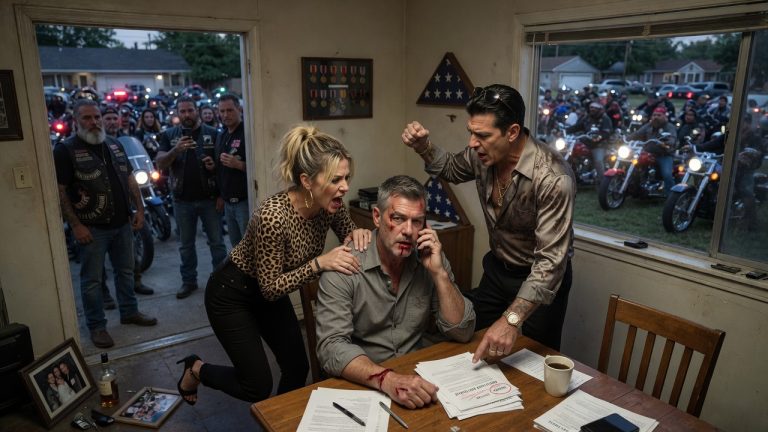
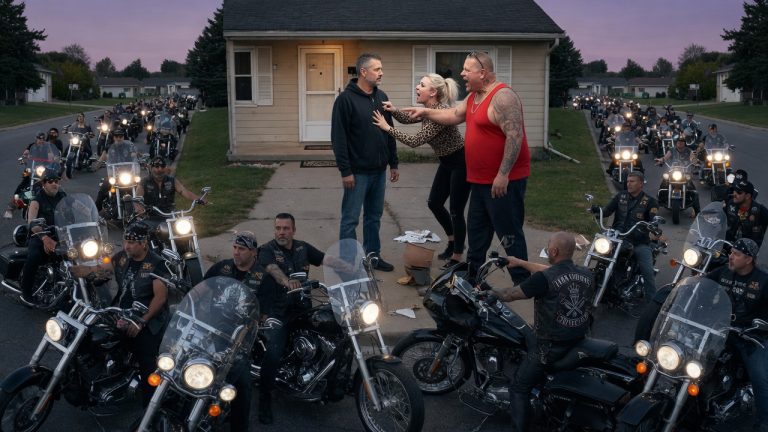
The fallout from the “”Maple Street Stand-Off,”” as the local papers began to call it, was swifter than anyone expected. With 1,500 witnesses and Sarah’s meticulous recordings, Miller didn’t have a leg to stand on. His lawyer tried to argue “”civilian intimidation,”” but the video footage from a dozen different doorbells showed the truth: the 1,500 men hadn’t touched him. They hadn’t even raised their voices. They had simply existed in his space until his own guilt crushed him.
But the story wasn’t just about Miller anymore. It had gone viral. People from all over the country were sharing the footage of the silent wall of men. It became a symbol of something people were hungry for: accountability.
Three days after the arrest, I was at the local diner, The Rusty Spoon, grabbing a burger with Marcus. The atmosphere was buzzing. People who used to keep their heads down were talking loudly, laughing, and shaking hands.
“You see the news?” Marcus asked, nodding toward the TV mounted over the counter.
The headline read: LOCAL PRECINCT CLEANUP: THREE MORE ARRESTS IN CORRUPTION SCANDAL.
“Halloway is moving fast,” I said, taking a sip of my coffee. “He’s a good man. He just needed to know the community had his back.”
“Speaking of community,” Marcus leaned in, “We’ve got a problem.”
I raised an eyebrow. “What kind of problem?”
“The Guardians. Since the video went out, my phone hasn’t stopped ringing. Every vet, every retired cop, every blue-collar guy in three counties wants in. We’re not 1,500 anymore, Elias. We’re heading toward 5,000.”
I rubbed my jaw. Power is a dangerous thing. I’d seen it corrupt better men than Miller. “We have to be careful, Marcus. We’re not a militia. We’re a neighborhood watch with teeth. We start letting everyone in, we lose the core. We lose the heart.”
“I know,” Marcus agreed. “That’s why I’m vetting them all personally. But Elias… there are other ‘Millers’ out there. I’m getting calls from three towns over. A developer trying to illegally evict a widow. A shopkeeper being shaken down by a local gang. People are asking for the 1,500.”
I looked out the window. Across the street, I saw Sarah. She was walking into the grocery store, and for the first time, she wasn’t rushing. She was stopping to talk to people. She looked safe.
“We help where we can,” I said. “But we do it the right way. No violence. No shadows. We show up, we stand tall, and we let the truth do the heavy lifting.”
Saturday morning arrived, and as promised, the street in front of Sarah’s house looked like a construction site. But it was the most organized construction site in history.
Men were unloading lumber, cans of ‘eggshell white’ and ‘baby blue’ paint, and a crib that had been donated by a local furniture store owner who’d heard the story.
I stood on the sidewalk, directing traffic, when a black sedan pulled up. Out stepped a woman in a sharp suit—the District Attorney, Elena Vance.
“Mr. Thorne,” she said, walking up to me. “I was hoping I’d find you here.”
“DA Vance. Here to help with the painting?”
She smiled, but it was professional. “Not today. I’m here to tell you that Miller is talking. He’s trying to cut a deal. He’s naming names—not just in the police department, but in the city council. It goes deep, Elias. The ‘neighborhood fees’ were funding a lot of local campaigns.”
“I figured as much,” I said. “Men like Miller don’t grow that big without someone watering the soil.”
“I’m going to need your men,” she said. “Not as a wall this time, but as witnesses. I need the stories of everyone who was targeted. I need them to come forward without fear.”
I looked at the house, where Sarah was laughing as Marcus tried to figure out how to assemble a high chair.
“They’ll come,” I promised. “Every single one of them.”
As the sun reached its peak, the nursery was finished. It was perfect. But more than that, the house was full of life. There was a barbecue going in the backyard, the smell of charred burgers and sweet corn filling the air.
I stood back, watching the 1,500—or at least the hundred or so who had shown up to work—interacting with the neighbors. There was no “”us”” and “”them”” anymore. There was just “”us.””
I felt a presence beside me. It was Sarah. She handed me a cold bottle of water.
“You did more than save my house, Elias,” she said softly. “You saved my faith in people. I was ready to pack up and leave. I didn’t want to raise my son in a place like this.”
I looked at her, then at the strong, capable men and women surrounding us. “It’s not the place that’s the problem, Sarah. It’s the silence. All it takes for a bully to win is for everyone else to be quiet.”
“Well,” she smiled, rubbing her belly. “I don’t think this town will be quiet ever again.”
FULL STORY: CHAPTER 6
The final chapter of the Miller saga didn’t happen in the streets, but in a wood-paneled courtroom downtown.
The room was packed. Usually, these kinds of hearings are empty affairs, attended only by lawyers and bored journalists. But today, the gallery was a sea of leather jackets and flannel shirts. The Iron Guardians had filled every seat, and hundreds more stood in the hallways and on the courthouse steps.
Miller was led in wearing an orange jumpsuit. Without his uniform, without his gun, he looked shrunken. He refused to look at the gallery. He kept his eyes fixed on the floor.
One by one, the witnesses stood up.
Mrs. Gable spoke about the medication she couldn’t afford because Miller had “”fined”” her for a broken taillight that wasn’t broken.
Mr. Henderson spoke about the fear of walking to his mailbox.
And then, Sarah stood up.
She didn’t cry this time. She spoke with a calm, icy precision that made the court reporter stop typing for a second just to listen. She detailed the moment Miller had pressed his finger into her shoulder. She described the terror of feeling her unborn child kick in response to her pain.
When she finished, the silence in the courtroom was absolute.
The judge, a stern woman with thirty years on the bench, looked down at Miller. “Officer Miller—I refuse to call you that. Mr. Miller. You were given a trust. You were given the power of the state to protect the vulnerable. Instead, you used it to prey upon them. You are not a victim of a ‘civilian mob.’ You are a victim of your own arrogance.”
The sentence was the maximum: fifteen years in state prison, with no possibility of parole for the first ten.
As the bailiffs led him away, Miller finally looked up. His eyes met mine. I didn’t feel triumph. I didn’t feel joy. I just felt a deep, settled sense of justice. I gave him a slow, single nod.
The message was clear: We are still here. And we will always be here.
Outside the courthouse, the sun was shining bright. The 1,500 men had formed a corridor from the doors to the street. As Sarah walked out, they didn’t cheer. They simply stood at attention, a silent guard of honor for the woman who had been brave enough to speak first.
A month later, I got a call in the middle of the night. It was Sarah.
“Elias? It’s time.”
I didn’t need to ask. I was at the hospital in twenty minutes. I wasn’t the only one. Marcus was there. Mrs. Gable was there. In the waiting room, twenty members of the Iron Guardians sat in the plastic chairs, drinking terrible hospital coffee.
At 4:14 AM, the doors opened. A nurse came out, smiling. “Healthy baby boy. Eight pounds, six ounces.”
The waiting room erupted. These tough, hardened men were hugging each other, wiping away tears they’d swear weren’t there the next day.
They named him Leo Elias.
Two weeks later, the real Leo came home.
The entire town showed up for the homecoming. We lined the streets from the airport all the way to their front porch. When the black car pulled up and the young soldier stepped out, he stopped dead.
He saw his wife holding his son. He saw his house, freshly painted and glowing in the sun. And then he saw us. 1,500 men, standing shoulder to shoulder, protecting his peace while he was gone.
Leo walked over to me, his uniform crisp, his eyes wet. He tried to salute, but I grabbed his hand and pulled him into a hug instead.
“Thank you, Elias,” he choked out. “Thank you for taking care of them.”
I looked at the massive brotherhood I’d helped build—the men who had proven that when the good stand together, the wicked have nowhere to hide.
“We didn’t just take care of them, Leo,” I said, looking at the town we’d reclaimed. “We took care of home.”
The final sentence of the story was written not in a notebook, but in the hearts of everyone who watched that young father hold his son for the first time.
Because a badge might represent the law, but a brotherhood represents the soul of a nation.
Justice isn’t something you wait for; it’s something you build together.”