The tray hit the floor with a clatter that sounded like a gunshot in the crowded cafeteria.
I didn’t even have time to look up before the first slap landed. It wasn’t just a hit; it was a message. Connor Vance, the kid whose father basically owned this town, stood over me with a grin that didn’t reach his eyes.
“Trash belongs in the bin, Leo,” he sneered. His friends, the “princes” of Oak Ridge High, erupted in laughter.
Before I could breathe, they grabbed the collar of my thrift-store hoodie and dragged me toward the exit. I looked at the teachers. I looked at the principal, Mr. Sterling, who was standing by the vending machines. He just looked away, adjusted his tie, and pretended he was fascinated by a bag of pretzels.
They kicked me out of those double doors and into the freezing hallway, screaming that I was “garbage” and “a mistake.” I stood there shivering, the sting on my cheek turning into a dull, throbbing heat. I felt small. I felt invisible.
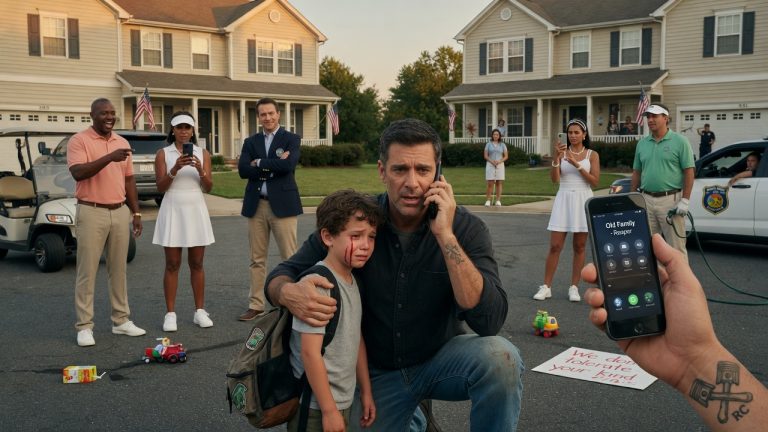
I pulled out my phone with shaking hands. I didn’t call the police. They wouldn’t do anything against a Vance. I didn’t call my mom; she was working a double shift at the hospital and already carried the weight of the world on her shoulders since Dad died.
I called the only man who ever told me that family isn’t just about blood—it’s about who shows up when the world turns dark.
“Uncle Mike?” I whispered, my voice breaking. “They did it again. But worse this time.”
There was a silence on the other end of the line—a heavy, vibrating silence that felt like a storm gathering over the mountains.
“Stay at the front gate, Leo,” Mike said. His voice was a low, dangerous rumble. “Don’t go back inside. Just wait. The Brotherhood is coming.”
I didn’t know what he meant. I thought he’d show up in his old truck to pick me up early.
I was wrong.
Thirty minutes later, the ground started to vibrate. It started as a low hum in my chest, then grew into a thunderous roar that drowned out the sound of the school bells.
I looked toward the main road, and my heart nearly stopped.
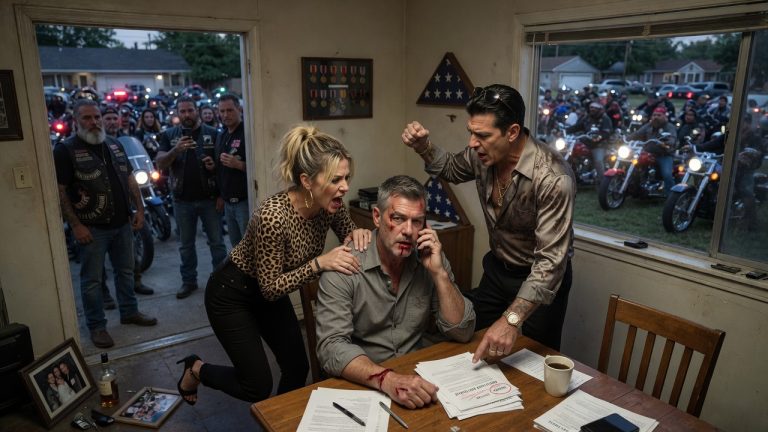
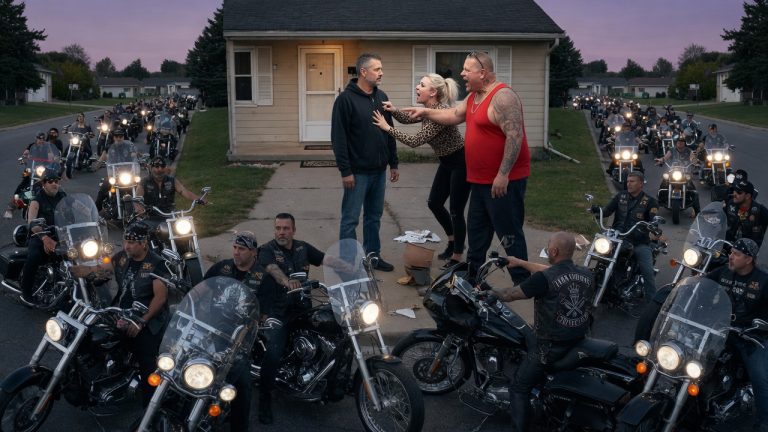
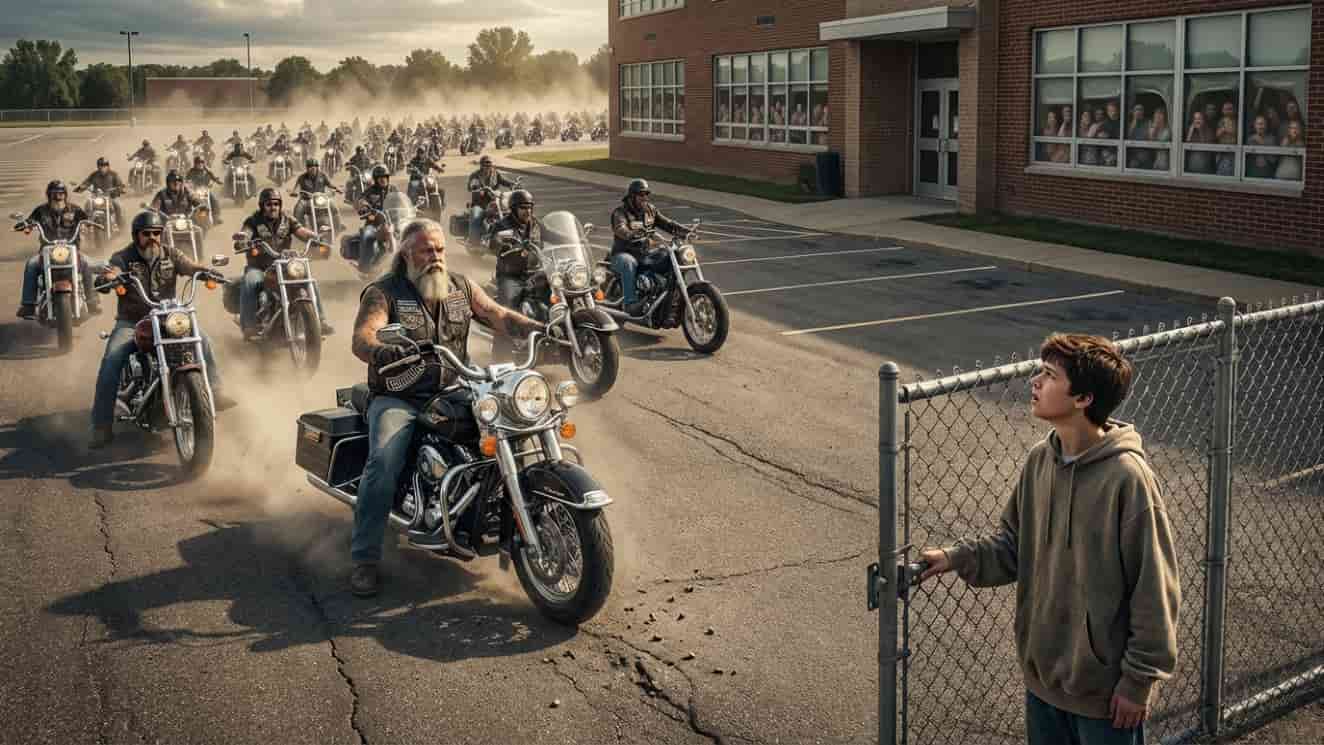
A sea of chrome, leather, and black steel was turning into the school driveway. Not ten bikes. Not fifty. Three hundred bikers, riding in a formation so tight it looked like a literal wall of iron. Every single one of them wore the “Iron Justice” patch.
At the front was Mike, his silver beard catching the light, his eyes locked on the school doors. He didn’t look like my uncle who grilled burgers on Sundays. He looked like an avenging god.
The roar of three hundred Harleys echoed off the brick walls of Oak Ridge High, shattering the windows of the silent classrooms. Every student, every bully, and every coward of an administrator ran to the windows to see the storm that had just arrived.
And for the first time in my life, I wasn’t the one who was afraid.
FULL STORY
Chapter 1: The Echo of a Slap
The air in the Oak Ridge High cafeteria always smelled like stale floor wax and disappointment. For Leo Miller, it was a minefield.
He sat at the “Island of Misfits,” a small, wobbly table near the kitchen doors where the noise of the industrial dishwasher usually drowned out conversation. His only companion was Sam, a kid with thick glasses and a nervous habit of shredding napkins.
“Just three more months, Leo,” Sam muttered, staring at his lukewarm pizza. “Then we graduate. Then we’re ghosts. They can’t hurt ghosts.”
“I’m already a ghost, Sam,” Leo replied, his voice barely audible.
He was wearing a hoodie that had belonged to his father—a man who had been a mechanic, a veteran, and a hero until a distracted driver took him away three years ago. The sleeves were frayed, but it was the only thing that made Leo feel like he had a suit of armor.
That armor was pierced seconds later.
Connor Vance didn’t walk; he swaggered. He was the quarterback, the son of the district’s biggest donor, and the undisputed king of a hierarchy built on cruelty. He stopped at Leo’s table, flanked by two other boys whose identities seemed entirely tied to how loudly they could laugh at Connor’s jokes.
With a casual, practiced motion, Connor reached down and flipped Leo’s tray.
The sound was explosive. Spaghetti and gray-looking meat sauce splattered across Leo’s chest, staining his father’s hoodie.
“Oops,” Connor said, his voice dripping with mock sympathy. “Looks like the trash spilled itself.”
Leo felt the heat rise in his neck. He didn’t look up. He knew the rules. If you looked up, they took it as a challenge. If you looked down, they eventually got bored. But today, Connor wasn’t bored.
“Look at me when I’m talking to you, Miller,” Connor hissed.
Leo slowly raised his head. His blue eyes were glassy, reflecting the fluorescent lights above. “Please, Connor. Just leave it.”
Slap.
The sound echoed through the entire room. The cafeteria, which had been a roar of five hundred voices, went dead silent. Leo’s head snapped to the side. The sting was immediate, a sharp, white-hot bloom of pain across his cheek.
“You don’t tell me what to do,” Connor said. He grabbed Leo by the hood, dragging him out of the chair. Sam tried to stand up, but one of Connor’s friends put a heavy hand on his shoulder, shoving him back down.
Leo was dragged across the linoleum, his shoes squeaking. He looked toward the staff table. Mrs. Gable, the English teacher who always spoke about “courage” in literature, looked at her lap. Mr. Sterling, the principal, turned his back to “check” the beverage cooler.
They didn’t see. They chose not to see.
Connor threw Leo against the double doors leading to the hallway. “You’re an eyesore, Miller. Your dad was a grease monkey, and you’re just a stain. Get out of my sight before I really lose my temper.”
He kicked Leo’s backpack out after him, the zippers clattering. The doors swung shut, but not before Leo heard the roar of laughter from the students inside.
He stood in the empty hallway, the silence more painful than the slap. He felt the sauce soaking through his shirt, cold against his skin. He felt the shame, heavy as lead in his stomach.
He walked to the school’s front entrance, his legs shaking. He sat on the concrete steps, the March wind biting through his damp clothes. He pulled out his phone.
He didn’t want revenge. He just wanted to feel like he existed.
He called his Uncle Mike.
Mike wasn’t his father’s brother by birth. They had served together in the 101st Airborne. When Leo’s dad died, Mike had been the one to hold his mother’s hand at the funeral. He was a man of few words, a man who smelled of motor oil and Marlboros, and the only person who still looked at Leo like he was worth something.
“Mike?” Leo choked out.
“Leo? Why aren’t you in class, kid?”
Leo told him. He told him about the slap. He told him about the principal looking away. He told him about the “trash.”
The line went silent. For a moment, Leo thought the call had dropped.
“Uncle Mike?”
“I hear you, Leo,” Mike finally said. His voice wasn’t loud, but it had a vibration to it, like a heavy engine idling. “I’ve been waiting for the school to handle this. I’ve been waiting for you to tell me it stopped. It hasn’t stopped.”
“I’m sorry,” Leo sobbed.
“Don’t you ever apologize for being hurt, Leo. You stay right there. On those steps. Do you hear me? Don’t move.”
“What are you going to do?”
“I’m calling the family,” Mike said. “The whole family.”
Chapter 2: The Ghost of the Garage
To understand why the ground shook that afternoon, you have to understand Mike “Big Mac” Mackenzie.
Mike lived on the edge of town in a house that was more garage than living space. He was the National President of the Iron Justice Motorcycle Club. In the media, groups like his were often painted with a dark brush, but in Oak Ridge, they were the ones who organized the “Toy Runs” for the orphanage and the “Guardians” who stood between grieving families and protesters at veteran funerals.
Mike was a man who believed in the “Social Contract.” You be kind, you work hard, and you mind your business. But if you break that contract—if you hurt someone who can’t fight back—the contract is void.
As soon as he hung up with Leo, Mike walked to the center of his garage. A massive map of the state hung on the wall, pinned with the locations of different chapters.
He didn’t hesitate. He hit a speed-dial button on his landline.
“Stitch,” Mike said when the call was answered. “It’s time. The Miller boy. They laid hands on him today at the school.”
On the other end, Stitch, a man who had lost an eye in Fallujah and found a home in the club, didn’t ask for details. “How many?”
“Everyone,” Mike said. “Call the Riverdale chapter. Call the Heights. I want a wall of steel around that school. We meet at the old trailhead in twenty minutes.”
“Copy that, Pres. We’re rolling.”
Mike walked over to his bike—a custom 1998 Harley Heritage Softail, blacker than a moonless night. He pulled his leather vest over his broad shoulders. On the back was the patch: a pair of scales balanced on a sword. Iron Justice.
He looked at a photo tucked into the corner of his workbench mirror. It was him and Leo’s father, both young, dusty, and grinning in a desert somewhere far away.
“I got him, brother,” Mike whispered.
Meanwhile, back at Oak Ridge High, the lunch period had ended. The hallways were filled with the usual chaos of teenagers moving to their next period.
Connor Vance was leaning against his locker, regaling a group of girls with a dramatized version of how he “put the Miller kid in his place.”
“He was literally crying,” Connor laughed, tossing a football into the air and catching it. “I did him a favor. Kid needs to learn how the real world works. You’re either a predator or you’re prey.”
At the end of the hall, Mr. Sterling, the principal, walked by. He saw Connor. He knew exactly what had happened in the cafeteria. But Connor’s father, Elias Vance, sat on the school board. Elias had just donated $200,000 for a new turf field.
Sterling cleared his throat and checked his watch. “Get to class, Mr. Vance,” he said with a weak, conciliatory smile.
“You got it, Coach,” Connor smirked.
No one noticed the faint vibration in the floorboards. No one heard the distant, rhythmic thrumming that sounded like a coming storm.
But out on the front steps, Leo Miller felt it. He sat with his head in his hands, but then he felt the concrete beneath his sneakers begin to hum. He looked toward the horizon.
The sun caught the chrome first.
A single headlight turned onto the long, winding road that led to the school. Then two. Then ten. Then a swarm.
It was a formation of motorcycles so large it stretched back as far as the eye could see. They weren’t speeding; they were marching. The sound was a physical weight, a low-frequency roar that rattled the teeth in Leo’s head.
He stood up, his heart hammering against his ribs. He saw the “Iron Justice” colors. He saw the grim, determined faces of men and women who looked like they were riding into battle.
The first bike, Mike’s bike, pulled right up to the curb where the “No Parking” signs were posted. He didn’t care. Behind him, the bikes peeled off in perfect synchronization, filling every parking spot, every fire lane, and the entire front lawn of the school.
Three hundred engines. Three hundred heartbeats of pure, unadulterated thunder.
The school went silent. The teachers stopped talking. The students froze at the windows.
The Brotherhood had arrived.
Chapter 3: The Wall of Steel
The principal’s office had a large window that overlooked the parking lot. Mr. Sterling was mid-sentence, lecturing a freshman about a late library book, when the roar hit his office.
The pens on his desk started to dance. A framed picture of his wife tilted to the left.
“What in the hell…” Sterling muttered, stepping to the window.
His face went from a healthy pink to a sickly, translucent white. He saw the bikes. He saw the leather. He saw the sheer, overwhelming presence of three hundred men and women who looked like they hadn’t smiled since the nineties.
“Call the police,” Sterling barked at his secretary through the intercom.
“Sir,” the secretary’s voice came back, trembling. “The police are already here. Officer Miller is one of them. He’s… he’s getting off his motorcycle and hugging the leader.”
Sterling felt a cold sweat break out. He realized, with a sinking feeling, that the “Iron Justice” weren’t just random bikers. They were the local mechanics, the construction workers, the off-duty cops, and the veterans of Oak Ridge.
Outside, Leo stood paralyzed. The roar died down as, one by one, the bikers cut their engines. The sudden silence was even more intimidating than the noise.
Mike dismounted his bike. He didn’t look at the school. He looked at Leo.
He walked up the steps, his heavy boots echoing. He reached out a massive hand and gently tilted Leo’s face up. He saw the red welt on the boy’s cheek. He saw the spaghetti sauce on the sacred hoodie.
Mike’s jaw tightened. “You okay, Leo?”
“I am now,” Leo whispered.
“Stitch!” Mike shouted without turning around.
“Yeah, Pres?” A massive man with a grey ponytail and a scarred face stepped forward.
“Keep the perimeter. Nobody enters, nobody leaves until we’re done. And get some of the guys to clear a path. We’re going inside.”
“Wait, Uncle Mike,” Leo said, grabbing his arm. “You can’t. You’ll get in trouble.”
Mike looked at the school doors—the doors that had failed to protect his brother’s son. “Leo, sometimes the only way to fix a broken house is to walk through the front door and show them where the foundation is rotting.”
At that moment, the double doors creaked open. Mr. Sterling stepped out, flanked by two nervous security guards.
“Now see here!” Sterling shouted, his voice cracking. “This is private property! You are trespassing on school grounds! I have already called the authorities!”
Stitch stepped forward, pointing to a biker in the third row who was wearing a police uniform under his leather vest. “Officer Miller is right there, Principal. He says we’re just here for a ‘parent-teacher conference.'”
The bikers chuckled—a low, dark sound.
Mike stepped toward Sterling. Mike was six-foot-four and built like an oak tree. Sterling looked like a ball of dough in a cheap suit.
“Mr. Sterling,” Mike said, his voice deceptively calm. “My name is Michael Mackenzie. I’m Leo’s legal guardian. We’re not here for trouble. We’re here for an accounting.”
“An accounting?” Sterling stammered.
“My nephew was assaulted in your cafeteria today,” Mike said. “He was humiliated. He was called ‘trash.’ And from what I understand, you watched it happen and chose to do nothing.”
“That’s… that’s a misrepresentation of the facts!” Sterling argued, though his eyes were darting toward the sea of bikers.
“The facts are written on the boy’s face,” Mike said, gesturing to Leo. “Now, we can do this the easy way, or we can do this the Iron Justice way. The easy way is you take us to the boy who did this. Right now.”
“I can’t just—”
Mike took one more step. The air between them seemed to vibrate. “The Iron Justice way involves me calling the local news, the school board, and three hundred people staying on this lawn until you are fired for negligence. Which will it be?”
Sterling looked at the bikers. He looked at the determined, angry eyes of a community that was tired of his excuses.
“He’s in the gym,” Sterling whispered. “Fifth-period athletics.”
“Lead the way,” Mike said.
Chapter 4: The Long Walk
The walk through the hallways of Oak Ridge High was something Leo would never forget.
It wasn’t a riot. It was a procession.
Mike walked in the center, his hand on Leo’s shoulder. Flanking them were Stitch and four other senior members of the club. They didn’t shout. They didn’t break anything. They just were.
Students lined the hallways, their backs against the lockers. For months, these kids had watched Leo get shoved, tripped, and mocked. They had stayed silent out of fear. But now, they watched him walk with a phalanx of giants.
They reached the gym. The sounds of bouncing basketballs and whistles echoed from inside.
Mike didn’t knock. He pushed the heavy metal doors open.
The gym class froze. Connor Vance was at the free-throw line, mid-shot. The ball clattered off the rim and bounced away into the silence.
The gym teacher, a man named Coach Miller (no relation), blew his whistle. “Hey! Who the hell are you people?”
Mike didn’t even look at the coach. His eyes were locked on Connor.
Connor tried to maintain his “tough guy” persona. He crossed his arms and let out a forced laugh. “What is this? Leo brought his biker gang to play dress-up?”
The bikers didn’t react. Their silence was more terrifying than a threat.
Mike walked to the center of the court. He stopped ten feet from Connor. The boy was tall, athletic, and used to being the biggest person in the room. Beside Mike, he looked like a child.
“Connor Vance,” Mike said.
“That’s me. You want an autograph, Pops?”
Mike didn’t flinch. “I want to know why you think you have the right to lay a hand on my nephew.”
“He’s a freak,” Connor said, though his voice was a pitch higher than usual. “And he’s poor. Someone had to teach him his place.”
“His place?” Mike repeated. “His father died serving this country. He spends his weekends volunteering at the VA. He’s a better man at sixteen than you will ever be. And yet, you called him trash.”
“It was a joke,” Connor said, his eyes darting toward his friends. They were backing away, wanting no part of this.
“A joke,” Mike said. He turned to the Principal, who was cowering near the door. “Mr. Sterling, does your ‘zero tolerance’ policy cover ‘jokes’ that leave bruises?”
“I… we will handle this internally,” Sterling said.
“No,” Mike said, turning back to Connor. “You’re going to handle it right now. You see those men outside? Every one of them knows what you did. They aren’t here to hurt you. We don’t beat children. That’s your hobby, not ours.”
Mike leaned in, his voice dropping to a whisper that somehow carried across the entire gym.
“But from this moment on, you are invisible. You are the one who is trash in this town. Because every time you walk down the street, every time you go to a store, every time you try to bully a kid in this county, one of us will be watching. We are the shadows you’ll never get rid of.”
Connor’s lip began to tremble. The bravado was evaporating. He looked around for his father, for his status, for his power. He found nothing but the cold stares of three hundred people who were done with him.
“Apologize,” Mike commanded.
“What?”
“Apologize to Leo. For the slap. For the lunchroom. For every second of hell you put him through.”
Connor looked at Leo. For the first time, Leo didn’t look away. He stood tall, supported by the weight of the Brotherhood.
“I’m… I’m sorry,” Connor muttered.
“Louder,” Stitch growled from the sidelines.
“I’m sorry, Leo!” Connor shouted, his voice breaking into a sob. He was no longer the king of the school. He was just a scared kid who realized he had picked the wrong fight.
Chapter 5: The Truth Revealed
The confrontation in the gym was only the beginning.
As Mike and Leo turned to leave, a voice called out from the bleachers.
“It’s not just Connor!”
A girl named Maya, who had been bullied by Connor’s clique for her weight, stood up. Her face was flushed, but her eyes were bright.
“Mr. Sterling knows everything!” she shouted. “We’ve sent emails! Our parents called! He ignores it because Connor’s dad pays for the football uniforms!”
The dam broke.
“He took my phone and smashed it!” another boy shouted.
“They shoved me into a locker and locked it for three hours!” a girl in the back cried.
The Principal tried to speak, but the room was filled with the voices of the “invisible” children. Mike looked at Sterling. The man looked small, pathetic, and exposed.
“Looks like your ‘internal handling’ hasn’t been working, Principal,” Mike said.
At that moment, the gym doors opened again. A man in an expensive Italian suit marched in. It was Elias Vance, Connor’s father. He looked furious.
“What is the meaning of this?” Elias roared. “Sterling, why is there a riot in my school? And why are these… these people here?”
He gestured at the bikers with utter disgust.
Mike walked over to Elias. “We’re the ‘people’ who do the work your money can’t buy, Mr. Vance.”
“I’ll have you all arrested! I’ll buy this entire police department if I have to!” Elias screamed.
Officer Miller, the biker-cop, stepped forward. He pulled a small digital recorder from his pocket.
“Actually, Elias,” Officer Miller said, “I’ve been sitting in the back row. I’ve heard you threaten to ‘buy’ the police department. And I’ve heard about thirty students testify to the systematic abuse your son has been handing out—abuse you’ve been covering up through the school board.”
Elias turned pale. “That’s hearsay!”
“No,” Mike said. “That’s the end of the line. The school board is meeting tonight. And guess what? Three hundred bikers are going to be sitting in the front row of that meeting. We’re going to bring every one of these kids who has a story to tell. We’re going to make sure the world knows exactly what kind of ‘donations’ you’ve been making.”
Elias looked at his son, who was crying on the gym floor. He looked at the Principal, who had basically vanished into the shadows. He looked at Mike.
For the first time in his life, Elias Vance realized that money couldn’t silence a storm.
Mike turned back to Leo. “You ready to go, kid?”
“Yeah,” Leo said. “But I don’t want to ride in the truck.”
Mike grinned. It was the first time he had smiled all day. “Stitch! Get the spare lid!”
Chapter 6: The Sound of Freedom
The departure was even louder than the arrival.
Leo sat on the back of Mike’s Heritage Softail, wearing a heavy leather jacket that was three sizes too big and a matte black helmet.
As they pulled out of the parking lot, something happened that hadn’t happened in years at Oak Ridge High.
The students didn’t stay inside. They flooded the lawn. They weren’t cheering for the bikers—they were cheering for the idea that someone finally stood up. They were cheering for Leo.
The pack of three hundred bikes moved as one, a glittering, roaring river of steel. They didn’t head toward Leo’s house. They headed toward the hills.
They rode for an hour, the wind whipping past Leo, the vibration of the engine a comforting hum against his legs. He felt the weight of the last three years—the grief for his father, the fear of the hallways, the shame of being “trash”—slowly peel away and fly off into the wind.
They pulled over at a scenic overlook as the sun began to dip toward the horizon, painting the sky in bruises of purple and gold.
The three hundred bikers parked, but they didn’t break formation. They stood by their machines, a silent army of guardians.
Mike walked over to Leo and helped him take off the helmet.
“You okay, kid?”
Leo looked out over the valley. For the first time in a long time, he didn’t feel small.
“I didn’t know I had so many uncles,” Leo said, his voice thick with emotion.
Stitch walked over and clapped Leo on the shoulder. “The club doesn’t just ride for the road, Leo. We ride for each other. Your dad was a brother. That means you’re family. Always.”
That night, the school board meeting was the most attended event in the town’s history. Under the watchful, silent eyes of the Iron Justice, the board had no choice. Mr. Sterling was placed on administrative leave. Connor Vance was expelled. And a new committee was formed to ensure that “zero tolerance” actually meant something.
But Leo didn’t care about the meetings or the news reports.
He was back in his garage a week later, helping Mike change the oil on a bike. His father’s hoodie was clean now, the spaghetti stains gone, though the fraying sleeves remained.
“Uncle Mike?” Leo asked, looking up from the wrench.
“Yeah, Leo?”
“What happens if they try it again? If someone else thinks I’m trash?”
Mike stopped what he was doing. He looked at the boy—the boy who was starting to look more and more like his father every day.
“Then we’ll roar again,” Mike said firmly. “Because trash is something you throw away, Leo. But family? Family is something you never leave behind.”
Leo smiled, picked up the wrench, and got back to work. He wasn’t a ghost anymore. He was a Miller. And he knew that whenever the world got too loud, there were three hundred engines ready to drown out the noise.
The loudest sound in the world isn’t a motorcycle engine; it’s the silence of a man who knows he’s no longer alone.