Elias “Easy” Thorne is a man of the shadows, and not by choice. His eyes are failing, turning the world into a blur of grey Ohio fog and oil smoke. For years, he’s stayed quiet, turning wrenches for a motorcycle club that forgot his name the day his brother died in a prison cell for a crime they both committed.
Now, his granddaughter’s life hangs in the balance, and the only thing Elias has left is a 1978 Shovelhead he’s been rebuilding for a decade. But the bike holds more than chrome and steel. Hidden in its guts is the one thing that can burn the club to the ground—or buy his family a future.
In a town where loyalty is a death sentence, Elias has to decide: does he protect the “brothers” who abandoned him, or does he betray the only life he’s ever known to save a son who can’t even look him in the eye?
FULL STORY
Chapter 1
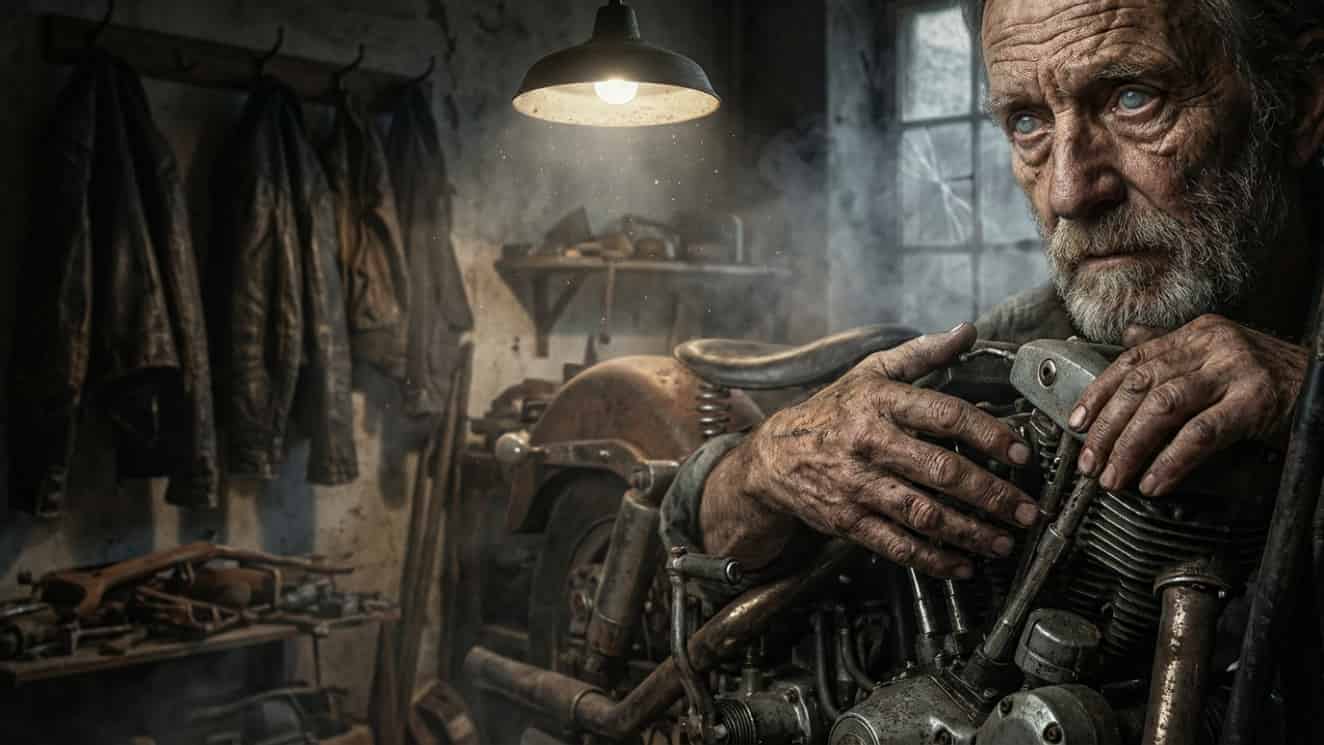
The air in the garage smelled like 1984. It was a thick, permanent soup of 20W-50 motor oil, stale Winston cigarettes, and the damp, metallic rot of a town that had been dying since the mills choked out their last breath of soot. Elias Thorne, known to everyone in Steubenville as Easy, sat on a low rolling stool, his knees popping like dry kindling.
He reached out, his hand hovering an inch above the primary cover of the Shovelhead. To anyone else, it was a masterpiece of vintage engineering. To Elias, it was a shimmering, silver ghost. The cataracts had moved in three years ago, weaving a white curtain across his vision that turned the world into an impressionist painting of grease and grit. He didn’t need his eyes, though. He’d built this engine four times in his head and twice with his hands before the lights started going out.
“Pop? You missed a spot.”
Sarah’s voice was small but sharp. She was seven, sitting on an upturned milk crate with a rag in her hand. She was the only person Elias allowed in the shop these days. She was his eyes, and she didn’t judge him for the way he fumbled for a 9/16th wrench.
“Where, Birdy?” Elias asked, his voice a low rumble.
“The shiny part. Near the bottom. It’s got a smudge.”
Elias leaned in, his nose inches from the chrome. He saw the blur of her small finger pointing. He wiped the spot with a microfiber cloth, his movements slow and deliberate. “Better?”
“Yeah. It looks like a mirror now.”
Elias grunted. A mirror was the last thing he wanted to see. He didn’t want to see the deep lines in his face or the way his beard had gone the color of galvanized steel. He especially didn’t want to see the “Highway Kings” patch hanging on a nail by the door—the one he hadn’t worn in fifteen years but couldn’t bring himself to burn.
The heavy steel door of the garage creaked open, scraping against the concrete floor. The sound sent a jolt of adrenaline through Elias’s chest that he hadn’t felt since his days on the road. The light from the street flooded in, silhouetting a figure that was too tall and moved with too much unearned confidence.
Jax. The new President of the Steubenville chapter. He was thirty-two, wore high-end tactical boots instead of greased-up engineer boots, and looked at the club like it was a franchise he’d bought into rather than a life he’d earned.
“Easy,” Jax said. He didn’t step in. He stood there, letting the cold Ohio wind whistle past him. “Tell me the bike’s done. I got a buyer in Cleveland who doesn’t like to wait, and the club needs the liquid.”
Elias didn’t look up. He kept his hand on the cool metal of the tank. “It’s done when the timing is right. Shovels are temperamental. You rush the timing, you blow the heads.”
“We aren’t in the seventies anymore, old man,” Jax said, finally stepping into the shop. His boots clicked on the concrete. He stopped next to Sarah, looking down at her like she was a stray cat that had wandered into a boardroom. “Kid shouldn’t be breathing these fumes. It’s bad for the lungs.”
“She’s fine,” Elias said, his voice tightening. “And the bike stays here until I say it’s ready. It’s my personal project, Jax. Not club inventory.”
Jax laughed, a short, dry sound. He reached out and ran a finger along the handlebars. “The parts came from the shop’s account. The frame was recovered from a ‘donation’ in ’09. Everything in this garage belongs to the Kings, Easy. Including your retirement. You’re only still here because I respect the history. Don’t make me stop respecting it.”
Elias felt the heat rising in his neck. He wanted to tell Jax that he’d been a King when Jax was still wetting his bed. He wanted to tell him about the night in ’82 when he’d ridden through a blizzard to get a brother to a vet for a gunshot wound. But the words felt heavy and useless. The club wasn’t about brotherhood anymore. It was about moving product and keeping the books clean for the Feds who were perpetually circling the block.
“Friday,” Jax said, his tone shifting to something colder. “I’m bringing a trailer. Have the paperwork ready. And Easy? Clean yourself up. You look like you’re rotting along with the building.”
The door slammed shut. The silence that followed was heavier than the noise. Elias let out a breath he didn’t know he was holding. He felt Sarah’s hand on his forearm.
“Pop? Is that man a friend?”
Elias looked toward the blur of her face. “No, Birdy. He’s just someone I work for.”
He stood up, his joints complaining. He needed to finish the bike, but not for Jax. He’d spent ten years on this machine, scavenging parts from across the Midwest, polishing every bolt until his fingers bled. It was supposed to be his peace offering. His way back into the life of the man who lived three miles away but hadn’t spoken to him in five years.
David. His son. A man who worked twelve-hour shifts at the remaining chemical plant, trying to pay off the debt of a life Elias had helped ruin.
“Come on,” Elias said, reaching for his coat. “Let’s get you home. Your dad’s gonna be off shift soon.”
They walked out into the dusk. Steubenville was a town of orange streetlights and long shadows. The old brick buildings downtown were mostly boarded up, their windows staring like empty eye sockets. Elias drove his beat-up Ford F-150 by memory, navigating the turns of the familiar streets by the rhythm of the potholes and the incline of the hills. Sarah sat beside him, narrating the world like a radio commentator.
“The light’s yellow, Pop. Now it’s red. Okay, go. There’s a cat on Mrs. Miller’s porch. It’s black.”
“Thanks, Birdy,” he whispered.
He dropped her off at the small, peeling bungalow where David lived. He didn’t pull into the driveway. He stayed at the curb, the engine idling with a rough, uneven lope. He watched the blur of Sarah running to the front door, watched it open, and saw the taller blur of David standing there.
David didn’t wave. He didn’t acknowledge the truck. He just pulled Sarah inside and closed the door.
Elias sat there for a long time, the heater blowing lukewarm air onto his cold hands. He thought about his brother, Mickey. Mickey, who had been the fast one, the loud one, the one who took the fall for the warehouse job forty years ago because Elias had a two-year-old son and a wife who was already packing her bags. Mickey had died in a state pen in Lucasville after a botched lung surgery, and Elias had spent the rest of his life trying to convince himself that the sacrifice was worth it.
But looking at that closed door, he wasn’t sure. He’d stayed out of prison, but he’d spent the last four decades in a different kind of cell. One built of grease, club loyalty, and the slow, agonizing loss of everything that mattered.
He put the truck in gear and headed back to the garage. He had to finish the Shovelhead. It was the only thing he had left to give, and according to Jax, he didn’t even own that.
Chapter 2
The fluorescent light in the garage flickered, a rhythmic buzz-click that Elias could hear even if he couldn’t see the bulb. It was Tuesday, three days before Jax’s deadline. Elias was hunched over the workbench, trying to solder a wire on the bike’s ignition system. His hands, usually steady as a surgeon’s, were shaking.
“Damn it,” he hissed as the soldering iron slipped, the scent of burnt plastic filling the air.
He sat back, rubbing his eyes. It was no use. The white haze was winning. He felt like he was looking through a thick sheet of waxed paper.
The garage phone rang—an old wall-mounted rotary that he’d never bothered to replace. He stood up, navigating the minefield of spare tires and tool chests by muscle memory, and picked up the receiver.
“Yeah?”
“Elias. It’s Miller.”
Elias felt a small tightening in his gut. Miller was the Sheriff, but before that, he was the kid who’d lived two doors down from Elias and Mickey. They’d played ball in the dirt lots together. They’d shared their first beers behind the old granary.
“I’m busy, Tom. If this is about the noise complaint from the body shop next door, tell ’em to buy earplugs.”
“It’s not about the shop, Elias. It’s about David.”
The world seemed to go very still. The hum of the garage, the distant sound of traffic on Route 7—it all faded into the background. “What happened? Is he hurt? Is Sarah—”
“They’re fine, physically. But I’m at the clinic, Elias. I was finishing up some paperwork with the county nurse when David brought the girl in. She fainted at school today.”
Elias gripped the phone cord. “Fainted? Why?”
There was a long pause on the other end. Miller sighed, the sound of a man who had seen too much of this town’s slow collapse. “It’s her heart, Elias. That thing she was born with—the valve issue. It’s getting worse. David didn’t want me to call you. He’s in the waiting room right now looking like he’s about to break in half. The doctor says she needs the surgery. The real one. The one they have to do in Columbus.”
“So? Tell ’em to do it,” Elias said, his voice cracking.
“It’s fifty thousand dollars up front for the specialist and the facility fee, Elias. David’s insurance at the plant? It’s a joke. They called it a pre-existing condition. He’s got nothing. He’s already tapped out from the medications.”
Elias felt a cold, hollow sensation in his chest. Fifty thousand. In Steubenville, that might as well be fifty million.
“I’ll be there,” Elias said. He hung up before Miller could respond.
He didn’t drive his truck this time. He couldn’t trust himself on the main road with his head spinning like this. He walked. It was only six blocks to the clinic, but it felt like six miles. He tripped on a buckled sidewalk, scraping his palms, but he didn’t stop. He pushed through the glass doors of the clinic, the smell of antiseptic hitting him like a physical blow.
He saw the blur of the waiting room chairs. He saw Miller’s tan uniform, and then he saw David. His son was slumped over, his elbows on his knees. He looked older than thirty-five. He looked like the town—gray, exhausted, and pushed to the edge of the cliff.
“David,” Elias said.
David didn’t look up. “Go home, Dad.”
“Miller told me. About Sarah.”
David stood up then. He was taller than Elias now, and the anger radiating off him was a physical heat. “He shouldn’t have called you. There’s nothing you can do. You don’t have that kind of money. Nobody in this family has ever had that kind of money because we’re too busy being ‘loyal’ to a bunch of losers in leather vests.”
“I can find a way,” Elias said, though his heart wasn’t in it.
“How? You gonna sell some more meth for Jax? You gonna run another load of stolen parts?” David’s voice was rising, drawing the attention of the receptionist. “I spent my whole life trying to scrub the smell of this town off me, and look where it got me. My daughter is dying because I can’t afford a piece of plastic for her heart, and my father is a blind mechanic for a gang of thugs.”
“David, that’s enough,” Miller said, stepping forward.
“No, it’s not enough!” David shouted. He turned back to Elias, his eyes red. “Stay away from her. I don’t want her thinking you’re some hero who’s going to save the day. You couldn’t even save your own brother. Just stay in your garage and finish your bike, and leave us alone.”
David turned and walked down the hallway toward the exam rooms, his shoulders shaking.
Elias stood in the center of the waiting room. He felt small. He felt like a ghost. Miller put a hand on his shoulder, but Elias pulled away. He walked back out into the cold Ohio air.
He didn’t go back to the garage. He walked toward the bridge that spanned the river, the water below a dark, churning mass of industrial runoff and winter melt. He found himself at the old cemetery on the hill, standing in front of a headstone he couldn’t read but knew by the chip in the top left corner.
Michael Thorne. 1962-2002. A Loyal Brother.
“I’m sorry, Mick,” Elias whispered. “I’m so sorry.”
He thought about the night of the warehouse robbery. He’d been the lookout. Mickey had been the one inside. When the sirens started, Mickey had thrown the bag of cash through the window to Elias and told him to run. Think of David, he’d said. I’ll talk my way out of it.
Mickey never talked his way out. He took twenty years and died in year eighteen. And the money? The club had taken it. They’d said it was for “legal fees.” Elias had never seen a dime. He’d spent the rest of his life working for them, thinking he was paying off a debt, but the debt only grew.
He walked back to the garage, his mind racing. Fifty thousand dollars. Jax had said the buyer in Cleveland was willing to pay forty for the Shovelhead because of its history and the custom work. It wasn’t enough, but it was a start.
He let himself into the shop and flipped the lights. He walked over to the bike, his hands trembling. He started to pull the seat off. He was going to check the wiring one last time, to make sure it was perfect, to make sure Jax could get every cent for it.
But as he pulled the leather seat away, he felt something snag. A piece of heavy plastic taped to the underside of the frame, tucked deep into the hollow space where the oil lines ran.
He reached in, his fingers brushing against something cold and hard. He pulled it out. It was a ledger. A thick, leather-bound book wrapped in a Ziploc bag.
Elias sat on the floor, his back against the workbench. He opened the bag and pulled out the book. He held it three inches from his eyes, squinting until the tears ran down his cheeks.
Names. Dates. Amounts.
It wasn’t just a shop manual. It was the “black book” for the Highway Kings. Offshore accounts, VIN numbers for stolen bikes, pay-offs to city council members, and names of suppliers in Mexico. It was the lifeblood of the club, spanning twenty years.
Elias realized then why Jax was so desperate for the bike. It wasn’t the chrome. It wasn’t the engineering. It was the evidence. The former President, a man named “Big Jim” who’d died of a heart attack six months ago, must have hidden it there while the bike was in pieces, knowing the Feds wouldn’t look inside a half-built engine.
Elias held the book in his hands. It felt heavy. It felt like a bomb.
If he gave the bike to Jax, the ledger went with it, and the club stayed safe. If he gave the ledger to Miller, the club went to prison, but Elias and his family would be targets for the rest of their lives.
But there was a third option. A dangerous, terrifying option.
He looked at the Shovelhead. It was the most beautiful thing he’d ever built. And now, it was the only thing standing between his granddaughter and the grave.
Chapter 3
The ledger sat on the workbench like a coiled snake. Elias had spent the last two hours staring at it—or as close to staring as he could manage. He’d used a magnifying glass from his tool drawer to scan the pages. It was all there. The rot of the Highway Kings, documented in Big Jim’s cramped, messy handwriting.
He knew what this was worth. Not just to the Feds, but to the people who wanted it to stay buried.
A knock at the door made him jump. It wasn’t the heavy, arrogant kick of Jax. It was a soft, rhythmic tapping. Elias shoved the ledger into an empty grease rag bin and wiped his hands.
“Who is it?”
“It’s Cutter, Easy. Open up. It’s cold enough to freeze the balls off a brass monkey out here.”
Elias sighed and unlocked the door. Cutter stumbled in, bringing the smell of cheap fortified wine and unwashed clothes with him. Cutter had once been the club’s Sergeant-at-Arms, a man whose word was law on the road. Now, he was a “ghost.” He lived in a tent city down by the river, his mind partially erased by thirty years of hard living and the things he’d seen in Vietnam.
“You got a light, Easy? My matches are damp.”
Elias reached into his pocket and handed Cutter a lighter. He watched the blur of the old man’s face as he lit a cigarette. Cutter’s hands were gnarled, his fingernails black with permanent grease.
“Jax was looking for you,” Cutter said, exhaling a cloud of blue smoke. “He’s on a tear. Says you’re holding out on him. He’s talking about ‘cleaning house,’ Easy. You know what that means when these young kids say it.”
“I know what it means,” Elias said quietly.
Cutter leaned against a stack of tires, his eyes wandering to the Shovelhead. “That’s a hell of a machine. Big Jim used to talk about it. Said it was the last real bike in this town. Everything else is just plastic and computers now.” Cutter paused, his voice dropping an octave. “You found it yet?”
Elias went still. “Found what?”
“The insurance policy. Jim wasn’t stupid. He knew Jax was coming for the crown. He told me once, right before the heart took him, that he’d put the club’s ‘soul’ somewhere safe. Somewhere only an old-timer would look.”
Elias didn’t answer. He couldn’t. Cutter might be a drunk, but he wasn’t a fool.
“If you have it, Easy… burn it,” Cutter whispered. “Or run. Because Jax isn’t like us. We were outlaws, sure. But we had a code. These kids? They’re just businessmen with tattoos. They’ll kill you for a spreadsheet.”
“I can’t run, Cutter. I got a granddaughter who’s sick. I got a son who needs me.”
Cutter looked at him with a pity that cut deeper than Jax’s threats. “Then you’re already dead. You just haven’t stopped breathing yet.”
Cutter handed back the lighter and shuffled out into the night. Elias locked the door and leaned his forehead against the cool wood. His head throbbed. He looked at the Shovelhead. It was supposed to be a gift. Now it was a cage.
He went back to the workbench and pulled out the ledger. He started flipping through the back pages. There, tucked into the binding, was a series of phone numbers and bank routing codes. One of them was labeled L.V. – Emergency.
Elias knew what L.V. stood for. Las Vegas. The “Mother Chapter.” The old guard.
He picked up the shop phone and dialed the number. It rang four times before a gravelly voice answered.
“Yeah.”
“This is Easy. Steubenville chapter. I’m holding Big Jim’s black book.”
There was a long, heavy silence. “Who’d you say this is?”
“Elias Thorne. I was patched in ’79. I worked the warehouse job with Mickey Thorne.”
“I remember Mickey,” the voice said, softening slightly. “He was a good man. What do you want, Easy?”
“I want out. And I want my family taken care of. Jax is selling the chapter to a cartel out of Detroit. He’s liquidating everything. The book proves he’s been skimming from the Mother Chapter’s cut for three years.”
Elias heard the sound of a lighter clicking on the other end. “Skimming, you say?”
“Hundreds of thousands. It’s all here. If I give this to the Feds, the Kings are done. From here to Cali. But I don’t want the Feds. I want fifty thousand dollars and a bus ticket for my son and granddaughter. You give me that, and the book goes to you.”
“Fifty thousand is a lot of money for a ghost, Easy.”
“It’s cheaper than a RICO case,” Elias snapped. “I have the bike, too. The book is hidden in the frame. I’m bringing it to the old granary on Friday night. Tell Jax to meet me there for the ‘buyer.’ You have your people there to collect. If I don’t see the cash, I call the Sheriff. He’s an old friend. He’s just waiting for a reason to kick Jax’s door in.”
“You’re playing a dangerous game, old man.”
“I’m already blind, son,” Elias said. “I don’t have much left to fear.”
He hung up the phone. His heart was hammering against his ribs like a trapped bird. He’d just declared war on the President of his own club. He looked at the Shovelhead. He had three days to make sure it was the most perfect thing Jax had ever seen—and the most expensive.
He spent the rest of the night working. He didn’t use his eyes. He used his fingers. He felt the tension of every cable, the fit of every gasket. He sang to the machine—old songs he and Mickey used to listen to on the radio while they worked on their first dirt bikes.
Around 4 AM, he heard a car pull up outside. Not a bike. A car.
He moved to the window, squinting through the haze. It was David’s sedan.
Elias opened the door before David could knock. His son stood there, looking hollowed out. He had a gym bag in his hand.
“She’s in the hospital,” David said. His voice was flat, devoid of the anger from earlier. “They’re keeping her stable, but the surgeon says it has to happen by Saturday or she might not… her heart is too weak to keep waiting.”
“I have the money, David.”
David looked at him, his brow furrowing. “What? How?”
“I’m selling the Shovelhead. A private collector. It’s a lot of money.”
“Dad, no collector is going to pay fifty thousand for an old Harley.”
“This one will,” Elias said, stepping closer. He reached out, and for once, David didn’t pull away. Elias felt the rough fabric of David’s jacket. “I need you to trust me. Just this once. I know I haven’t given you many reasons to, but Sarah… she’s the only thing we did right. I won’t let her go.”
David looked at the bike, then back at his father. “Is this going to get you killed?”
Elias smiled, a thin, tired expression. “I’ve been dead a long time, Dave. I’m just making it official. Go back to the hospital. Stay with her. I’ll bring the money on Friday night. I promise.”
David stood there for a long moment. He reached out and squeezed Elias’s hand—a quick, awkward gesture that meant more than any speech. Then he turned and walked back to his car.
Elias watched the red tail-lights disappear into the fog. He had seventy-two hours. He went back to the bike and picked up a wrench. He had work to do.
Chapter 4
Thursday was the kind of day that made people leave Ohio and never look back. A cold, biting sleet turned the streets of Steubenville into a skating rink of gray slush. Inside the garage, the temperature had dropped, but Elias didn’t turn on the heater. He wanted the cold. It kept him sharp.
He was polishing the fuel tank when the door was kicked open.
Jax didn’t come alone this time. He had two of his “enforcers” with him—kids named Rondo and Slim who looked like they’d been grown in a gym and fed on a diet of energy drinks and spite.
“Change of plans, Easy,” Jax said. He was wearing a heavy leather coat, his hands stuffed in his pockets. “The buyer is coming tonight. Now. He’s in town and he’s got a window. Roll it out.”
Elias felt a cold spike of panic. “I told you, Friday. It’s not ready. The carb is still spitting.”
“I don’t care if it runs on goat piss,” Jax said, walking over to the bike. “We’re moving it. Now.”
He reached for the handlebars, but Elias stepped in the way. He was a head shorter than Jax and thirty years older, but he stood his ground.
“Get your hands off it,” Elias said.
The room went silent. Rondo and Slim moved to flank Elias, their shadows stretching long across the oil-stained floor.
Jax leaned in, his face inches from Elias’s. “You’re starting to bore me, Easy. I know you’ve been on the phone. I know you’ve been talking to people you shouldn’t be talking to. You think I don’t have ears in Vegas?”
Elias’s heart skipped a beat. He’d underestimated how fast word traveled in the club.
“I’m trying to save this chapter, Jax,” Elias said, his voice steady. “The Mother Chapter knows you’re skimming. They know about the Detroit deal. If you take that bike now, you’re dead. If you let me finish it, if we do the deal on Friday like I arranged, I can make sure the ledger disappears.”
Jax’s eyes widened slightly. “The ledger? You found it.”
“I found it. And I know what’s in it. Everything Big Jim kept on you. The kickbacks, the side-deals. It’s all there.”
Jax looked at Rondo, then back at Elias. He started to laugh, but there was a jagged edge to it. “You think that book matters? Big Jim was a dinosaur. The guys in Vegas? They’re just as dirty as I am. They don’t want the book because I’m skimming—they want it because they want their cut. You’re playing middle-man in a game where both sides want you erased.”
Jax grabbed Elias by the front of his shirt and slammed him back against the workbench. Tools clattered to the floor. Elias’s vision swam, the white haze turning into flashes of red.
“Where is it?” Jax hissed. “Give me the book, and maybe I’ll let you live long enough to see your granddaughter get her heart cut open.”
“Go to hell,” Elias spat.
Jax raised his fist, but a sudden, sharp rapping at the door stopped him.
“Sheriff’s Department! Open up!”
Miller’s voice was unmistakable. Jax cursed under his breath and shoved Elias away. He straightened his jacket as Elias scrambled to find his footing.
“Open it,” Jax whispered to Rondo.
Rondo cracked the door. Miller stood there in the sleet, his hands resting on his belt. Behind him, the blue and red lights of his cruiser pulsed against the gray sky.
“Is there a problem here, Jax?” Miller asked, stepping inside without waiting for an invitation. He looked at Elias, noticing the way the old man was leaning against the bench, breathless. “Easy? You okay?”
“Just a disagreement about a repair, Tom,” Elias said, his voice ragged. “Nothing to worry about.”
Miller looked at Jax, his eyes narrowing. “I’ve got three calls about motorcycles tearing up the residential streets near the hospital. Your boys are getting restless, Jax. Maybe it’s time for a curfew.”
“We were just leaving, Sheriff,” Jax said, his voice dripping with fake politeness. “Easy was just giving us the final update on the Shovelhead.”
Jax walked toward the door, but he stopped next to Elias. He leaned in, his voice a whisper that Miller couldn’t hear. “Friday night. The granary. If the book and the bike aren’t there, I’m going to the hospital. And I’m not going there to bring flowers.”
Jax and his muscle walked out into the cold. Miller watched them go, then turned to Elias.
“You’re in over your head, Elias,” Miller said. “I can see it in your eyes. What’s going on? Give me something I can use to pick them up.”
“I can’t, Tom. If you move now, they’ll scatter. And I need them in one place.”
“For what?”
“For justice,” Elias said. “The kind this town hasn’t seen in a long time.”
Miller sighed and walked over to the Shovelhead. He ran a hand over the fender. “It’s a beautiful bike, Elias. Mickey would have loved it.”
“Mickey died for nothing, Tom. I’m not going to let Sarah do the same.”
“What can I do?” Miller asked.
Elias looked toward the blur of his old friend. “Friday night. 9 PM. The old granary on the south side of the tracks. Bring everyone you’ve got. But don’t move until I give the signal.”
“What’s the signal?”
“You’ll see it from three miles away,” Elias said.
After Miller left, Elias sat in the dark for a long time. He felt the weight of the years pressing down on him. He thought about his wife, who’d left him thirty years ago because she couldn’t live with a man who was always waiting for a phone call that would take him away. He thought about David, who’d grown up in the shadow of a father who was more a legend than a man.
He reached into the rag bin and pulled out the ledger. He didn’t need the Mother Chapter. He didn’t need Jax. He just needed to make sure the secret died with the only thing he’d ever built that was worth anything.
He spent the rest of the night modifying the bike. He didn’t work on the engine this time. He worked on the fuel lines. He bypassed the petcock and rigged a small, concealed valve near the seat. With one turn, the entire tank would dump onto the hot exhaust pipes.
It was a suicide rig. A one-way trip.
He sat on the bike, his hands on the grips. He closed his eyes and for a moment, he wasn’t a blind old man in a dying town. He was twenty-five again, the wind in his hair, his brother riding beside him, the road ahead of them infinite and bright.
“Soon, Mick,” he whispered. “Soon.”
Chapter 5
The old granary was a skeleton of wood and rusted corrugated metal, standing like a tombstone on the edge of the Ohio River. The wind howled through the gaps in the walls, sounding like the ghosts of the men who used to work there. It was 8:45 PM.
Elias sat on the Shovelhead, the engine idling with a deep, rhythmic throb. The vibration traveled up through his spine, a familiar comfort. He’d ridden the bike here by following the white line on the shoulder of the road, his heart in his throat every time a car passed.
The headlights appeared first—three sets, cutting through the darkness. They pulled into the clearing in a semi-circle, trapping Elias in a cage of light.
Jax climbed out of the lead truck. He was holding a heavy canvas bag. Behind him, Rondo and Slim stood with their hands near their waistbands. From the other side, a black SUV pulled up. Two men in expensive leather jackets stepped out—the representatives from Vegas.
“You’re a man of your word, Easy,” Jax said, stepping into the light. “I’ll give you that.”
The man from Vegas, a silver-haired veteran named Sal, walked forward. He looked at Elias with a mixture of respect and suspicion. “You have the book?”
“I have the bike,” Elias said. “The book is inside. But first, I want to see the money. For my son.”
Sal nodded to Jax. Jax tossed the canvas bag at Elias’s feet. It hit the dirt with a heavy thud.
“Fifty thousand,” Jax said. “Count it if you can see that far.”
Elias didn’t count it. He looked at Sal. “There’s more in that book than just skimming, Sal. There’s the names of every man Jax was planning to sell out to the Detroit cartel once he took your seat.”
Jax’s face went pale. “He’s lying! He’s a senile old man trying to save his skin!”
“Is he?” Sal said, his voice cold as ice. “Let’s see the book.”
Elias reached down, his hand hovering near the hidden valve he’d rigged under the seat. “The book is right here. But there’s one thing you all forgot.”
“What’s that?” Jax sneered.
“Loyalty isn’t something you buy,” Elias said. “It’s something you earn. And none of you earned a damn thing.”
In one swift motion, Elias turned the hidden valve. He heard the rush of gasoline hitting the hot chrome pipes. The scent of high-octane fuel filled the air.
“What are you doing?” Jax shouted, stepping forward.
Elias pulled a Zippo from his pocket. He flicked it open. The flame was a tiny, brilliant point of light in the center of his blurred world.
“The book dies tonight,” Elias said. “And so does the club.”
“No!” Jax lunged for him, but it was too late.
Elias dropped the lighter.
The explosion was a wall of orange heat that knocked everyone back. The Shovelhead disappeared into a pillar of fire, the magnesium in the rims sparking like a thousand tiny stars. The fuel tank blew a second later, sending a fountain of flame twenty feet into the air.
Elias was thrown from the bike, hitting the dirt hard. He rolled, his clothes smoking, his skin stinging from the heat. Through the roar of the fire, he heard shouting, the sound of car doors slamming, and then the high, wailing scream of sirens.
Miller’s cruisers tore into the clearing, their lights flashing blue and red against the burning granary.
“Federal agents! Don’t move!”
The Vegas men tried to run, but they were cut off by a line of officers. Jax was on his knees, staring at the inferno. The ledger, the evidence, the “soul” of the Highway Kings—it was all being reduced to ash in the center of the yard.
Elias lay on the ground, his breath coming in ragged gasps. He felt a pair of hands on his shoulders.
“Elias! Can you hear me?”
It was Miller. He looked down at his old friend, his face lit by the fire.
“Did… did the bag stay clear?” Elias wheezed.
Miller looked over at the canvas bag, which had landed ten feet away from the bike. “Yeah, Elias. It’s safe. It’s right here.”
“Take it,” Elias said, clutching Miller’s arm. “Take it to the hospital. Now. Tell David… tell him I’m sorry I was late.”
“The paramedics are coming, Elias. Just hold on.”
“I’m holding,” Elias whispered. He looked up at the sky. For the first time in years, the haze seemed to clear. He could see the stars. They were sharp and bright, like the chrome on a new bike.
He closed his eyes as the sound of the fire faded into the distance.
Chapter 6
The world was white.
It wasn’t the fuzzy, clouded white of his cataracts. It was a sharp, sterile, fluorescent white. Elias blinked, his eyelids feeling like they were made of sandpaper. He tried to move his hand, but it was anchored by an IV line.
“Pop?”
The voice was a whisper. Elias turned his head. The movement sent a spike of pain through his neck, but he didn’t care.
Sarah was sitting in a chair next to his bed. She was wearing a hospital gown, but her face had color in it—a soft, healthy pink he hadn’t seen in months. She was holding a book, her small thumb marking the page.
“Birdy,” Elias croaked.
“You’re awake! Daddy, he’s awake!”
David appeared a moment later. He looked different. The weight that had been crushing his shoulders for years seemed to have lifted. He was wearing clean clothes, and his eyes weren’t red for once.
He walked over to the bed and looked down at Elias. For a long time, neither of them spoke. The steady beep-beep of the heart monitor filled the silence.
“She had the surgery on Saturday,” David said, his voice thick. “The doctor says she’s going to be fine. She’ll be home by the weekend.”
Elias let out a long, slow breath. “And the money?”
“Miller brought it. He told the hospital it was an anonymous donation from a local estate. The Feds tried to seize it, but Miller… he’s a good man, Dad. He’d already processed the payment as a medical gift before they could get their paperwork in order.”
David sat on the edge of the bed. He reached out and took Elias’s hand. His grip was firm. “The club is gone. Jax, the guys from Vegas, the whole chapter… they’re all in custody. The Feds found enough at the shop and in the trucks to put them away for a long time. They’re calling you a hero in the papers.”
“I’m no hero, Dave,” Elias said. “I’m just a guy who finally finished his last job.”
“The bike,” David said, his voice dropping. “I’m sorry, Dad. I know how much that meant to you.”
Elias looked at his son, then at Sarah, who was climbing onto the end of the bed to be near him. “It was just metal, Dave. I spent my whole life thinking the club was my family. I spent forty years trying to protect a patch that didn’t mean a damn thing. The bike… it was just the last piece of that lie.”
He reached out and stroked Sarah’s hair. She leaned into his touch, her heart beating strong and steady under her ribs.
Two weeks later, Elias sat on the porch of David’s bungalow. His hands were bandaged, and his vision was still a blur, but the air felt different. It didn’t smell like oil and stale smoke anymore. It smelled like the river after a hard rain.
Miller pulled up in his cruiser. He got out and walked up the steps, carrying two cups of coffee.
“How you feeling, Easy?”
“Like I got run over by a freight train,” Elias said, taking the coffee. “But I’m still here.”
“I talked to the D.A.,” Miller said, leaning against the railing. “They aren’t going to press charges for the fire. They’re considering your ‘cooperation’ as full restitution. You’re a free man, Elias.”
“Free,” Elias repeated. The word felt strange in his mouth.
“What are you going to do now?”
Elias looked out at the street. He saw Sarah playing in the yard, running after a ball with a energy that seemed miraculous. He saw David coming out of the house, carrying a tray of sandwiches.
“I think I’m going to get my eyes fixed,” Elias said. “The doctor at the clinic says they can do the surgery now. I’d like to see my granddaughter’s face. Clearly. Just once.”
Miller nodded. “That sounds like a good plan.”
Elias sat back in his chair. He thought about the garage, now a blackened shell of brick and ash. He thought about the Shovelhead, sitting at the bottom of a scrap heap somewhere. He felt a twinge of sadness, the way one might feel for an old friend who had died to save another.
But then Sarah ran up the steps and jumped into his lap, her laughter ringing out like a silver bell.
“Pop! Look what I found!”
She held out a small, jagged piece of metal. It was a chrome bolt, blackened by fire but still recognizable. It must have been stuck in the tread of his boot the night of the explosion.
Elias took the bolt in his scarred hand. He ran his thumb over the threads. He could still feel the precision of the work, the weight of the history.
“It’s a good bolt, Birdy,” he said, pulling her close. “But we don’t need it anymore.”
He tossed the bolt into the tall grass of the yard. It disappeared with a soft thud, lost in the green, away from the grease and the oil and the rust.
Elias closed his eyes and felt the warmth of the sun on his face. He was an old man in a dying town, and he couldn’t see much of anything. But for the first time in forty years, he knew exactly where he was, and exactly where he belonged.
He had no bike, no club, and no legacy but the girl in his arms. And as far as he was concerned, he’d never been richer.