Silas Vance is seventy years old, dying of lung cancer, and riding a 1948 Panhead toward the daughter he abandoned forty-five years ago. He has two weeks to live, a group of young outlaws breathing down his neck for his bike, and a secret that will either save her life or make her hate him forever.
The rattle in my chest sounds like a handful of gravel in a blender. It’s been there since Kansas, a wet, heavy thrum that hits harder than the vibration of the 74-cubic-inch engine between my thighs.
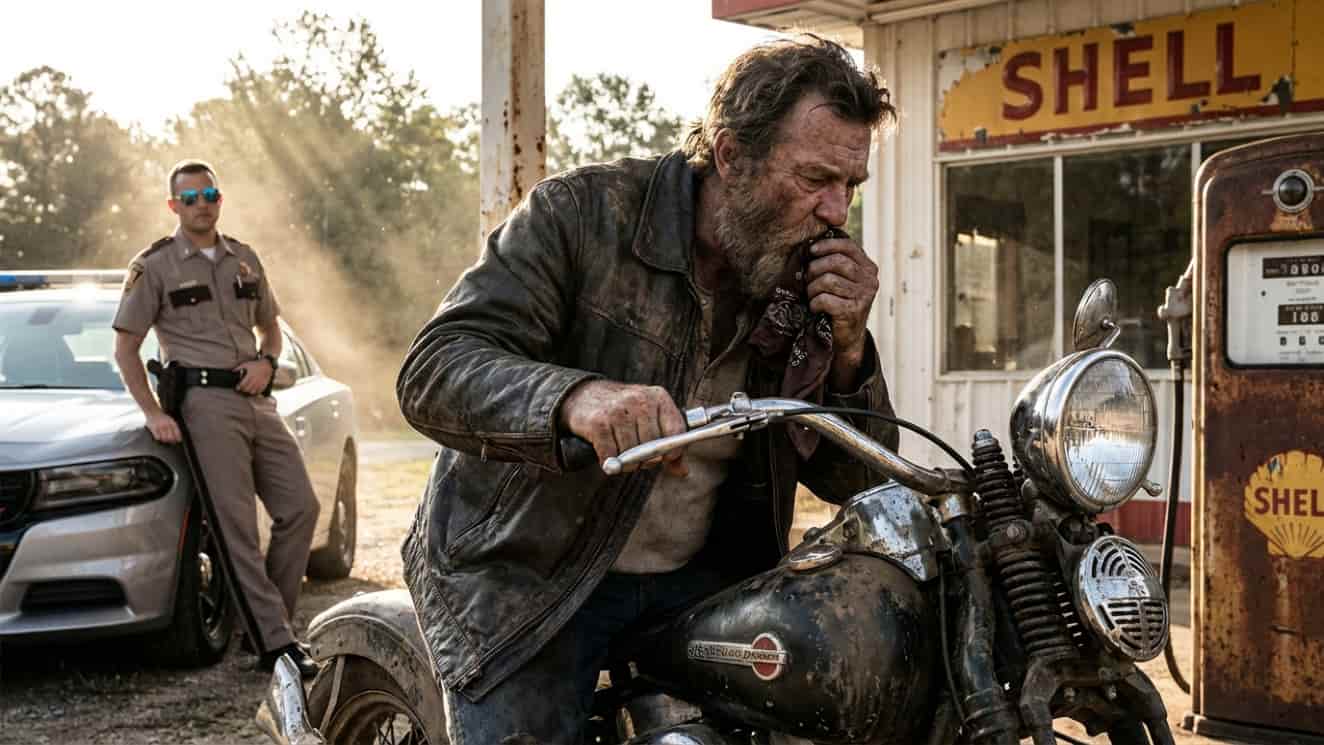
I pulled into the Shell station outside of Cleveland, Mississippi, and the air felt like breathing through a damp wool blanket. I didn’t mind the heat. It was the stillness that got to me. After fifty years on the road, stillness feels like a trap.
I kicked the stand down and sat there for a minute, my hands still humming from the handlebars. My knuckles are knotted like old cedar roots, stained with fifty years of 60-weight oil and road grime that no soap can touch.
I reached into my vest and pulled out the rag. When I pulled it away from my mouth, the blood was bright, almost neon against the dirty white cloth.
“Stage four,” the doctor in Denver had said three months ago. He’d talked about chemo and “quality of life,” but all I heard was the ticking of a clock I’d been trying to outrun since 1978.
I folded the rag, hiding the red, and looked up. A State Trooper was leaning against his cruiser twenty feet away. He was young, maybe twenty-five, with a high-and-tight haircut and aviators that reflected the sun like two chrome hubcaps.
He didn’t see a legend. He didn’t see the miles I’d put on this 1948 Panhead, the most beautiful piece of iron ever to roll out of Milwaukee. He saw a vagrant. A relic. A problem that needed to be moved along.
I stood up, my knees popping like dry kindling. I’m seventy, but in the morning light, I feel a hundred. I have one thing left of value in this world—this bike—and a daughter who doesn’t know I exist.
I have to find her before the engine in my chest finally seizes up for good.
FULL STORY
Chapter 1
The vibration of a 1948 Panhead isn’t like the smooth, balanced hum of a modern machine. It’s a rhythmic, mechanical violence. It’s the sound of metal trying to shake itself apart, held together only by the grace of tight bolts and a rider who knows exactly how to listen to the valves. For fifty years, that vibration was the only heartbeat I trusted. Now, it was competing with the one in my chest, and mine was losing.
I pulled the bike into the gravel lot of a Shell station on the edge of Cleveland, Mississippi. The Mississippi Delta in late March is a peculiar kind of miserable. The air doesn’t circulate; it just sits on you, heavy with the scent of wet earth and diesel exhaust. I kicked the stand down and sat there, my hands still curled in the shape of the grips. My fingers were stiff, the joints swollen into hard, painful knots.
I leaned over and coughed. It wasn’t a small sound. It was a deep, racking heave that felt like a serrated knife was being dragged across the inside of my ribs. I pulled a grease-stained rag from my leather vest and pressed it to my mouth. When I pulled it away, the blood was there—vivid and warm. I folded the rag carefully, hiding the evidence of my expiration date, and shoved it back into my pocket.
“You alright there, old timer?”
The voice was sharp, clinical. I looked up. A State Trooper was standing by his cruiser, his polished boots reflecting the morning sun. He looked like he’d been pressed in a book. His uniform was crisp, his sunglasses dark and impenetrable. He was the kind of man who believed the world could be kept in order with a ticket book and a stern look.
“Just the heat,” I said. My voice sounded like it had been dragged over a mile of unpaved road. “Gets into the lungs.”
The Trooper walked closer, his eyes moving over the Panhead. I saw the way his expression shifted. He recognized the chrome, the pristine black paint, the “S&S” carb. This wasn’t a junker. It was a masterpiece. In his world, a man like me—bearded, weathered, wearing a vest with no patches but plenty of scars—shouldn’t own something this valuable.
“That’s a lot of bike for a man who can barely stand up,” he said. He wasn’t being mean, not exactly. He was being factual. He saw a liability.
“I’ve been holding it up since before your father was in diapers, son,” I said. I reached for the gas cap. “I imagine I can manage another few miles.”
“Where you headed?”
“Cleveland. Just looking for a place to get some breakfast.”
“There’s a diner two miles up. The Blue Plate. Keep your speed down. The residents around here don’t care much for the noise.”
He stayed there, watching me as I filled the tank. He didn’t leave until I’d kicked the bike over—first try, a roar that split the humid morning air—and rolled out of the lot. I watched him in my mirror. He represented everything I’d spent my life avoiding: the rules, the clock, the steady paycheck, the judgment of people who stayed in one place.
I’d spent fifty years being a nomad. I’d seen the sun rise over the Badlands and set over the Pacific. I’d slept in haystacks, in jail cells, and in the arms of women whose names I forgot before I hit the state line. I thought that was freedom. I thought I was the king of the highway. But standing in that gas station, feeling the “rebar” in my lungs, I realized I was just a man who had run out of road.
I hit the main drag of Cleveland and slowed down. It was a town that felt like it was holding its breath. Worn brick buildings, a few storefronts with “Closed” signs, and the inevitable chain drugstores. I found the Blue Plate Diner. It was a low, tan building with a gravel lot and a neon sign that flickered with a tired hum. I parked the Panhead right in front of the window. I wanted to see it. I needed to know it was still there. It was the only thing I had to give.
Inside, the diner smelled of burnt coffee and floor wax. It was half-full of men in work shirts and women with tired eyes. I slid into a booth in the corner, my back to the wall. It’s an old habit. You don’t live to be seventy on the road without learning where the exits are.
A waitress walked toward me. She was in her early forties, wearing a faded blue uniform with “Clara” embroidered over the pocket in cursive script. She was carrying a pot of coffee and a thick ceramic mug. She didn’t look up at first. She was looking at her order pad, her brow furrowed in a way that looked permanent.
My breath hitched. I’d seen that furrow before. I’d seen it in a mirror in 1978, in a trailer park outside of Tulsa. I’d seen it on the face of a girl named Martha who told me she was late, and I’d responded by packing my gear and disappearing into the night before the sun came up.
Clara set the mug down and filled it. “Morning. You want a menu or you know what you’re after?”
She looked at me then. Her eyes were a pale, washed-out blue—the same color as mine. There was a hardness in them, a weariness that comes from decades of doubled shifts and unpaid bills. She didn’t recognize me. Why would she? She’d never seen me. To her, I was just another old man with a beard and a leather vest, probably looking for a cheap plate of eggs.
“Coffee’s a good start,” I said. My heart was thumping against my ribs, a panicked bird in a cage. “Maybe some rye toast. Dry.”
“Coming up,” she said. She started to turn away, then paused, glancing out the window at the bike. “That yours? The Harley?”
“It is.”
“It’s loud,” she said. There was no judgment in it, just an observation. “My boy, he’s obsessed with those things. He’s got posters all over his room. He’d probably lose his mind if he saw that one. It looks… old.”
“1948,” I said. “She’s a Panhead. Only year they made ’em with the springer front end and that specific head design. She’s a survivor.”
Clara nodded slowly. “A survivor. Well, that makes two of you, I guess.”
She walked back toward the kitchen, her gait heavy. She had a slight limp in her right leg, something she was trying to hide. I watched her go, and for the first time in my life, the weight of forty-five years hit me all at once. It wasn’t just the time. It was the absence. I hadn’t just missed her childhood; I’d missed the struggle that made her eyes look like that. I’d missed the moments that turned her into a woman who didn’t smile at strangers.
I reached into my vest and pulled out a small, plastic-wrapped bundle. Inside was a black-and-white photograph, the edges curled and yellowed. It was Martha, standing in front of my old Shovelhead, her hand on her stomach. I’d kept it in my toolkit for four decades, a piece of lead I couldn’t throw away.
I looked at the photo, then at the woman behind the counter. The resemblance was a physical blow.
The door to the diner swung open, and the bell chimed—a tinny, annoying sound. Three men walked in. They were young, maybe mid-twenties, wearing black leather vests with “Iron Reapers” embroidered on the back. They weren’t nomads. They were “weekend warriors” with expensive bikes and chips on their shoulders, the kind of kids who thought a leather vest made them dangerous.
They sat at a booth near the front, loud and taking up too much space. One of them, a guy with a shaved head and a tattoo of a coiled snake on his neck, pointed out the window at my Panhead.
“Check that out,” he said, loud enough for the whole room to hear. “An original ’48. Look at the chrome on that thing. That’s a hundred-thousand-dollar bike just sitting there in the dirt.”
“Old man probably doesn’t even know what he’s got,” another one said, laughing.
I took a sip of my coffee. It was bitter and scorched. I kept my eyes on the table. I wasn’t looking for a fight. I didn’t have the lungs for it. But I knew the type. They were vultures. They didn’t want the road; they wanted the status. And they were looking at my legacy like it was meat.
Clara walked over to their table. “You boys going to order, or are you just here to provide the soundtrack?”
The one with the snake tattoo grinned at her. It wasn’t a friendly look. “We’re looking for the owner of that bike, sweetheart. You think he’s man enough to talk business?”
“He’s eating his breakfast,” Clara said, her voice flat. “And I’m not your sweetheart. You want the specials or not?”
I felt a surge of something—not pride, I didn’t have the right to that—but a strange, sharp recognition. She was tough. She had to be.
The snake-neck guy leaned back, his eyes wandering over her. “You got a lot of fire for a waitress in a town that’s half-dead, Clara. That’s your name, right?” He reached out to touch the name tag on her chest.
Clara flinched back, her hand tightening on the coffee pot. “Don’t.”
I stood up. My knees screamed, and my chest felt like it was filling with hot lead, but I stood up. I walked over to their table, the heavy heels of my boots thudding on the linoleum. I didn’t look at Clara. I looked at the boy with the snake on his neck.
“The bike isn’t for sale,” I said.
The three of them looked up. They saw an old man. They saw the gray in my beard and the way my hands were trembling—from the palsy, not the fear. The leader laughed, a short, sharp sound.
“Everything’s for sale, Gramps. Especially when you’re one foot in the grave. Why don’t you sit back down before you break a hip?”
“I might break something,” I said, my voice low and steady. “But it won’t be my hip.”
The tension in the room thickened. The other patrons had stopped eating. The only sound was the hum of the refrigerator and the distant sizzle of the grill. I saw Clara out of the corner of my eye. She was looking at me, her mouth slightly open. There was no gratitude in her expression—just confusion. She didn’t know why this old stranger was stepping into her line of fire.
“Leave it, Silas,” a voice said from the door.
I turned. Standing in the entrance was Ghost. He was even older than me, his face a map of every mile we’d ridden together since the seventies. He was the only one left. The only one who knew where the bodies were buried, and the only one who knew why I was in Mississippi. He was wearing a worn denim jacket and carrying a helmet.
“Ghost,” I breathed.
“The boys are just leaving,” Ghost said, walking toward us. He didn’t look at the Reapers. He looked at me. He saw the blood on the rag I’d tucked into my sleeve. He knew. “Aren’t you, boys?”
The leader looked at Ghost, then back at me. He saw the way Ghost’s hand was tucked into his pocket, hovering over something heavy. He sighed, a dramatic, bored sound.
“Fine. We’re going. But that bike… it’s too nice for a junkyard, old man. We’ll be seeing you around.”
They stood up, knocking over a chair on their way out. The door slammed, and the bell jingled one last time.
The diner returned to its low-level hum. I felt the adrenaline drain out of me, replaced by a crushing fatigue. My lungs felt like they were collapsing. I sat back down in my booth, my head spinning.
Ghost sat across from me. He didn’t say anything for a long time. He just watched me. Clara came over a minute later. She set the chair back up and looked at the two of us.
“I didn’t need your help,” she said to me. Her voice was shaky, but her eyes were hard. “I’ve been handling guys like that since I was nineteen.”
“I know,” I said. I looked at her, really looked at her. “I could tell.”
She lingered for a second, her gaze dropping to the photo on the table. I tried to cover it with my hand, but I was too slow. She saw the bike in the picture—the Shovelhead. She saw the woman.
“Is that…?” she started, then stopped herself. She shook her head. “I’ll get your toast.”
She walked away. Ghost leaned in, his voice a whisper. “You’re running out of time, Silas. You going to tell her, or are you just going to let those kids kill you for a piece of history?”
“I don’t know,” I said, and for the first time in my life, I meant it. “I don’t know if a man like me is allowed to be a father this late in the game.”
I looked out the window. The sun was hitting the chrome of the Panhead, making it shine so bright it hurt to look at. It was a beautiful thing. But it couldn’t fix forty-five years of silence.
Chapter 2
The motel was called the Restful Inn, a name that was either a lie or a cruel joke. It sat on a strip of Highway 61 that the world had forgotten, a U-shaped collection of rooms with peeling white paint and a parking lot that was more weeds than asphalt. I’d taken Room 4, right at the end of the line, so I could keep the Panhead tucked under the overhang where I could see it from the window.
Ghost was in Room 5. He’d followed me from Memphis, despite me telling him I didn’t need a nursemaid. He’d been my “tail” for thirty years, the guy who’d pull me out of a bar fight or fix my primary chain in a rainstorm. We were the last of the Mohicans, two old men on iron horses in a world of plastic and fiber-optics.
I sat on the edge of the bed, the springs groaning under my weight. The room smelled of stale cigarettes and industrial-strength lemon cleaner. I had my toolkit spread out on a towel—wrenches, feeler gauges, a tub of grease. I was cleaning the spark plugs, a task I didn’t need to do, but it kept my hands busy. If my hands weren’t busy, they were shaking.
A knock at the door made me jump. I reached for the .38 I kept in my boot, then realized how ridiculous that was. I wasn’t in a war zone. I was in a town where the biggest threat was a high cholesterol count and a predatory biker gang.
I opened the door. It was Ghost. He was holding two plastic foam containers and a six-pack of cheap beer.
“Diner food,” he said, stepping in without waiting for an invitation. “Clara sent it. Said you forgot your toast.”
I took the container. It was heavy. Inside was a double order of rye toast, two eggs over-easy, and a side of grits. There was a small note scrawled on the lid in pen: Eat something besides coffee. You look like you’re about to blow away.
“She sent this?” I asked.
Ghost cracked a beer and handed it to me. “She asked where you were staying. I told her. She’s a smart girl, Silas. She figured out I was with you. She’s got that look, you know? The one you get when you’re trying to solve a puzzle that’s missing half the pieces.”
I sat back down. The smell of the eggs made my stomach turn, but I forced a bite. I hadn’t eaten a real meal in three days. The cancer didn’t just eat your lungs; it ate your appetite, your strength, and your dignity.
“She’s got a kid,” Ghost said, leaning against the wall. “Ben. Twelve years old. Good kid. Smart. He was out back of the diner when I was leaving. He was looking at my bike like it was a spaceship.”
“A grandson,” I whispered. The word felt heavy, like a stone in my mouth.
“Yeah. A grandson. He lives with her in a little house three blocks over. No father in the picture. Sound familiar?”
I looked at the spark plug in my hand. “I didn’t know, Ghost. I didn’t know about any of it.”
“You didn’t want to know,” Ghost corrected him, his voice not unkind, but firm. “You were too busy being a legend. The Vagabond. The man who couldn’t be caught. Well, you caught something now, Silas. And it’s going to catch you back.”
I coughed, a wet, rattling sound that went on for a full minute. I leaned over the sink, gasping for air, the world turning gray at the edges. When it finally stopped, I stayed there, my forehead against the cold porcelain, waiting for the room to stop spinning.
“You need to go to the hospital,” Ghost said.
“No. I’m not dying in a room with white walls and a machine breathing for me. I’m dying here. On my own terms.”
“Then do what you came here to do. Talk to her.”
“And say what? ‘Hey, I’m the guy who left your mother to rot in a trailer park? Here’s a vintage motorcycle to make up for forty-five years of therapy bills?’ She’ll throw it in my face, Ghost. And she’d be right to do it.”
I went back to the toolkit. I picked up a 5/8 wrench and started tightening a bolt on the air cleaner that was already tight.
“You’re scared,” Ghost said.
“I’m not scared of her. I’m scared of the look in her eyes when she realizes I’m exactly what she thought I was. A nothing.”
Ghost finished his beer and stood up. “I’m going to sleep. Those Iron Reaper kids are still in town. I saw their bikes at the bar down the street. They’re going to come for that Panhead, Silas. It’s not just a bike to them. It’s a trophy. You lose that bike, you lose everything.”
He left, and the silence of the room crashed back in. I couldn’t sleep. Every time I closed my eyes, I saw Martha’s face. Not the woman in the photo, but the woman she would have become. The woman who had to raise a daughter alone while I was chasing sunsets.
Around midnight, I couldn’t take it anymore. I put on my vest, tucked the photo into my pocket, and walked out to the bike. The air was cooler now, the humidity having settled into a thick dew that coated the leather seat. I rolled the bike out of the parking lot before starting it, not wanting to wake Ghost. Once I was a block away, I kicked it over.
The roar of the Panhead was a comfort. It was the only voice that didn’t judge me.
I rode through the quiet streets of Cleveland. The town was dark, save for a few streetlights that cast long, amber shadows. I found the house Ghost had mentioned. It was a small, white frame house with a sagging front porch and a yard full of patchy grass. A beat-up old Honda Civic was parked in the driveway, one of its tires looking low on air.
I parked at the end of the block and walked back. I felt like a thief, a prowler in my own life. I stood on the sidewalk, looking at the house. A light was on in the kitchen. I could see the silhouette of a woman moving—Clara. She was washing dishes, her movements slow and rhythmic.
Then I saw him. A young boy, maybe five feet tall, walked into the kitchen. He had a shock of dark hair and was wearing a t-shirt with a faded motorcycle on it. He said something, and Clara smiled—a real smile, the kind I hadn’t seen at the diner. She reached out and ruffled his hair.
My knees felt weak. That was my blood. That was the continuation of a story I’d tried to delete.
I walked toward the driveway. I didn’t know what I was doing until I was standing next to the Honda. I looked at the tire. It was nearly flat. I looked at the car—it was a death trap. The brake rotors were rusted, and the muffler was held up with a piece of wire.
I looked back at the house. Then I looked at the Panhead at the end of the street.
I spent the next three hours in that driveway. I’d brought a small portable compressor from my toolkit. I filled the tires. I crawled under the car and tightened the muffler wire. I checked the oil—it was black and thick. I topped it off with the spare quart I kept on my bike.
It was small. It was pathetic. It was a gallon of water in a desert of neglect. But it was something I could fix. I knew machines. I knew how to make things run. It was the only language I had.
As I was wiping my hands on my rag, a light snapped on over the porch. The front door creaked open.
“Who’s there?”
It was Clara. She was standing in the doorway, holding a heavy flashlight. She wasn’t wearing her uniform anymore; she was in a pair of oversized sweatpants and a t-shirt. She looked smaller, more vulnerable.
I froze. I was caught like a stray dog in the trash.
“It’s just me,” I said, stepping into the light. “The old man from the diner.”
She lowered the flashlight, but she didn’t put it down. Her eyes narrowed. “What are you doing at my house at three in the morning?”
“I was… I was just riding. I saw your car. The tire was low. I had a pump.”
She walked down the steps, her gaze moving from me to the car. She saw the open hood and the oil can. “You’re fixing my car?”
“Just a few things,” I said, my voice cracking. “I couldn’t sleep. The engine… it needed some attention.”
She looked at me for a long time. The silence was thick, filled only with the sound of crickets and the distant hum of the highway. I expected her to yell. I expected her to call the police.
Instead, she sat down on the porch steps. She looked exhausted. “Why?”
“Because it’s a bad car, Clara,” I said, using her name for the first time. “And you have a son. You shouldn’t be driving him around in something that might fall apart on the bypass.”
“How do you know my son?”
“I saw him through the window. He looks… he looks like a good kid.”
She put her head in her hands. “He is. He’s the only thing in this town that isn’t broken.” She looked up at me. “Who are you? Really? My mom had a picture of a bike like that. Not the same one, but similar. She used to look at it when she thought I wasn’t watching. She told me the man who owned it was a ghost.”
I felt the blood in my mouth again. I swallowed it down. “I’m not a ghost yet,” I said. “I’m just an old man who’s tired of riding.”
“Did you know her? Martha?”
The question hung in the air like a heavy curtain. I had a choice. I could tell her the truth. I could tell her I was the man who left. I could see the hatred flare in her eyes and have it over with.
But I looked at her tired face and the small house, and I realized that the truth wasn’t a gift. It was a burden. She didn’t need a father who was dying of cancer. She needed help. She needed the bike.
“I knew her,” I lied. The words tasted like ash. “I was an old friend of your father’s. We rode together back in Oklahoma. He… he asked me to check on you. Before he passed.”
Clara’s expression shifted. The hardness didn’t vanish, but it softened around the edges. “He passed? When?”
“A few months ago,” I said. “He didn’t have much. But he wanted you to have something. Something of value.”
She let out a dry, bitter laugh. “Value? He couldn’t even send a birthday card. Now he wants to send an old biker to fix my tires?”
“He was a coward,” I said, and for once, I was telling the truth. “He knew it. Every mile he rode, he knew it. He just didn’t know how to stop.”
Clara stood up. She walked over to me, her eyes searching mine. I held my breath, afraid she would see the lie, or worse, the resemblance.
“My mother died five years ago,” she said. “She never stopped waiting for him. Even at the end, she’d look out the window every time she heard a loud engine.”
“I’m sorry,” I said. It was the most useless word in the English language.
“Go back to your motel, Silas,” she said, her voice quiet. “The car will hold for now. But don’t come back here at night. It’s a small town. People talk.”
“I understand.”
I walked back to my bike. As I pulled away, I looked in the mirror. She was still standing on the porch, a small figure in the glow of the yellow light, watching me disappear into the dark.
Chapter 3
The next morning, the heat arrived like an unwelcome guest who refused to leave. By 9:00 AM, the humidity was at eighty percent, and the air felt thick enough to chew. I was sitting under the motel overhang, my back against the brick wall, watching Ghost work on his own bike. He was adjusting his valves, his movements practiced and rhythmic.
I was holding a manila envelope. Inside was the title to the Panhead, a stack of five thousand dollars in cash—every cent I had left—and a letter I’d spent all night writing. The letter didn’t say who I was. It just said the bike was hers, and that she should sell it and buy a house, or put her son through college, or whatever else a woman with a tired heart needed.
“You’re staring at that envelope like it’s a bomb,” Ghost said, not looking up from his engine.
“In a way, it is,” I said.
A low rumble started at the edge of the property. It wasn’t the sound of a vintage engine. It was the high-pitched, aggressive whine of modern Japanese sportbikes and the over-compensated roar of new Harleys with straight pipes.
Three bikes pulled into the motel lot. The Iron Reapers. The kid with the snake tattoo—whose name, I’d learned from the motel clerk, was Jax—was in the lead. He kicked his stand down and hopped off his bike, his movements full of a forced, cinematic swagger.
He walked toward us, his two friends trailing behind like shadows. They were carrying heavy leather gloves and wearing looks that they probably thought were intimidating. To me, they just looked like children playing dress-up.
“Morning, Gramps,” Jax said. He stopped five feet away, his eyes locked on the Panhead. “Still got that antique, I see. You think about my offer?”
“I don’t remember you making one,” I said. “I remember you making a fool of yourself in a diner.”
Jax’s jaw tightened. He didn’t like being talked to like that, especially in front of his crew. “I’m being nice, old man. I’m offering you ten grand for that pile of junk. That’s more than enough for a nice funeral and a casket with some padding.”
“Ten grand?” Ghost laughed, a dry, wheezing sound. “That bike is worth six times that at auction. You’re not buying a bike, kid. You’re trying to commit a robbery.”
Jax looked at Ghost. “Stay out of this, pops. This is between me and the Vagabond here.”
He stepped closer to the Panhead, reaching out to touch the chrome on the springer front end. I stood up. My chest burned, a white-hot coal under my sternum, but I moved faster than he expected. I grabbed his wrist before he could touch the metal. My grip wasn’t what it used to be, but I knew where the nerves were.
“Don’t touch it,” I said.
Jax’s eyes went wide for a second, then narrowed. He pulled his arm back, his face flushing red. “You’re making a mistake. You think because you’ve got a patch-less vest and some old stories that you’re still the king? The road changed. We own this stretch now.”
“You don’t own the road,” I said. “The road owns you. It just hasn’t collected the debt yet.”
Jax looked at his friends. They stepped forward, closing the circle. Ghost stood up, his hand sliding toward the wrench on his bike. The air in the parking lot was electric, the kind of tension that usually ends in broken glass and sirens.
“Hey! What’s going on here?”
It was the State Trooper from the gas station. He’d pulled his cruiser into the lot, the blue and red lights off, but his presence was enough to break the momentum. He climbed out of the car, his hand resting on his belt.
“Problem, gentlemen?” he asked, walking toward us.
Jax put on a fake smile. “No problem, Officer. Just admiring the man’s bike. We were just leaving.”
He looked at me, his eyes cold and promising. “We’ll see you later, Silas. The night’s a lot longer than the day in this town.”
They mounted their bikes and roared out of the lot, throwing gravel as they went. The Trooper watched them go, then turned to me. He looked at the Panhead, then at me.
“I told you those kids were trouble,” he said. “They’ve been harassing the local businesses for months. Their ‘club’ is mostly just a front for moving pills out of the delta.”
“I can handle myself,” I said, though my legs were shaking so hard I had to lean against the bike.
“Can you?” The Trooper stepped closer. He took off his sunglasses. His eyes weren’t clinical anymore; they were concerned. “You look like hell, Silas. I ran your name. You’ve got a record that goes back to the Carter administration. Mostly vagrancy, public disturbance, a couple of bar fights. Nothing serious in twenty years.”
“I’m a law-abiding citizen these days,” I said.
“A law-abiding citizen with a terminal diagnosis,” the Trooper said, his voice dropping. “I have a cousin who had what you have. He didn’t spend his last days riding a 70-year-old motorcycle through the Mississippi heat.”
“Maybe your cousin didn’t have anywhere to go,” I said.
The Trooper sighed. “Look, I’m not going to arrest you for dying. But if those kids come back, call the station. Don’t try to be a hero. You don’t have the breath for it.”
He got back in his car and drove away. Ghost looked at me. “He’s right, you know. They’re coming back tonight. They’re not going to let that bike go. They think you’re an easy mark.”
“I am an easy mark,” I said. I sat back down on the bed, the manila envelope still in my hand. “But they’re not getting the bike.”
“What are you going to do?”
“I’m going to find Clara. I’m going to give her the title. And then I’m going to get out of town. If I leave, the trouble goes with me.”
“You’re not going anywhere,” Ghost said. “You can barely walk across the room.”
“I can ride,” I said. “As long as I can kick that engine over, I can ride.”
I waited until the sun started to dip below the horizon, turning the sky the color of a fresh bruise. I didn’t want to go to the diner. I didn’t want to do this in public. I rode back to Clara’s house.
The Honda was in the driveway. The tires were still full. I parked the bike and walked to the door. My heart was pounding, a dull, rhythmic thud that made my vision blur. I knocked.
Clara opened the door. She looked surprised, then wary. “Silas? What are you doing here?”
“I brought you something,” I said. I handed her the manila envelope. “It’s from your father. Like I said.”
She took it, her fingers brushing mine. Her skin was warm, a sharp contrast to the cold sweat on my palms. She opened the envelope and pulled out the title and the cash. Her eyes went wide.
“What is this? This is for the motorcycle. The one out there.”
“It’s yours,” I said. “The title is signed. It’s legal. Sell it. There’s a guy in Memphis, a collector. I wrote his number on the back of the envelope. He’ll give you a fair price. It’ll be enough to get you out of this town. To get Ben into a good school.”
Clara looked at the money, then at the bike, then at me. “I can’t take this. I don’t even know you. And my father… why now? Why after forty years?”
“Because he’s a coward who’s running out of time,” I said. “Please, Clara. Don’t ask questions. Just take it. For the boy.”
She looked past me, and I saw her expression change. Her eyes filled with fear. I turned around.
At the end of the driveway, three sets of headlights were cutting through the dark. The Iron Reapers. They’d followed me.
Jax was in the middle, his engine idling with a menacing growl. He hopped off his bike and started walking up the driveway. He was holding a short, heavy length of pipe in his hand.
“I told you, Silas,” he shouted. “The night is long.”
Clara stepped back, pulling the door half-shut. “Who are they? What do they want?”
“Get inside,” I said, my voice low and urgent. “Lock the door. Call the police.”
“Silas—”
“Go!” I yelled, and the effort sent me into a coughing fit that brought me to my knees.
Jax was ten feet away now. He looked at Clara, then at the envelope in her hand. “Look at that. The old man’s giving away my bike. That’s not going to work for me, sweetheart.”
I looked up at him from the gravel. My lungs were on fire. The world was tilting. But I saw the look on his face—the arrogance, the cruelty. He wasn’t just coming for the bike anymore. He was coming for my family.
And for the first time in forty-five years, I wasn’t going to run.
Chapter 4
The sound of the heavy pipe hitting the palm of Jax’s hand was a dull, rhythmic thud. He was grinning, the kind of expression a man wears when he thinks the fight is already over. Behind him, his two friends—lanky kids with nervous eyes and leather vests that didn’t fit right—fanned out across the small lawn.
I was still on my knees, my hands buried in the gravel of Clara’s driveway. Every breath felt like I was inhaling broken glass. I could hear the door behind me click shut, but I knew Clara was still there, watching through the window, probably with her hand on the phone.
“Get up, Gramps,” Jax said. He stopped five feet away. The light from the porch hit the snake on his neck, making it look like it was twitching. “Give me the keys and the title, and maybe I won’t have to explain to the police why an old man with lung cancer fell down and broke his neck in a driveway.”
I looked at him. I wasn’t seeing a biker. I was seeing every mistake I’d ever made, every responsibility I’d dodged, every person I’d let down. He was the physical manifestation of my own shallow youth.
“The title is inside,” I said, my voice a ragged whisper. “And the door is locked.”
Jax glanced at the house. “A door doesn’t stop much. Not when I want something.”
He stepped toward the porch. I didn’t think. I didn’t have the strength to think. I just reacted. I lunged forward, grabbing his ankle. It was a desperate, ugly move. Jax let out a yelp of surprise and tumbled into the gravel.
The pipe flew out of his hand, clattering against the Honda’s fender. I scrambled toward it, my fingers scraping against the stones, but my body betrayed me. A spasm of coughing hit me so hard I curled into a ball, my vision swimming in red and black spots.
Jax was back on his feet in seconds. He was angry now, the swagger gone, replaced by a raw, petulant fury. He kicked me in the ribs. It wasn’t a powerful kick, but it didn’t have to be. It felt like my chest had been hit with a sledgehammer.
“You old piece of trash,” he spat. He reached down and grabbed the front of my vest, hauling me up. I was light—too light. The cancer had stripped thirty pounds off my frame in three months.
He slammed me against the side of the Panhead. The metal was cool against my back, the familiar shape of the tank pressing into my spine.
“The keys,” he demanded, his face inches from mine. He smelled of cheap cigarettes and energy drinks. “Now.”
“Silas!”
The front door burst open. Clara was standing there, but she wasn’t alone. Ben was behind her, his eyes wide with a terror no twelve-year-old should know. Clara was holding a heavy cast-iron skillet—a ridiculous weapon in the face of three bikers, but she held it like she meant to use it.
“Get away from him!” she screamed. “The police are on their way!”
Jax looked at her, then at the boy. He laughed, a high, nervous sound. “The police are ten minutes out, lady. That’s a long time in the dark.”
One of the other bikers, the one with the lanky frame and a scraggly beard, stepped toward the porch. “Just give us the papers, lady. We don’t want to hurt nobody. We just want the bike.”
“It’s not your bike!” Ben shouted, his voice cracking. “It’s his! He’s a survivor!”
The words hit me harder than the kick in the ribs. A survivor.
I looked at Jax. I saw the hesitation in his eyes. He was a bully, not a murderer. He wanted the glory of the machine, not the weight of a body.
“Let him go,” Clara said, her voice steadying. “Take the bike if you want it so bad. Just leave him alone.”
“No,” I gasped. I reached up and grabbed Jax’s wrists. My hands were shaking, but I held on with everything I had left. “The bike… stays.”
Jax raised his hand to strike me again, but he stopped. The sound of a heavy engine—real heavy, the rhythmic thrum of a well-tuned Shovelhead—echoed from the end of the block.
A single headlight cut through the dark, swinging into the driveway. It was Ghost. He didn’t slow down. He rode his bike right into the middle of the lawn, the tires churning up the grass, and skidded to a halt between Jax’s crew and the porch.
Ghost didn’t say a word. He didn’t have to. He hopped off his bike and reached into his denim jacket. He pulled out a heavy, rusted tire iron. He looked like a vengeful god of grease and oil.
“I think you boys are in the wrong neighborhood,” Ghost said. His voice was calm, but it had the weight of fifty years of road-justice behind it.
Jax looked at Ghost, then at his two friends. The lanky one was already backing toward his bike. The bravado was leaking out of them like air from a punctured tire. They were three kids against two old men and a woman with a skillet, but the old men looked like they had nothing left to lose. And that’s the most dangerous thing a man can be.
“This ain’t over,” Jax muttered. He pushed me away, sending me stumbling into the Panhead. He turned and walked back to his bike, his gait forced and stiff. “We’ll find you on the road, old man. You can’t stay in this driveway forever.”
They mounted their bikes and roared away, the sound of their engines fading into the humid night.
The silence that followed was heavy. Ghost didn’t move for a minute. He just stood there, the tire iron hanging at his side, watching the tail-lights disappear. Then he turned to me.
“You okay, Silas?”
I couldn’t answer. I leaned over and vomited blood into the gravel.
Clara was there in an instant. She dropped the skillet and was by my side, her hands on my shoulders. “Oh god. Ben, go get some towels! And a glass of water! Hurry!”
She helped me sit down on the porch steps. Ghost walked over, his face grim. He looked at the blood on the ground, then at me. He knew. We both knew the clock had just stopped ticking.
“I’m calling an ambulance,” Clara said, her voice trembling.
“No,” I said, grabbing her arm. My hand was covered in blood and grease, staining her sleeve. “No hospitals. Please.”
“You’re bleeding, Silas! You’re dying!”
“I know,” I said. I looked up at her, and for the first time, I didn’t see the waitress or the daughter of a ghost. I saw the woman I’d abandoned. “I’ve been dying for a long time, Clara.”
Ben came back with a stack of white towels. He was crying, silent tears tracking through the dust on his face. He handed a towel to his mother, and she pressed it to my mouth.
“Why?” she whispered. “Why did you come here? If you were his friend, why didn’t you come forty years ago?”
I looked at Ghost. He gave me a tiny, imperceptible nod. The lie was a lead weight. It was dragging me down, and I couldn’t breathe under it anymore.
“I wasn’t his friend, Clara,” I said. The words came out slow, agonizingly clear. “I was the coward. I was the man who rode away.”
The towel in her hand stopped moving. She froze, her eyes searching mine. The realization dawned on her slowly, like a cold sunrise. She looked at my eyes, then at the photo that had fallen out of my pocket during the struggle. She picked it up. She saw the young man with the Shovelhead and the pregnant woman with the permanent furrow in her brow.
“You,” she whispered.
“Me,” I said.
She stood up, stepping back as if I’d suddenly turned into a snake. “You’re Silas Vance. You’re the ‘Vagabond.’ You’re my father.”
“I am,” I said.
She looked at the manila envelope on the porch, the one filled with the title and the cash. Then she looked at the bike—the legacy I’d spent my life polishing.
“I don’t want it,” she said. Her voice was flat, devoid of the anger I’d expected. It was worse. It was empty. “I don’t want your money. I don’t want your bike. And I don’t want you.”
“Clara—”
“Get off my porch,” she said. “Get your friend and your motorcycle and get out of my life. You had forty-five years to find us. You don’t get to show up now because you’re scared of the dark.”
She grabbed Ben by the shoulder and pulled him toward the door. The boy looked back at me, his face a mask of confusion and heartbreak. He’d seen a hero in the driveway, and now he was seeing a monster.
The door slammed shut. The lock clicked.
I sat there on the steps, the bloody towel in my hand. Ghost walked over and put a hand on my shoulder.
“I’m sorry, Silas,” he said.
“Don’t be,” I said, leaning my head against the porch railing. “She’s right. She’s absolutely right.”
I looked at the Panhead. It sat there in the moonlight, indifferent to the wreckage of my life. It was just iron and oil. It couldn’t forgive. It couldn’t apologize. It just waited for the next mile.
Chapter 5
The night didn’t end with the slamming of the door. It just stretched out, thin and cold. I spent the next four hours in Room 4 of the Restful Inn, sitting in the dark. I didn’t turn on the lights. I didn’t want to see the person in the mirror.
Ghost was in the chair by the window, his silhouette a jagged shadow against the neon glow of the motel sign. He hadn’t said a word since we left Clara’s. He just sat there, his arms crossed, watching the road. He was waiting for the Iron Reapers. He knew they weren’t done.
I was lying on the bed, my chest wrapped in a torn sheet to keep the ribs from shifting. Every breath was a conscious effort. It felt like I was breathing through a straw filled with sand.
“They’re coming,” Ghost said. It wasn’t a warning; it was a statement of fact.
“Let them,” I said.
“Don’t talk like that. You still have that envelope. She didn’t take it.”
“She will,” I said. “When I’m gone, and the bills keep coming, she’ll take it. She’s a survivor, remember? She’ll do what she has to do for the boy.”
“And the bike?”
“The bike is the only thing I have that’s worth anything. If I can’t give it to her, I’ll give it to the road.”
Ghost turned his head. “What does that mean?”
I didn’t answer. I reached into my bag and pulled out a small, heavy object. It was a brass knuckles set I’d carried since 1982. I slipped it into my vest pocket. I didn’t have the strength to swing a chain or a pipe, but I could make a punch count if I had to.
Around 3:00 AM, the sound returned. This time, it wasn’t a roar. It was a low, muffled rumble—the sound of bikes coasting with the engines off. They were coming in quiet.
“Here we go,” Ghost said. He stood up, the floorboards groaning. He picked up his tire iron.
I stood up too. My vision went white for a second, a sharp spike of pain shooting through my lungs, but I forced myself to walk to the door. I grabbed the keys to the Panhead from the dresser.
We stepped out onto the walkway. The parking lot was a sea of gray shadows. I could see the outlines of four bikes parked near the entrance, and three figures moving toward the Panhead.
Jax was in the middle. He was holding a plastic jug. The smell of gasoline hit me before he even spoke.
“Last chance, Silas!” Jax shouted. He didn’t care about being quiet anymore. “Give me the keys, or I burn this piece of history to the ground. If I can’t have it, nobody can.”
He unscrewed the cap and splashed a stream of gasoline over the seat and the tank of the Panhead. The smell was overwhelming, sharp and volatile.
I walked down the steps, my boots hitting the asphalt with a heavy, final sound. Ghost stayed on the walkway, his eyes on the other two bikers, who were holding heavy chains.
“You’re a small man, Jax,” I said. My voice was surprisingly steady. “You think destroying things makes you powerful. It just makes you a waste of space.”
Jax pulled a lighter from his pocket. He flicked it. The small flame danced in the humid air, reflecting in the gasoline-soaked paint of the bike.
“The keys,” he said.
I held them up. The silver ring glinted in the neon light. “Come and get them.”
Jax stepped forward, the lighter held out like a shield. He was trembling. He was out of his depth, and he knew it. He’d expected an old man to cower, to beg. He didn’t know how to handle a man who was already dead.
“I’ll do it!” he screamed. “I’ll light it right now!”
“Then do it,” I said, walking closer. I was three feet away now. I could see the sweat on his upper lip. “Burn it. Burn the only thing I ever loved. See if it makes you feel like a man.”
Jax hesitated. His thumb wavered on the lighter. In that split second of doubt, I saw his true face—a scared kid who wanted to be something he wasn’t.
But then, a light flared from the edge of the lot.
A heavy, white beam of light hit us, blinding and absolute.
“State Police! Drop the lighter! Hands in the air!”
It was the Trooper. He’d been sitting in the dark of the closed gas station across the street. He’d followed the Reapers.
Jax panicked. Instead of dropping the lighter, he dropped the jug. Gasoline splashed everywhere—over his boots, over the gravel, over the front tire of the Panhead. The lighter fell into the pool.
A whoosh of air, and then the world turned orange.
The fire erupted with a roar. Jax screamed, jumping back as his boots caught fire. The front of the Panhead was engulfed in a wall of flame.
“No!” I shouted.
I didn’t think about the cancer. I didn’t think about my ribs. I ran toward the bike.
“Silas, no! Get back!” Ghost yelled.
I ignored him. I grabbed the heavy wool blanket I kept strapped to the sissy bar. It was soaked in dew. I threw it over the front end of the bike, beating at the flames with my bare hands. The heat was blistering, the smell of burning rubber and gasoline filling my lungs.
I didn’t feel the pain. I only felt the need to save the legacy.
The Trooper was there a second later with a fire extinguisher. A cloud of white chemical dust billowed over the bike, choking out the flames.
Jax was on the ground, rolling in the dirt, his friends long gone. The Trooper ignored him, focusing on the fire.
When the white dust settled, the Panhead was a mess. The front tire was melted, the chrome was blackened, and the paint on the tank was bubbled and charred. But the engine—the heart of the machine—was untouched.
I collapsed into the gravel next to the bike. I couldn’t breathe. My hands were scorched, the skin peeling away in angry red strips. I looked up at the sky. The stars were disappearing, the first light of dawn graying the horizon.
Ghost was by my side, his face white. “You’re a crazy old man, Silas. You nearly killed yourself for a piece of iron.”
“It’s not just iron,” I wheezed.
The Trooper walked over, his face grim. He looked at Jax, who was being cuffed by another officer who had just arrived. Then he looked at me.
“I told you to call us,” the Trooper said. He knelt down, looking at my hands. “You need a doctor. Now.”
“Not yet,” I said.
I looked toward the entrance of the motel. A car had pulled in—the beat-up Honda Civic.
Clara got out. She was wearing her diner uniform. She must have been on her way to an early shift. She stood at the edge of the lot, looking at the charred motorcycle, the police cars, and the old man lying in the dirt.
She walked toward me, her footsteps slow and deliberate. She stopped three feet away. She looked at my burned hands, then at the bike.
“Why?” she asked. Her voice was quiet, but it didn’t have the emptiness from before. It was filled with a terrible, aching curiosity. “Why did you risk your life for that?”
“Because it’s the only thing I have that’s true,” I said. I reached out, my fingers trembling, and touched the blackened metal of the frame. “I spent my life running from the things that mattered. I thought the road was the goal. But the road is just a way to get somewhere. I finally got here, Clara. I’m just forty years late.”
She knelt down in the gravel. She didn’t touch me, but she didn’t look away.
“Ben saw the fire from the window,” she said. “He wanted to come. I told him to stay put.”
“Tell him… tell him I’m sorry about the bike,” I said. “I’ll fix it. I just need a little time.”
I coughed, and this time, the blood didn’t stop. It poured out of my mouth, staining the front of my vest. My vision started to fade, the edges of the world blurring into a soft, gray fog.
“Silas?” Clara’s voice sounded like it was coming from the end of a long tunnel.
“I’m tired, Martha,” I whispered, the names slipping in the dark.
I felt a hand on mine. It was small, warm, and rough from years of work. It was the hand of a woman who had survived without me.
“It’s Clara,” she said. “My name is Clara.”
“Clara,” I repeated. “My daughter.”
I closed my eyes. The vibration of the road finally stopped.
Chapter 6
The hospital room was too quiet. After seventy years of wind noise and engine roar, the silence felt unnatural. It was the sound of a machine waiting to be turned off.
I’d been there for three days. The doctors had stabilized me, which was a polite way of saying they’d plugged the holes in the bucket so the water would drain out a little slower. My hands were bandaged, and I had a mask over my face that forced oxygen into my failing lungs.
Ghost was there every day. He sat in the chair by the window, the same way he’d sat in the motel room. He didn’t say much. We’d already said everything that needed to be said over the last thirty years.
“The Trooper came by,” Ghost said on the fourth morning. “Jax is looking at ten years for arson and assault. His ‘club’ folded the minute the handcuffs clicked. Turns out they were all talking to the D.A. by noon.”
I nodded, the movement making the plastic of the mask crinkle.
“And the bike?” I asked, my voice a ghost of itself.
“It’s in my garage,” Ghost said. “I’ve been working on it. The damage was mostly cosmetic. The frame is straight, and the engine is sound. I’ve already got a new tire on the front. I’m cleaning the soot off the chrome. She’ll be back on the road in a week.”
“No,” I said, pulling the mask down. “Not the road. To her.”
Ghost looked at me, his eyes softening. “She’s here, Silas. She’s in the hallway. She’s been here every day, but she didn’t want to come in while you were sleeping.”
“Bring her in,” I said.
A minute later, the door creaked open. Clara walked in. She looked older than she had three days ago. There were dark circles under her eyes, and her hair was pulled back in a messy knot. She was carrying a small, brown paper bag.
She sat in the chair next to the bed. She didn’t look at the machines or the tubes. She looked at me.
“Ben sent you something,” she said. She reached into the bag and pulled out a drawing. It was a picture of the Panhead, done in colored pencils. It wasn’t perfect, but he’d captured the specific curve of the handlebars and the “S&S” carb. At the bottom, in big, block letters, it said: THE SURVIVOR.
I took the drawing with my bandaged hands. I felt a lump in my throat that had nothing to do with the cancer.
“He wants to help fix it,” Clara said. “He’s been watching YouTube videos on vintage Harleys. He told me he needs a ‘half-inch socket’ and some ‘mother’s polish.'”
I smiled, a jagged, painful thing. “He’s a smart kid.”
“He is,” she said. She leaned forward, her elbows on her knees. “I went through the envelope, Silas. The money. It’s too much. I can’t take that from you.”
“You’re not taking it from me. You’re taking it from the man who owed it to you forty years ago. Think of it as back-dated child support. With interest.”
Clara looked at the floor. “I hated you for a long time. Even before I knew your name. I hated the empty chair at my graduation. I hated the way my mother looked at the road. I wanted to tell you that. I wanted to scream it at you until you felt as small as I felt when I was six years old.”
“You should,” I said. “I deserve every word.”
“I know you do,” she said, looking up. Her eyes were wet, but her voice was firm. “But then I saw you running into the fire for that bike. I saw you fighting those kids. And I realized… you weren’t running away anymore. You were standing your ground. For us.”
“It’s the only time I ever did,” I said.
“It’s not enough,” she said. “A few days at the end of a life doesn’t make up for forty years of nothing. It doesn’t fix the car or the bills or the way my mother died alone.”
“I know.”
“But,” she continued, “it’s a start. And maybe a start is all we get.”
She reached out and took my bandaged hand. She didn’t squeeze it, but she held it.
We sat there for a long time. The afternoon sun moved across the floor, the shadows of the window blinds lengthening. For the first time in my life, I didn’t feel the urge to leave. I didn’t want to see what was over the next hill. I was exactly where I needed to be.
I died two days later, in the middle of the night. It wasn’t dramatic. The rattle in my chest just slowed down, and then it stopped. Ghost was there. He told me later that I looked peaceful, though I find that hard to believe. A man like me doesn’t go peacefully. He just runs out of gas.
The funeral was small. It was held in the cemetery on the edge of town, under a stand of ancient oaks. Ghost was there, of course. The State Trooper showed up in his dress uniform, standing at the back of the crowd. A few of the regulars from the diner came by, out of a strange sense of loyalty to the old man who had caused a stir.
And Clara and Ben were there.
Ben was wearing a small leather jacket that Ghost had found for him. It was too big, the sleeves rolled up, but he wore it with pride.
After the service, Ghost led them out to the parking lot. The Panhead was sitting there, gleaming in the Mississippi sun. He’d finished the repairs. The blackened chrome was gone, replaced by a deep, mirror-like shine. The tank had been repainted—a deep, midnight black that looked like velvet.
Ghost handed the keys to Clara.
“He wanted you to have it,” Ghost said. “Not to keep, necessarily. But to use. Or to sell. It’s your choice.”
Clara looked at the bike. She looked at the “Vagabond” emblem I’d had engraved on the primary cover years ago. She reached out and touched the seat.
“I don’t know how to ride,” she said.
“I do!” Ben shouted, stepping forward. “Well, I know how it works. Ghost showed me.”
Clara looked at her son, then at the old man who had been my only friend. She looked at the road that stretched out beyond the cemetery, a long, gray ribbon that led to everywhere and nowhere.
“We’re not selling it,” she said.
She climbed onto the bike, her movements tentative. Ben scrambled up behind her, his arms wrapping around her waist. Ghost showed her how to find neutral, how to pull the clutch, and how to kick the engine over.
It took three tries. The first two were just hollow thumps. But on the third kick, the 1948 Panhead roared to life.
It was a beautiful sound—a mechanical violence that spoke of survival, of legacy, and of a mile finally finished.
Clara didn’t ride away. She just sat there for a minute, feeling the vibration of the engine, the heartbeat of a man she’d finally met. She looked at the headstone one last time.
Silas Vance. 1956 – 2026. He stopped running.
She clicked the bike into gear and eased out of the lot, the sound of the vintage Harley echoing through the trees, a loud, defiant roar in the quiet Mississippi afternoon.