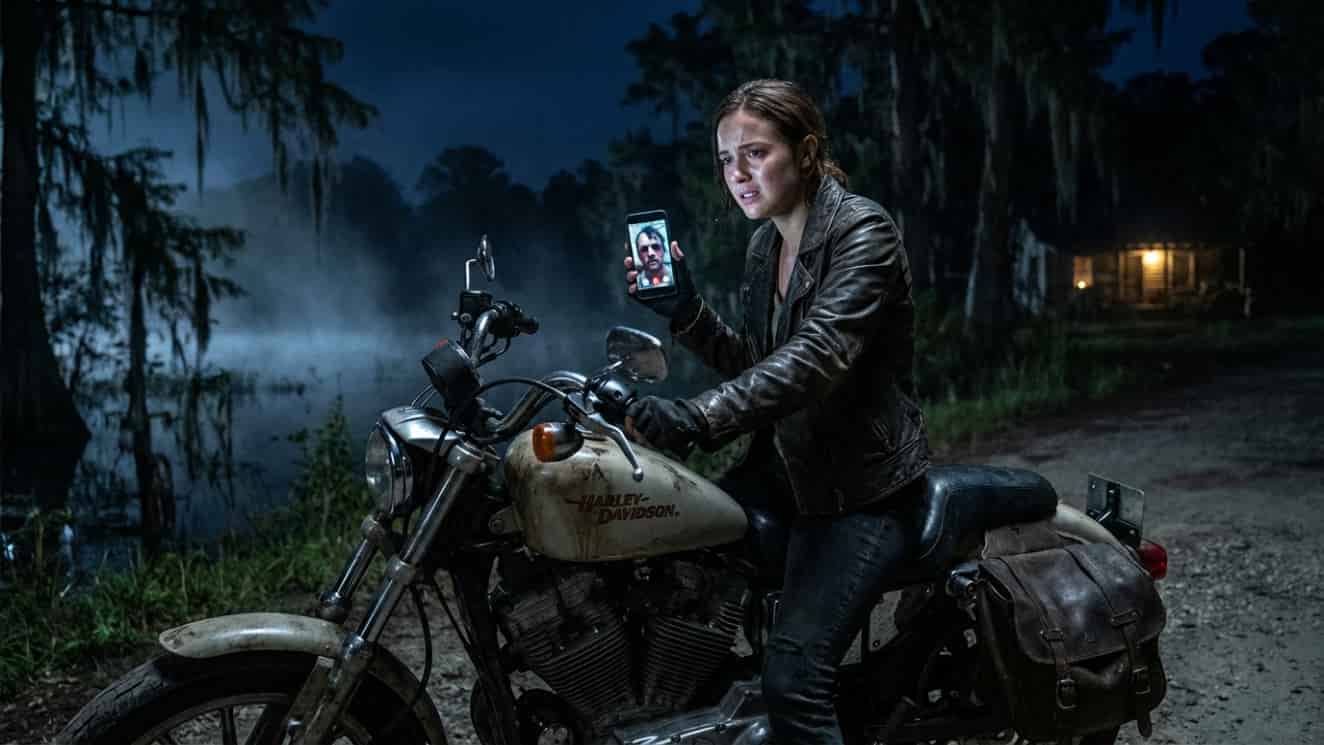
The humidity in Henderson was thick enough to choke a radiator. I sat on the Sportster my father built, the vibration of the engine the only thing keeping my hands from shaking.
In the saddlebag, two hundred thousand dollars of the Black Bayou MC’s “War Chest” sat like a lead weight. It was supposed to be my ticket out—past the state line, past the “Princess” labels, past the smell of stale beer and bad decisions.
Then my phone buzzed. A video of Link. My brother. The one who stayed. He was bleeding in a shed I recognized all too well.
“Sway, please,” he choked out.
They didn’t want the money. They wanted to remind me that once you’re club property, you never really leave. But they forgot one thing: my father didn’t just teach me how to ride. He taught me how to fight dirty.
FULL STORY
Chapter 1
The air in Henderson didn’t just sit; it pressed. It was three in the afternoon, and the humidity was hovering somewhere near ninety percent, making the moss on the live oaks look like it was sweating. I sat on the curb outside a Sunoco, the Sportster idling between my thighs. The vibration was a low, rhythmic thrum that usually settled my nerves, but today it felt like a countdown.
I’d spent twenty-eight years in the shadow of the Black Bayou MC. My father, “Big Jim” Miller, had been the president until a stroke took him out two years ago. Since then, I’d been the “Club Princess.” It sounded like a title of respect, but it was really just a polite way of saying I was part of the inventory. I fixed their bikes, I kept the books when the Treasurer got too drunk to add, and I smiled when the “Old Ladies” told me I’d make some prospect a fine wife one day.
I looked down at the heavy leather saddlebag. Inside, wrapped in thick plastic and duct tape, was two hundred thousand dollars. It was the club’s “War Chest”—the rainy-day fund for lawyers, bribes, and bail. Crozier, the current Treasurer, kept it in a floor safe in the back office of the clubhouse. He’d gotten sloppy. He’d started trusting me to lock up.
I’d spent six months planning the exit. I had a new ID waiting in a locker in Beaumont and a line on a job at a custom shop in Austin. I just had to get across the Atchafalaya Basin without looking over my shoulder.
My phone vibrated in my pocket. I pulled it out, squinting against the glare of the Louisiana sun. It was a text from Link, my older brother. He’d stepped into our father’s boots as Sergeant-at-Arms, a role he wasn’t nearly mean enough for, which made him twice as dangerous because he was always trying to prove he belonged.
Where are you? Crozier is looking for the keys.
I didn’t answer. I tucked the phone back into my vest and kicked the Sportster into first gear. The bike was a ’98, bored out to a 1200, with a custom rake my dad had finished the summer before he died. It was the only thing in this world that felt like it belonged to me, and the only thing I was taking with me.
I pulled out onto the highway, the wind offering no relief from the heat. It felt like riding through a blow dryer. Ten miles in, the phone buzzed again. This time it was a video file. I told myself to keep riding. I told myself that Link was a big boy, that he’d made his choice to stay with the Black Bayou. But the itch in my brain won. I pulled over onto the soft shoulder, the tires crunching through dried pine needles.
The video was short. It was shot in the “Processing Shed”—a windowless outbuilding behind the clubhouse where the brothers took people who owed them things. Link was sitting in a metal folding chair. His face was a map of purple and red. One eye was swollen shut.
Crozier’s voice came from off-camera. Cold. Business-like. “He says he doesn’t know where you went, Sway. He says you wouldn’t do this to your own blood. I told him he doesn’t know you like I do. You’ve always had a bit of your old man’s greed in you.”
Crozier stepped into the frame, holding a pair of heavy-duty pliers. He didn’t look angry. He looked like a man doing inventory. “You have six hours to bring the bag to the Landing. If you aren’t there, Link starts losing pieces. After that, we come for you. And you know we’ll find the bike.”
The video ended on Link’s good eye, wide and terrified, staring directly into the lens.
I looked at the road ahead. The Texas border was less than three hours away. I could go. I could change my name, melt into the Hill Country, and never look back at this swamp again. Link had chosen the club over me a dozen times. When I’d told him I wanted to go to college, he’d laughed and told me I was needed in the shop. When I’d complained about the way the prospects looked at me, he’d told me to “grow a thicker skin.”
I gripped the handlebars so hard my knuckles turned white. I hated him. I hated this life. I hated the smell of oil and the sound of gravel.
I turned the bike around.
The Landing was an old fishing camp on the edge of the basin, half-rotted and reclaimed by the cypress knees. It was neutral ground, or as close to it as the Black Bayou got. I arrived as the sun was beginning to dip, turning the sky the color of a fresh bruise.
Crozier was there, leaning against his blacked-out Street Glide. Beside him stood Brenda, his “Old Lady.” Brenda had been around since I was in diapers. She was a hard-faced woman who smelled like Virginia Slims and resentment. She’d always hated me, mostly because I knew how to do more than just pour a beer.
“You’re late,” Crozier said. He checked his watch. “Link’s still got all his fingers, though. For now.”
“Where is he?” I asked, keeping the engine running.
“In the van,” Crozier gestured to a beat-up white Econoline parked under the trees. Two prospects stood by the rear doors, looking bored and sweaty.
“Show me,” I said.
Crozier nodded. One of the prospects opened the door. Link was slumped against the interior wall, his hands zip-tied behind his back. He looked up, his one good eye blinking slowly.
“Sway,” he wheezed. “You shouldn’t have come back.”
“Shut up, Link,” I said. I looked at Crozier. “I have the money. But we’re doing this my way.”
Brenda let out a short, sharp laugh. “Your way? Look at you. You’re playing dress-up in your daddy’s clothes. You’re nothing but a thief who got cold feet.”
I ignored her. I reached into the saddlebag and pulled out a small, handheld GPS tracker. I tossed it to Crozier.
“The bag is in a dry box, submerged in three feet of water exactly at those coordinates,” I said. “It’s ten miles into the marsh. You go get it. Link stays here with me. When you confirm the cash is there, you call your boys and tell them to let us go.”
Crozier caught the tracker, his thumb tracing the screen. He looked at the van, then back at me. A slow, ugly smile spread across his face. “You think you’re smart, don’t you? Using the swamp. Just like Jim.”
“I learned from the best,” I said, my voice steady even as my stomach did somersaults.
“Take them to the camp,” Crozier told the prospects. “If I don’t call in an hour, finish it.”
He hopped on his bike and roared off toward the boat launch, Brenda following him in her sedan. The prospects grabbed me by the arms, pulling me off the Sportster. I didn’t fight them. I let them lead me toward the van. This was the first move. Now I just had to survive the second.
Chapter 2
The interior of the fishing camp smelled like wet dog and mildew. It was a one-room shack with a sagging porch and a single bare lightbulb that flickered every time the wind picked up. The prospects, a kid named Rabbit who couldn’t have been more than twenty and a hulking guy they called Ox, sat me down in a chair across from Link.
Link looked terrible. The blood had dried on his lip, and his breathing was shallow. He wouldn’t look at me.
“You really took it,” he whispered, his voice cracking. “The War Chest. I didn’t believe them.”
“Believe it,” I said. I looked at Rabbit, who was nervously tapping a knife against his thigh. “How’s the club, Rabbit? They treating you well? Or are you still just the guy who cleans the grease traps?”
Rabbit scowled. “Shut up, Sway. You’re a traitor. You stole from the brothers.”
“The ‘brothers’ are currently using my brother as a punching bag because they’re too lazy to check their own security,” I snapped. “And you’re standing guard over a woman and a tied-up man while Crozier goes to play treasure hunter. Real high-stakes stuff, kid.”
Ox stepped forward, his shadow looming over me. “I said shut up. Another word and I’ll tape your mouth.”
I went quiet, but I kept my eyes on Link. I needed him to be present. I needed him to realize that the loyalty he’d given his whole life to was a one-way street.
“Link,” I said softly, ignoring Ox’s glare. “When dad died, who was there? Was it Crozier? Was it the club? No. It was me. I was the one holding the basin while he died. They were at the bar, ‘toasting his memory’ before the body was even cold.”
“They’re family, Sway,” Link said, but there was no conviction in it.
“They’re a business, Link. And right now, you’re an overhead cost they’re looking to cut.”
The minutes ticked by. The mosquitoes were getting thick, buzzing around the lightbulb. Every few minutes, Rabbit would check his phone, waiting for the signal from Crozier. I knew the coordinates I’d given were real, but I also knew that the dry box was tucked deep into a cypress root system that was home to a very large, very territorial alligator. It would take Crozier more than an hour to get it.
“What happens when he finds the money?” Link asked, finally meeting my eyes.
“He’ll call,” I said. “And then we leave.”
“He won’t let you leave, Sway,” Link said, and for the first time, he sounded like my brother again. Not a biker, not a Sergeant-at-Arms. Just a guy who knew the world he lived in. “You know too much. You took the money. In their eyes, you’re dead already. They’re just waiting to make it official.”
I knew he was right. I’d known it the second I turned the bike around. But I had a plan. Or at least, the beginning of one.
Suddenly, the sound of an engine approached. Not a bike. A car.
The door to the shack swung open, and Brenda walked in. She wasn’t supposed to be there. She was supposed to be with Crozier. She held a small, snub-nosed revolver in her hand, her finger resting casually on the trigger.
“Rabbit, Ox, go outside,” she said.
“Crozier said we stay with them,” Ox argued.
“Crozier is waist-deep in a swamp looking for a bag of cash,” Brenda said, her voice like sandpaper. “I’m the one here. Go. Now.”
They hesitated, then shuffled out onto the porch. Brenda shut the door and leaned against it, lighting a cigarette with her free hand. She looked at me with a mixture of pity and pure, unadulterated venom.
“You always thought you were better than us,” Brenda said, blowing smoke toward the ceiling. “Little Sarah Miller. Reading her books. Fixing the engines because she was too smart for the kitchen. You thought you could just walk away?”
“I am walking away, Brenda,” I said. “Whether you like it or not.”
“No, you aren’t,” she said. She stepped closer, the gun level with my chest. “See, Crozier thinks he’s going to bring you back and make an example of you. Put you to work in one of the houses down in New Orleans. But I’ve had to put up with your ‘princess’ attitude for twenty years. I’m not waiting for Crozier’s version of justice.”
She raised the gun. Link yelled something, trying to lunge forward in his chair, but his feet were tied to the legs.
“Wait,” I said, my heart hammering against my ribs. “Brenda, look at the bag on the table.”
I pointed to my leather jacket, which Rabbit had tossed onto a side table. A small corner of a white envelope was sticking out of the pocket.
“What is it?” she hissed.
“It’s a letter. From my father. He left it for me in the safe. It’s not just money I took, Brenda. I took the records. The real records. The ones that show who was skimming from the club ten years ago. The ones that show who tipped off the feds about the shipment in ’14.”
Brenda froze. The color drained from her face. “You’re lying.”
“Am I? Why do you think Crozier wants me alive so badly? It’s not for the money. It’s because he knows what’s in those files. And he knows if I don’t check in with a lawyer in Houston by tomorrow morning, those files go to the District Attorney.”
It was a total bluff. There were no files. My father hadn’t been that organized, and Crozier wasn’t that smart. But Brenda was paranoid. Everyone in the club was. You couldn’t live that life without wondering who was stabbing you in the back.
Brenda lowered the gun slightly, her eyes darting toward the jacket. In that split second of hesitation, the floorboards on the porch creaked.
A heavy thud followed. Then silence.
The door didn’t open. It exploded inward.
Chapter 3
It wasn’t the police. It wasn’t Crozier. It was three men in tactical vests, their faces covered by black balaclavas. They didn’t say a word. The first one through the door caught Brenda with a butt-end of a shotgun to the temple, dropping her like a sack of grain.
Rabbit and Ox must have been handled outside, because they never made a sound.
I looked at Link. He was as confused as I was. These weren’t bikers. These were professionals.
One of the men stepped toward me. He didn’t point his weapon at me; he slung it over his shoulder and pulled down his mask. It was a man I hadn’t seen in five years. “Elias?” I breathed.
Elias had been my father’s “cleaner.” He wasn’t a member of the MC. He was the guy the club hired when things got too messy for leather-clad bikers to handle. My dad had treated him like a son, and for a summer when I was nineteen, I’d thought I loved him. Then he’d vanished.
“Sway,” he said, his voice as calm as a graveyard. “You really stirred the nest this time.”
“Who are you working for?” I asked, my mind racing.
“Myself,” Elias said. He looked at Link. “And your father. He had a contingency plan for when the club eventually turned on his kids. He set aside a fund. He told me if I ever heard you were in trouble, I was to come get you. I’ve been tracking your phone since you left Henderson.”
He walked over to Link and sliced through the zip-ties with a serrated blade. Link rubbed his wrists, staring at Elias with a mixture of awe and suspicion.
“Contingency plan?” Link asked. “Dad didn’t tell me about any plan.”
“Because you were part of the problem, Link,” Elias said bluntly. He turned back to me. “We need to go. Crozier is on his way back. He found the box, but he also found the tracker. He knows he’s being watched.”
“Wait,” I said. I looked at Brenda, unconscious on the floor. “What about the money?”
“Forget the money,” Elias said. “The club is already descending on this place. Crozier called for backup. They think there’s a rival gang moving in.”
“I’m not leaving the Sportster,” I said. It was stubborn, it was stupid, but that bike was the only piece of my father that hadn’t been corrupted.
Elias sighed, a weary sound. “Fine. My guys will trailer it. But we move now.”
We scrambled out of the shack. The swamp was alive with the sound of crickets and the distant hum of outboard motors. In the driveway, a blacked-out SUV was idling. Two of Elias’s men were already loading my Sportster into the back of a covered trailer.
As we reached the car, headlights cut through the trees. Not one pair. Three.
The roar of V-twin engines echoed off the water. The Black Bayou had arrived.
“Into the car!” Elias shouted.
Link scrambled into the backseat, and I jumped in beside him. Elias hopped into the driver’s seat and floored it just as the first line of bikers rounded the bend. Bullets began to “thwip” against the SUV’s armored glass.
“Get down!” Elias yelled.
I pressed my face into the leather seat, the smell of gunpowder and expensive upholstery filling my nose. Beside me, Link was shaking. Not from fear, but from something else. Rage.
“They’re shooting at us,” Link whispered. “The brothers. They’re actually shooting at us.”
“I told you, Link,” I said, my voice muffled by the seat. “The brotherhood ends where the money begins.”
Elias swerved onto a narrow dirt track, the SUV bouncing violently. The bikers were right behind us, their headlights dancing in the rearview mirror like angry fireflies. I saw Crozier in the lead, his face twisted in a mask of fury. He wasn’t just after the money anymore. He was after his pride.
Elias reached into the center console and pulled out a small remote. “Hold on,” he said.
He pressed a button. A hundred yards behind us, a series of small, pre-set charges went off along the narrow bridge we’d just crossed. The wooden structure collapsed into the black water of the bayou, taking two of the lead bikes with it.
The remaining bikers screeched to a halt at the edge of the gap. For a moment, we were safe.
Elias didn’t slow down. He drove until the trees thinned out and the lights of the highway appeared in the distance.
“Where are we going?” Link asked.
“To a safe house in Baton Rouge,” Elias said. “We stay there for forty-eight hours, then we move you out of state.”
“I can’t just leave,” Link said. “I have a life there. My house, my shop…”
“You don’t have a life there anymore, Link,” I said, sitting up. I looked at him, really looked at him. The bruises were starting to swell, making him look like a stranger. “You’re a dead man to them. Just like me.”
Link looked out the window, his reflection ghostly against the dark glass. “What now, Sway?”
“Now,” I said, “we stop being Millers. And we start being people.”
Chapter 4
The safe house was a nondescript ranch-style home in a quiet suburb of Baton Rouge. It was the kind of place where people mowed their lawns on Saturdays and never asked their neighbors what they did for a living. To me, it felt like another planet.
Elias’s men were posted at the doors and windows. They were quiet, efficient, and utterly humorless. Elias himself was in the kitchen, brewing a pot of coffee that smelled like burnt rubber.
Link was in the living room, staring at a television that wasn’t turned on. He hadn’t spoken since we left the swamp.
I walked into the kitchen and sat across from Elias. He pushed a mug toward me.
“You didn’t really have a letter from your father, did you?” he asked, a ghost of a smile playing on his lips.
“No,” I said. “But Brenda believed it. That’s all that mattered.”
“You’ve got your mother’s eyes and your father’s instinct for the jugular,” Elias said. He leaned back, his chair creaking. “So, what’s the plan, Sway? You’ve got your bike. You’ve got your brother. But you don’t have the money.”
“I don’t need the money,” I said. It was a lie, but a necessary one. “I just want out.”
“Out isn’t a place,” Elias said. “Out is a state of mind. And right now, the Black Bayou is making calls. They’ve reached out to the clubs in Texas and Mississippi. You’re a ‘green-light’ target, Sway. Both of you.”
“What about the money?” I asked. “If we give it back…”
“Crozier already has the bag you hid,” Elias reminded me. “But he’s telling the club it was empty. He’s telling them you spent it or hid it somewhere else. He’s using you as a scapegoat so he can keep the two hundred grand for himself.”
I felt a cold chill run down my spine. Crozier was smarter than I’d given him credit for. By telling the club the money was gone, he ensured they would keep hunting us while he quietly laundered the cash into his own pockets.
“We have to prove he has it,” I said.
“And how do you plan on doing that?” Elias asked. “Walk into the clubhouse and ask for a receipt?”
“No,” I said. I looked toward the living room, where Link was still motionless. “But I know someone who can.”
An hour later, I was sitting on the back porch, watching the fireflies. The humidity was lower here, but the air still felt heavy with the weight of things unsaid.
The screen door creaked open, and Link walked out. He sat on the steps, his back to me.
“I’m sorry, Sway,” he said.
“For what?”
“For everything. For making you stay. For thinking the club was more important than you. I thought… I thought I was protecting you. If you were with us, you were safe.”
“I wasn’t safe, Link. I was a pet. A mascot with a wrench.”
“I know,” he said. He turned around, his face illuminated by the porch light. “I want to help. I want to make it right.”
“Then you have to do something you’re going to hate,” I said.
“Anything.”
“You have to go back. Not to the club. To Brenda.”
Link frowned. “Brenda? She tried to kill you.”
“Exactly. And she knows Crozier better than anyone. She knows he’s skimming. She’s been his Old Lady for fifteen years; she’s watched him hide pennies for a decade. If he has that bag, she knows where it is. And more importantly, she’s pissed off because he left her at the fishing camp to get hit by Elias’s men.”
“She won’t talk to me,” Link said.
“She will if you tell her you’re ready to flip. Tell her you know where the real money is—the money I ‘stole.’ Tell her you want to cut a deal to get out before Crozier kills her too.”
Link looked out at the dark yard. “She’ll kill me the second she sees me.”
“Not if Elias is watching your back,” I said. “It’s the only way, Link. If we expose Crozier, the club turns on him. They’ll be too busy tearing each other apart to worry about us. It’s our only chance to disappear.”
Link stood up, his posture straighter than it had been in days. “Okay. Let’s do it.”
Elias appeared in the doorway, his arms crossed. “It’s a suicide mission.”
“No,” I said, looking Elias in the eye. “It’s a family business. And we’re the only ones left who know how to run it.”
Chapter 5
The air at the Starlight Motel was thick with the scent of pine cleaner and desperation. It was a “no questions asked” joint on the edge of Lafayette, the kind of place Brenda always went when she and Crozier were fighting.
Elias and I were in a van parked across the street, watching through a thermal scope. Link was standing in front of Room 114, knocking softly.
“He’s in,” Elias whispered as the door cracked open.
I watched the grainy heat signature of my brother disappear into the room. My hands were slick with sweat. If Brenda pulled that snub-nosed revolver again, Elias wouldn’t be able to get through the door in time.
“Why are you doing this, Elias?” I asked, my voice barely a whisper. “My dad’s been dead for two years. You don’t owe us anything.”
Elias didn’t look away from the scope. “Your father found me when I was sixteen, Sway. I was living in a literal ditch. He gave me a job, a place to sleep, and he never asked me to pull a trigger for him. He wanted me to be better than the club. Helping you… it’s the only way I can pay him back.”
Minutes stretched into an eternity. Inside the room, the two heat signatures moved closer, then further apart. There was a lot of hand-waving—Brenda was agitated. Then, they sat down.
Suddenly, Link’s voice came over the wire we’d tucked into his collar.
“…he’s leaving tonight, Brenda. He’s got the bag in the false bottom of the Street Glide’s trailer. He’s heading for the border. He’s not taking you. He told the boys you were ‘compromised’ after the shack.”
Brenda’s voice was a low growl. “That son of a bitch. I gave him twenty years. I took the beatings for him. I lied to the Feds for him.”
“He’s done with you,” Link said, his voice steady. “But I’m not. Give me the ledger. The one you keep in the floorboard of your car. I know it’s there, Brenda. I’ve seen you writing in it. Give me the proof that he’s been skimming, and I’ll make sure the club finds out. They’ll take care of Crozier, and you can walk away with enough to start over.”
There was a long silence. I held my breath.
“Why should I trust you, Link?” Brenda asked.
“Because I’m the only one left who doesn’t want you dead,” Link said. “Sway is gone. Dad is gone. It’s just us leftovers, Brenda. And leftovers have to stick together.”
Another silence. Then, the sound of a zipper.
“The ledger is in the spare tire well,” Brenda said, her voice sounding old and tired. “But you better move fast. He’s meeting the President at the clubhouse in an hour to ‘report’ on the missing money.”
“We’ve got it,” Elias said, dropping the scope. “Move, move, move!”
We pulled the van up to the door just as Link stepped out. He looked pale but determined. He handed a small, leather-bound notebook to Elias.
“She gave it up,” Link said.
“Get in,” I told him. “We have to get to the clubhouse.”
“Sway, you can’t go there,” Link protested. “It’s a fortress.”
“We aren’t going in,” I said, a cold realization settling over me. “We’re going to make sure everyone else does.”
We drove back toward the swamp, the familiar smell of woodsmoke and stagnant water filling the air. As we neared the clubhouse—a sprawling, fenced-in compound on the edge of the bayou—we saw the rows of bikes parked outside. The entire chapter was there.
Elias pulled over a quarter-mile away. “What’s the move?”
“We send the photos,” I said. “Link, you have the phone numbers for the whole board. Send them pictures of the ledger pages. The ones showing Crozier’s ‘private’ accounts.”
Link took the notebook and started snapping photos with his phone. His fingers were shaking, but he didn’t stop. He hit ‘Send’ on a group chat that included every patched member of the Black Bayou.
We waited.
Five minutes passed. The woods were silent.
Then, the shouting started. It was a dull roar at first, then the sound of breaking glass and overturned furniture. A gunshot rang out—a single, sharp crack that echoed off the water. Then another.
“It’s happening,” Link whispered.
Through the trees, we saw men spilling out of the clubhouse. They weren’t riding out; they were fighting in the dirt. In the center of the chaos, I saw Crozier. He was trying to get to his bike, his face bloody. He was tackled by three prospects and dragged back toward the “Processing Shed.”
The brotherhood was eating itself.
“Let’s go,” I said. “Before they remember why they’re mad at us.”
We turned the van around and headed back toward the highway. As we passed the Sunoco where this had all started, I saw my Sportster in the trailer mirror. It looked beautiful in the moonlight—a piece of history that was finally, truly mine.
But the feeling wasn’t one of triumph. It was a hollow, aching weight. We had won, but we had burned everything to do it.
Chapter 6
We stopped at a rest area near the Texas border. The sun was just beginning to peek over the horizon, painting the sky in pale pinks and oranges. Elias’s men were fuel-loading the SUV and the trailer.
Link and I sat on a concrete bench, watching the trucks roll by on I-10. He had a clean bandage over his eye and a fresh shirt Elias had given him. He looked like a normal guy. For the first time in his life, he didn’t have a leather vest on.
“I don’t know who I am without the patch, Sway,” he said quietly.
“You’re my brother,” I said. “That’s a start.”
“Where are we going?”
“Austin. There’s a shop there that needs a good mechanic. And a front-desk person who knows how to handle difficult customers.”
Link smiled, a small, genuine thing. “I think I can handle the difficult ones. I’ve had practice.”
Elias walked over, wiping his hands on a rag. “The trailer is secure. I’ve wiped the GPS on the bike. You’re ghosting now. No social media, no calls to the old area codes. In six months, if you’re clean, I’ll send you the rest of the contingency fund your father left.”
“Wait,” I said. “The fund… how much is it?”
Elias looked at me for a long time. “Enough to buy a shop of your own. Your dad knew the club would fail, Sway. He just didn’t know how to stop it while he was alive. This was his apology.”
I looked at the Sportster, the chrome catching the early light. I thought about the two hundred thousand dollars Crozier had stolen, and the lives that had been ruined for it. My father had been a criminal, a liar, and a hard man, but in the end, he’d tried to build a bridge out of the swamp.
“Thank you, Elias,” I said.
He nodded, put on his sunglasses, and climbed into the SUV. “See you in six months. Don’t make me come looking for you.”
He drove off, leaving us with a secondary car and the trailer.
Link looked at me. “You want to ride the rest of the way?”
I looked at the highway stretching out toward the west. It was flat, gray, and went on forever. It didn’t have any cypress knees to trip over or dark water to hide secrets in.
“No,” I said. “Let’s keep it in the trailer for a while. I think I’ve had enough wind in my face for one week.”
We got into the car, Link behind the wheel. As we crossed the Sabine River into Texas, I looked back one last time. The Louisiana state sign was fading in the rearview mirror.
I thought about Brenda, probably sitting in that motel room wondering where it all went wrong. I thought about Crozier, and the sound of that shed door closing. I thought about my father, whose ghost was finally starting to quiet down.
I reached out and turned on the radio. It was a local station playing something old and country—a song about a man who lost everything and found himself on the road.
“You okay?” Link asked.
I adjusted the seat, leaning my head back against the headrest. My hands were clean. No oil, no blood, no grease. Just the dry, cool air of the car and the sound of the tires on the asphalt.
“I’m fine, Link,” I said. And for the first time in my life, I wasn’t lying.
We drove on, the sun climbing higher in the sky, burning off the last of the morning mist until the road ahead was nothing but light.