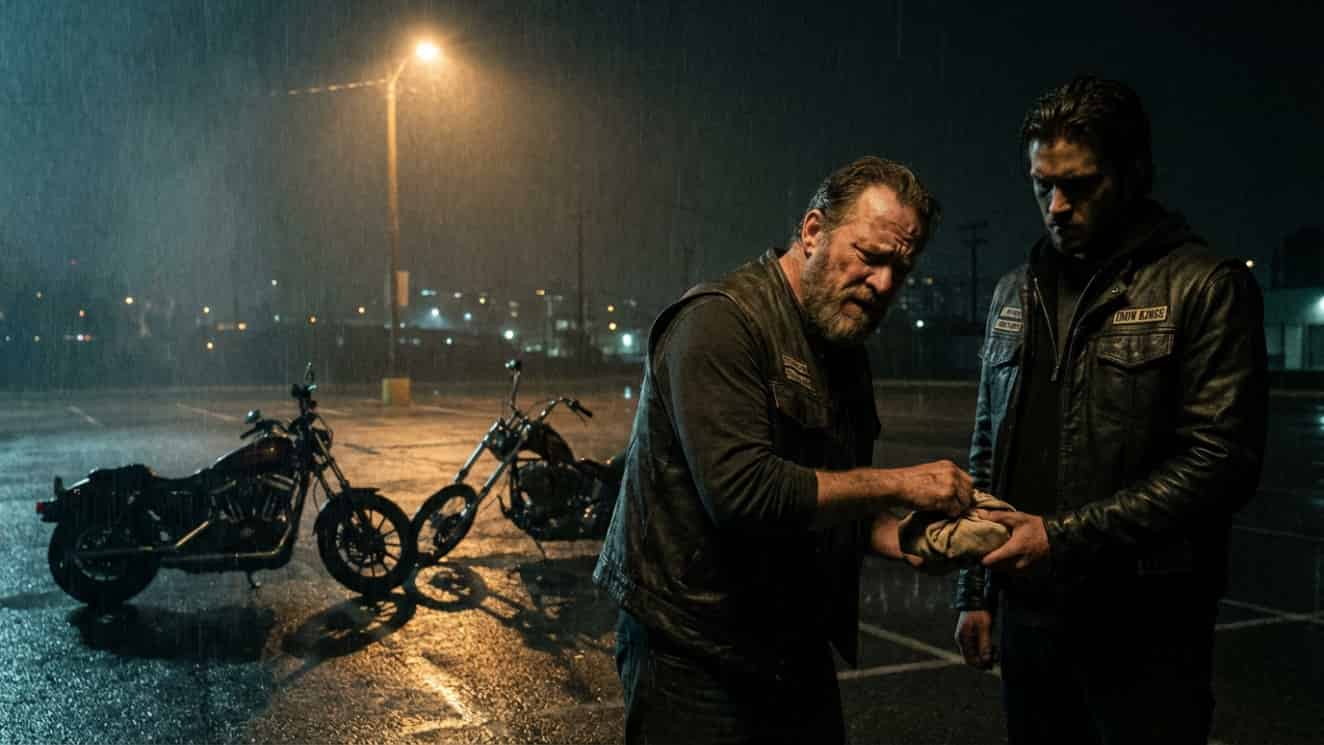
Grif is fifty years old, and his back hurts every time he kicks his Harley into life. He’s the President of the Iron Sowers, a small-town club in a world that doesn’t have room for “small” anymore.
Thirty years ago, he watched his father die in a gutter defending a patch of dirt that nobody remembers now. Grif promised himself he wouldn’t let that happen again. Not to his men. Not to the kids like T-Bone who think “honor” is something you find at the bottom of a grave.
But survival has a price. To keep the massive Iron Kings from wiping his club off the map, Grif is doing the unthinkable. He’s talking to the enemy. He’s selling pieces of the club’s soul to keep their hearts beating.
Every time he meets Viper in a dark parking lot, Grif loses a little more of himself. He’s a “rat” in his own mind, a savior in his intentions, and a dead man walking if his brothers ever find out.
How do you choose between the men you love and the code you live by? When the young bloods start screaming for war, can Grif keep the secret long enough to save them from themselves?
FULL STORY
Chapter 1
The air in the clubhouse smelled like it always did: stale American Spirit tobacco, leaked primary oil, and the sour tang of industrial floor cleaner that never quite won the war against the dirt. Grif sat at the end of the bar, the wood scarred by decades of cigarette burns and heavy glass mugs. He was fifty, but in the low amber light of the Miller High Life sign, he looked sixty-five. His hands, thick-knuckled and stained with the kind of grease that lives permanently under the skin, wrapped around a lukewarm bottle of beer.
Across the room, T-Bone was making too much noise. T-Bone was twenty-eight, all lean muscle and bad intentions, with a “100% Pure” tattoo crawling up his throat and a chip on his shoulder the size of the Allegheny Mountains. He was currently tearing down a Sportster engine on a lift, but he wasn’t working with the rhythmic patience of a mechanic. He was hitting things. He was making a point.
“They crossed the county line again, Grif,” T-Bone said, not looking up from the greasy heart of the bike. He slammed a socket wrench onto the steel table. The ring of metal on metal vibrated in Grif’s teeth. “Three of ’em. Spotted at the Sunoco on Route 22. Full patches. They didn’t even try to hide it.”
Grif didn’t move. “Sunoco is public property, Terry. People buy gas.”
“The Iron Kings don’t ‘buy gas’ in our zip code,” T-Bone snapped, finally looking up. His eyes were bright with the kind of dangerous energy that Grif used to have before he understood how hard it was to clean up blood. “They’re scouting. They’re looking at the shop, looking at who’s coming and going. And we’re sitting here drinking shitty beer while they piss on our porch.”
Grif took a slow pull of his drink. “We’re sitting here because it’s Tuesday. And because nobody’s been hit. You want to start a war over a gas station run? My old man died for a gas station. You remember that?”
“I remember the story, Grif. Everyone knows the story,” T-Bone said, his voice dropping into a register that was dangerously close to disrespectful. “But your old man didn’t have the Kings breathing down his neck. He had a bunch of local drunks. This is different. These guys are corporate. They’re a machine. If we don’t show teeth, they’re just going to swallow us whole.”
Grif looked past T-Bone, toward the back wall where the original “Mother” charter hung in a heavy oak frame. It was dated 1974. His father’s signature was the first one on the line, a bold, looping script that looked like it had been written by a man who expected to live forever. Grif had been twelve when they buried him. He remembered the smell of the lilies and the way the leather vests of the club members looked too shiny and stiff in the afternoon sun. He remembered thinking that “honor” felt a lot like being cold and hungry.
“I’ll handle it,” Grif said.
“Handle it how?” T-Bone stepped away from the lift, wiping his hands on a rag that was already black with filth. “You’ve been ‘handling it’ for six months, and they’re getting closer. The guys are talking, Grif. They’re wondering if we’re still a club or if we’re just a social circle for aging enthusiasts.”
The “guys” were only seven other men. The Iron Sowers had never been big. They were a neighborhood club, a group of guys who worked at the local machining shops, the HVAC companies, and the county road crews. They liked bikes, they liked each other, and they liked the idea that they belonged to something that the rest of the world couldn’t touch. But the rest of the world was touching them now. The Iron Kings were a national organization with a legal fund, a drug pipeline, and a standing army.
“The guys can talk to me if they have a problem,” Grif said, standing up. His knees popped, a sharp, audible sound in the quiet room. “Go home, Terry. Finish the Sportster tomorrow. You’re over-torquing the bolts because you’re pissed off.”
T-Bone stared at him for a long beat, the silence stretching out until it felt like a physical weight. Finally, the younger man threw the rag onto the floor and grabbed his jacket. “One of these days, Grif, you’re going to have to decide if you’re the President or a peace officer.”
Grif waited until he heard T-Bone’s truck roar to life in the gravel lot and fade into the distance. He waited another ten minutes, then he went to the small office in the back. He opened a drawer, pulled out a burner phone he kept hidden behind a stack of outdated tax forms, and dialed a number he had memorized but never saved.
“Yeah,” a voice answered on the second ring. It was calm, articulate, and completely devoid of warmth.
“It’s me,” Grif said. “We need to talk.”
“I was wondering when the Sunoco visit would register,” the voice—Viper—said. “The diner on Route 30. Twenty minutes. Come alone, Leo. Don’t make me explain why.”
Grif hung up. He looked at his hands. They were still shaking, just a little. He hated that he was Leo to this man. In the club, he was Grif. In the world, he was Leo. Viper knew exactly which version of him held the power, and it wasn’t the guy with the patch on his back.
He rode his Harley through the damp Pennsylvania night. The fog was rolling off the hills, thick and smelling of wet earth and decaying leaves. He bypassed the main roads, sticking to the back-alleys and the county routes where the cops didn’t sit. He felt like a ghost haunting his own town.
The diner was a 24-hour place, the kind with neon that hummed and coffee that tasted like burnt rubber. He saw Viper’s vehicle in the far corner of the lot—a late-model GMC Yukon, black, clean, and anonymous. Viper didn’t ride a bike to meetings like this. Viper was a regional lieutenant for the Kings; he didn’t need to perform his identity. He lived it.
Grif walked inside. The bell above the door jingled, a cheerless sound. A waitress with a tired face and a permanent limp pointed him toward a back booth. Viper was sitting there, wearing a button-down shirt and a light jacket. He looked like a mid-level manager at a logistics firm.
“You’re late,” Viper said, checking a watch that probably cost more than Grif’s bike.
“Traffic,” Grif lied, sliding into the booth.
“T-Bone is getting loud,” Viper said, skipping the pleasantries. “My scouts say he’s looking for a fight. He’s telling your boys that the Kings are soft. That you can hold the line.”
“He’s a kid,” Grif said. “He talks. That’s what kids do.”
“Kids with guns and bad attitudes get people hurt, Leo. I don’t want a mess in this county. It’s bad for business. My bosses want this territory settled. No friction. No headlines.” Viper leaned forward, his eyes like two pieces of flint. “I’ve been patient. I’ve given you six months to ‘transition’ your guys into our fold as a support club. But T-Bone is pushing for a vote at your next Church meeting. He wants to declare us hostile.”
Grif felt a cold knot tighten in his stomach. “How do you know about the vote?”
Viper smiled, but it didn’t reach his eyes. “I have ears everywhere, Leo. Even in that little clubhouse of yours. Now, here’s the deal. T-Bone is planning a run this Friday. He thinks he’s going to intercept one of our shipments coming through the gap. He thinks he’s going to make a statement.”
Grif stared at him. “He’s an idiot. He’ll get killed.”
“Exactly. He’ll get killed, and then your other six guys will feel obligated to retaliate, and then I’ll have to burn your clubhouse to the ground with everyone inside it. I don’t want to do that. It’s messy. It brings the Feds.” Viper reached into his jacket and pulled out a small, heavy envelope. He slid it across the table. “This is for your ‘consultation’ fee. In exchange, I need the exact route T-Bone is planning to take. I’ll have a ‘mechanical failure’ for my truck, and the police will just happen to be patrolling that stretch of the gap. T-Bone gets arrested, his bike gets impounded, and he spends a few months in county thinking about his life choices. No blood. No war.”
Grif looked at the envelope. He knew what was inside. Money to pay the mortgage on the clubhouse. Money to keep the lights on. Money that smelled like betrayal.
“You’re asking me to rat on my own VP,” Grif whispered.
“I’m asking you to save his life,” Viper corrected. “And the lives of the others. You know what happens if they show up to that shipment, Leo. My guys won’t be carrying wrenches. They’ll be carrying Uzis.”
Grif’s mind flashed back to his father. The way the blood had looked on the pavement—so much darker than he expected. The way the club had fallen apart within a year, leaving his mother to work three jobs just to keep the heat on.
“Friday,” Grif said, his voice cracking. “They’re taking the old logging road through the gap. They’ll be there at 11:00 PM.”
“Good choice,” Viper said, sliding the envelope closer until it touched Grif’s hand. “You’re a good leader, Leo. You’re keeping your family alive. That’s more than your father could say, isn’t it?”
Grif didn’t answer. He took the envelope and walked out into the rain. He felt like he was carrying a lead weight in his pocket. He climbed onto his bike, but he didn’t start it right away. He just sat there, the rain soaking through his leather, listening to the silence of the night and the thumping of his own heart, which felt like a drum counting down the seconds until he finally broke.
Chapter 2
The house was quiet when Grif pulled into the driveway. It was a small ranch-style place on the edge of town, the kind of house where the siding was starting to chalk and the gutters needed a afternoon of work he didn’t have the energy for. He sat in the driveway for a long time, the engine of the Harley ticking as it cooled. The smell of hot metal and gasoline always calmed him, but tonight it felt like a reminder of everything he was trading away.
He walked through the back door into the kitchen. Sarah was there, sitting at the small table with a stack of bills and a calculator. She was wearing an old flannel shirt of his and had her hair pulled back in a messy knot. She looked up when he entered, her eyes scanning him for damage before she even spoke.
“You’re late,” she said. It wasn’t an accusation, just a fact.
“Meeting ran long,” Grif said. He went to the sink and started scrubbing his hands. The grease was stubborn tonight. He used the Gojo, the gritty orange soap scratching at his skin, but he couldn’t get the feeling of that envelope out of his mind.
“Was T-Bone there?” she asked.
“No. Just business.”
Sarah stood up and walked over to him. She leaned against the counter, watching him work. “You’re scrubbing too hard, Leo. You’re going to draw blood.”
He stopped, his hands covered in orange foam. He didn’t look at her. “He’s pushing for a war, Sarah. He’s got the younger guys all riled up. They think it’s 1970. They think they’re outlaws in a movie.”
“And what do you think?”
“I think I’m tired of burying people,” he said, finally turning the water on to rinse his hands. “I think the Kings have more money in their petty cash drawer than we have in our entire bank account. If we fight, we lose. There’s no version of this where the Iron Sowers come out on top.”
Sarah reached out and took his hand, her skin soft against his rough palms. “The mortgage on the clubhouse is three months behind, Leo. The taxes on this house are due next week. I saw the notice in the mail.”
Grif felt the weight of the envelope in his pocket. It felt like it was burning a hole through the leather. “I’ve got it covered. I did some consulting work tonight.”
Sarah’s eyes narrowed. She wasn’t a biker’s wife by accident. She’d grown up in this world; her brother had been the one who taught Grif how to ride. She knew what “consulting” meant in their world, and she knew the look of a man who was lying to himself.
“Who did you consult for, Leo?”
“Just an old contact. Don’t worry about it.”
“I worry because I’m the one who has to watch you leave every night,” she said, her voice dropping. “I worry because T-Bone came by here today. While you were at the shop.”
Grif froze. “What did he want?”
“He wanted to know if you were ‘losing your nerve.’ He said the club needs a leader who isn’t afraid of the future. He was being ‘respectful,’ in that way that feels like a threat.” She stepped closer, her face inches from his. “He’s dangerous, Leo. Not because he’s smart, but because he’s desperate to be important. Don’t let him pull you down with him.”
“I’m trying to save him,” Grif said, and the truth of it felt like a bitter pill in his throat. “I’m trying to save all of them.”
“You can’t save people who want to be martyrs,” she said. She kissed his cheek, a brief, dry touch, and went to bed.
Grif sat at the kitchen table for an hour, staring at the bills. He eventually pulled the envelope out. He counted the cash. Five thousand dollars. It was enough to catch up the clubhouse, pay the taxes, and have a little left over for groceries. It was exactly the amount of money a man needs to feel like he’s bought himself some time, even if he knows he’s actually just rented it.
The next morning, the sun was a pale, watery disc behind the clouds. Grif drove to the clubhouse early. He wanted to be there before anyone else, to have a moment with the place before the noise started. He let himself in, the heavy door creaking on its hinges.
The clubhouse was an old converted tavern. It had history in the walls. Grif walked over to the Charter. He looked at the names. Half of them were dead—accidents, cancer, or the slow erosion of poverty. A few had just drifted away, trading the patch for a minivan and a 401k. Grif was one of the few who had stayed. He had stayed because he didn’t know how to be anything else. He was the President of the Iron Sowers because his father had been, and because he believed, perhaps foolishly, that he could keep the fire from burning the house down.
He heard the rumble of engines outside. T-Bone and two others, Moose and Specs, pulled into the lot. They came in loud, laughing and talking about a party they’d been to the night before.
“Morning, Pres,” Moose said, nodding toward Grif. Moose was a big man, a welder by trade, with a heart of gold and the intellect of a hammer. He followed T-Bone because T-Bone gave him something to do.
“Grif,” T-Bone said, his tone neutral. He went straight to the fridge and pulled out a soda. “We’re meeting at 10:00 tonight. Just us. To prep for the run.”
Grif felt a prickle of alarm. “The run isn’t until Friday, Terry.”
“Plans change,” T-Bone said, leaning against the bar. “The shipment is moving early. I got word from a guy I know at the freight yard. They’re moving it through the gap tonight instead. We need to be ready.”
Grif’s heart skipped. Tonight? Viper had said Friday. If T-Bone moved tonight, the “police presence” wouldn’t be there. It would be a slaughter. Viper’s men would be waiting for a shipment that wasn’t supposed to be intercepted until Friday, and if T-Bone’s crew showed up, they’d be seen as a legitimate threat.
“The freight yard guy might be feeding you bullshit, Terry,” Grif said, trying to keep his voice steady. “We should stick to the original plan. Friday gives us more time to scout.”
“We’ve scouted enough,” T-Bone said, his eyes locking onto Grif’s. “The Kings are getting comfortable. They think we’re scared. If we hit ’em tonight, we have the element of surprise. Unless, of course, someone tells them we’re coming.”
The room went silent. Moose and Specs looked between the two men, the tension suddenly thick enough to taste.
“What’s that supposed to mean?” Grif asked.
“It means you’ve been real quiet lately, Grif,” T-Bone said, stepping away from the bar. “It means you’ve been taking ‘meetings’ that nobody knows about. It means I’m starting to wonder whose side you’re on.”
“I’m on the side of the Sowers,” Grif said, his voice low and dangerous. “I’m the one who keeps this roof over your head. I’m the one who handles the heat so you can play soldier. You want to lead? Then lead. But don’t you ever question my loyalty in this house.”
T-Bone didn’t flinch. He just nodded, a slow, deliberate movement. “Tonight. 10:00 PM. We’re moving. You can come with us and prove me wrong, or you can stay here and wait for the news.”
He turned and walked out, Moose and Specs trailing after him like obedient dogs.
Grif stood alone in the center of the room. He needed to get to a phone. He needed to reach Viper. But as he reached for his jacket, he noticed something. The Charter on the wall—the frame was slightly crooked. He reached up to straighten it, and his fingers brushed the glass. It was cold. Cold as the grave his father was lying in.
He realized then that he wasn’t just trying to save T-Bone. He was trying to save himself from the memory of that blood on the pavement. But the more he tried to navigate the middle ground, the more he felt the ground disappearing beneath his feet. He had to make a call, and he had to make it now, or the Iron Sowers wouldn’t survive the night.
Chapter 3
The burner phone felt like a live wire in Grif’s hand. He sat in his truck, parked behind a derelict bowling alley two towns over. He couldn’t risk being seen at the clubhouse or the diner again. The sky was a bruised purple, the sun dipping below the jagged silhouette of the Appalachian foothills.
Viper answered on the first ring. “You have something for me?”
“The timeline changed,” Grif said, his breath hitching. “T-Bone is moving tonight. 10:00 PM. Same location, the old logging road through the gap. He thinks he’s being clever. He thinks he has a lead from the freight yard.”
There was a long silence on the other end. Grif could hear the faint sound of music in the background—something classical and cold.
“That’s problematic,” Viper said eventually. “My ‘arrangement’ with the local authorities was scheduled for Friday. Moving it to tonight on such short notice is expensive. And complicated.”
“You said you didn’t want a mess,” Grif reminded him, his voice rising. “If they show up tonight and your guys are there with the shipment, people are going to die. My guys. Your guys. It’ll be a bloodbath.”
“I’m aware of the physics of a gunfight, Leo,” Viper said. “But you need to understand something. My primary responsibility is the cargo. If your boys interfere with that cargo without the police there to provide a ‘civil’ intervention, my security team will respond with maximum prejudice. They don’t know who T-Bone is. They only know he’s a threat.”
“Then move the shipment!” Grif shouted.
“No. We don’t change our logistics because of a few kids in leather vests. You have two hours to talk them down, Leo. Or you have two hours to make sure the police get there anyway. But if my team has to pull triggers, the deal is off. And I’ll want my five thousand dollars back. Along with interest.”
The line went dead.
Grif slammed his fist against the steering wheel. The horn honked, a lonely, pathetic sound in the empty lot. He felt trapped in a closing vice. He couldn’t call the police himself—that was the ultimate sin, the one thing you could never come back from. If he called 911 and his own men were arrested because of his tip, he’d be a dead man by morning, and the club would be finished anyway.
He drove back toward the gap, his mind racing. He had to stop them. He had to find a way to make T-Bone see reason without revealing how much he already knew.
He arrived at the staging area—a turnout near an abandoned limestone quarry—at 9:45 PM. Three bikes were already there, their headlights cutting through the swirling mist. T-Bone, Moose, and Specs were checking their gear. T-Bone was wearing a tactical vest over his colors, a heavy 9mm strapped to his thigh.
“You made it,” T-Bone said, his voice mocking. “I figured you’d be tucked in by now.”
“I told you, Terry, this is a mistake,” Grif said, climbing out of his truck. He didn’t bring his bike; he wanted to be able to block the road if he had to. “The Kings aren’t stupid. They know that logging road is the only way through. They’ll have scouts. They’ll be waiting.”
“Then we hit ’em harder,” T-Bone said. He pulled a heavy chain from his saddlebag and wrapped it around his fist. “We aren’t going there to negotiate, Grif. We’re going there to take what’s ours. This county belongs to the Sowers.”
“This county belongs to whoever has the most guns,” Grif snapped. “Look at yourselves. You’re three guys with handguns and a chain. You’re going up against a professional security detail. You’re not outlaws; you’re targets.”
Moose shifted uncomfortably, looking from T-Bone to Grif. “Maybe he’s right, T. Maybe we should wait for the others.”
“The others are scared,” T-Bone said, his eyes fixed on Grif. “Just like the President. You see it, don’t you? He’s been talking to them. I saw his truck near that diner on 30 yesterday. Who were you meeting, Grif? Was it Viper? Was it the guy who’s trying to put us in the ground?”
Grif felt the world tilt. He had been careful, or so he thought. “I was meeting a contact about a loan for the clubhouse. I told you, I’m trying to keep the lights on.”
“Liar,” T-Bone spat. He stepped closer, his hand resting on the grip of his pistol. “You’re selling us out. You’re ‘patching us over’ before we even have a choice. You’re a rat, Leo. Just like your old man probably was.”
Grif didn’t think. He swung. His fist caught T-Bone square in the jaw, the force of it sending the younger man reeling back against his bike. The Harley tipped, the heavy chrome crashing into the gravel with a sickening crunch.
“Don’t you ever say his name,” Grif hissed, his chest heaving. “He died for this club. He died so you could have a place to play tough guy.”
T-Bone wiped a smear of blood from his lip. He didn’t look angry; he looked satisfied. He looked like he had finally gotten the confirmation he was looking for.
“See?” T-Bone said to Moose and Specs. “He’s protecting them. He’s more worried about the Kings than he is about his own brothers.”
T-Bone stood up, ignoring his fallen bike. He pulled the 9mm from its holster. He didn’t point it at Grif, but he held it at his side, the barrel glinting in the moonlight.
“Get in your truck, Grif,” T-Bone said. “Go home. Sit with your wife and your bills. We’re going to the gap. And when we come back with that shipment, we’re going to have a Church meeting. A real one. And we’re going to vote on who gets to wear that ‘President’ patch.”
“Terry, listen to me—”
“Go!” T-Bone screamed.
Grif watched as they mounted their bikes. T-Bone struggled to right his Harley, the engine coughing before it roared to life. They took off, the sound of their exhausts echoing off the quarry walls like gunfire.
Grif stood in the dust, the smell of burnt rubber hanging in the air. He had less than twenty minutes. He looked at his truck, then at the road leading into the gap. He couldn’t save the club’s honor anymore. That was gone the moment he took Viper’s money. But he could still save their lives.
He got into the truck and dialed 911.
“State Police,” a voice answered.
“I need to report a masked armed robbery in progress,” Grif said, his voice sounding like it belonged to someone else. “The old logging road at the Gap. Three men on motorcycles. They’re armed and dangerous. They’re planning to intercept a commercial truck.”
“Sir, can I have your name?”
Grif hung up. He threw the burner phone out the window and into the dark waters of the quarry. He put the truck in gear and started driving, not toward the gap, but toward the clubhouse. He had done the one thing his father would have hated more than dying. He had invited the law into their world. He had traded his brothers’ freedom for their breath.
And as he drove, he realized the five thousand dollars in his pocket felt like thirty pieces of silver.
Chapter 4
The clubhouse was eerily quiet. Grif sat in the darkness, not turning on the lights. He didn’t want to see the dust or the empty chairs. He just wanted to wait. Every minute felt like an hour. Every distant siren he heard in the night made his skin crawl.
He sat behind the bar, the heavy oak providing a sense of illusory safety. He kept thinking about the look on T-Bone’s face—that smug, righteous certainty. T-Bone thought he was the hero of the story. He thought he was the one upholding the legacy. He didn’t understand that legacies are heavy, and they break people who aren’t strong enough to carry them.
Around 1:00 AM, the headlights of a car swept across the front windows. Grif tensed, his hand going to the heavy iron pipe he kept under the bar. But it wasn’t a bike. It wasn’t the police. It was Sarah’s old Subaru.
She came through the door, her face pale. She didn’t say anything at first. She just walked over to the bar and sat down across from him.
“The scanner,” she said, her voice trembling. “I heard it on the scanner, Leo. Armed robbery at the Gap. Three arrests. No shots fired.”
Grif let out a breath he felt like he’d been holding for a lifetime. “No shots?”
“The police were already there,” Sarah said, watching him closely. “They said the troopers were staged in the woods. They moved in before the bikes even reached the truck. T-Bone, Moose, and Specs. They’re in custody at the barracks.”
Grif closed his eyes. They were alive. They were in a cell, facing ten to twenty years for attempted armed robbery, but they were alive. He had won, and he had lost everything in the process.
“You called them,” Sarah whispered. It wasn’t a question.
“Viper was going to kill them, Sarah. He told me. He said if they interfered with the shipment, his security team would have ‘maximum prejudice.’ I couldn’t let it happen. I couldn’t watch another funeral.”
Sarah reached across the bar and took his hand. Her grip was tight, almost painful. “They’re going to know, Leo. Maybe not today, maybe not tomorrow. But the paperwork will come out. The timing of the police… someone will figure it out.”
“I know,” Grif said.
“We have to leave,” she said. “We can take the truck. We can go to your sister’s in Ohio. We can leave the house, the club, all of it.”
Grif looked up at the Mother Charter. The oak frame seemed to glow in the dim light. “I can’t leave. If I leave, the Kings just take the building. They take the history. They turn this place into a distribution hub. I have to stay. I have to manage the fallout.”
“There is no managing this!” Sarah stood up, her voice rising in the empty room. “You ratted out your VP! In this world, that’s a death sentence. It doesn’t matter why you did it. It doesn’t matter that you saved their lives. All they’ll see is the betrayal.”
“I’m the President,” Grif said, his voice flat. “I’ll handle the Church meeting. I’ll tell the others what happened—a version of it. I’ll say I got a tip and I tried to stop them.”
“And the money, Leo? How are you going to explain the five thousand dollars that paid our taxes today?”
Grif didn’t have an answer for that. He just sat there, the silence of the clubhouse pressing in on him.
The next few days were a blur of cold coffee and hushed conversations. The remaining members of the club—four men who were older, more tired, and less inclined toward violence—gathered at the clubhouse. They were confused, scared, and looking for leadership.
“They got set up,” one of them, a man named Miller who had been with the club since the 80s, said. “The cops were waiting. How do the cops know to wait on a logging road at midnight?”
“Maybe the freight yard guy was a plant,” Grif suggested, leaning against the bar. He felt like he was performing a play he hadn’t rehearsed. “Maybe the Kings set a trap to clear us out.”
“T-Bone said you were meeting them,” Miller said, his eyes narrowing. “He said you were talking to Viper.”
“I was trying to negotiate a peace,” Grif said. “I was trying to keep us from getting wiped out. Is that a crime now? Trying to keep you guys from ending up like T-Bone?”
“T-Bone’s alive,” Miller pointed out. “But he’s facing twenty years. That’s a long time to think about who knew what.”
The pressure was building. Grif could feel it in the way the men looked at him, in the way they avoided his eyes when he talked about the future. He spent his afternoons at the lawyer’s office, using part of Viper’s money to retain a defense attorney for Moose and Specs. He didn’t buy one for T-Bone. He told himself it was because T-Bone was the ringleader and would be more expensive, but the truth was simpler: he was afraid of what T-Bone would say to a lawyer.
On Thursday, Viper called again.
“You handled that well,” Viper said. “A little dramatic with the 911 call, but effective. My shipment went through without a hitch. The county is quiet.”
“I’m done, Viper,” Grif said. “I saved their lives. Now leave us alone.”
“Oh, Leo. We’re just getting started,” Viper chuckled. “You have a talent for management. I have another shipment coming through next week. And I’ve noticed your clubhouse has a very large, very discreet garage. It would be a perfect place for some temporary storage. In exchange, I’ll ensure that the ‘anonymous tipster’ who called 911 remains anonymous. It would be a shame if that recording ever found its way to the Iron Sowers’ remaining members.”
Grif felt a cold sweat break out across his back. “You recorded the call?”
“The police record everything, Leo. And I have friends in the police department. It’s a small world. See you Tuesday.”
Grif sat in his truck, the phone still pressed to his ear long after Viper had hung up. He looked at the clubhouse, the place he had spent his entire life protecting. He realized then that he hadn’t saved anyone. He had just traded a quick death for a slow one. He was no longer the President of an independent club. He was a warehouse manager for the Iron Kings.
He walked back inside. Miller was sitting at the bar, looking at a photo album from the early days. He pointed to a picture of Grif’s father, young and grinning, leaning against an old Shovelhead.
“He was a hell of a man,” Miller said. “Never backed down from a fight. Even when the odds were shit.”
“Yeah,” Grif said, his voice a ghost of a sound. “He was.”
Grif went to the back office and locked the door. He took the remaining cash from the envelope and stared at it. It looked like ordinary paper, but it felt like it was stained with something that wouldn’t wash off. He realized that the only way to protect the club now was to destroy it. If he stayed, he was Viper’s puppet. If he left, the club would fold.
He looked at the framed Charter through the open door. He thought about the men in the cells, and the men in the bar, and his father in the ground. He realized that “honor” wasn’t about winning or losing. It was about what you were willing to live with when the lights went out. And Grif knew, with a terrifying clarity, that he couldn’t live with this.
Chapter 5
The Church meeting was scheduled for Sunday afternoon. In the MC world, Church was sacred. It was the one time the doors were locked, the phones were off, and the truth—theoretically—was the only currency allowed.
The four remaining members sat around the heavy scarred table in the back room. Grif sat at the head, the President’s gavel in front of him. He looked at the empty chairs where T-Bone, Moose, and Specs should have been. The silence in the room was deafening, filled with the ghosts of thirty years of brotherhood.
“We have a problem,” Miller said, breaking the silence. “I went to see Moose in county lockup yesterday. During visiting hours.”
Grif felt a tightening in his throat. “How’s he doing?”
“He’s scared. But he’s also thinking,” Miller said. He leaned forward, his elbows on the table. “He told me that before they left for the Gap, T-Bone told them you were a rat. He said you’d been taking money from the Kings. I told him he was crazy. I told him you were the one who paid for his lawyer.”
The other three men looked at Grif. Their faces were masks of expectation, waiting for the denial that would set the world right again.
“I took the money,” Grif said.
The words fell into the room like stones in a well. No one moved. No one breathed.
“I took five thousand dollars,” Grif continued, his voice steady, almost clinical. “I used it to pay the taxes on this building so the county wouldn’t seize it. I used it to pay our mortgage. And I used it to hire a lawyer for Moose and Specs.”
“Where did the money come from, Grif?” a member named Red asked. Red was sixty, a retired plumber with a bad hip. He looked like he was about to cry.
“It came from Viper,” Grif said. “In exchange for information.”
Miller stood up so quickly his chair clattered to the floor. “You sold us out? To those corporate pricks? You gave them our routes? Our business?”
“I gave them a way to avoid a war!” Grif shouted, slamming his hand on the table. “I knew T-Bone was going to that gap. I knew Viper’s security team was waiting with automatic weapons. If they had met on that road, our boys would be in body bags right now! I called the police because a jail cell is better than a coffin!”
“It wasn’t your choice to make!” Miller screamed. “We’re a club, Leo! We live by a code! If we die, we die together! You don’t get to go behind our backs and play God because you’re afraid of a little blood!”
“I’m not afraid of blood, Miller! I’m tired of it!” Grif stood up, his height looming over the table. “I watched my father die for this patch! I watched my mother go broke for this patch! And for what? So a bunch of guys can sit in a bar and pretend they’re the kings of a town that doesn’t even want them here? The Iron Sowers are a memory, Miller. We’re an antique. And I was trying to keep the antique from being smashed to pieces!”
“You’re not a President,” Red whispered, his voice shaking. “You’re a traitor. You’re everything your father hated.”
Grif felt a sharp, stabbing pain in his chest. “Maybe. But you’re all alive. And you’re going to stay alive.”
“Not as Sowers,” Miller said. He reached up and slowly, deliberately, began to unbutton his vest. He pulled it off and threw it onto the table. It landed with a heavy thud, the patches—the top rocker, the bottom rocker, the center logo of the iron plow—staring up at Grif like an accusation.
One by one, the other three men did the same. They stripped themselves of their identity, leaving their colors in a pile in the center of the table. They didn’t say another word. They walked out of the room, through the bar, and out the front door.
Grif stood alone in the Church. He looked at the pile of leather. He felt a strange, hollow sense of relief. It was over. The lie was dead. The club was gone.
But then, the back door creaked open.
Grif turned, expecting to see Miller coming back for his keys. Instead, he saw Viper. He was wearing a dark suit and carrying a small briefcase. He looked around the room with an appreciative nod.
“Moving day?” Viper asked, gesturing toward the pile of vests.
“They quit,” Grif said. “There is no more Iron Sowers. You can have the building. You can have the territory. I’m done.”
“I don’t want the building, Leo. I want the President of the Iron Sowers,” Viper said, walking toward the table. He picked up Grif’s vest, which was still draped over his chair. “A club that officially exists on paper, with a legitimate charter and a local history, is a very valuable thing for moving certain types of cargo. If you quit, the charter becomes void. But if you stay—if you remain the sole officer—this place remains a ‘private club.’ Untouchable by most local zoning laws. Very convenient.”
“I won’t do it,” Grif said.
Viper opened his briefcase and pulled out a digital recorder. He pressed play.
“I need to report a masked armed robbery in progress… The old logging road at the Gap…”
Grif’s own voice filled the room, sounding thin and desperate.
“T-Bone has a lot of friends in the state prison system, Leo,” Viper said, clicking the recorder off. “If this recording makes its way to the yard, T-Bone won’t last a week. Neither will Moose or Specs. They’ll be seen as part of the setup. They’ll be killed by their own kind before they even get to a hearing.”
Grif felt his knees give out. He slumped back into his chair.
“You have two choices,” Viper said, leaning over the table. “You stay here. You keep the lights on. You let my trucks come and go. And in exchange, your friends stay alive in prison. And you get to keep your little house and your wife. Or, you walk away, and by tomorrow morning, T-Bone is dead and the police are at your door with a warrant for conspiracy.”
Grif looked at the pile of vests. He thought about Sarah. He thought about T-Bone’s mother, who had already lost a husband to the mills.
“What do I have to do?” Grif asked.
“Just stay the President, Leo,” Viper said, patting him on the shoulder. “It’s what you were born for, isn’t it?”
Viper left, the door clicking shut behind him. Grif sat in the silence of the empty clubhouse. He looked at the gavel. He picked it up and struck the table once, a sharp, final sound that echoed into the rafters. The meeting was adjourned. The Iron Sowers were dead, and Grif was the only one left to guard the grave.
Chapter 6
A month later, the Pennsylvania autumn had turned into a hard, biting winter. The ground was frozen solid, and a thin layer of grey slush covered the gravel lot of the clubhouse.
Grif stood on the back porch, a cigarette dangling from his lips. He didn’t smoke much anymore, but the cold air made the smoke feel like a companion. Inside, he could hear the sound of heavy crates being moved. Two of Viper’s men—guys who didn’t wear leather, guys who wore work boots and carried suppressed pistols—were unloading a semi-truck into the garage.
They didn’t talk to Grif. He was just the guy who held the keys.
He walked back inside and went to the bar. He poured himself a glass of water. He hadn’t touched a drop of alcohol since the Church meeting. He wanted to feel everything, even the shame. He wanted it to be sharp.
The clubhouse looked the same, but it felt like a museum. He had kept the neon signs on. He kept the floor swept. He even kept the Mother Charter on the wall. But the soul of the place had been sucked out, replaced by the sterile, efficient hum of a criminal enterprise that didn’t care about “brotherhood.”
Sarah had stayed. She didn’t have anywhere else to go, and she knew that Grif was doing this to keep T-Bone and the others alive. But she didn’t look at him the same way. When they sat at dinner, they talked about the weather or the news. They didn’t talk about the club. They didn’t talk about the future. They lived in a permanent present, a state of waiting for a hammer that had already fallen.
Grif went to the back office. He pulled out a ledger. It wasn’t the club’s ledger anymore; it was a log of the shipments. He recorded the dates, the times, and the signatures of the drivers. He was a clerk for the Iron Kings.
There was a knock on the front door. Grif frowned. Viper’s men used the back. He walked to the front and opened the heavy oak door.
It was Miller.
He looked older. He was wearing a regular winter coat, no vest. He looked like any other retiree in Pennsylvania—tired, cold, and a little lost.
“Miller,” Grif said.
“Grif.” Miller stayed on the porch. He wouldn’t step inside. “I came to tell you. T-Bone got moved to a different block. He’s safe for now. Word is, he’s keeping his head down.”
“Good,” Grif said. “That’s good.”
“Moose’s wife is struggling,” Miller continued. “The car broke down. She’s looking for work.”
Grif reached into his pocket and pulled out a roll of cash—Viper’s latest “management fee.” He handed it to Miller. “Give her this. Tell her it’s from the club’s emergency fund.”
Miller looked at the money, then at Grif. He didn’t take it. “We don’t want your money, Leo. We just wanted to know if the rumors were true.”
“What rumors?”
“That you’re still here. That you’re running things for the Kings.” Miller looked past him, into the bar. He saw the crates in the back. He saw the two men in the garage. “I didn’t believe them. I told Red you’d rather burn this place down than let them in.”
“I’m keeping them alive, Miller,” Grif said, his voice cracking. “Every day I stay here, they stay alive. That’s the deal.”
“At what cost?” Miller asked. “Look at you. You’re a ghost in your own house. You’re wearing the patch, but you’ve got a leash around your neck. My father always said it was better to be a dead man with a clean name than a living one with a dirty one.”
“Your father didn’t have to see you die,” Grif snapped.
Miller shook his head. “Maybe not. But he’d be ashamed of you, Leo. We all are.”
Miller turned and walked away, his boots crunching in the frozen gravel. Grif watched him go until his taillights disappeared into the fog.
Grif went back inside and locked the door. He walked over to the Mother Charter. He looked at his father’s signature. He thought about the night his father died. He remembered the way the club members had stood around the grave, promising to never let the Kings take what was theirs.
He realized then that he had kept his promise. The Kings hadn’t taken the club. They didn’t have to. He had given it to them. He had saved the men, but he had killed the idea.
He reached up and took the Charter off the wall. It was heavier than it looked. He took it into the back room, to the wood-burning stove they used for heat in the winter. He opened the iron door. The coals were glowing a deep, angry orange.
He looked at the names one last time. His father. Miller. Red. Moose. T-Bone.
He slid the Charter into the stove.
The paper caught first, the edges curling and turning black. The oak frame took longer, the varnish bubbling and hissing as the heat took hold. Grif watched until the glass cracked, a sharp pop that sounded like a single, distant gunshot.
He sat on a crate in the garage, listening to the fire. He was fifty years old, and he was alone. He had saved his brothers, but he had no one to call a brother anymore. He was a President without a club, a man without a code, sitting in a building that was no longer a home.
He looked at his hands. They were clean now. No grease. No oil. Just the pale, wrinkled skin of an old man who had survived everything except his own choices.
The garage door opened, and another truck backed in. The driver honked—two short, impatient blasts. Grif stood up. He walked toward the truck, ready to sign the manifest, ready to do the work. He was the only one left to do it.
And as the cold wind swept into the building, Grif realized that the weight of the patch wasn’t the leather or the history. It was the silence of the men who weren’t there to wear it with you.