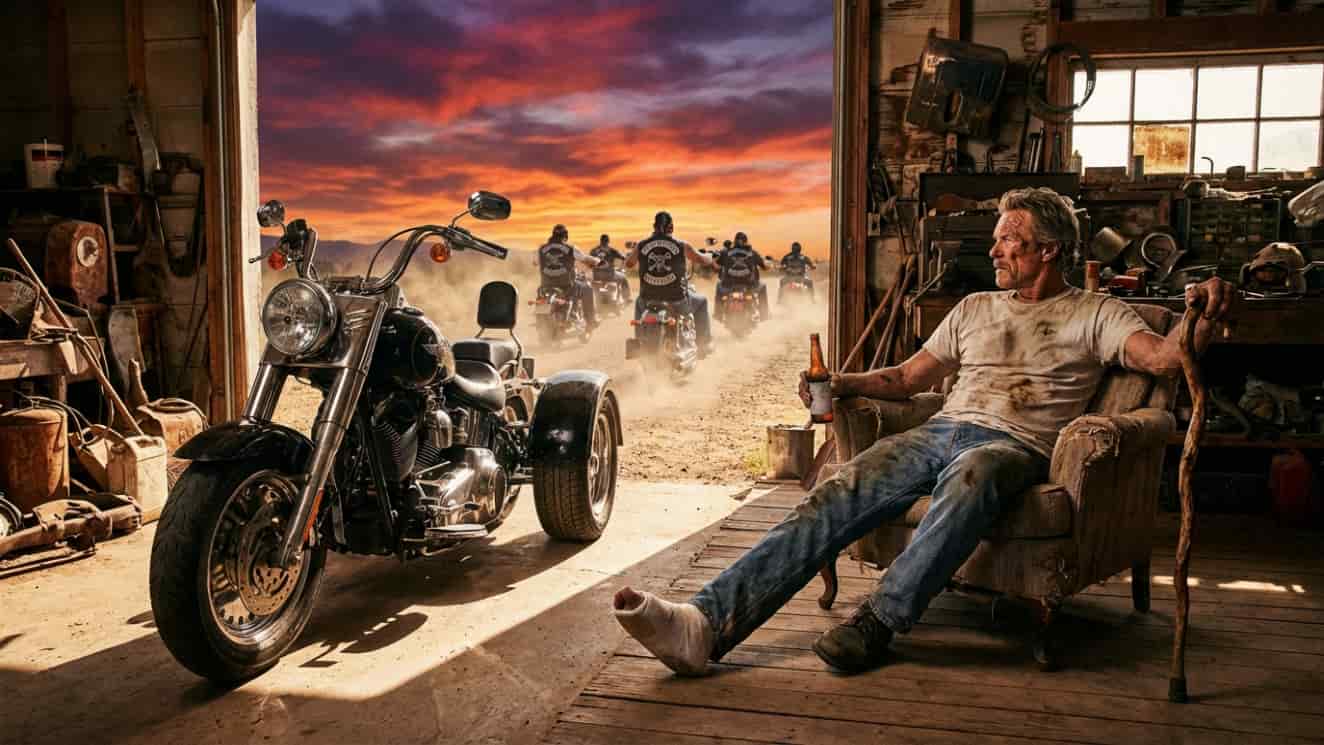
The Iron Reapers didn’t give Solo a golden watch when his leg shattered in a pile-up outside Gallup. They gave him twenty-four hours to strip his patches and hand over his keys.
In the biker world, you’re only as good as the miles you can pull. And Solo? He was a “civilian” now. A ghost in a garage, smelling of oil and resentment.
But they forgot one thing. Solo didn’t just ride the bikes. He built them. He knew every bolt, every shim, and every weakness in the machines they rode.
Now, the Reapers are crashing. One by one. The “accidents” are piling up, and a rival gang is smelling blood in the water.
Solo has a secret in his garage—a three-wheeled beast that doesn’t care about his limp. He could save them. He could be the hero of the brotherhood that threw him away.
Or he could just sit on his porch with a cold beer and watch the dust settle over their graves.
FULL STORY
Chapter 1
The heat in Albuquerque doesn’t just sit on you; it presses. It’s a physical weight, like a heavy hand on the back of your neck, forcing your head down toward the cracked pavement. Solo felt it more than most today. His left leg, the one held together by titanium pins and a stubborn refusal to heal, was throbbing in time with the overhead fan in the garage.
He was hunkered over a 1998 Electra Glide that belonged to a guy named Miller, a guy who didn’t know a spark plug from a lug nut but had enough cash to demand a 24-hour turnaround. Solo’s hands were black with 10W-40, the grease worked so deep into his cuticles he figured it was part of his DNA now.
“You’re late on the intake, Solo,” a voice grated from the bay door.
Solo didn’t look up. He knew the boots. Heavy, square-toed, with the silver heel rands that clicked on the concrete. Mac. The man who had inherited Solo’s spot as Sergeant-at-Arms for the Iron Reapers. Mac was ten years younger, twenty pounds heavier in the chest, and possessed the kind of unearned confidence that usually ended in a closed-casket funeral.
“Miller’s bike is a dog,” Solo said, his voice like gravel shifting in a pan. “He ran it lean. Valves are fried.”
“I didn’t ask for a mechanical report,” Mac said. He stepped into the shop, the smell of cheap leather and expensive cigarettes following him. He kicked the leg of Solo’s stool. Not hard enough to knock him off, just enough to make the pain in Solo’s hip flare. “The club’s heading up to Santa Fe tonight. We need the support truck ready. Tiny said you were dragging your feet.”
Solo finally looked up. He wiped his hands on a rag that was more oil than cotton. “Tiny knows where I am. If he wants the truck, he can come get it. It’s sitting in the back lot.”
Mac leaned against a tool chest, eyeing Solo’s cane leaned against the workbench. It was an old piece of hickory with a brass top, worn smooth from two years of heavy use. “Must be hard,” Mac mused, a cruel little smile playing on his lips. “Watching us roll out while you’re here scrubbing grease off a civilian’s toy. You used to be the first one on the 25. Now you’re just the guy who fixes the leaks.”
“I’m the guy who keeps you from hitting a wall at eighty miles an hour because you don’t know how to torque a head bolt,” Solo snapped.
“Careful, Solo,” Mac warned, his tone dropping the playfulness. “You aren’t patched anymore. You’re a contractor. A charity case we keep around because the President has a soft spot for the old days. But the old days are dead. You’re just a gimp in a garage.”
Solo felt the heat rise in his chest, a hot, liquid rage that felt more dangerous than the New Mexico sun. He looked at Mac—really looked at him. He saw the way Mac’s vest sat too stiffly on his shoulders, the way he preened. Mac didn’t love the road. He loved the theater of it.
“Get out of my shop, Mac,” Solo said quietly.
“It’s the club’s shop,” Mac reminded him, spitting a glob of phlegm onto the floor near Solo’s boot. “Don’t forget who pays the rent.”
When Mac walked out, the silence of the garage felt heavier than the noise. Solo sat there for a long time, the wrench heavy in his hand. His leg screamed. The phantom itch of where his calf muscle used to be was driving him crazy.
He thought about the night of the wreck. Two years ago. A patch of black ice in the mountains, a split second of physics taking over, and the heavy Harley crushing his leg against a guardrail. The club had been there, initially. They’d brought beer to the hospital. They’d promised he’d be back on two wheels in months.
But months turned into a year. The “brotherhood” started missing his hospital visits. Then they stopped calling. When Solo finally hobbled back to the clubhouse, expecting a seat at the table, he found Mac sitting in it. The President, a man Solo had bled for, couldn’t even look him in the eye. ‘You can’t ride the line, Solo. You’re a liability on the road. We’re a motorcycle club, not a social circle.’
They’d “allowed” him to keep the garage work to pay off his debts to the club. They’d stripped his colors, leaving only the scars.
Solo stood up, his knee popping like a gunshot. He didn’t go back to Miller’s bike. He walked to the very back of the shop, behind a wall of stacked tires and old crates. There was a bike there, covered by a heavy, oil-stained canvas.
He pulled the cover back.
It wasn’t a Harley. Not anymore. It was a Frankenstein’s monster of a machine. He’d taken an old Goldwing frame, chopped it, and welded a custom rear axle to it. Two wheels in the back, one in the front. A trike. In the MC world, a trike was a “geriatric mobile.” It was an insult.
But Solo had built this one different. It was low, wide, and powered by a bored-out 103-inch motor he’d “liberated” from the club’s parts bin over the last six months. It was painted a flat, bruised purple that looked black in the shade.
He ran his hand over the seat. He couldn’t balance 800 pounds of chrome on two wheels anymore, but this? This he could ride. He’d built it in secret, late at night, when the club was out partying or running its business.
He reached into the pocket of his coveralls and pulled out a small, specialized tool—a thin, high-tensile wire saw.
He thought about Mac’s bike. A brand new Street Glide. Mac was meticulous about the exterior, but he never checked the brake lines where they tucked behind the frame. He never checked the secondary tensioner on the primary drive.
Solo looked at the trike, then back at the door where Mac had disappeared. The debt wasn’t being paid. It was being recalculated.
He spent the next three hours in the club’s main storage bay. He knew the security codes; they hadn’t bothered to change them. Why would they? Solo was “loyal.” Solo was “the guy who fixes things.”
He moved like a shadow, despite the limp. He didn’t do anything obvious. No cut wires, no sugar in the tanks. That was amateur hour. Solo went for the subtle things. A quarter-turn looseness on a rear axle nut. A slight crimp in a fuel line that would hold for twenty miles but collapse under the heat of a long climb. A dab of industrial lubricant on the brake rotors—just enough to make them slide when they needed to grip.
By the time he was done, six of the club’s primary bikes were ticking time bombs. Especially Mac’s. Solo had spent a little extra time on that one, ensuring the throttle cable would bind if it was opened up all the way.
As he hobbled back to his living quarters—a small, cramped room partitioned off in the garage—he saw Elena waiting by his door.
Elena was his physical therapist, a woman who had seen Solo at his absolute worst and somehow didn’t look at him with the pity he hated. She was holding a plastic bag that smelled like green chile cheeseburgers.
“You look like you’ve been crawling through a sewer,” she said, her eyes scanning his hunched posture.
“Just work, Elena,” Solo said, leaning heavily on his cane.
“You’re overworking the leg. I can tell by the way you’re tilting your pelvis. Sit down.”
“I’m fine.”
“You’re a terrible liar. Sit.”
He sat on the small, lumpy sofa. She started unpacking the food, but her eyes wandered to the back of the shop, toward the stack of tires where the trike was hidden.
“You’re doing it again,” she said softly. “Building something you shouldn’t.”
“It’s just a project. Keeps my hands busy.”
“It keeps your heart bitter, Solo. I see the way you look at those guys when they ride past the clinic. You’re holding onto a ghost.”
“They took everything, Elena. My patch, my pride. They even took my bike and sold it to pay for ‘club expenses’.”
“They’re losers with loud mufflers,” she said, handing him a burger. “You’re a craftsman. You could leave this town, go to Phoenix, open a real shop. Why stay here and be their slave?”
Solo took a bite of the burger, but it tasted like ash. “Because I’m not finished yet.”
Outside, the roar of engines signaled the start of the Santa Fe run. Solo listened to the cadence of the motors. He knew those sounds. He knew which one was Tiny’s, which one was Preacher’s, and which one was Mac’s.
Mac’s bike sounded perfect. For now.
“They’re leaving,” Solo whispered.
Elena looked at him, a flicker of genuine concern crossing her face. “Let them go, Solo. Just let them go.”
He didn’t answer. He just watched the dust settle in the doorway as the sound of the engines faded into the desert night.
Chapter 2
The call came at three in the morning. Solo wasn’t sleeping; he was sitting in the dark of the shop, cleaning the same carburetor for the third time. The vibration of his phone on the metal workbench sounded like a chainsaw.
It was Tiny.
“Solo,” the big man wheezed. There was wind noise in the background, and the frantic, rhythmic pulse of sirens. “Solo, you gotta get up here. We’re on the 285, just south of Lamy.”
Solo felt a cold prickle of electricity go down his spine. “What happened, Tiny?”
“Everything went to hell. Preacher’s bike… his rear wheel just locked up. He went down, and Cade was right behind him. Cade didn’t have anywhere to go. He hit the guardrail, man. He’s… it’s bad, Solo. Mac’s bike is smoking, he can’t get it to stay in gear. We’re stranded, and there’s blood everywhere.”
Solo’s hand tightened on the phone. Cade. Cade was nineteen. The “prospect” of the club. He was a kid from a broken home who looked at Solo not as a gimp, but as a legend. Cade was the only one who had come by the garage to bring Solo a six-pack without being asked. He was the only one who hadn’t laughed when Solo’s cane slipped in the rain.
“Is Cade okay?” Solo asked, his voice cracking.
“He’s not moving, Solo. The medics are working on him, but… man, it’s a mess. The bikes are just falling apart. How does that happen? All at once?”
“I don’t know, Tiny,” Solo lied. The lie felt like a stone in his throat.
He hung up and stood in the dark. The silence of the garage was suddenly unbearable. He hadn’t meant for Cade to be in the line. Cade was a prospect; he should have been at the back, or in the truck. But Mac probably made him ride point to “prove his worth.”
Solo grabbed his cane and made his way to the back of the shop. He pulled the tarp off the trike. He needed to get there. He needed to see.
The trike roared to life on the first touch of the starter. It was a deep, guttural sound, more airplane than motorcycle. He backed it out of the shop, the three wheels providing a stability that felt like a betrayal of his old life, yet a necessity for his new one.
The ride up to Lamy was cold. The desert air at night drops forty degrees, biting through denim and leather. Solo pushed the trike hard. It handled the corners with a strange, flat precision. No leaning. Just brute force steering.
When he arrived, the scene was worse than he’d imagined. Two bikes were unrecognizable heaps of scrap. Preacher was sitting on the shoulder, his face a mask of road rash and shock.
But it was the center of the road that drew Solo’s eyes. The white sheets were already out.
Mac was standing near his smoking Street Glide, screaming at a state trooper. When he saw Solo roll up on the three-wheeled monster, his face twisted into something ugly.
“You!” Mac lunged forward, his boots clicking rhythmically. He grabbed Solo by the collar of his jacket as he sat on the trike. “What the hell did you do to my bike? And Preacher’s? They were in your shop yesterday!”
Solo looked past Mac at the sheet covering Cade. The kid’s boots—new ones he’d been so proud of—were sticking out from the bottom. They were scuffed and ruined.
“I didn’t do anything you didn’t ask for,” Solo said, his voice dead. “I fixed the things you told me to fix.”
“You sabotaged us!” Mac roared, swinging a fist. Solo didn’t have the balance to dodge it. The blow caught him in the jaw, knocking his head back.
Tiny stepped in, grabbing Mac’s arm. “Cut it out, Mac! The Trooper’s right there! We don’t know what happened. Maybe it was the heat, maybe it was the road.”
“Six bikes, Tiny? At the same time?” Mac spat. He looked back at Solo, his eyes full of a murderous realization. “You’re a dead man. You hear me? You’re a ghost.”
Solo didn’t stay. He couldn’t. He turned the trike around and rode back toward Albuquerque. The wind felt like it was trying to peel the skin off his face.
The next morning, Solo found himself at a small, roadside diner called ‘The Iron Stirrup’. It was a veteran hangout, a place where men with missing limbs and haunted eyes drank coffee and didn’t talk much.
He saw Gabe sitting in the corner. Gabe was a former Marine who’d lost both legs in Fallujah. He sat in a wheelchair, but he carried himself with a terrifying kind of stillness.
Solo sat down across from him. “I messed up, Gabe.”
Gabe didn’t look up from his coffee. “Usually do when you’re trying to play God with a wrench.”
“How did you know?”
“I saw you lurking around their clubhouse last week. And I know that look on a man’s face. It’s the look of someone who’s decided that everyone else’s life is worth less than his own anger.”
Solo leaned his cane against the table. “They discarded me. Like I was trash.”
“So you made them trash,” Gabe said, finally looking up. His eyes were hard, blue, and empty. “But you killed the wrong one, didn’t you? That’s the problem with vengeance. It’s a blind dog. It bites whoever’s closest.”
“I didn’t mean for Cade to…”
“Doesn’t matter what you meant. Matters what’s under the sheet.” Gabe leaned forward. “You think you’re the only one who got thrown away? I came home to a country that didn’t want to see my stumps. I had a ‘unit’ that moved on without me while I was still learning how to pee in a tube. You find a way to live, or you find a way to die. But this? This halfway-in, halfway-out shit? It just makes more bodies.”
Solo left the diner and went to the physical therapy clinic. He didn’t have an appointment, but Elena saw him and ushered him into a back room.
She looked at the bruise on his jaw. “Mac?”
“Yeah.”
“The news said there was a fatal accident last night. An Iron Reaper.”
Solo nodded. He couldn’t look at her.
“Solo, look at me.” She grabbed his chin, forcing his head up. “Did you do something?”
“I wanted to humble them,” Solo whispered. “I wanted them to feel what it’s like when the machine you trust fails you. I wanted Mac to look like a fool.”
“And now a boy is dead,” Elena said. Her voice wasn’t angry. It was worse. It was disappointed. “You’re so consumed by what they took from you that you’ve turned into exactly what they said you were. A liability.”
She let go of him and walked to the window, looking out at the dusty street. “There are people coming for you, Solo. I saw two trucks with Viper plates circling your shop this morning.”
Solo froze. The Vipers. A rival club from Las Cruces. They’d been fighting the Reapers for territory for years.
“If the Reapers are down, the Vipers will move in,” Solo realized. “They’ll take the clubhouse. They’ll take the shop.”
“They don’t care about the shop,” Elena said. “They care about the fact that the Reapers are weak. And they know you’re the one who weakened them. They don’t want to thank you, Solo. They want to eliminate the man who knows how to break the Reapers.”
Solo stood up, his leg screaming in protest. He felt a different kind of pressure now. Not just the heat, but the closing of a trap. He’d started a fire to burn his enemies, but the wind had shifted, and now the whole neighborhood was going up.
Chapter 3
The Vipers weren’t like the Reapers. The Reapers were old-school, obsessed with the “myth” of the biker. The Vipers were a cartel-adjacent street gang on wheels. They wore the patches, but they traded in meth and human misery. If they moved into Albuquerque, the body count wouldn’t stop at Cade.
Solo spent the afternoon at his shop, but he wasn’t fixing Miller’s Electra Glide. He was barricading the back door and checking the cylinders on his .45.
A shadow fell across the bay.
It was Tiny. He looked older than he had twenty-four hours ago. His beard was tangled, and his eyes were rimmed with red. He wasn’t wearing his vest.
“They kicked me out,” Tiny said, walking into the shop. He sat on a stack of tires. “Mac told the President it was my fault. Said I didn’t supervise the maintenance. Said I was in league with you.”
Solo didn’t lower the gun. “Are you?”
Tiny looked at the .45, then at Solo. “I saw what you did to Mac’s bike, Solo. I’m a mechanic too. I found the lubricant on the rotors. I saw the fuel line crimp.”
Solo’s heart hammered against his ribs. “Then why aren’t you telling them?”
“Because Mac is a snake. And because Cade is dead, and nothing is going to bring him back. If I tell them, they’ll kill you. And then the Vipers will kill them, because without you, half our fleet is junk and the other half is poorly timed.”
Tiny leaned forward, his massive hands resting on his knees. “The Vipers hit the clubhouse an hour ago. They didn’t kill anyone, but they took the bikes. They know we can’t chase ’em. They’re mocking us, Solo. They’re going to execute the President and Mac at the old quarry tonight. Make a show of it. Then they’re coming for the shop.”
Solo felt a surge of cold irony. He had delivered his enemies right into the hands of something worse.
“Why tell me?” Solo asked.
“Because you’re the only one with a working machine,” Tiny said, gesturing toward the trike. “And because you owe it to Cade. He shouldn’t have died for your grudge, Solo. He should have died for something that mattered.”
Solo looked at the trike. It was a beautiful, ugly thing.
“I can’t ride a line, Tiny. My leg…”
“You don’t need to ride a line. You need to be a ghost. You know the quarry. You know where the fuel tanks are stored.”
Tiny stood up and walked to the door. “I’m going home, Solo. I’m done with the club. I’m done with the Vipers. But if you have any soul left in that busted body of yours, you’ll go to that quarry.”
After Tiny left, Solo sat in the silence. He thought about the Vipers. He thought about Mac’s arrogant face. He thought about the way Cade used to ask him how to tune a carburetor.
“Hey Solo, why does the air-fuel mixture matter if the spark is strong?”
“Because it’s about balance, kid. Too much of one thing ruins the whole engine.”
Solo had been all fuel and no air for two years.
He stood up, grabbing his leather jacket. He didn’t use the cane. He leaned against the wall, dragging his leg, forcing it to move. He reached the trike and climbed on.
The weight of the machine felt solid beneath him. He didn’t need to balance it. It held him up. It was the only thing in the world that did.
He drove out into the night, heading toward the foothills. The quarry was a jagged scar in the earth, miles from the nearest house. It was where the Reapers went to settle internal business. Now, it was where they were going to be erased.
As he rode, he saw the flickering lights of the Vipers’ convoy. They were loud, arrogant, and numerous. At least twenty bikes.
Solo took a back trail, a goat path he’d scouted years ago. The trike struggled with the loose gravel, the two rear wheels spinning and throwing dust, but it climbed. It was a tractor with a racing heart.
He reached the ridge overlooking the quarry floor.
Below, the scene was lit by the harsh glare of high-beams. Mac and the President were kneeling in the dirt, their hands zip-tied behind their backs. A man in a Vipers vest—a thin, rat-faced guy with a long ponytail—was pacing in front of them, holding a chrome-plated 1911.
“The Reapers are a joke,” the Viper leader shouted, his voice echoing off the rock walls. “You can’t even keep your bikes on the road. You’re a dying breed. We’re the new management.”
Mac was sobbing. It wasn’t the sound of a warrior. It was the sound of a man who realized his theater had no audience.
Solo looked at the fuel tanks. They were old, rusty cylinders used for the quarry equipment, sitting just twenty yards from the Vipers’ line of bikes.
He reached into his jacket and pulled out a flare gun he’d taken from the support truck months ago.
He didn’t feel like a hero. He felt like a man cleaning up a mess he’d made. He felt the weight of Cade’s death pressing on his shoulders, heavier than the New Mexico heat.
He aimed the flare gun.
“For the kid,” he whispered.
The flare streaked through the dark, a bright red arc of defiance. It hit the base of the fuel tanks.
The explosion wasn’t cinematic. It was a sudden, violent expansion of pressure that knocked Solo back even on the ridge. A wall of orange flame erupted, consuming the Vipers’ bikes in an instant. The heat rolled up the canyon, smelling of gasoline and melting rubber.
Chaos erupted below. The Vipers scrambled, screaming as their precious machines turned into skeletons of fire.
Solo didn’t wait. He shifted the trike into gear and roared down the embankment. He wasn’t leaning into the turns; he was fighting the handlebars, his bad leg braced against the custom footpeg.
He hit the quarry floor like a thunderclap. The Vipers, blinded by the fire and confused by the sudden appearance of the three-wheeled phantom, scattered.
Solo rode straight toward Mac. He didn’t stop. He swung the heavy hickory cane—which he’d strapped to the side of the trike—like a mace, catching the Viper leader in the side of the head as he passed.
The man went down hard.
Solo skidded the trike to a halt in front of the President. He pulled a knife from his belt and slashed the zip-ties.
“Get up,” Solo growled.
The President looked at him, his eyes wide with a mixture of terror and shame. “Solo? You… you came?”
“Don’t make me regret it,” Solo said.
He looked at Mac. Mac was staring at the trike, at Solo’s missing patch, at the fire.
“My bike…” Mac whimpered. “The Vipers… they’ll kill us.”
“The Vipers are busy,” Solo said, nodding toward the burning line of motorcycles. “Now get in the truck over there and drive. Don’t look back.”
As the Reapers scrambled for the one remaining truck that hadn’t been caught in the blast, Solo sat on his trike. The fire reflected in his goggles.
The Viper leader was crawling toward his gun.
Solo didn’t shoot him. He didn’t need to. He just sat there, the engine of the trike idling with a steady, mechanical heart. He watched as the Reapers—the men who had been his brothers, the men who had discarded him—fled like cowards.
He was alone in the quarry with the fire and the ghosts.
Chapter 4
The aftermath was a slow burn.
Solo didn’t go back to the garage. He knew the police would be there eventually, and he knew the Vipers would be looking for the “freak on the three-wheeler.”
He ended up at Elena’s house, a small adobe place on the outskirts of the South Valley. He parked the trike under a sagging carport and sat on the porch, waiting for the sun to come up.
Elena found him there at 6:00 AM. She was wearing a bathrobe, holding a mug of coffee. She didn’t look surprised.
“You’re alive,” she said, sitting on the step below him.
“Part of me is.”
“I heard about the quarry. People are talking. They say a ghost on a purple bike blew up half the Vipers’ fleet.”
Solo looked at his hands. They were shaking. The adrenaline had worn off, leaving only the cold, sharp reality of his physical pain. “I saved them, Elena. The men who took my life away.”
“You saved yourself, Solo. You stopped being their victim.”
“Cade is still dead.”
“Yes. And he’ll stay dead. But you didn’t let them kill anyone else.” She reached out and touched his bad knee. “Does it hurt?”
“Always.”
“Good. It means you’re still here.”
Over the next few days, Solo watched the world from the shadows of Elena’s porch. The Iron Reapers were finished. Without their bikes, without their reputation, and with the President fleeing to Arizona, the club dissolved. Mac was rumored to be hiding out in a trailer park in Moriarty, terrified of both the Vipers and the law.
The Vipers were reeling, too. The loss of their bikes and the humiliation at the quarry had sparked an internal power struggle. They weren’t coming for the shop. They were too busy killing each other.
One afternoon, Gabe rolled up the driveway in his modified van. He climbed out, his prosthetic legs clicking on the gravel. He sat next to Solo.
“Nice fireworks,” Gabe said.
“I’m a mechanic. I know how things burn.”
“So, what’s the plan now, Solo? You going to keep hiding here, or you going to do something with that machine in the carport?”
Solo looked at the trike. It was covered in dust and soot. “I don’t know who I am without the patch, Gabe. I’ve been a Reaper for fifteen years.”
“You were a Reaper for fifteen years,” Gabe corrected. “And for fifteen years, you let a bunch of guys in leather tell you what you were worth. Now, you’re just Solo. It’s a bigger patch, but it’s harder to wear.”
Gabe stood up, his balance perfect despite the artificial limbs. “I’m opening a shop. For vets. We’re going to build adaptive gear. Bikes, cars, whatever people need to keep moving. I need a lead mechanic. Someone who knows how to weld soul into steel.”
Solo looked at him. “You want me?”
“I want the guy who built that trike. Not the guy who sabotaged his brothers.”
Solo didn’t answer right away. He thought about the garage, the smell of oil, and the way it felt to ride without the fear of falling. He thought about Elena and the way she looked at him when he wasn’t being a “biker.”
“I’ll think about it,” Solo said.
“Don’t think too long. The road doesn’t wait.”
That night, Solo went back to the shop one last time. It was quiet. The air was thick with the scent of old grease and forgotten dreams. He walked to the back lot and found the support truck.
Inside the cab, he found a small box. It was Cade’s. It contained the kid’s tools, a few pictures of his mom, and a single Iron Reapers prospect patch.
Solo took the patch and walked to the center of the shop. He placed it on the workbench where he used to fix the club’s bikes. He took a lighter and set it on fire.
He watched the embroidery curl and blacken. He watched the “brotherhood” turn to smoke.
When he walked out, he didn’t use his cane. He leaned on the doorframe, took a deep breath of the desert air, and headed for the trike.
Chapter 5
The move to Gabe’s shop was supposed to be a fresh start, but the past has a way of clinging like grease under a fingernail.
The shop was a large, airy warehouse on the north side of town. It was filled with light, a stark contrast to the dungeon Solo had inhabited for years. There were other men there—vets with missing eyes, scarred faces, and quiet voices. They worked with a discipline that Solo found both comforting and intimidating.
For three weeks, Solo worked. He built a hand-controlled throttle for a guy in a wheelchair. He designed a custom seat for a double-amputee who wanted to ride a sidecar. He was good at it. His hands were steady, and for the first time in years, the pain in his leg felt like a secondary concern.
But then, the world came knocking.
It was a Tuesday afternoon when the black SUV pulled into the lot. Two men got out. They weren’t wearing colors, but they had the look. Hard eyes, cheap suits, and the unmistakable bulge of holstered steel under their jackets.
They weren’t Vipers. They were Reapers. Or what was left of them.
“Solo,” one of them said. It was Preacher. He looked clean-shaved, his road rash healed into a jagged map of scars.
“Preacher,” Solo said, not putting down his welding torch.
“We heard you were working here. Building toys for the cripples.”
Solo turned off the torch. The silence that followed was heavy. “We’re building freedom, Preacher. Something you wouldn’t know about.”
“Mac’s dead,” Preacher said flatly.
Solo felt a hollow thud in his chest. “How?”
“The Vipers caught up to him in Moriarty. It wasn’t quick. They wanted him to tell them where the ‘trike guy’ was. He held out for a while, but everyone breaks eventually.”
Preacher stepped closer, his voice dropping to a whisper. “They’re coming, Solo. They know about this place. They think you’re the one holding the Reapers’ secrets. They think we hid our money with you.”
“There is no money,” Solo said.
“Doesn’t matter. They want blood, and they want the trike. They think it’s some kind of trophy.”
Solo looked around the shop. He saw the other vets. Men who had already given enough. He couldn’t bring this fire to their doorstep.
“Why tell me?” Solo asked.
“Because the President is gone, and Mac is dead, and you’re the only one left who ever actually cared about the club. We’re leaving town, Solo. Going east. But we thought you should know. The Vipers are coming tonight.”
Preacher turned and walked back to the SUV. He stopped at the door. “You should have just stayed on two wheels, Solo. Everything went to hell when you stopped leaning.”
Solo watched them drive away. He felt the old familiar heat rising in his chest. He’d tried to run, tried to build a new life, but the debt was still outstanding.
He went to Gabe’s office. Gabe was looking at a set of blueprints.
“They’re coming tonight,” Solo said.
Gabe didn’t look up. “I know. I saw the SUV.”
“I have to leave, Gabe. I can’t let them trash this place. It’s not your fight.”
Gabe finally looked up. He smiled, a thin, dangerous line. “Not my fight? Solo, I spent three tours in a desert fighting people who thought they could take whatever they wanted. You think I’m going to let a bunch of meth-head bikers roll over my shop?”
“They have guns, Gabe. Lots of them.”
“So do we,” Gabe said, gesturing to a heavy locker in the corner. “And we actually know how to use them. We aren’t bikers, Solo. We’re soldiers. There’s a difference.”
Solo felt a surge of something he hadn’t felt in a long time. It wasn’t the “brotherhood” of the MC. It was the solidarity of the broken.
“I have a better idea,” Solo said. “We don’t fight them here. We lead them out. Into the dust.”
The plan was simple, but dangerous. Solo would use the trike—the “trophy”—as bait. He would lead the Vipers out to the salt flats, where their numbers wouldn’t matter as much as their skill.
Elena showed up as he was prepping the machine. She was crying.
“You’re going to die, Solo. You know that, right?”
“Maybe,” Solo said, tightening the strap on his goggles. “But for the first time in two years, I know exactly what I’m riding for.”
“Don’t do this for the Reapers,” she pleaded.
“I’m not. I’m doing it for Cade. And for me. And for every guy in this shop who’s tired of being told they’re finished.”
He kissed her—a quick, desperate moment that tasted of salt and engine oil. Then he climbed on the trike.
Gabe and three other vets were in the van, armed and ready.
“See you on the other side, mechanic,” Gabe said.
Solo twisted the throttle. The trike roared, the sound echoing through the warehouse. He rode out into the twilight, the purple paint glowing like a bruise against the darkening sky.
The Vipers were waiting at the end of the block. Six bikes, two trucks. When they saw the trike, they let out a collective howl.
Solo didn’t wait. He pinned the throttle and headed for the open road.
Chapter 6
The salt flats at night are a lunar landscape. White, flat, and indifferent to the struggles of men.
Solo could feel the Vipers behind him. Their headlights were like predatory eyes, bobbing in the rearview mirror. He was pushing the trike to its limit, the needle hovering at a hundred. The wind was a solid wall, trying to push him off the seat, but the three wheels held him steady.
He reached the center of the flats, miles from any road. He slowed down, circling a single, abandoned water tower.
The Vipers surrounded him, their bikes kicking up clouds of white dust. The leader, the rat-faced man with the ponytail, stepped out of the lead truck. He was holding a sawed-off shotgun.
“End of the road, gimp,” he shouted. “Where’s the money?”
Solo turned off the engine. The silence was absolute.
“There is no money,” Solo said, his voice loud in the empty space. “There’s just a bunch of dead men and a lot of wasted time.”
“You cost us a lot of steel at the quarry,” the Viper said, leveling the shotgun. “We’re going to take your legs first. See how you like being a real cripple.”
“You forgot one thing,” Solo said.
“What’s that?”
“I’m not a biker anymore.”
A single, sharp crack echoed across the salt.
The Viper leader’s head snapped back as a bullet found its mark. He crumpled into the white dust.
From the darkness beyond the headlights, more flashes erupted. Gabe and the vets were positioned in the shadows of the water tower and behind the salt ridges. They weren’t spraying and praying. They were taking measured, lethal shots.
The Vipers panicked. They were used to intimidation, to overwhelming force against people who were afraid of them. They weren’t prepared for a disciplined ambush by men who didn’t care about their “badass” reputation.
Solo didn’t stay still. He restarted the trike and drove straight into the chaos. He wasn’t shooting; he was using the machine as a weapon, side-swiping bikes, knocking riders into the salt.
It was over in minutes. The Vipers who weren’t down were fleeing into the night, their bravado evaporated.
Solo skidded to a stop next to the fallen Viper leader. The man was still twitching, his eyes fixed on the stars.
Gabe walked over, his rifle slung over his shoulder. He looked at the carnage. “You okay, Solo?”
Solo looked at his hands. They were covered in white salt dust. “I’m tired, Gabe. I’m so damn tired.”
“Then let’s go home.”
But as they turned to leave, a lone bike emerged from the dust. It was Mac’s Street Glide—or a bike just like it.
The rider pulled up and took off his helmet. It wasn’t a Viper.
It was the President of the Iron Reapers. He looked haggard, his leather vest dusty and worn.
“Solo,” he said, his voice trembling. “I heard what happened. I heard you took out the Vipers.”
Solo didn’t move. “What do you want, Pres?”
“The club… we can restart. We have the shop. We can get the guys back from the east. With you as Vice President, Solo. No one will ever question your spot again. You can ride the trike. We’ll make it a club thing. ‘The Chrome Chariot’ or something.”
Solo looked at the man. He saw the desperation, the greed, and the hollow shell of a “brotherhood” that had abandoned him the moment he became inconvenient.
He looked at Gabe, who was watching him with a neutral expression. He looked at the trike, the machine he’d built out of spite and necessity.
“The Iron Reapers are dead, Pres,” Solo said. “They died in the mountains two years ago. They died under a sheet on the 285. And they died in that quarry.”
“Solo, come on. You’re one of us!”
“No,” Solo said, and the word felt like the final piece of an engine clicking into place. “I’m just a guy who fixes things. And the club is broken beyond repair.”
Solo turned the trike around and rode away, leaving the President standing alone on the salt flats.
A month later, Solo was back in the warehouse. He was working on a new project—a hand-cycle for a kid who had lost his legs to a drunk driver.
Elena came in, bringing him a coffee. She looked at the trike, which was now painted a bright, hopeful silver.
“Are you going out tonight?” she asked.
“Maybe for a little bit. The air is supposed to be cool.”
“Solo?”
“Yeah?”
“I’m glad you kept the trike.”
“Me too,” he said. “It’s the only thing that keeps me balanced.”
He watched her walk away, her silhouette framed by the late afternoon sun. He felt the ache in his leg, a constant reminder of what he’d lost. But he also felt the weight of the wrench in his hand, a reminder of what he could still create.
He wasn’t a hero. He wasn’t a brother. He was just a man with three wheels and a long road ahead of him.
The Iron Reapers were gone. The Vipers were broken. And Cade… Cade was a memory he carried with every mile.
Solo climbed onto the silver trike and headed out into the New Mexico dusk. He didn’t look back at the shop. He didn’t look for his reflection in the windows. He just watched the horizon, where the dust of the past was finally starting to settle.
The dark irony of it all wasn’t that he’d lost his patch. It was that he’d had to lose everything to finally find out that he never needed it in the first place. He was solo now, but for the first time in his life, he wasn’t alone.
As he hit the highway, he twisted the throttle. The engine roared, a clean, powerful sound that cut through the silence of the desert. He wasn’t leaning into the turns, but he was moving forward. And in the end, that was the only thing that mattered.
The dust stayed behind him, right where it belonged.