I walked out of the prison gates with forty dollars and a bus ticket, wearing a suit that fit me fifteen years ago. The Pennsylvania air tasted like coal dust and regret.
I did fifteen years for a fire I didn’t start. I did it for the “Patch.” I did it for Iron Mike, the man I called brother. I thought I was protecting my family.
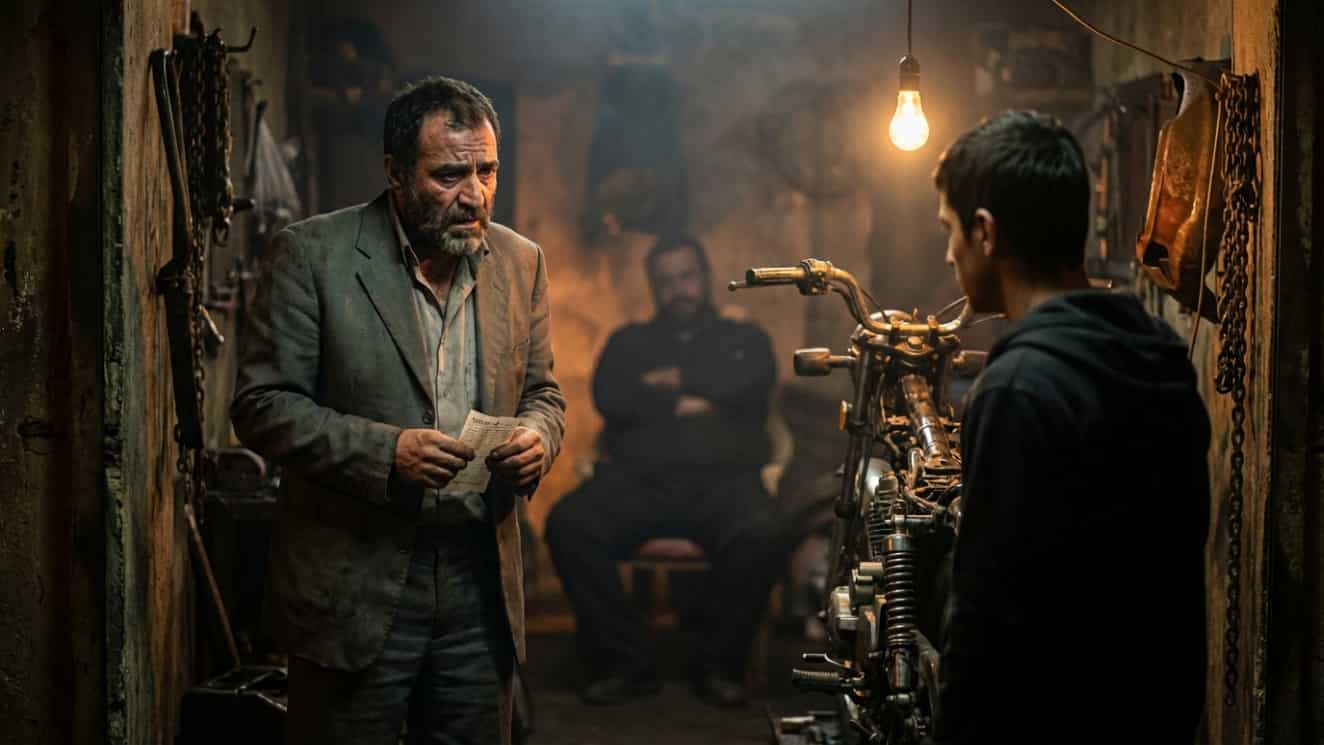
But when I saw my son, Caleb, standing over a modified engine with the same desperate look in his eyes that I used to have, I realized the “brotherhood” hadn’t protected anything. They’d just been waiting for the next generation to burn.
Caleb doesn’t know me. To him, I’m just the ghost who let his mother die in a house fire while I was out playing outlaw. He doesn’t know the truth about that night. He doesn’t know that the man giving him orders at the garage is the same man who poured the gasoline.
Now, I have to choose. I can stay a ghost and let my son hate me, or I can tear down the Iron Coffin we all built together—even if it means we all go down with it.
FULL STORY
Chapter 1: The Weight of Fresh Air
The bus from Rockview didn’t smell like anything. That was the first thing Ray noticed. It didn’t smell like industrial floor wax, or bleached denim, or the sour, metallic tang of five hundred men breathing the same recycled air. It just smelled like nothing, which felt like everything.
Ray sat in the third row, his knees pressed against the plastic backing of the seat in front of him. He was fifty-one, but his body felt like a piece of scrap metal that had been left out in the rain too long—stiff, creaky, and prone to seizing up. He wore a cheap, charcoal-gray suit the state had given him. It was a size too large in the shoulders and a size too short in the sleeves, making him look like a boy playing dress-up in his father’s clothes.
Outside the window, the Pennsylvania landscape blurred into a smear of late-March brown. Skeletal trees, rusted-out barns with “MAIL POUCH TOBACCO” faded on their sides, and the occasional jagged tooth of a coal breaker jutting out of the earth. It was a landscape that had been chewed up and spit out a century ago, and it hadn’t changed a bit in the fifteen years Ray had been gone.
He reached into his pocket and felt the forty dollars and the crinkled piece of paper with an address written in his own shaky handwriting.
1142 Miller Street.
It was a diner in the town of Oakhaven. His son, Caleb, worked there on the night shift, or so the last letter from the old defense attorney had said. That letter was two years old.
“First time out?” the driver asked, catching Ray’s eye in the oversized rearview mirror.
Ray didn’t answer immediately. He had to remember how to talk to people who weren’t wearing a uniform or a jumpsuit. “Long time,” Ray finally said. His voice sounded like gravel shifting in a bucket.
“Don’t look back,” the driver said, shifting gears as they hit the off-ramp for Oakhaven. “Nothing back there but ghosts. You look back, you turn into salt. That’s what my grandma used to say.”
Ray nodded, though he didn’t believe him. Some people were born as ghosts.
The bus hissed to a stop in front of a shuttered Greyhound station. Ray stepped down onto the cracked pavement. The air was cold, a damp chill that seeped through the cheap polyester of his suit. He started walking. He knew these streets, even if the storefronts had changed. The old hardware store was a vape shop now. The movie theater was a pile of rubble behind a temporary fence. But the smell of the nearby river—thick with silt and old chemicals—was exactly the same.
Miller Street was on the edge of the industrial district. The diner, The Rusty Spoon, was a silver-sided railcar-style joint that looked like it was being held together by layers of grease and stubbornness.
Ray stopped ten feet from the door. He straightened his tie. He wiped a smudge of dirt off his cheap black shoes. He felt a sudden, violent urge to turn around, to find a bar, to disappear into a bottle of cheap rye. But he thought of the letters. The letters he’d written every week for fifteen years, most of which had been returned unopened, marked Refused.
He pushed the door open. A bell jingled—a cheerful, domestic sound that made his stomach flip.
The diner was nearly empty. A couple of truckers sat at the far end of the counter, hunched over plates of biscuits and gravy. Behind the counter, a young man was wiping down the griddle with a brick.
He was tall, maybe six-one, with broad shoulders and dark, messy hair held back by a grease-stained baseball cap. He was wearing a black t-shirt that showed off arms covered in faint oil smears and a few small burn scars.
Ray’s heart didn’t shatter. It didn’t skip a beat. It just felt heavy, like a stone sinking into mud.
The boy looked up. He had his mother’s eyes—wide, amber-flecked, and inherently suspicious.
“Kitchen’s closing in ten,” the boy said. His voice was deeper than Ray had imagined. “I can do breakfast or a cold sandwich. No burgers.”
Ray walked to the counter and sat on a stool. He gripped the edge of the laminate top until his knuckles turned white. “Coffee’s fine,” Ray said.
The boy grabbed a ceramic mug and filled it. He slid it across the counter with a practiced flick of the wrist. “Cream or sugar?”
“Black.”
Ray watched him. He looked for himself in the boy’s jawline, in the way he moved his shoulders. It was there, buried under fifteen years of resentment and hard living.
“You’re Caleb,” Ray said.
The boy froze. He still had the coffee pot in his hand. He slowly set it back on the burner. He looked at Ray, really looked at him this time. He took in the cheap suit, the prison-pale skin, the way Ray sat—stiff and alert, like a man waiting for a blow.
“I don’t know you,” Caleb said. The suspicion in his eyes sharpened into something colder.
“I’m Ray,” Ray said. “Your father.”
The silence that followed wasn’t dramatic. It was just awkward and painful. One of the truckers looked over, then quickly looked back at his gravy. The hum of the refrigerator felt unnaturally loud.
Caleb didn’t yell. He didn’t cry. He just picked up the rag and started scrubbing the griddle again, harder this time. “I don’t have a father,” he said, his back to Ray. “I had a guy who burned my mother alive and then went for a long walk in the woods. That’s what the neighborhood says.”
“That’s not how it happened, Caleb,” Ray said, his voice low.
“Doesn’t matter how it happened,” Caleb snapped, turning around. His face was flushed. “You weren’t there. For fifteen years, you weren’t there. I grew up in foster homes and state dorms while you were playing ‘Old School’ behind bars. What do you want? A thank you?”
“I want a meal,” Ray said, trying to keep his hands from shaking. “And I want to talk to you.”
“I’m busy,” Caleb said. He pointed to a sign on the wall: No Loitering. “You drink your coffee, you pay your buck-fifty, and you leave. That’s the transaction.”
Ray looked at his son. He saw the anger, but he also saw the exhaustion. Caleb looked like he hadn’t slept in a week. There was a smudge of black grease behind his ear and a nervous twitch in his left hand.
“You’re racing,” Ray said quietly.
Caleb stiffened. “What?”
“The oil on your arms. The way you’re holding your hand. That’s from gripping a high-torque wheel too long. You’re running the backroads, aren’t you? Same ones I used to run.”
“Don’t act like you know me,” Caleb hissed, leaning over the counter. “You don’t know a damn thing about my life. I do what I have to do to pay the rent because nobody left me a trust fund. Now get out.”
Ray reached into his pocket and pulled out two crumpled dollar bills. He laid them on the counter. “I’m staying at the Motel 6 off Route 22. Room 14.”
“I’m not coming,” Caleb said.
“I know,” Ray said. “But I’ll be there.”
Ray stood up. His legs felt like they were made of glass. He walked to the door, the bell jingling again as he stepped out into the cold Pennsylvania night. He didn’t look back, but he could feel Caleb’s eyes on his spine, sharp and accusing.
He walked three miles to the motel. His feet ached in the new shoes. The motel was a low-slung, U-shaped building with peeling yellow paint and a flickering neon sign that hummed like a disturbed beehive.
Inside Room 14, the air smelled of stale cigarettes and lemon-scented industrial cleaner. Ray sat on the edge of the bed. He didn’t turn on the TV. He didn’t lie down. He just stared at the wall.
He thought about the night of the fire. The way the sky had looked—orange and terrifying—against the black silhouette of the trees. He thought about the smell of the gasoline and the way Iron Mike had looked at him, breathless and panicked, holding the empty can.
“Take this, Ray. You got a clean record. I got two strikes. If I go back, I’m dead. The Club will take care of Sarah. They’ll take care of the kid. I swear on the Patch, Ray. We’re brothers.”
Ray had been twenty-six. He had believed in the Patch. He had believed in the brotherhood. He had taken the can, and he had taken the fall.
He didn’t know then that Sarah was still inside. Mike had told him the house was empty. Mike had told him it was just an insurance job, a way to get the Club out of debt.
By the time Ray realized the truth, he was already in the back of a squad car, and the house was a funeral pyre.
A knock came at the door.
Ray stood up, his heart hammering against his ribs. He thought it might be Caleb. He hoped it was Caleb.
He opened the door.
It wasn’t Caleb. It was a man who looked like he’d been carved out of an old tire. He was wearing a leather vest with a familiar patch on the back: a skeletal hand clutching a smoking piston. The 500 MC.
“Welcome home, Ray,” the man said. It was “Iron” Mike. He looked older, richer, and meaner. Behind him, two younger guys—prospects, by the look of their clean vests—stood like sentries.
“Mike,” Ray said. He didn’t move. He didn’t let him in.
“You didn’t call,” Mike said, flashing a grin that didn’t reach his eyes. “We had a party planned. Steak, whiskey, the whole nine yards. We look after our own, Ray. You know that.”
“I’m tired, Mike,” Ray said. “I just want to sleep.”
Mike stepped forward, forcing Ray to either back up or be shoved. Ray backed up. Mike entered the room, the two prospects staying at the door. Mike looked around the dingy room with a sneer.
“This is no place for a hero of the 500,” Mike said. He reached into his leather jacket and pulled out a thick envelope. He tossed it onto the bed. “Five thousand. Just to get you on your feet. There’s a job waiting for you at the garage tomorrow morning. Managing the floor. Easy work. Good pay.”
Ray looked at the envelope. It looked like a bribe. It felt like a shackle.
“I saw my son today,” Ray said.
Mike’s expression shifted, just for a second. A flicker of something—guilt? Or maybe just calculation. “He’s a good kid. A little hot-headed. Like his old man. He’s been doing some work for us. Driving parts. Making some deliveries.”
Ray felt a cold spike of fear. “He’s working for the Club?”
“He’s family, Ray,” Mike said, clapping him on the shoulder. The weight of Mike’s hand felt like a mountain. “We look after our own. You stayed quiet for fifteen years. You did your time like a man. Now it’s time to get paid. See you at the shop at eight.”
Mike turned and walked out. The door stayed open for a moment, the cold air rushing in, before the prospects pulled it shut.
Ray sat back down on the bed. He looked at the envelope of money. Then he looked at his hands. They were still pale, still shaking.
He hadn’t been out for six hours, and the Iron Coffin was already closing its lid.
Chapter 2: The Debt of Brotherhood
The 500 MC garage was located in a converted warehouse at the end of a dead-end road, flanked by the river on one side and a rusting scrap yard on the other. It was a cathedral of grease and chrome. The air inside was thick with the smell of scorched metal and heavy-duty degreaser.
Ray arrived at 7:55 AM. He wasn’t wearing the suit anymore. He’d bought a pair of work dungarees and a flannel shirt at a nearby Walmart with some of the money from the envelope. He felt more like himself, but “himself” was a man he hadn’t seen in a very long time.
Iron Mike was in the glass-walled office overlooking the shop floor. He was leaning back in a leather chair, a mug of coffee in one hand and a cigar in the other. He gestured for Ray to come up.
“Look at this place, Ray,” Mike said, waving his cigar toward the floor where half a dozen bikes were in various stages of disassembly. “We’re the biggest custom shop in the tri-state area now. We don’t just do bikes. We do high-end restorations. We got a contract with a firm in Philly.”
Ray looked down. He saw a young man in a gray jumpsuit working on the transmission of a Harley. It wasn’t Caleb. “Where is he?” Ray asked.
“Who? The kid?” Mike blew a cloud of blue smoke. “He doesn’t work the day shift. He’s our ‘night owl.’ He handles the transport. He’s got a talent for moving things fast and not getting noticed by the staties.”
“You have my son running contraband,” Ray said. It wasn’t a question.
Mike leaned forward, his eyes narrowing. “I have your son earning a living. He was heading for a jail cell or a ditch before I stepped in, Ray. He was street racing for fifty-dollar pots. I gave him a purpose. I gave him a family.”
“He had a family,” Ray said. “Before you burned it down.”
The air in the office suddenly felt very thin. Mike didn’t move. The cigar smoke curled around his head like a halo of filth. “Careful, Ray,” Mike whispered. “We had a deal. You took the weight, and in exchange, you’re a legend. You start talking crazy, and legends have a way of disappearing.”
“I’m not talking,” Ray said, though his heart was thumping a frantic rhythm against his ribs. “I’m just saying… let the boy go. He doesn’t owe you anything.”
“He owes me everything,” Mike said. He stood up, his massive frame blotting out the light from the window. “He owes me for the food in his mouth and the roof over his head when the state gave up on him. And you owe me, too. You think you survived Rockview on your own? Who do you think paid the guards to keep the Aryans off your back? Who do you think made sure you didn’t get shivved in the yard?”
Ray looked away. He had always suspected. He had known, deep down, that his survival had been bought and paid for. He was a piece of property.
“Go down there,” Mike said, pointing to the floor. “Inventory the parts in the back cage. Keep your head down. Do your job.”
Ray spent the next four hours in a chain-link cage, counting pistons, gaskets, and chrome pipes. It was mind-numbing work, the kind he’d done in the prison laundry, but without the constant threat of a shank in the kidneys.
Around noon, a man walked up to the cage. He was thin, with a face that looked like a crumpled paper bag and teeth that were mostly yellowed porcelain.
“Ray? Ray Carver?”
Ray looked up. “Yeah?”
“It’s Eddie. Eddie ‘The Rat’ Munson.”
Ray blinked. He remembered Eddie. They’d spent three years together in the woodshop at Rockview. Eddie had been out for six months. He looked terrible—shrunken and jittery.
“Eddie. What are you doing here?”
“I heard you was out,” Eddie said, looking around nervously. “I’m sweeping up here. Doing the grunt work. Mike, he… he’s a hard man to work for, Ray. Not like the old days.”
Eddie leaned against the wire mesh, his voice dropping to a whisper. “You shouldn’t have come back here, man. This place… it ain’t a club no more. It’s a meat grinder. Mike’s got his hands in everything. Meth, boosters, you name it. And he’s using the kids to do the dirty work.”
“I know,” Ray said.
“No, you don’t know,” Eddie said, his eyes darting to the office. “He’s got your boy Caleb doing the ‘Midnight Run.’ That’s the high-stakes stuff. Across the border into Jersey. It’s only a matter of time before the feds catch him, Ray. And Mike? He won’t take the fall for him. He’ll let that boy rot.”
Ray felt a cold knot of dread tighten in his stomach. “Why are you telling me this, Eddie?”
“Because you saved my life when that skinhead tried to take my eyes in the woodshop,” Eddie said. He reached into his pocket and pulled out a small, crumpled business card. “There’s a lady. A reporter. She’s been sniffing around. She knows about the fire, Ray. She knows it didn’t add up.”
Ray looked at the card. Sarah Jenkins. The Philadelphia Inquirer.
“She’s been looking for you,” Eddie whispered. “She says the fire report from fifteen years ago has been tampered with. She says the accelerant used wasn’t what they said in court.”
“Ray! Get back to work!”
The shout came from one of the prospects. Eddie scrambled away, grabbing a broom and disappearing into the shadows of the warehouse.
Ray tucked the card into his pocket. His hands were shaking again.
That evening, Ray didn’t go back to the motel. He waited in the shadows across the street from the garage. He watched as the day shift left, the roar of motorcycles filling the air. Then, around 9:00 PM, a blacked-out Ford F-150 pulled up to the loading dock.
Caleb got out.
He looked different in the dark. Sharper. More dangerous. He moved with a frantic energy, helping two other guys load heavy wooden crates into the back of the truck.
Ray watched as Mike came out of the office. He put an arm around Caleb’s shoulders, laughing at something the boy said. It was a picture of fatherly affection, and it made Ray want to vomit. Mike was grooming him. He was turning Caleb into a sacrificial lamb, just like he’d done with Ray.
When the truck was loaded, Caleb climbed into the driver’s seat. The truck roared to life and sped out of the lot, heading toward the highway.
Ray ran to his own car—a beat-up Chevy he’d bought for eight hundred dollars that afternoon. He followed at a distance, his heart in his throat.
They headed east, toward the Jersey line. The roads were winding and dark, flanked by dense woods. Caleb was driving fast, pushing the truck to its limits. Ray struggled to keep up, his old Chevy groaning with the effort.
Suddenly, blue and red lights flashed in the distance.
Ray’s blood turned to ice. State police.
He saw the truck’s brake lights flare. Caleb didn’t pull over. He floored it. The truck fishtailed, tires screaming, and disappeared around a sharp bend.
Ray pushed his car harder. He rounded the bend just in time to see the truck jump a curb and plow into a thicket of trees. The police cruiser skidded to a stop, two officers jumping out with guns drawn.
“Get out of the vehicle! Hands in the air!”
Ray watched from a hundred yards away, hidden by the darkness. He saw Caleb stumble out of the truck, his face bloodied. He saw the police tackle him to the ground.
He wanted to scream. He wanted to run to him. But he knew if he did, they’d both be gone.
Instead, Ray pulled his car into a U-turn and drove back toward Oakhaven. He didn’t go to the motel. He didn’t go to the garage.
He went to a payphone outside a 7-Eleven and dialed the number on the crumpled business card.
“Hello?” a woman’s voice answered.
“My name is Ray Carver,” Ray said, his voice cracking. “I think you’ve been looking for me.”
Chapter 3: The Ghost of the Heist
The woman, Sarah Jenkins, met Ray at a 24-hour Wawa off the turnpike. She was younger than he expected, with sharp features and a no-nonsense ponytail. She looked like she lived on black coffee and spite.
“You’re a hard man to find, Mr. Carver,” she said, sliding into the booth opposite him. She didn’t offer a handshake. She just opened a notebook.
“I wasn’t hiding,” Ray said. “I was just… occupied.”
“Fifteen years for arson and involuntary manslaughter,” Sarah said, reading from her notes. “A tragic accident. A grease fire that got out of control. That was the official story.”
“That was the story we all agreed on,” Ray said.
“Except it wasn’t a grease fire,” Sarah said. She pulled a grainy photocopy from a folder. “This is the original lab report from the fire marshal. It was suppressed during the trial. The accelerant wasn’t cooking oil. It was high-octane racing fuel. The kind the 500 MC used to use for their bikes.”
Ray stared at the paper. The truth was right there, in black and white, buried under fifteen years of lies.
“Why are you telling me this now?” Ray asked.
“Because I think Iron Mike is about to do it again,” Sarah said. “The 500 is in deep with a Jersey syndicate. They’re overleveraged. Mike needs a way out, and he usually finds one by burning things down and collecting the insurance. But this time, he’s got a fall guy lined up who’s even younger than you were.”
“Caleb,” Ray whispered.
“He’s being set up, Ray. That truck he was driving tonight? It wasn’t full of contraband. It was full of stolen electronics that Mike had already reported as ‘lost’ to his insurers. It was a staged bust. Mike gets the insurance money, and Caleb goes to jail, keeping the feds off Mike’s back for another five years.”
Ray felt a wave of nausea. Mike hadn’t just used Caleb. He’d orchestrated the whole thing.
“Where is he?” Ray asked.
“County lockup. But he won’t stay there. Mike’s lawyer is already moving to get him out on bail. Not because Mike wants him free, but because he needs him out so he can finish the job.”
Ray stood up. “What job?”
“There’s a warehouse in Allentown,” Sarah said. “It’s Mike’s main distribution hub. It’s also where he keeps his ‘private’ ledger. If that warehouse burns with Caleb inside, Mike gets twenty million in insurance and his only loose end is tied up forever.”
Ray didn’t wait to hear more. He walked out of the Wawa, the cold air hitting him like a physical blow.
He drove to the county lockup. It was a squat, concrete building that looked like a fortress. He sat in the parking lot for an hour, watching the entrance.
At 2:00 AM, the doors opened. Caleb walked out, looking small and broken. He was flanked by a man in an expensive suit—Mike’s lawyer.
Ray started his car and pulled up to the curb. “Caleb! Get in!”
Caleb looked at him, his eyes wide and glazed with shock. The lawyer tried to grab his arm, but Caleb shoved him away and ran to Ray’s car. He scrambled into the passenger seat.
“Drive!” Caleb yelled.
Ray floored it. He didn’t look back until they were five miles away, lost in the labyrinth of backroads.
“You okay?” Ray asked, glancing at his son. Caleb’s face was a mess of bruises and dried blood.
“They caught me, Dad,” Caleb sobbed, the word ‘Dad’ slipping out for the first time. “I had the stuff. I’m going back. I’m going where you went.”
“No, you’re not,” Ray said, his voice steady. “You’re not going anywhere.”
“Mike said… he said he’d take care of it,” Caleb said, his voice trembling. “He said the lawyer would fix it. He told me to go to the Allentown warehouse tonight. To pick up another load. He said it was the only way to pay for the lawyer.”
“It’s a trap, Caleb,” Ray said. “He’s going to burn that warehouse. With you in it.”
Caleb went quiet. He stared out the window at the passing trees. “Why would he do that? He’s… he’s been like a father to me.”
“Because he’s not a father,” Ray said. “He’s a predator. And he killed your mother.”
Ray pulled the car over to the side of the road. He turned off the engine. In the sudden silence, he told Caleb everything. The night of the fire. The gasoline can. The lie that had cost them fifteen years.
When he finished, Caleb was silent for a long time. Then, he let out a low, jagged breath. “I thought you hated her,” Caleb whispered. “I thought you left us because you didn’t care.”
“I loved her more than my own life,” Ray said. “That’s why I took the fall. I thought I was keeping her memory clean. I thought I was keeping you safe. I was a fool.”
Caleb looked at him. The resentment was still there, but it was being eclipsed by something else. Rage.
“What are we going to do?” Caleb asked.
“We’re going to Allentown,” Ray said. “But we’re not going for a load. We’re going for the ledger.”
They arrived at the Allentown warehouse at 4:00 AM. It was a massive, windowless structure in the heart of the industrial park. A single light burned over the loading dock.
“Stay in the car,” Ray said.
“No way,” Caleb said. “He’s my ‘father’ too, remember? I want to see his face when it all falls apart.”
They slipped through a gap in the perimeter fence. Ray knew the layout of these warehouses—they were all the same. The office would be on the second floor, accessible by a metal catwalk.
They moved like shadows through the rows of crates. The air inside smelled of sawdust and old cardboard.
Suddenly, the smell changed.
Ray stopped. He sniffed the air. His heart skipped a beat.
Gasoline.
“He’s already here,” Ray whispered.
They heard a muffled thump from above. Ray looked up. A figure was moving on the catwalk, silhouetted against the office window.
Iron Mike.
He was carrying a large plastic jug, splashing liquid over the wooden crates. He was moving with a frantic, desperate energy.
“Wait here,” Ray whispered to Caleb.
Ray climbed the stairs to the catwalk. His boots made a hollow clack-clack on the metal. Mike didn’t hear him over the sound of the pouring gasoline.
Ray reached the top of the stairs. He stood ten feet away from the man who had ruined his life.
“Working late, Mike?” Ray asked.
Mike spun around, the gasoline jug slipping from his hand and clattering to the floor. He looked at Ray, then at the half-empty jug. He didn’t look scared. He looked annoyed.
“Ray. You always had bad timing.”
“It’s over, Mike,” Ray said. “The reporter has the lab reports. Caleb is with me. And I’m not taking the fall this time.”
Mike laughed, a dry, rattling sound. “You think a reporter matters? You think a couple of lab reports will stand up against my lawyers? You’re a convicted felon, Ray. Nobody believes a ghost.”
Mike reached into his waistband and pulled out a heavy-duty lighter. He flicked it. A small, dancing flame appeared in the darkness.
“I’m going to walk out of here,” Mike said. “And you and the kid are going to stay. A tragic reunion. A father and son, reconciled in death. It’s almost poetic.”
“Don’t do it, Mike,” Ray said, stepping forward.
“Stay back!” Mike yelled, holding the lighter over the gasoline-soaked crates.
Suddenly, a voice rang out from below.
“Hey, Mike!”
Mike looked down. Caleb was standing on the warehouse floor, holding a heavy iron pipe.
“You forgot one thing,” Caleb yelled.
Caleb swung the pipe with all his strength against a row of metal drums. The sound was deafening, a massive CLANG that echoed through the warehouse like a gunshot.
Startled, Mike jerked back. His foot caught on the edge of the catwalk. He stumbled, the lighter flying from his hand.
It landed in a pool of gasoline.
Whoosh.
The fire ignited instantly. A wall of orange flame erupted between Ray and Mike.
“Caleb! Get out!” Ray screamed.
Ray lunged through the flames, grabbing Mike by the collar just as the older man was about to fall over the railing. He pulled him back onto the catwalk, the heat singeing Ray’s eyebrows.
“Let me go!” Mike screamed, clawing at Ray’s hands.
The warehouse was filling with thick, black smoke. The fire was spreading with terrifying speed, fueled by the racing fuel.
Ray looked into Mike’s eyes. He saw the cowardice buried under the leather and the bravado. He could let him go. He could let the fire take the man who had taken everything from him. It would be justice. It would be easy.
But then he looked down at Caleb, who was coughing and stumbling toward the exit.
If Ray killed Mike, he’d be the man everyone thought he was. He’d be a murderer. He’d be a ghost forever.
Ray hauled Mike to his feet and shoved him toward the stairs. “Run! You piece of trash! Run!”
They scrambled down the stairs as the ceiling began to groan. They burst through the exit into the cold morning air just as the first windows of the warehouse shattered from the heat.
Mike didn’t stop. He ran toward his car, disappearing into the darkness.
Ray collapsed onto the pavement, gasping for air. Caleb was beside him, his face covered in soot.
“You let him go,” Caleb said, his voice thick with smoke.
“I didn’t let him go,” Ray said, looking at the burning building. “I let myself go.”
From his pocket, Ray pulled out a small, black ledger. He’d grabbed it from the office desk in the chaos.
“He’s not going far,” Ray said.
Chapter 4: The Paper Trail
The sun rose over Allentown in a sickly shade of bruised purple. Ray and Caleb sat in the Chevy, parked three blocks away from the warehouse. Fire trucks screamed past them, their sirens a mournful wail in the quiet morning.
Ray opened the ledger. It was filled with names, dates, and numbers—a meticulous record of every bribe, every shipment, and every “accident” Mike had orchestrated over the last decade.
“Is he in there?” Caleb asked, leaning over the seat.
“Everyone is in here,” Ray said. “The cops he paid off. The insurance adjusters. Even the guy who tampered with the fire report fifteen years ago.”
Ray felt a strange sense of calm. For fifteen years, he’d lived in a world where the truth was a flexible thing, bent and twisted by men like Mike. Now, he held the truth in his hands. It was heavy and smelled of old paper, but it was solid.
“What do we do now?” Caleb asked.
“We go to the one person who can use this,” Ray said.
They drove back to Oakhaven. Ray felt like he was moving through a dream. The familiar streets looked different now—less like a prison and more like a map.
He called Sarah Jenkins from a gas station.
“Meet me at the old quarry,” Ray said. “And bring your recorder.”
The quarry was a jagged scar in the earth on the outskirts of town, long abandoned and filled with stagnant green water. It was a place where people went to dump old tires and secrets.
Sarah was waiting for them in a dusty Subaru. She looked like she hadn’t slept either. When Ray handed her the ledger, her hands shook.
“This is it,” she whispered, flipping through the pages. “This is the whole empire.”
“I want immunity for my son,” Ray said. “He was coerced. He’s a kid.”
“I can’t give you immunity, Ray,” Sarah said. “I’m a reporter, not a DA. But I can make sure the world knows he was a victim. I can make it impossible for them to charge him without charging the half the police force.”
“That’s not enough,” Ray said.
“It’s the best I can do,” Sarah said. “But Ray… what about you? This ledger proves you didn’t start the fire, but it also proves you lied under oath. It proves you were an accessory after the fact.”
“I know,” Ray said. “I’ve spent fifteen years paying for a lie. I can spend another five paying for the truth.”
Caleb grabbed Ray’s arm. “No. You’re not going back. We’ll leave. We’ll go to Ohio, or further. We’ll disappear.”
Ray looked at his son. He saw the fear in his eyes, the same fear he’d seen in the mirror for fifteen years.
“If we run, we’re always running, Caleb,” Ray said softly. “I want to be able to sit in a diner and not look at the door every time the bell jingles. I want to be able to walk down the street and not feel like a ghost.”
He turned back to Sarah. “Take the book. Write the story. All of it.”
Sarah nodded, tucked the ledger into her bag, and drove away.
Ray and Caleb stayed at the quarry for a long time, watching the sun climb higher in the sky.
“What now?” Caleb asked.
“Now, we have a meal,” Ray said. “A real one. No counter, no grease. Just a table.”
They went to a small family restaurant in the center of town. They sat in a booth by the window. Ray ordered eggs, bacon, and pancakes. Caleb ordered the same.
They ate in silence for a while, the only sound the clinking of silverware and the low murmur of other customers. It was the most normal thing Ray had done in half a lifetime.
“Why did you do it, Dad?” Caleb asked suddenly. “Why did you really take the fall?”
Ray put down his fork. He looked out the window at the town he’d grown up in. “I thought I was a part of something,” he said. “The Club… they made me feel like I mattered. Like I had brothers who would die for me. And when Mike asked me to do it, I thought I was being a hero. I thought I was saving the family.”
He looked at Caleb. “I didn’t realize that a real family doesn’t ask you to destroy yourself for them. They’re the ones who try to stop you from doing it.”
Caleb nodded slowly. He reached across the table and touched Ray’s hand. His grip was strong and calloused.
Suddenly, the door to the restaurant opened. Three men walked in. They weren’t wearing leather vests, but they had the same hard, predatory look.
Ray recognized them. They were Mike’s “cleaners”—the guys who handled the things the Club didn’t want to get their hands dirty with.
They didn’t go to a table. They walked straight toward the booth.
“Ray Carver,” the man in the lead said. He was wearing a cheap suit and a pair of wraparound sunglasses. “Mike wants his book back.”
Ray didn’t move. He felt the familiar coldness settle over him, the prison-honed instinct to fight or fly. But he wasn’t in the yard anymore.
“The book is gone,” Ray said. “It’s with the papers now. By tonight, it’ll be on every newsfeed in the state.”
The man leaned over the table, his face inches from Ray’s. “Then you’re a dead man, Ray. And the kid too.”
Ray felt Caleb stiffen beside him. He felt his son’s hand move toward the steak knife on the table.
“No,” Ray said, his voice low and commanding. “Don’t.”
Ray looked at the man in the sunglasses. “You can kill us,” Ray said. “But it won’t change anything. The truth is out. Mike is done. You can go down with him, or you can walk out that door and find a new job. Because the 500 MC is dead.”
The man hesitated. He looked around the restaurant. People were starting to stare. A waitress was holding a cordless phone, her thumb hovering over the buttons.
“We’ll find you,” the man hissed.
He turned and walked out, his two associates following close behind.
Ray let out a breath he didn’t know he was holding. He looked at Caleb.
“We need to go,” Ray said.
“Where?”
“To the police station,” Ray said. “We’re going to tell them the truth before Mike can tell them a lie.”
Chapter 5: The Breaking Point
The Oakhaven police station was a drab, low-ceilinged building that smelled of floor wax and desperation. Ray and Caleb sat on a hard wooden bench in the lobby for three hours before anyone talked to them.
Finally, a detective named Miller called them into a small, windowless interview room. He was a tired-looking man with a grey mustache and eyes that had seen too many domestic disputes and petty thefts.
“So,” Miller said, clicking a pen. “You’re the arsonist who just got out of Rockview. And you’re telling me that the fire fifteen years ago—the one you confessed to—was actually set by Michael ‘Iron Mike’ Rossi?”
“That’s what I’m telling you,” Ray said.
“And you have proof?”
“There’s a ledger,” Ray said. “It’s with Sarah Jenkins at the Inquirer. And there’s a lab report she has that proves the accelerant was tampered with.”
Miller leaned back, sighing. “Mr. Carver, do you have any idea how many people come in here and tell me Iron Mike did something? He’s the biggest employer in the county. He donates to the PAL. He’s friends with the Mayor.”
“He’s a murderer,” Caleb snapped. “He killed my mother.”
Miller looked at the boy, his expression softening slightly. “I’m sorry for your loss, son. But words aren’t evidence. Especially not from a kid who just got picked up for reckless endangerment and transport of stolen goods.”
“That was a setup!” Caleb yelled.
“Maybe it was,” Miller said. “But right now, the only thing I have is a warehouse in Allentown that burned down this morning. And guess whose truck was seen fleeing the scene?”
He looked at Ray. “Your Chevy, Mr. Carver. We have you on traffic cams.”
Ray felt the walls closing in. He had expected this, but the reality of it was like a physical weight.
“I was there,” Ray said. “I was trying to stop him. He set the fire to destroy the evidence. To destroy me.”
“It’s your word against his,” Miller said. “And right now, his word is backed by twenty years of being a ‘pillar of the community.'”
Suddenly, the door opened. A young officer leaned in. “Detective? You might want to see this.”
He turned on a television mounted on the wall. It was the noon news. Sarah Jenkins was standing in front of the charred ruins of the Allentown warehouse.
“…and sources say the ledger contains evidence of a decade-long racketeering operation involving several high-ranking local officials,” Sarah was saying. “The most shocking revelation, however, concerns the fatal fire fifteen years ago that claimed the life of Sarah Carver. New evidence suggests the crime was orchestrated by Michael Rossi, who then coerced a member of his club into taking the blame.”
The screen cut to a photo of Iron Mike. Underneath it, the headline: THE IRON COFFIN: A DECADE OF CORRUPTION UNVEILED.
The room went silent. Detective Miller stared at the screen, his mouth slightly open.
“Well,” Miller said, turning back to Ray. “I guess it’s not just your word anymore.”
The next twelve hours were a whirlwind of statements, depositions, and phone calls. Ray and Caleb were kept in separate rooms, but for the first time, Ray didn’t feel like a prisoner. He felt like a witness.
By midnight, the news was everywhere. Warrants were being issued. The 500 MC clubhouse was being raided.
“You’re free to go,” Miller told Ray. “For now. But don’t leave town. The DA is going to have a lot of questions for you.”
“What about my son?” Ray asked.
“The charges for the truck are being dropped,” Miller said. “It’s clear he was under duress. But he needs to stay clean, Carver. One more slip-up, and I won’t be able to help him.”
Ray walked out of the station. Caleb was waiting for him on the steps. The boy looked exhausted, but there was a light in his eyes that hadn’t been there before.
“Is it over?” Caleb asked.
“Not yet,” Ray said. “But the lid is off.”
They drove to the motel. As they pulled into the parking lot, Ray noticed a black motorcycle parked in the shadows.
A figure was leaning against the wall of Room 14.
Iron Mike.
He looked different. His expensive leather jacket was torn and soot-stained. His hair was disheveled, and his eyes were wild. He was holding a heavy-duty revolver.
“You ruined it, Ray,” Mike rasped. his voice cracked. “Everything I built. All for a woman who was going to leave you anyway.”
Ray pushed Caleb behind him. “It’s over, Mike. The police are coming. Put the gun down.”
“I’m not going back to a cell,” Mike said. “I’m not like you, Ray. I won’t survive in there. They’ll kill me in a week.”
“Then let it go,” Ray said. “Just walk away. You’ve got money hidden somewhere. Go to Mexico. Go anywhere.”
“I can’t,” Mike said. He raised the gun, pointing it at Ray’s chest. “But I can take you with me. The man who betrayed the Patch.”
“The Patch was a lie, Mike,” Ray said. “It was always a lie.”
Mike’s hand was shaking. He looked at Caleb, then back at Ray.
“I loved her, you know,” Mike whispered. “In my own way. She was the only one who didn’t look at me like I was a dog. But she was going to talk. She was going to tell the cops about the Jersey deal. I didn’t have a choice.”
“You always have a choice,” Ray said.
Suddenly, sirens erupted in the distance. Blue and red lights reflected off the motel’s yellow paint.
Mike looked toward the sound. A look of pure, unadulterated terror crossed his face.
He turned the gun on himself.
“Mike, don’t!” Ray yelled.
CRACK.
The sound was sharp and final. Mike slumped against the wall, then slid down to the concrete. The gun clattered to the ground.
Ray didn’t move. He watched as the life faded from the man who had been his “brother.” He didn’t feel joy. He didn’t feel relief. He just felt a deep, hollow sadness for the waste of it all.
Caleb stepped forward, looking at the body. He looked at Ray.
“He’s gone,” Caleb whispered.
“Yeah,” Ray said. “He’s gone.”
The police cars swarmed into the parking lot, but Ray didn’t look at them. He looked at his son.
“Let’s go home,” Ray said.
“Where is home?” Caleb asked.
Ray looked at the gray Pennsylvania sky, where the first stars were starting to peek through the clouds.
“Wherever we want it to be,” Ray said.
Chapter 6: The Long Dinner
Three months later, the dust had mostly settled.
Iron Mike was buried in a pauper’s grave, his assets seized by the state and his “empire” dismantled. Most of the 500 MC were either in jail or had skipped town. The warehouse in Allentown was a scorched skeleton, a monument to a dead era.
Ray sat at a small wooden table in a one-bedroom apartment on the edge of town. It wasn’t much—the linoleum was peeling and the radiator hissed like a disturbed snake—but it was his. He had a job at a local mechanic’s shop, one that didn’t involve stolen parts or insurance scams.
He was wearing a clean flannel shirt and a pair of jeans that actually fit. On the table was a plate of roast chicken, mashed potatoes, and green beans. Two plates.
The door opened, and Caleb walked in. He was wearing a college sweatshirt. He’d enrolled in a vocational program for automotive engineering. He looked healthier, the dark circles under his eyes finally fading.
“Smells good,” Caleb said, tossing his backpack on the sofa.
“It’s okay,” Ray said. “I’m still learning how to use an oven that doesn’t have a timer that yells at you.”
They sat down and began to eat. It was a Tuesday. It was an ordinary, unremarkable Tuesday, and for Ray, that was a miracle.
“I saw the lawyer today,” Caleb said, stabbing a potato. “The deal is final. I have two years of probation, but no jail time. As long as I stay out of trouble.”
“You will,” Ray said.
“I know,” Caleb said. He looked at Ray. “And you? The DA called?”
“Yeah,” Ray said. “Suspended sentence. Time served. They decided that fifteen years was enough of a down payment for the truth.”
They ate in silence for a while. It wasn’t the heavy, suffocating silence of the prison yard or the diner. It was a quietness that felt earned.
“I went to the cemetery today,” Caleb said softly. “I put some flowers on Mom’s grave. Lilies. I remembered she liked those.”
Ray felt a lump in his throat. He hadn’t been able to bring himself to go yet. The guilt was still there, a dull ache in his chest that he knew would never entirely go away.
“I’m sorry, Caleb,” Ray said. “For all of it. For believing Mike. For leaving you.”
“I know, Dad,” Caleb said. “But you came back. That’s more than most people get.”
Caleb looked around the small apartment. “It’s not much, is it?”
“No,” Ray said. “But it’s a start.”
Ray thought about the fifteen years he’d lost. He thought about the man he might have been if he’d never joined the Club, if he’d never taken the fall. That man was gone, buried under layers of scar tissue and regret.
But as he looked at his son, he realized that he wasn’t a ghost anymore. He was a man, sitting at a table, eating a meal with his child.
The Iron Coffin was broken. The secrets were out. The debt was paid.
“What are we doing tomorrow?” Caleb asked.
“I thought we might go look at that old Mustang you wanted to restore,” Ray said. “The one in the scrap yard. It needs a lot of work.”
Caleb smiled. It was a real smile, one that reached his eyes. “Yeah. It’s a wreck. It’s going to take years to fix.”
“That’s okay,” Ray said, picking up his fork. “We’ve got time.”
Outside, the Pennsylvania wind rattled the windowpane, and the distant sound of a train whistle echoed through the valley. The town of Oakhaven was still gray, still struggling, still scarred. But in the small apartment, the light was warm, the food was hot, and for the first time in fifteen years, Ray Carver wasn’t waiting for the other shoe to drop.
He was just home.